




TL;DR: Best HIPAA compliance tools
- HIPAA compliance protects PHI by enforcing strict standards for data privacy, security, and breach response.
- Manual compliance approaches limit visibility and increase risk, making automation essential for maintaining consistent, ongoing compliance.
- Effective HIPAA tools provide centralized visibility, continuous monitoring, and structured workflows to keep teams aligned and accountable.
- Scytale stands out as the leading HIPAA compliance tool, combining AI-powered automation with expert GRC guidance to ensure continuous HIPAA compliance.
- Choosing the right platform depends on your organization’s need for automation, scalability, integrations, and long-term compliance management.
If your organization operates within or supports the healthcare sector, you have likely encountered HIPAA requirements. If not, it is essential to understand them promptly, as non-compliance can lead to significant regulatory and financial consequences.
Achieving and maintaining HIPAA compliance can be complex, particularly given the number of controls, processes, and safeguards involved. Fortunately, a range of tools are available to simplify and accelerate this process while improving efficiency. Whether you are a healthcare provider, a SaaS company serving the healthcare industry, or any organization handling Protected Health Information (PHI), compliance is a critical requirement.
Let’s explore what HIPAA compliance tools are, how they work, and how to choose the right solution for your organization.
Best HIPAA compliance tools
- Scytale
- Bright Defense
- SFTP To Go
- ComplyAssistant
- Paubox
- Sprinto
- Abyde
- Drata
- Secureframe
Why you need a HIPAA compliance tool
HIPAA (Health Insurance Portability and Accountability Act) requirements are complex, setting strict standards for how organizations store, process, and share sensitive health information, as well as how they respond to potential PHI breaches. Failure to comply can result in significant consequences, including financial penalties, legal exposure, and reputational damage that can be difficult to recover from.
Manual approaches to compliance are often time-consuming, resource-intensive, and susceptible to human error. HIPAA compliance tools provide a more efficient alternative by enabling organizations to streamline processes, reduce risk, and maintain continuous oversight. With the right solution in place, teams can track, manage, and monitor compliance in real time, minimizing reliance on spreadsheets and manual workflows while ensuring ongoing adherence to regulatory requirements.
Top benefits of HIPAA compliance tools
Modern HIPAA compliance tools go beyond basic checklists, providing organizations with the capabilities to manage compliance in a more structured, efficient, and scalable way. The most effective solutions deliver the following benefits:
Risk identification and PHI visibility
Automatically identifies and classifies sensitive data to highlight potential risks to Protected Health Information (PHI). This enables organizations to better understand where PHI resides and proactively address vulnerabilities, particularly in complex or multi-system environments.
Reduced audit preparation time
Streamlines audit readiness by automatically collecting and organizing required documentation and evidence. This significantly reduces the time and effort needed for both internal reviews and external audits.
Embedded security and privacy controls
Integrates security and privacy controls directly into operational workflows, ensuring that compliance becomes a continuous process rather than a periodic activity. This helps organizations maintain consistency and reduce the risk of gaps.
Centralized compliance management
Provides a unified platform to monitor compliance status, track policy updates, and assign tasks across teams. This improves visibility, strengthens accountability, and minimizes the likelihood of oversight.
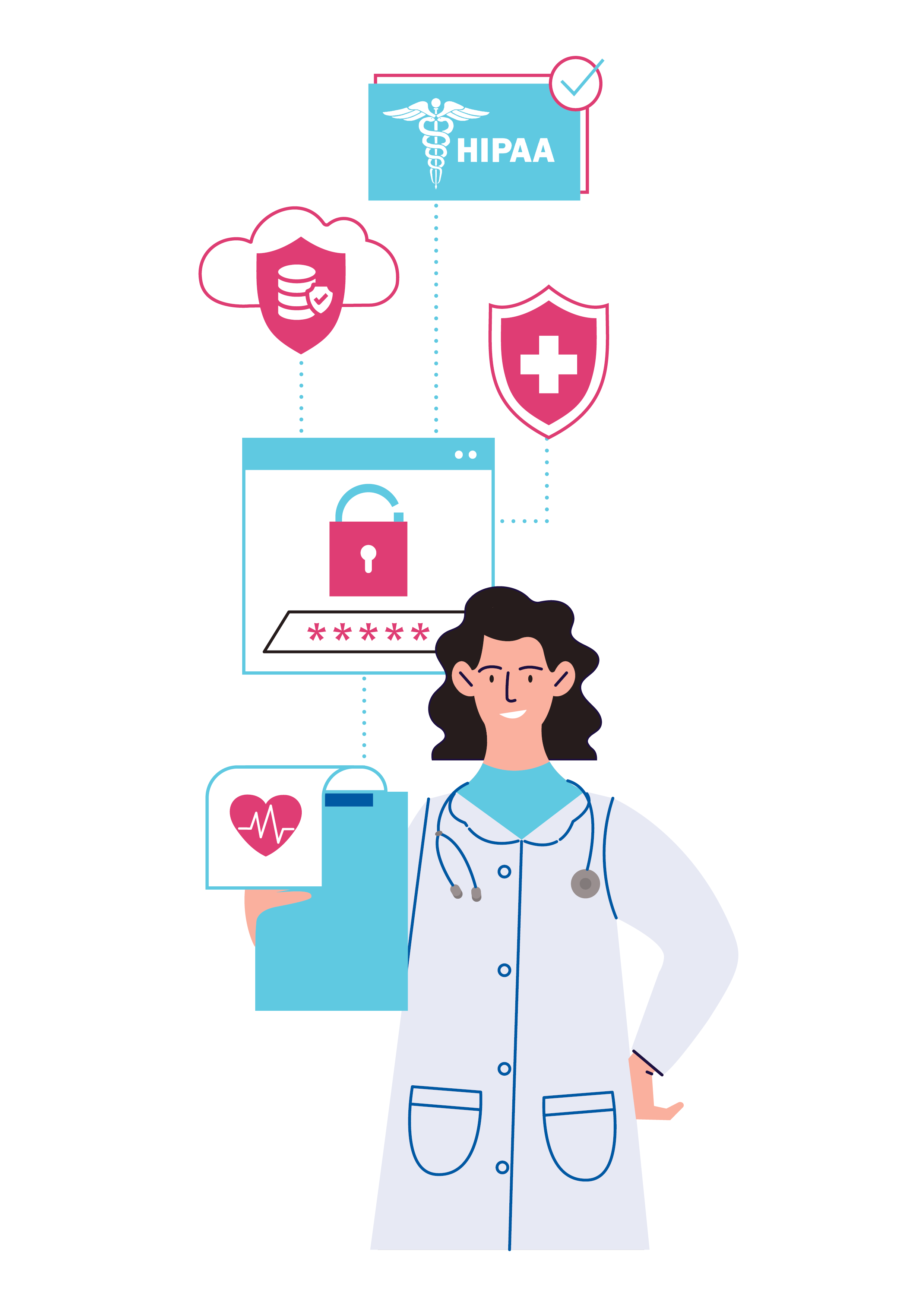
A practical way to approach this is to view HIPAA compliance automation as a way to shift operational burden away from manual processes, allowing teams to focus on improving security and responding to risks more effectively. By centralizing and standardizing compliance activities, it increases consistency and efficiency across the organization.
Beyond day-to-day operations, these tools also support scalability by improving oversight and coordination across teams. This helps ensure compliance efforts remain structured, sustainable, and aligned with business needs as the organization grows.
Key features to look for in HIPAA compliance tools
Automated HIPAA compliance tools provide significant advantages, from reducing human error to simplifying both the achievement and maintenance of compliance. Before evaluating specific solutions, it is important to understand the key features that define an effective HIPAA compliance platform.
Not every tool will meet the needs of every organization, so it is essential to identify the capabilities that align with your specific requirements. Key features to consider include:
1. Digital HIPAA compliance reporting
Clear, well-structured reports and dashboards provide immediate visibility into your compliance status. They enable organizations to identify gaps, track progress, and maintain ongoing alignment with HIPAA requirements.
2. Automated risk assessments
Effective tools should support automated HIPAA risk assessments, enabling organizations to identify security gaps and vulnerabilities on an ongoing basis. This reduces reliance on manual reviews and allows teams to proactively manage and mitigate risks.
3. Automated evidence collection
HIPAA compliance requires comprehensive documentation to demonstrate adherence to compliance requirements. Automated evidence collection captures key artifacts such as system logs, training records, and security controls, simplifying audit preparation.
4. Continuous monitoring
Real-time monitoring of security controls ensures that any deviations or non-compliance issues are identified promptly. Continuous control monitoring (CCM) supports ongoing compliance by enabling timely remediation before issues escalate.
5. HIPAA policy management
A robust platform should simplify the creation, updating, and distribution of HIPAA-aligned policies. Centralized policy management ensures that documentation remains current and accessible, reducing the risk of non-compliance.
6. Employee awareness training
Compliance depends not only on systems but also on employee awareness. Tools that include built-in HIPAA training help ensure staff understand and adhere to privacy and security requirements, strengthening overall compliance posture.
Streamline GRC workflows with seamless automation.
9 best HIPAA compliance tools in 2026
Now that we’ve covered the key features to look for, here are nine of the best HIPAA compliance tools available in 2026. Each offers different capabilities, so you can find the solution that best fits your organization’s needs.
1. Scytale
Scytale stands out as a leading HIPAA compliance platform, offering an all-in-one solution designed to simplify and automate complex compliance processes. Built with scaling SaaS and healthcare-focused organizations in mind, Scytale enables teams to manage HIPAA alongside other key frameworks such as SOC 2 and ISO 27001 within a single AI compliance platform.
Scytale streamlines HIPAA compliance through automated evidence collection, continuous monitoring, and policy management, supported by its AI GRC agent that further enhances compliance automation and provides valuable insights to guide next steps. By combining AI-driven automation with dedicated expert support, along with seamless integrations, real-time monitoring, and full visibility across compliance activities, Scytale enables organizations to achieve and maintain HIPAA compliance with confidence.
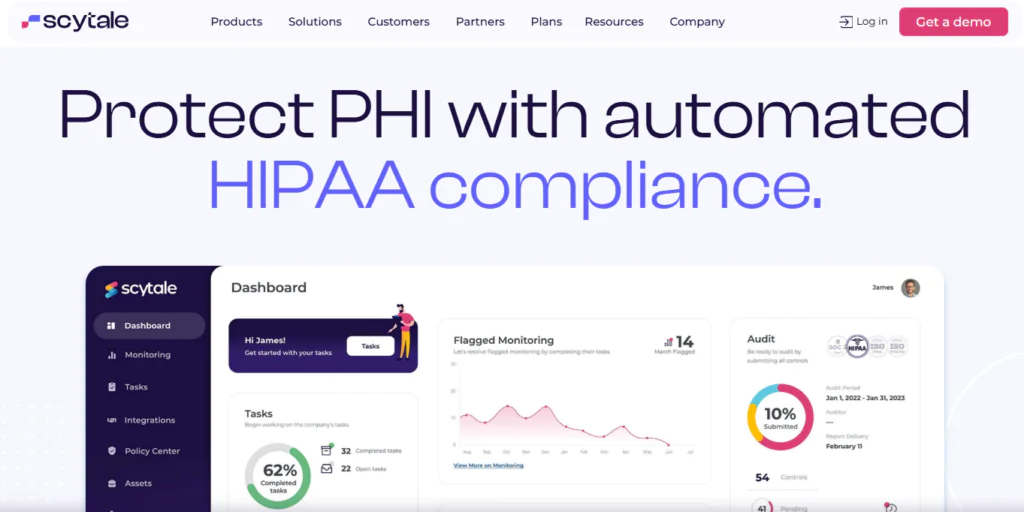
(Screenshot from Scytale’s website)
Why Scytale is the best:
- AI-powered automation for key processes like evidence collection, access reviews, and vendor risk management
- Continuous compliance with real-time monitoring and full visibility into risk and security posture
- Built-in AI GRC agent (Scy) to identify gaps and deliver actionable insights
- Customizable Trust Center to easily showcase your security and compliance posture
- Dedicated GRC expert support with tailored, end-to-end guidance
- Multi-framework cross-mapping to reduce duplicate work across HIPAA, SOC 2, ISO 27001, GDPR and more
2. Bright Defense
Bright Defense delivers HIPAA compliance as a managed service, focusing on expert-led implementation and ongoing oversight. It is suited for organizations that prefer outsourcing compliance responsibilities.
(Screenshot from Bright Defense’s website)
Key strengths:
- Ongoing HIPAA guidance from certified professionals
- Covers risk analysis, remediation, and policy development
- Includes strategic security and compliance advisory support
Limitations:
- Limited automation in compliance processes
- Reduced visibility for internal teams
3. SFTP To Go
SFTP To Go provides a secure, HIPAA-compliant solution for file transfer and storage without requiring infrastructure management. It focuses on protecting sensitive data during movement and storage.
(Screenshot from SFTP To Go’s website)
Key strengths:
- Supports SFTP, FTPS, and HTTPS protocols
- Encryption for data in transit and at rest
- Reliable cloud infrastructure with high availability
Limitations:
- Limited to file transfer use cases
- Does not support broader compliance workflows
4. ComplyAssistant
ComplyAssistant offers a centralized platform for managing HIPAA documentation and assessments. It helps teams organize compliance activities and maintain audit records.
(Screenshot from ComplyAssistant’s website)
Key strengths:
- Centralized policy and risk management
- Tools for managing compliance assessments
- Structured documentation for audits
Limitations:
- Requires manual updates
- Limited continuous automation
5. Paubox
Paubox enables secure, HIPAA-compliant email communication without disrupting existing workflows. It simplifies encrypted messaging for healthcare organizations.
(Screenshot from Paubox’s website)
Key strengths:
- Automatic email encryption
- Integrates with Google Workspace and Microsoft 365
- No portals or extra steps for recipients
Limitations:
- Focused only on communication
- No centralized compliance management
6. Sprinto
Sprinto is a compliance platform that supports HIPAA through guided processes and system integrations. It is designed to help teams manage compliance tasks and maintain oversight through a structured workflow approach.
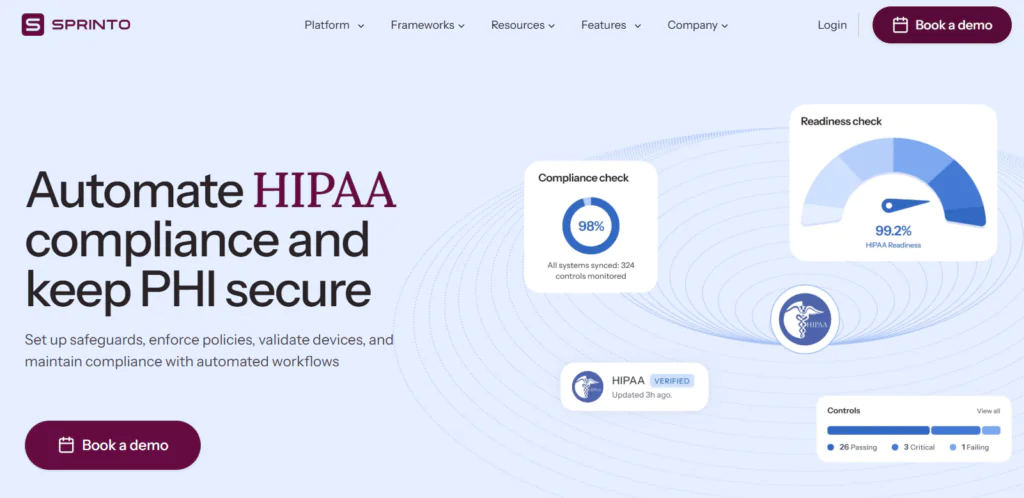
(Screenshot from Sprinto’s website)
Key strengths:
- Workflow-based task management
- Integrates with cloud systems
- Unified compliance tracking
Limitations:
- Depends on predefined workflows
- Requires ongoing configuration
7. Abyde
Abyde is a HIPAA-focused solution tailored for healthcare practices, offering simplified tools for managing compliance requirements. It emphasizes ease of use and accessibility for smaller organizations.
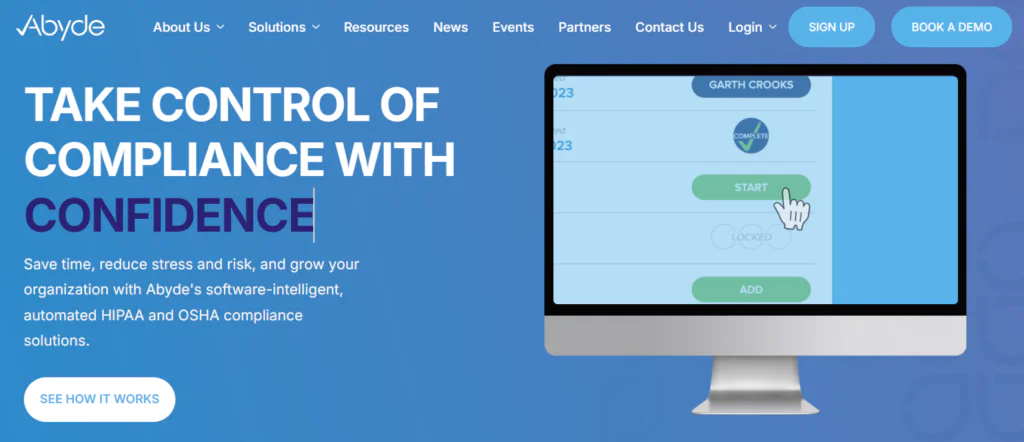
(Screenshot from Abyde’s website)
Key strengths:
- Built for healthcare providers
- Includes training and awareness tools
- Simplified risk and documentation processes
Limitations:
- Best suited for smaller teams
- Less suited for complex environments
8. Drata
Drata is a compliance platform designed to help organizations maintain audit readiness and track HIPAA controls in a structured way. It provides visibility into compliance status and supports audit preparation through structured control tracking and system integrations.
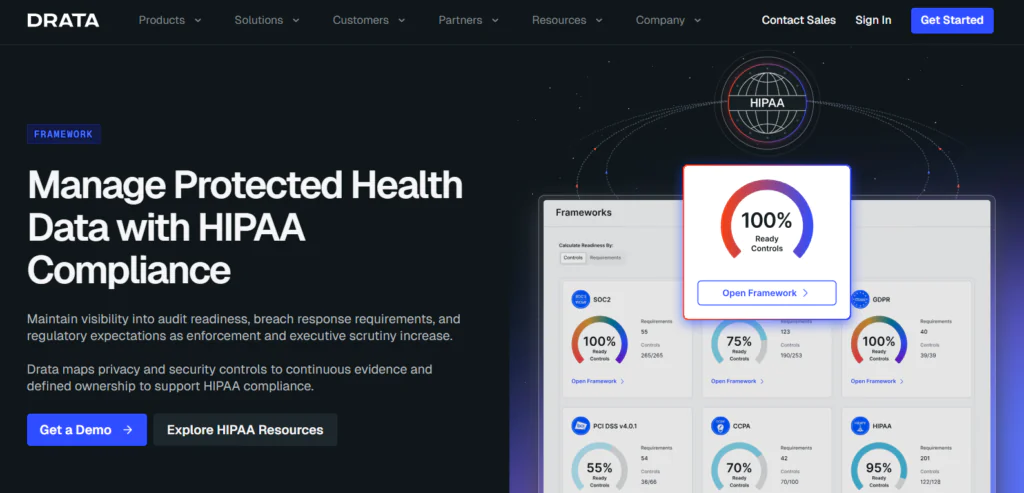
(Screenshot from Drata’s website)
Key Features
- Streamlined alerts for risk identification
- Continuous control monitoring
- Built-in policy templates and dashboards
Limitations
- Pricing can increase as organizations scale
- May require customization for complex setups
9. Secureframe
Secureframe offers a platform for managing HIPAA compliance through guided compliance processes and visibility into requirements. It supports organizations in maintaining structured compliance programs.
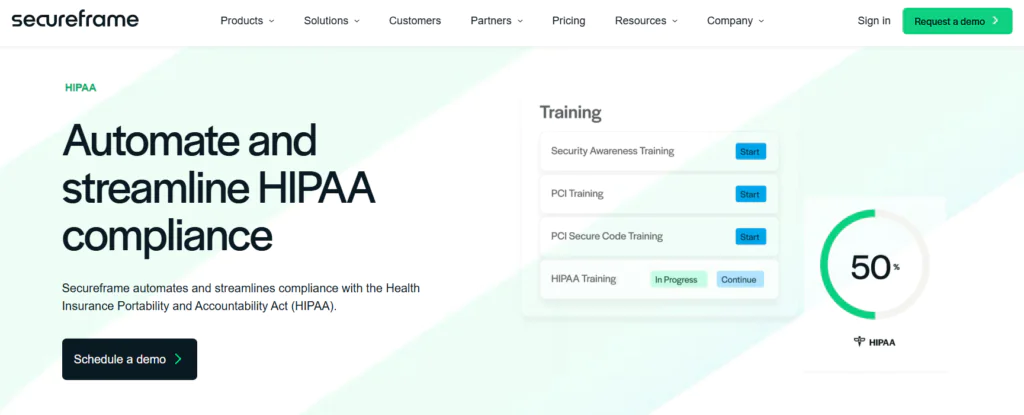
(Screenshot from Secureframe’s website)
Key Features:
- Compliance tracking and audit preparation
- Automated evidence collection
- Vendor risk and security management
Limitations:
- May be less scalable for complex compliance needs
- Less adaptable for highly customized programs
Top 9 HIPAA compliance tools compared for 2026
| Platform | Key Strength | Key Limitation | Best Fit |
| Scytale | AI compliance automation, continuous security and compliance monitoring, multi-framework management, streamlined GRC processes, expert guidance | Requires integrations setup | SaaS organizations of all sizes pursuing HIPAA that need efficient AI-driven compliance management processes |
| Bright Defense | Expert-led compliance service with ongoing advisory | Limited automation, less internal visibility | Teams wanting outsourced compliance |
| SFTP To Go | Secure file transfer with encryption and high availability | Limited to file transfer use cases | Organizations focused on secure data exchange |
| ComplyAssistant | Centralized documentation and assessment management | Manual updates, limited automation | Teams focused on audit documentation |
| Paubox | Seamless encrypted email within existing workflows | Limited to communication use case | Healthcare teams needing secure email |
| Sprinto | Workflow-driven compliance with integrations | Requires configuration, less adaptive monitoring | Teams managing structured compliance workflows |
| Abyde | Simple, healthcare-focused compliance tools | Limited scalability for complex environments | Small healthcare practices |
| Drata | Audit readiness with control tracking and integrations | Setup and customization required | Teams focused on audit preparation |
| Secureframe | Guided compliance processes with visibility and tracking | Less flexible for complex needs | Teams needing structured compliance programs |
AI-native GRC for how teams work today.
How to choose the right HIPAA compliance tool for your organization
Selecting the right HIPAA compliance tool does not have to be complex. It depends on understanding your organization’s requirements and identifying the capabilities most critical to your compliance strategy. The following considerations can help guide your selection:
1. Assess your current compliance process
Start by identifying gaps and inefficiencies within your existing HIPAA compliance efforts. Understanding where risks or operational challenges exist will help you select a solution that directly addresses those areas.
2. Evaluate technical expertise
Consider your team’s level of technical proficiency. Choosing a user-friendly platform with strong support and training resources can help ensure smooth adoption and effective use across the organization.
3. Ensure scalability
As your organization grows, so will your compliance requirements. It is important to select a solution that can scale alongside your organization and accommodate increasing complexity over time.
4. Integration with existing systems
A suitable HIPAA compliance tool should integrate seamlessly with your existing technology stack, such as cloud platforms and business systems. This enables more efficient workflows and supports automated evidence collection without disruption.
5. Tailor-made compliance
Every organization has unique compliance needs based on its size, structure, and data environment. A flexible solution that can be tailored to your workflows will provide greater long-term value and alignment with your operations.
GET HIPAA COMPLIANT 90% FASTER
Streamline your HIPAA compliance journey with Scytale
Scytale simplifies HIPAA compliance by bringing structure and consistency to what is often a fragmented process. This HIPAA compliance software enables organizations to manage compliance requirements within a centralized platform, reducing reliance on manual coordination and disconnected tools. It allows teams to move away from reactive, audit-driven efforts and maintain ongoing alignment with HIPAA requirements while improving efficiency and strengthening the protection of PHI.
With tailored guidance from GRC experts alongside its AI compliance platform capabilities, Scytale supports organizations throughout their compliance journey, ensuring processes are implemented correctly and maintained over time. This approach helps teams build a scalable compliance program, reduce operational friction, and stay consistently audit-ready.
FAQs about best HIPAA compliance tools
How do HIPAA compliance tools facilitate risk assessments?
HIPAA compliance tools streamline risk assessments by automating the identification of security gaps and vulnerabilities within an organization. They provide continuous evaluations, generate detailed reports, and highlight areas requiring attention. This enables organizations to prioritize and address critical risks more efficiently while reducing the likelihood of human error.
What are the benefits of using HIPAA compliance software?
HIPAA compliance software simplifies regulatory management by automating tasks like evidence collection, risk assessments, and policy updates. It reduces errors, supports continuous monitoring, and helps organizations maintain compliance more efficiently. AI-powered compliance platforms like Scytale centralize compliance activities, enhance collaboration, support employee training, and strengthen the protection of sensitive patient data.
What role does automation play in HIPAA compliance?
Automation plays a key role in streamlining HIPAA compliance by managing repetitive tasks such as evidence collection, risk assessments, and monitoring security controls. It reduces reliance on manual processes, minimizes errors, and provides real-time visibility into compliance status. This enables organizations to maintain ongoing adherence to regulatory requirements while allowing teams to focus on core business priorities.
Do HIPAA compliance tools support multiple regulations?
Many HIPAA compliance tools are designed to support multiple regulations, making it easier for organizations to manage compliance across various frameworks. These tools, like Scytale, provide integrated solutions for healthcare organizations that need to adhere to other industry-specific regulations alongside HIPAA.
Can HIPAA compliance tools integrate with existing systems?
Yes, most HIPAA compliance tools are designed to integrate with existing systems, such as electronic health records (EHR), customer relationship management (CRM) platforms, and security software. These integrations ensure seamless data flow, streamline workflows, and improve overall efficiency in maintaining compliance. Scytale integrates with hundreds of tools and also offers custom integrations to suit each organization’s unique needs.