

TL;DR: IT security audit
- An IT security audit evaluates the effectiveness of your organization’s security controls, policies, and processes.
- Audits assess technical infrastructure, applications, and physical safeguards to identify risks and compliance gaps.
- The audit process typically includes planning, evidence collection, testing, reporting, remediation, and follow-up reviews.
- Most organizations should conduct a full IT security audit annually, with additional audits after major business or technology changes.
- Scytale is an AI GRC platform that streamlines IT security audits through automated evidence collection, continuous monitoring, and centralized audit management.
IT environments are constantly changing. New systems, cloud services, vendors, and business requirements can introduce risks that are difficult to identify through routine operations. Without regular reviews, security gaps can accumulate unnoticed over time.
An IT security audit provides an independent, structured assessment of whether security controls are operating as intended, where gaps exist, and how overall security compliance can be improved. In this article, we’ll explain what an IT security audit is, how the audit process works, what should be included in an audit checklist, why audits are important, and how organizations can improve audit readiness through automation and continuous monitoring.
What is an IT security audit?
IT security auditing is a structured, systematic review of an organization’s IT infrastructure, security controls, policies, access controls, and data-handling practices. The goal is to identify vulnerabilities and evaluate whether security controls are operating effectively. Auditors also assess whether the organization meets Governance, Risk, and Compliance (GRC) requirements, as well as internal policies, and industry standards.
A comprehensive audit examines three key layers of the IT environment:
- Technical infrastructure: Networks, servers, endpoints, databases, and cloud environments. Auditors assess areas such as system configurations, access controls, patch management, and network security.
- Application-level resources: Software applications, APIs, authentication mechanisms, and data protection controls. This review helps identify weaknesses that could expose sensitive information.
- Physical infrastructure: Facility access controls, hardware security, surveillance systems, and environmental safeguards that protect critical assets and systems.
While often confused with penetration testing, an IT security audit serves a broader purpose. Penetration testing simulates attacks to uncover exploitable weaknesses, whereas an audit evaluates technical controls, governance, policies, and operating practices. The result is a prioritized report that identifies risks, highlights compliance gaps, and provides actionable remediation recommendations.
AI-native GRC for how enterprise teams work today.
Why are IT security audits important?
As organizations adopt new technologies and expand their digital environments, security risks can emerge faster than controls can adapt. An IT security audit provides a structured way to assess whether security measures remain effective, aligned with current threats, and capable of protecting sensitive data. Its value can be understood through these three key pillars:
1. Risk mitigation
The primary purpose of an IT security audit is to identify and reduce risk before it leads to an incident. Audits uncover vulnerabilities such as excessive user permissions, misconfigured systems, outdated software, and gaps in monitoring or recovery processes. This enables organizations to prioritize remediation efforts and strengthen their overall security posture.
2. Compliance
Many regulations, frameworks, and customer requirements expect organizations to maintain documented controls and demonstrate that they are operating effectively. An IT compliance audit helps identify gaps before formal assessments take place, reducing the risk of failed audits and costly remediation. It is particularly valuable when preparing for frameworks such as SOC 2, ISO 27001, HIPAA, and GDPR.
3. Stakeholder trust
Customers, investors, partners, and boards increasingly expect evidence of strong security practices. An independent audit provides objective validation that risks are being managed and controls are functioning as intended. This helps build confidence, strengthen business relationships, and support long-term growth.
Streamline GRC workflows with seamless automation.
How to conduct an IT security audit: Step-by-step
A successful IT security audit follows a structured process that helps organizations identify risks, evaluate controls, and prioritize improvements. While the exact approach may vary between organizations, most audits follow the same six core stages:
Step 1: Planning and scoping
Planning establishes the objectives, scope, and boundaries of the audit. This ensures auditors focus on the systems, processes, and controls that matter most to the business.
Step 2: Information gathering
Auditors collect the documentation and evidence needed to evaluate the current security environment. This provides the foundation for identifying gaps and validating control effectiveness.
Step 3: Risk assessment
The collected evidence is analyzed to uncover control weaknesses, vulnerabilities, and areas of elevated risk. Findings are typically ranked according to their likelihood and potential business impact.
Step 4: Security testing
Security testing validates whether controls operate effectively in practice. This may include configuration reviews, access testing, vulnerability assessments, and backup validation.
Step 5: Reporting
Findings are documented in a formal report and prioritized based on risk. The report should clearly outline what was discovered, why it matters, and what actions should be taken.
Step 6: Remediation and follow-up
The final stage focuses on resolving identified issues and verifying that corrective actions were successful. Follow-up reviews help ensure risks remain addressed over time.
6 key steps in the IT security audit process
| Step | Primary focus | Key question | Example |
|---|---|---|---|
| 1. Planning and scoping | Define audit boundaries | What systems, processes, and controls fall within scope? | A SaaS company includes its production cloud environment, identity provider, and customer support systems. |
| 2. Information gathering | Collect evidence | What evidence demonstrates how security operates today? | Auditors review policies, asset inventories, network diagrams, and access records. |
| 3. Risk assessment | Prioritize risks | Which weaknesses pose the greatest business risk? | Missing MFA on privileged accounts is identified as a high-priority finding. |
| 4. Security testing | Validate controls | Do security controls work as intended? | Firewall rules, endpoint configurations, and backup restoration processes are tested. |
| 5. Reporting | Communicate findings | What issues were identified, and what actions are required? | Findings are grouped by severity and assigned remediation owners. |
| 6. Remediation and follow-up | Close gaps | Have identified risks been resolved? | Orphaned admin accounts are removed and offboarding procedures are strengthened. |
Always-on GRC. Built for modern teams.
IT security audit checklist
Once the audit scope is defined, auditors use a checklist to evaluate the controls, policies, and processes that protect the organization. A strong IT security audit checklist helps explain what auditors review and why each area matters. The following categories are commonly included in a comprehensive IT security audit:
Governance and policies
Governance sets the foundation for every other security control. Auditors review whether each IT security policy is documented, regularly updated, and actively enforced across the organization. Technical safeguards alone cannot compensate for weak governance, unclear accountability, or inconsistent processes. Auditors also assess whether security responsibilities are clearly defined and whether the security program supports business objectives, GRC requirements, and customer expectations.
To evaluate governance effectiveness, auditors typically review:
- Security policy documentation and review cadence
- Assigned roles and responsibilities
- Security awareness training records
- Alignment with business objectives
Access control & identity management
Access control remains one of the most important audit areas because excessive privileges and unmanaged accounts are common causes of security incidents. Auditors assess whether access is granted according to business need and removed promptly when employees change roles or leave the organization. They also evaluate whether privileged accounts receive stronger safeguards and monitoring than standard user accounts.
To assess access management practices, auditors commonly review:
- User provisioning and deprovisioning processes
- Multi-factor authentication (MFA) enforcement
- Periodic access reviews
- Privileged Access Management (PAM) controls
- Separation of duties controls
Network security
Network security focuses on how effectively an organization controls and monitors traffic across internal and external environments. Auditors evaluate whether network defenses can prevent unauthorized access, detect suspicious activity, and limit the impact of a potential compromise. Special attention is often given to remote access and network segmentation, as these areas frequently introduce risk in modern distributed environments.
To evaluate network security controls, auditors typically review:
- Firewall rule reviews
- Network segmentation
- Intrusion Detection and Prevention Systems (IDS/IPS)
- Encrypted and logged remote access
- Email and web filtering controls
Data protection
Data protection focuses on whether sensitive information is properly identified, secured, and recoverable. Auditors look for evidence that organizations understand where critical data resides and apply consistent controls throughout its lifecycle. This area also examines resilience, ensuring critical data can be recovered following system failures, outages, or security incidents.
To assess data protection practices, auditors commonly review:
- Data classification processes
- Encryption controls
- Backup testing and recovery time objectives (RTOs)
- Retention and disposal policies
- Data Loss Prevention (DLP) controls
Incident response
Incident response measures an organization’s ability to detect, contain, and recover from security events. Auditors want evidence that response plans are more than documents on paper and that personnel understand their responsibilities during an incident. Organizations that regularly test and refine their response procedures are generally better prepared to minimize business disruption and security impact when incidents occur.
To evaluate incident response readiness, auditors typically review:
- Incident response plans and escalation procedures
- Tabletop exercises and testing frequency
- Post-incident reviews and corrective actions
- Integration with business continuity planning
Third-party and compliance
Third-party relationships often introduce risks that organizations cannot control directly. Auditors assess how vendors are evaluated before onboarding and whether ongoing oversight is performed throughout the relationship. They also examine how third-party controls support broader GRC obligations, particularly when organizations rely on vendors to process, store, or secure sensitive information.
To assess third-party risk management and compliance efforts, auditors typically review:
- Vendor security assessments before onboarding
- Security requirements in vendor contracts
- Ongoing vendor monitoring
- Framework mapping for SOC 2, ISO 27001, HIPAA, and GDPR
4 best practices for IT security audits
Strong IT security audits are built on repeatable processes rather than last-minute preparation. Effective audit programs combine well-defined processes, ongoing control monitoring, and the right compliance audit software to maintain visibility into security and GRC requirements throughout the year. Here are a few best practices to help improve audit readiness and strengthen your overall security posture.
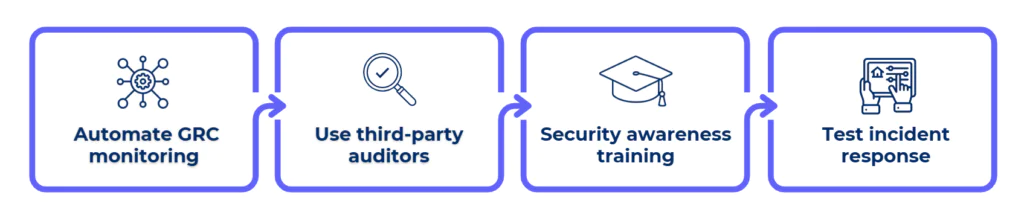
1. Automate GRC monitoring
Manual audits are time-consuming, error-prone, and often miss control drift between annual reviews. GRC tools continuously monitor controls, collect evidence, and flag gaps in real time, allowing auditors to focus on strategic analysis rather than administrative tasks. Automation also helps audit preparation scale as the business grows without requiring additional headcount.
2. Use third-party auditors
External auditors provide an independent perspective that helps uncover risks and control weaknesses internal teams may overlook. Their assessments add credibility with customers and key stakeholders and are often required for frameworks such as SOC 2 and ISO 27001. Third-party audits help validate that controls are operating effectively and strengthen confidence in your overall security program.
3. Security awareness training
Many security incidents are caused by human error rather than technical failures. Regular security awareness training and phishing simulations help employees recognize common threats, follow security best practices, and reduce overall organizational risk.
4. Test incident response
An audit should evaluate not only whether controls exist, but whether they work under pressure. Tabletop exercises and simulated attack scenarios help validate incident response plans, exposing communication breakdowns, unclear responsibilities, and escalation gaps that policy reviews often miss. Testing readiness in realistic conditions provides a more accurate picture of an organization’s ability to respond to real-world incidents.
How often should you conduct an IT security audit?
Most organizations should conduct a full IT security audit at least once a year. Annual audits help validate security controls, identify emerging risks, and support continuous compliance efforts. Organizations in regulated industries such as healthcare (HIPAA), fintech (PCI DSS), and government contracting (CMMC) often require semi-annual or quarterly audits.
Organizations that lack dedicated internal resources often engage IT security audit services to assess controls, identify risks, and prepare for compliance audits. Independent auditors can provide an objective perspective on the effectiveness of existing controls. Additional audits may also be needed following major infrastructure changes, mergers or acquisitions, security incidents, new compliance requirements, or enterprise customer requests. These audits help ensure security controls remain effective as the organization grows.
While continuous monitoring tools provide valuable real-time visibility, they cannot replace a formal IT security audit. Similarly, when evaluating penetration testing vs compliance audits, organizations should recognize that each serves a different purpose. Penetration tests identify exploitable vulnerabilities, while audits assess the effectiveness of controls, policies, and compliance efforts. The two approaches work best together.

How Scytale simplifies IT security audits
Scytale’s AI GRC platform simplifies IT security audits by automating evidence collection, continuously monitoring controls, and providing real-time visibility into your security posture. With native and custom integrations, multi-framework cross-mapping, and centralized audit management, teams can reduce manual effort, identify gaps earlier, and stay audit-ready year-round. This allows teams to focus on strengthening security controls rather than managing audit administration.
Scytale’s suite of AI agents and dedicated GRC experts help organizations streamline remediation, maintain continuous compliance, and demonstrate compliance with confidence. Whether you’re conducting an IT security audit or working toward frameworks such as SOC 2, ISO 27001, HIPAA, GDPR, PCI DSS, or SOX ITGC, Scytale provides the automation, visibility, and guidance needed to improve audit readiness and support stronger compliance outcomes.
FAQs about IT security audit
What is the difference between an IT security audit and a compliance audit?
An IT security audit reviews the effectiveness of your technical, administrative, and physical security controls. A compliance audit focuses on whether those controls align with a specific framework, contract, or legal requirement. In practice, the two often overlap because many compliance reviews depend on strong security evidence.
How long does an IT security audit typically take?
An IT security audit typically takes a few weeks to a few months, depending on scope, system complexity, and evidence readiness. A focused internal review moves faster than a broad external assessment across multiple environments. Leading AI GRC tools like Scytale helps shorten timelines by organizing evidence and reducing manual collection work.
What happens in each stage of the IT security audit process?
The IT security audit process usually includes planning and scoping, information gathering, risk assessment, security testing, reporting, and remediation follow-up. Each stage answers a different question about control design, operation, and business impact. The process works best when teams assign owners and track evidence from the start.
How much does an IT security audit cost?
IT security audit cost depends on audit scope, assessor type, environment size, and the depth of testing required. Internal reviews cost less upfront, while external audits bring more independence and credibility. Costs also rise when teams lack organized evidence because auditors spend more time validating basic control information.
Should you use an internal team or an external auditor for an IT security audit?
You should use an internal team for routine readiness checks and an external auditor when independence and credibility matter most. External reviewers bring a fresh perspective and often satisfy customer or certification expectations. AI GRC platforms like Scytale supports both models by giving internal teams and outside auditors a cleaner evidence trail.