



TL;DR: Compliance reporting software
- Compliance reporting must meet the needs of boards, investors, sales teams, and auditors, each requiring varying levels of visibility into compliance status.
- The best software offers real-time dashboards, framework tracking, exportable evidence, and gap visibility for accuracy and transparency.
- Effective platforms integrate reporting directly into the compliance workflow, streamlining the process and improving efficiency.
- Scytale is the top compliance reporting platform, providing built-in reporting, real-time views, and multi-framework tracking all within one centralized hub.
- Choose a tool that aligns with your compliance reporting needs, reporting cadence, and framework complexity.
Compliance used to be a background function. Today, boards request quarterly risk summaries, enterprise customers require compliance reporting before contracts are signed, and investors expect structured evidence of a functioning Governance, Risk and Compliance (GRC) program.
With global cybercrime costs projected to hit $15.63 trillion annually by 2029, the financial impact of security failures is becoming impossible for organizations to ignore. However, many teams continue to rely on spreadsheets and manual reports to fulfill these compliance requirements.
In this article, we’ll explore what effective compliance reporting software should do, which platforms excel at it, and how to choose the right solution for your organization’s reporting needs.
Best compliance reporting software
- Scytale
- TeamMate (StandardFusion)
- Optro
- Sprinto
- Drata
- Secureframe
- Vanta
Why compliance reporting matters in 2026
Compliance reporting is no longer something teams can leave until an audit. Boards and executives need clear visibility into compliance and risk, leadership wants to understand the ROI on compliance investments, and sales teams need accurate information for customer security reviews. Reporting now plays an ongoing role in helping teams make decisions and demonstrate compliance.
As organizations manage more frameworks, controls, and evidence, static reports and manual updates become harder to maintain. Modern reporting gives teams a current view of their compliance posture, making it easier to track progress, identify gaps, and keep stakeholders informed. This reduces the need to rebuild reports whenever requirements or compliance data change.
Compliance reporting is the process of collecting and presenting compliance data to show an organization’s status, risks, control performance, and progress against requirements.
Streamline GRC workflows with seamless automation.
What compliance reporting software should do
Good compliance reporting software should give teams a clear, current view of their compliance status without requiring manual reporting. It should connect controls, evidence, risks, and framework progress so teams can quickly identify what is complete, what needs attention, and where gaps remain. Here are the key capabilities to look for.
Real-time compliance visibility
Compliance reporting software should provide ongoing visibility into controls, risks, and overall compliance status. Dashboards should show whether compliance evidence management is current and flag incomplete or failing controls. This helps teams identify issues early and take corrective action before they affect an audit.
Framework-specific progress tracking
Teams should be able to track progress against individual frameworks such as SOC 2, ISO 27001, GDPR, and SOX ITGC. Reports should clearly show completed requirements, outstanding evidence, control gaps, and remaining tasks. This makes it easier to understand exactly where each compliance program stands.
Executive and auditor-ready reporting
Executives and stakeholders need high-level reporting without having to work through detailed control data. The software should provide clear summaries of compliance progress, control performance, and risk exposure that can be shared with leadership. Reports should also be easy to export for auditors and other stakeholders without extensive manual formatting.
Historical trends and customizable views
Historical data helps teams track compliance progress, identify recurring issues, and demonstrate improvement over time. Customizable views should allow users to filter reporting by framework, team, control, or risk area. This gives executives a high-level overview while allowing compliance teams to access the detail they need.
Best software solutions for compliance reporting in 2026
The right compliance reporting software depends on your frameworks, reporting needs, stakeholders, and level of automation. Here are the best software solutions for continuous compliance reporting in 2026, evaluated for their ability to meet the needs of SaaS organizations:
1. Scytale
Scytale is the leading AI GRC platform for compliance reporting, designed to provide accurate, timely insights for executives, GRC teams, and external stakeholders. Unlike traditional platforms that treat reporting as a separate task, Scytale seamlessly integrates it into the compliance workflow, offering real-time, audit-ready visibility while teams manage their daily operations.
The platform offers continuous control monitoring across 80+ frameworks, with role-based dashboards and customizable reporting features. Its Trust Center enhances transparency, enabling organizations to share their compliance posture with customers and partners. Backed by a dedicated team of GRC experts, Scytale streamlines compliance reporting, aligning with your organization’s evolving needs and security requirements, making it the ideal solution for scaling and maintaining compliance across multiple frameworks.
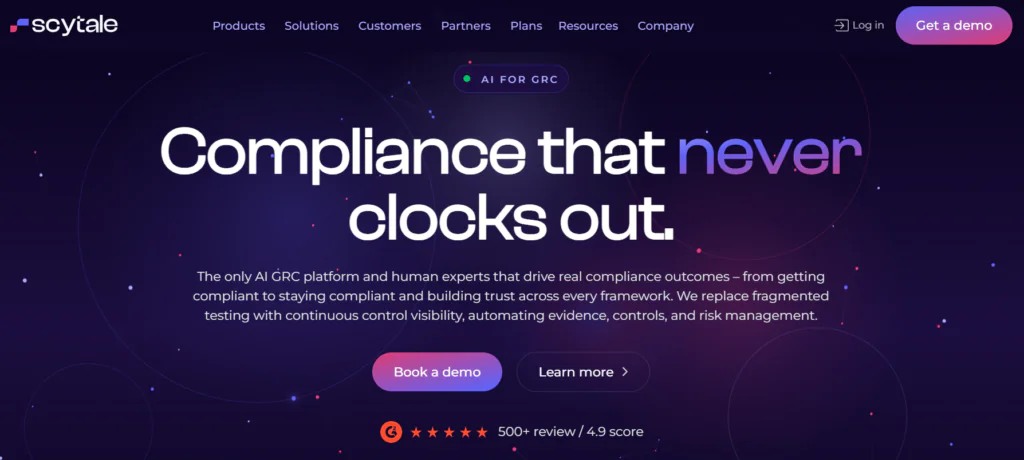
(Screenshot from Scytale’s website)
Why Scytale is the best:
- Continuous compliance with real-time monitoring, offering full visibility into your security and risk posture
- AI GRC automation streamlining key compliance processes, such as evidence collection, access reviews, monitoring, and vendor risk management
- Multi-framework management with cross-mapping to eliminate redundant work across SOC 2, ISO 27001, GDPR, HIPAA, and other standards
- Customizable Trust Center for clearly showcasing your security and compliance posture to stakeholders
- Streamlined integrations with essential tools and customizable options for enhanced automation and flexibility.
- Dedicated GRC expert support, guiding you through every step of the compliance journey
2. TeamMate (StandardFusion)
TeamMate, previously known as StandardFusion, is a GRC platform for managing risks, controls, compliance requirements, and reporting in one structured system.
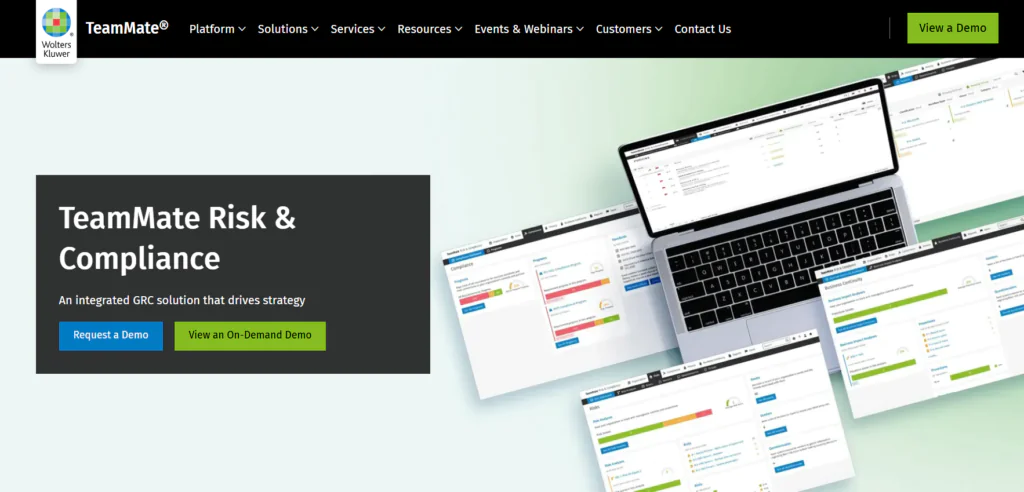
(Screenshot from TeamMate’s website)
Key strengths:
- Flexible reporting across risk, compliance, and control activities
- Customizable dashboards for different GRC teams and stakeholders
- Centralized controls, requirements, and compliance documentation in one place
Limitations:
- Requires more upfront configuration to fit specific GRC processes
- Less emphasis on AI-powered compliance automation and workflows
3. Optro
Optro is tailored for audit and risk management, offering detailed reporting on control performance, audit findings, and organizational risk exposure.
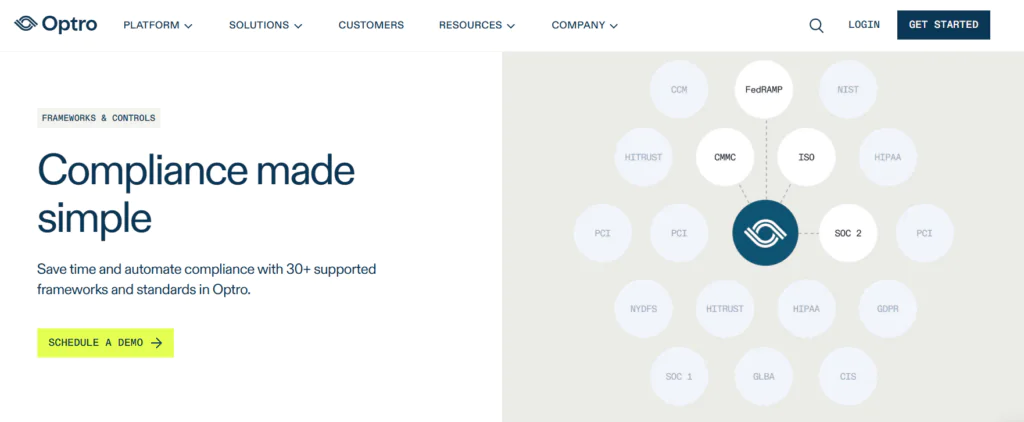
(Screenshot from Optro’s website)
Key strengths:
- Detailed audit reporting and risk exposure visibility
- Strong control performance tracking for established audit teams
- Offers structured workflows to manage audit tasks
Limitations:
- Enterprise pricing limits accessibility for mid-market teams
- Not optimized for SaaS compliance workflows or multi-framework GRC
4. Sprinto
Sprinto is a compliance automation platform designed for cloud-based businesses. It helps teams monitor controls, track compliance progress, and stay prepared for audits.
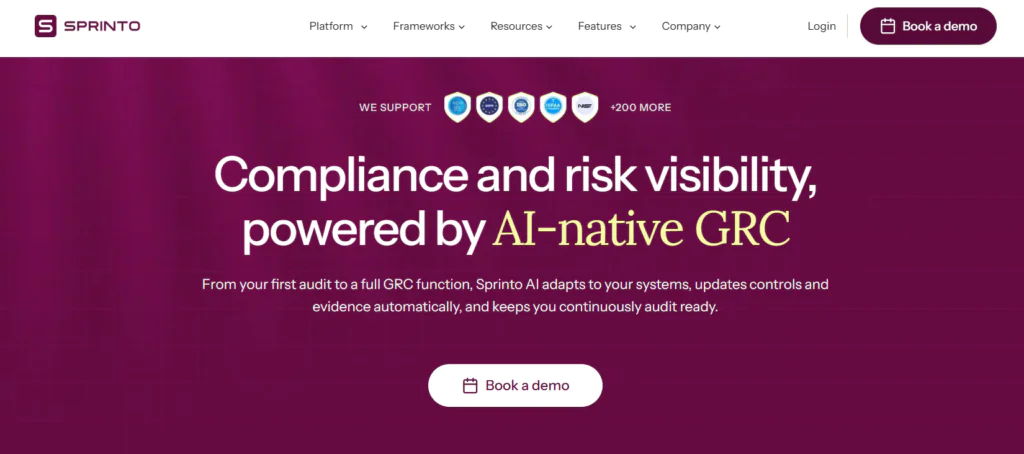
(Screenshot from Sprinto’s website)
Key strengths:
- Clear compliance progress and audit readiness tracking across frameworks
- Automated control checks across connected cloud tools and systems
- Structured workflows for assigning and resolving compliance issues efficiently
Limitations:
- Reporting focuses more heavily on compliance and audit readiness
- Less suited to complex enterprise-wide GRC reporting requirements
5. Drata
Drata centralizes compliance evidence, facilitates auditor collaboration, and runs daily automated control tests. Designed for engineering-driven organizations, it supports compliance managers and auditors.
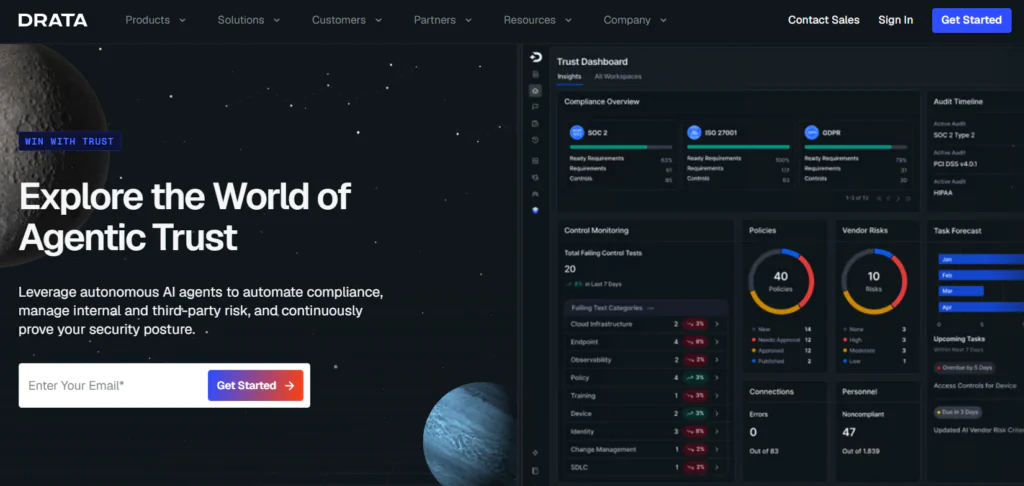
(Screenshot from Drata’s website)
Key strengths:
- Centralized audit hub for collaboration and evidence tracking
- Automated control testing with progress tracking
- Integrations suited for cloud infrastructure and technical teams
Limitations:
- Executive and multi-stakeholder reporting requires manual setup
- Implementation complexity demands dedicated internal resources
6. Secureframe
Secureframe simplifies compliance programs with automated evidence collection, AI-assisted control guidance, and audit readiness dashboards. Ideal for organizations starting their compliance journey or managing standard certifications.
(Screenshot from Secureframe’s website)
Key strengths:
- Guided onboarding with structured compliance programs
- AI tools for addressing failing controls and policy updates
- Automated evidence collection across key integrations
Limitations:
- Limited reporting depth for complex or multi-framework programs
- Manual evidence uploads required in non-standard or custom environments
7. Vanta
Vanta automates evidence collection and continuous control checks across cloud infrastructure. It integrates with key identity and cloud tools, offering a real-time dashboard that shows compliance status across various frameworks.
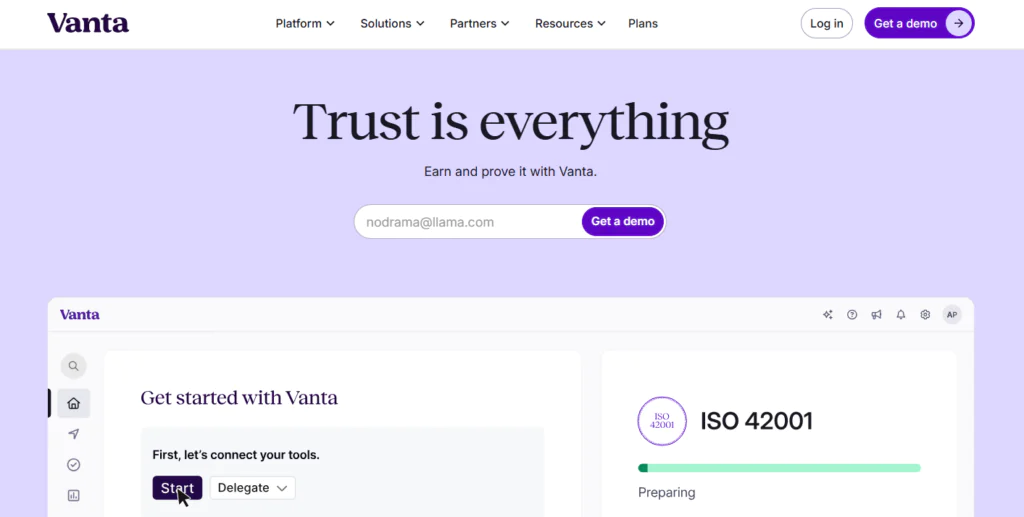
(Screenshot from Vanta’s website)
Key strengths:
- Automated evidence collection with live cloud integrations
- Real-time control dashboards with evidence tracking
- Simple setup for standard compliance programs
Limitations:
- Limited executive and board-level reporting with business-context summaries
- Platform costs increase with expanded framework scope and integrations
Compliance reporting software comparison
| Platform | Best for | Key strength |
| Scytale | SaaS organizations of all sizes with complex compliance needs seeking efficient AI GRC management processes | AI GRC compliance automation, multi-agent GRC suite, continuous security and compliance monitoring, multi-framework management, streamlined GRC processes, and expert guidance |
| TeamMate (StandardFusion) | GRC teams needing structured and flexible compliance reporting | Customizable reporting across risks, controls, and compliance requirements |
| Optro | Established audit and risk management teams | Detailed reporting on audits, controls, and organizational risk exposure |
| Sprinto | Cloud-based businesses focused on compliance and audit readiness | Automated control monitoring with clear compliance progress tracking |
| Drata | Engineering-focused teams managing cloud compliance programs | Centralized evidence tracking and automated control testing |
| Secureframe | Teams starting or managing standard compliance certifications | Guided compliance workflows with automated evidence collection |
| Vanta | Cloud-based teams automating ongoing compliance monitoring | Real-time control visibility supported by broad cloud integrations |
Always-on GRC. Built for modern teams.
How to choose the right compliance reporting tool
Choosing the right compliance reporting tool is about more than comparing features. The platform needs to fit how your organization reports today, who relies on that information, and how your compliance requirements may grow. Here are the key factors to consider when evaluating your options.
Identify who needs compliance reports
Start by identifying who will use the reports and what information they need. Boards and executives typically want concise summaries, auditors need detailed evidence and control information, and internal teams require operational insights. The right tool should serve each audience without forcing compliance teams to manually rebuild reports.
Consider your reporting frequency
Think about how often your organization needs compliance updates. Weekly or monthly reporting can quickly become time-consuming when teams rely on manual processes. Look for a platform that automates recurring reporting tasks and keeps information current with less manual effort.
Consider your compliance scope
Look at the frameworks your organization currently manages and identify where controls and evidence overlap. The right platform should help teams reuse shared controls across frameworks rather than maintain separate reporting processes, reducing duplicate work and keeping compliance reporting consistent.
Evaluate automation and integrations
Consider how much manual work is required to keep compliance data accurate and reports current. Integrations and automated evidence collection can reduce repetitive tasks by pulling relevant information from the systems your organization already uses. This makes reporting easier to maintain as the volume of controls and evidence increases.
Test usability before choosing
A reporting tool should be easy for compliance teams, executives, and auditors to use without extensive training. During evaluation, test common tasks such as finding information, generating reports, and accessing supporting evidence. Powerful features provide limited value if users struggle to navigate the platform or understand the data.
Plan for future compliance needs
Avoid choosing a tool based only on what your compliance program might eventually become. An overly complex platform can slow teams down today, while a basic solution may become limiting as requirements increase. Look for a tool that meets your current needs while supporting additional frameworks, users, and reporting requirements over time.
Common compliance reporting mistakes
Accurate compliance reporting is essential for maintaining audit readiness and clear communication across teams. Here are the most common mistakes organizations make in their compliance reporting processes:
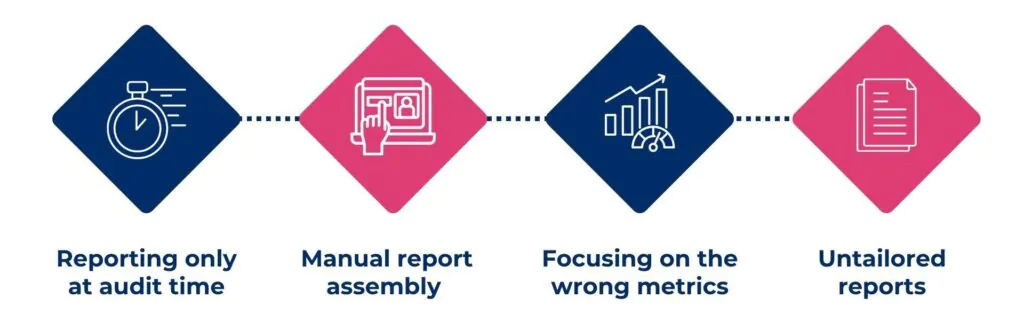
1. Reporting only at audit time
One of the most common mistakes is treating compliance reporting as a once-a-year task. Waiting until audit time to compile data can lead to outdated information, missed gaps, and a reactive approach to compliance. Reporting should be continuous to ensure that teams can stay proactive and address any issues as they arise.
2. Manual report assembly
Relying on spreadsheets, manual data entry, and piecing together reports from various sources is inefficient and error-prone. Manual processes slow down compliance reporting and often lead to inconsistent or incomplete data, making it harder to maintain audit readiness and meet stakeholder expectations.
3. Focusing on the wrong metrics
Tracking activities, like how many controls were reviewed or tasks completed, doesn’t always reflect your true compliance posture. Outcome metrics, such as the effectiveness of controls or the status of evidence, are more meaningful indicators of compliance health and should be prioritized.
4. Untailored reports
Another mistake is not customizing reports for different audiences. Boards need high-level summaries, auditors require detailed control evidence, and team leads need actionable insights. Failing to tailor reports accordingly can lead to confusion and a lack of alignment across stakeholders.

How Scytale makes compliance reporting effortless
Scytale’s AI GRC platform integrates compliance reporting into your daily operations and overall compliance management. Automated evidence collection, continuous control monitoring, and gap detection keep compliance data current while reducing manual work and giving teams clear visibility across frameworks.
The platform’s multi-agent suite works continuously to support evidence collection, identify gaps, and monitor control health. Scalable, role-based dashboards provide audit-ready views for auditors, while executives and compliance teams can track progress, risks, and compliance status from one central hub.
Dedicated GRC experts provide guidance from initial setup through audit preparation. This combination of automation and expert support helps teams maintain accurate reporting, address gaps sooner, and stay prepared for audits without relying on manual processes.
FAQs about compliance reporting software
What is the difference between compliance reporting and audit reporting?
Compliance reporting offers ongoing visibility into your organization’s security and control posture across frameworks, serving internal teams and leadership. Audit reporting, on the other hand, is a formal deliverable for external auditors at a specific point in time. Scytale seamlessly supports both through its integrated AI GRC platform, providing real-time data for stakeholder summaries and audit-ready evidence without duplication.
How often should organizations generate compliance reports?
For executives, monthly or quarterly reports are typical, while internal teams benefit from real-time dashboards and weekly or on-demand reports. Audit reports should be available at any time, based on current control status, rather than a fixed annual schedule. Leading AI GRC platforms like Scytale support all reporting cadences from a unified continuous compliance infrastructure.
Can compliance reporting software replace an external auditor?
No, compliance reporting software does not replace an auditor. It simplifies audit preparation by automating evidence collection, ensuring controls are in place, and evidence is complete. Auditors independently validate controls, while the software ensures controls are operating effectively and ready for review.
What is compliance reporting software?
Compliance reporting software helps organizations collect, track, and present compliance data in one place. It provides visibility into controls, evidence, risks, and progress across relevant frameworks, reducing the need for manual reporting.
How does compliance reporting software improve audit readiness?
Compliance reporting software improves audit readiness by keeping controls, evidence, and compliance progress organized and current. Automated evidence collection and ongoing monitoring help teams identify gaps earlier and provide auditors with the information they need more efficiently.
