









TL;DR: Compliance automation ROI
- The value of compliance automation is not always immediately visible, since it shows up through efficiency gains and reduced risks.
- Manual compliance creates significant time and cost burdens across teams, often without clear visibility into the full impact.
- Automation reduces audit preparation time and accelerates compliance, enabling faster sales cycles.
- Continuous monitoring boosts ROI by reducing audit costs through real-time risk visibility and eliminating expensive last-minute fixes.
- Top AI GRC platforms like Scytale combine automation, continuous monitoring, and expert support to drive clear, measurable ROI over time.
Compliance has become a strategic business function, influencing how organizations manage risk and scale operations. For CISOs and CFOs, the focus has shifted from whether to invest in compliance to whether that investment delivers measurable value.
While automation is often positioned as the solution, the reality is less clear. Many vendors promise efficiency and cost savings, but few define what return looks like in practice. In a budget-conscious environment, leadership needs proof that compliance spend delivers measurable returns.
This article outlines what ROI from compliance automation truly looks like, breaking down where value is created and how to measure it in practice.
Why compliance automation ROI is hard to pin down
Measuring ROI for compliance automation is not as straightforward as other technology investments. Unlike revenue-generating tools, compliance platforms deliver value through risk reduction, efficiency gains, and keeping the organization running without disruption. Many of these benefits are indirect, such as avoiding fines, preventing security incidents, and accelerating sales cycles, making them difficult to quantify upfront.
This creates a challenge when applying traditional ROI models, especially for finance stakeholders looking for clear, immediate returns. The value of compliance automation also compounds over time, evolving from reduced audit preparation effort into continuous visibility and stronger control over security posture.
The key is to rethink how ROI is measured. Instead of focusing only on cost savings, organizations should evaluate automation based on efficiency gains, risk reduction, and the ability to scale Governance, Risk and Compliance (GRC) without increasing headcount.
Always-on GRC. Built for modern teams.
The real costs of manual compliance
Manual compliance is often underestimated because costs are spread across teams and processes. In reality, it creates a significant operational and financial burden.
Personnel hours are one of the biggest hidden costs. Security, IT, and engineering teams spend hundreds of hours collecting evidence, updating spreadsheets, managing controls, and responding to audit requests, often reaching 200 to 400+ hours per audit cycle.
Audit preparation creates additional operational pressure. Without automation, organizations must consolidate documentation and validate controls within constrained timelines, often leading to inefficiencies and higher reliance on external consultants, typically costing $10,000 to $50,000+ per audit depending on complexity.
Manual GRC also impacts revenue. Delayed certifications can slow or stall sales cycles, especially when prospects require proof of compliance before signing. At the same time, security teams are pulled away from higher-value work like risk management and strategic initiatives, limiting the organization’s ability to scale securely.
What compliance automation actually saves
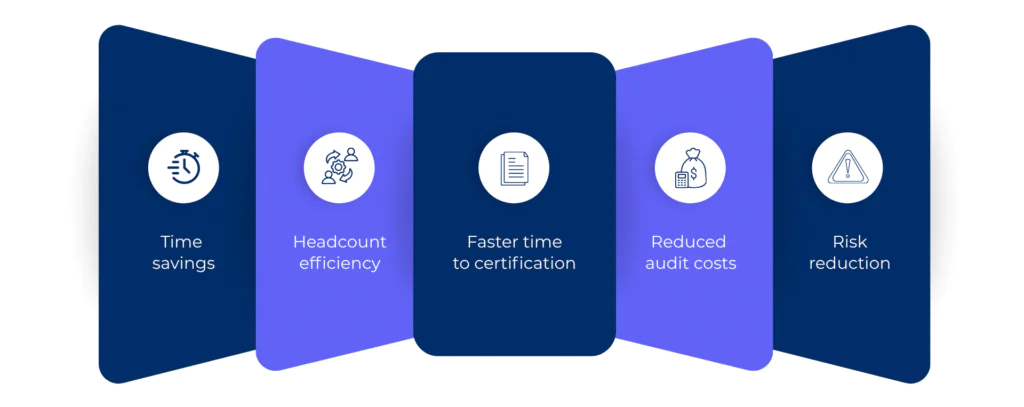
Compliance automation delivers value across multiple areas of the organization. Here are the key areas where it drives measurable savings:
Time savings
Compliance automation tools significantly reduce the time spent on repetitive tasks such as evidence collection, policy updates, and audit preparation. Instead of manually gathering data across systems, automated platforms continuously collect and organize evidence in real time.
In practice, organizations often reduce audit preparation time by 50 to 70 percent, saving hundreds of hours per cycle. Tasks that once took weeks, such as compiling audit-ready documentation, can be completed in days, improving efficiency and minimizing last-minute pressure on teams.
Headcount efficiency
GRC automation enables organizations to scale compliance programs without a proportional increase in staffing. As requirements expand, teams can maintain coverage and consistency without adding additional headcount.
Automation removes the need for manual tracking, follow-ups, and repetitive administrative work. This allows security and compliance teams to focus on higher-value activities such as risk analysis and control improvement. As a result, teams can support more security and privacy frameworks and business initiatives without increasing overhead.
Faster time to certification
Achieving compliance manually can take months, especially when processes are fragmented and evidence collection is inconsistent. Automation accelerates this timeline by providing structured workflows, continuous monitoring, and real-time visibility into readiness.
Organizations can reduce time to project completion by several weeks or even months, depending on their starting point. This faster turnaround enables organizations to meet customer requirements sooner and move through procurement processes more efficiently.
Reduced audit costs
Automation helps streamline the audit process by ensuring that evidence is accurate, complete, and readily accessible. This reduces the need for back-and-forth with auditors and minimizes the likelihood of gaps or inconsistencies.
As a result, audit cycles become smoother and more predictable. Organizations often see a reduction in external audit and consulting costs, as well as fewer audit findings that require remediation. Over time, this leads to lower overall compliance spend.
Risk reduction
One of the most valuable benefits of compliance automation is the ability to identify and address risks early. Continuous monitoring ensures that gaps are detected in real time, rather than during periodic reviews or audits.
This proactive approach reduces the likelihood of security incidents, regulatory fines, and reputational damage. It can also positively impact cyber insurance premiums by demonstrating stronger control over risk. While harder to quantify, the financial impact of avoiding a single breach or GRC failure can far exceed the cost of automation.
Setting realistic ROI expectations
ROI from compliance automation does not happen overnight, but it typically becomes visible within 3 to 6 months of implementation. Early gains are driven by time savings in audit preparation and reduced manual effort, while longer-term value comes from improved compliance management processes and continuous visibility.
It is important to distinguish between hard and soft ROI:
- Hard ROI includes measurable cost savings such as reduced audit fees, fewer consultant hours, and lower operational overhead. It is easier to quantify and directly impacts the bottom line, making it simple to justify in a business case.
- Soft ROI includes benefits like reduced risk exposure, improved team efficiency, stronger customer trust, and faster sales cycles. It is more challenging to measure upfront, but these benefits often have a greater long-term impact on business growth and success.
ROI also compounds over time. As organizations expand into additional frameworks or scale their operations, the same automated processes can be reused, reducing incremental effort. What starts as a single initiative scales into a continuous compliance program that delivers increasing value without a proportional increase in cost or headcount.



How to build a business case for compliance automation
Building a business case for compliance automation requires a clear view of current costs and expected outcomes. The following steps outline how to quantify, measure, and link GRC efforts to business impact:
Step 1: Quantify your current spend
Start by understanding what compliance is currently costing your organization. This includes internal hours spent on evidence collection, audit preparation, and control management, as well as external costs such as consultants and auditors. Many organizations underestimate these expenses because they are spread across teams. Consolidating this data provides a clear baseline and highlights inefficiencies that automation can address.
Step 2: Identify the measurable outcomes
Define what success looks like in measurable terms. Common metrics include hours saved on audit preparation, reduction in time to compliance, and fewer audit findings. You can also factor in improvements such as faster response times to security questionnaires and reduced manual tracking. These metrics help translate automation into tangible operational gains that leadership can evaluate.
Step 3: Map to business impact
Compliance outcomes should be directly tied to business performance. Faster certifications can accelerate deal cycles, while stronger security posture can improve customer trust and retention. Reducing delays in procurement processes can unlock revenue opportunities that would otherwise be stalled. Positioning GRC as a business enabler, rather than a cost center, strengthens the overall case for investment.
Step 4: Present a phased approach
A phased rollout makes the investment easier to approve and the ROI easier to demonstrate. Start with a single framework or priority area, measure the impact, and expand from there. This approach reduces upfront complexity and allows organizations to prove value early. Over time, organizations can expand across frameworks and processes with minimal added effort, strengthening long-term ROI.
Steps to build a business case for compliance automation
| Step | What to do | Business impact |
| 1. Quantify current spend | Calculate internal hours across security, IT, and engineering, plus external audit and consultant costs | Establish a baseline and uncover hidden inefficiencies |
| 2. Identify measurable outcomes | Define metrics such as hours saved, time to certification, and reduction in audit findings | Translate compliance into trackable performance improvements |
| 3. Map to business impact | Link outcomes to revenue, sales cycles, customer trust, and operational efficiency | Position compliance as a growth enabler, not a cost center |
| 4. Present a phased approach | Start with one framework or priority area, measure results, and expand over time | Reduce risk, prove value early, and scale efficiently |
ROI benchmarks for compliance automation
While ROI varies by company size, maturity, and scope, there are consistent benchmarks organizations can use to evaluate compliance automation.
Most organizations see a 50 to 70 percent reduction in audit preparation time, driven by automated evidence collection and continuous monitoring. Time to certification also improves, with many companies achieving initial certification 30 to 50 percent faster, particularly when transitioning from fragmented or manual processes.
Automation also improves headcount efficiency. Many organizations effectively gain the equivalent of one to two full-time resources by eliminating repetitive tasks, allowing existing teams to support additional frameworks and initiatives.
Outcomes will vary based on factors such as framework scope, internal processes, and infrastructure. However, automation is redefining compliance management by consistently reducing operational overhead while improving visibility and control.
Compliance automation pitfalls that reduce ROI
Not all compliance automation solutions deliver the ROI they promise. Here are some common pitfalls to be aware of:
- Overpromising immediate results: Vendors may promise quick returns without factoring in the complexity of implementation. Compliance requires a structured approach, and unrealistic timelines can delay the expected value.
- Implementation effort: While automation reduces long-term workload, the initial setup demands significant time and cross-team alignment. It’s important to understand that the upfront effort is necessary for long-term benefits.
- Focusing on the wrong metrics: Organizations often prioritize tool usage or feature adoption rather than focusing on the outcomes that matter, like audit efficiency and reduced risk exposure.
- Point-in-time compliance: Solutions that only support point-in-time compliance can limit sustained value. Without continuous monitoring and visibility, teams may face recurring compliance challenges during each audit cycle, ultimately reducing overall ROI.
Streamline GRC workflows with no blind spots.
How Scytale delivers compliance automation ROI
Scytale delivers unparalleled ROI by transforming compliance from a reactive, audit-driven process into a proactive, scalable model. Combining AI GRC automation, real-time monitoring, and tailored GRC expertise, Scytale provides continuous visibility and control while drastically reducing operational overhead.
With automated evidence collection, structured workflows, and centralized control management, teams can complete audits faster and more accurately, minimizing manual coordination. Continuous monitoring and Scytale’s multi-agent suite ensure real-time gap identification and remediation, cutting audit findings and reducing reliance on external consultants.
Scytale drives even more ROI by enabling multi-framework cross-mapping, allowing organizations to manage standards like SOC 2, ISO 27001, GDPR, and SOX ITGC with a unified approach. Its customizable Trust Center also helps organizations showcase their security and GRC posture, accelerating deal cycles and building stronger customer trust.
FAQs about compliance automation investments ROI
How long does it take to see ROI from compliance automation?
Most organizations begin to see measurable ROI within 3 to 6 months. Early returns come from reduced audit preparation time and improved operational efficiency. Longer-term value builds through continuous monitoring and the ability to scale without increasing headcount, enabled by AI GRC platforms like Scytale.
What’s the biggest driver of compliance automation ROI?
The primary driver is time savings from automating repetitive tasks such as evidence collection, control tracking, and audit preparation. This reduces manual effort, improves accuracy, and enables teams to focus on higher-value activities that impact risk management and business performance.
Is compliance automation worth it for small companies?
Yes, particularly for companies planning to scale. Automation allows smaller teams to manage compliance efficiently without adding headcount, while accelerating time to certification and reducing the risk of delays.
How do we measure compliance automation ROI after implementation?
ROI can be measured by tracking metrics such as hours saved, reduced audit preparation time, faster certification timelines, and lower external audit costs. Additional indicators include fewer compliance gaps, improved team productivity, and shorter sales cycles linked to meeting compliance requirements, all of which can be tracked within AI GRC tools like Scytale.
