


TL;DR: Multi-framework compliance platforms
- Most SaaS organizations operate across multiple frameworks simultaneously, like SOC 2, ISO 27001, GDPR, and HIPAA.
- Managing separate tools for each framework leads to duplicated effort, inconsistent controls, and increased audit risk.
- Top multi-framework compliance platforms consolidate evidence collection, control monitoring, and audit preparation into a single, centralized system.
- Scytale’s AI GRC platform stands out by combining support for 80+ frameworks with built-in cross-mapping and hands-on guidance from dedicated GRC experts.
- AI is improving multi-framework compliance by reducing manual effort, identifying gaps in real time, and enabling continuous audit readiness.
Running compliance for a single framework is already resource-intensive. For scaling SaaS organizations and established enterprises, that effort now extends across multiple standards such as SOC 2, ISO 27001, GDPR, and SOX ITGC, often within complex cloud and SaaS environments. Managing these requirements in parallel increases operational complexity and heightens the risk of gaps.
The compliance workload has grown significantly. The global regulatory technology market is projected to reach $38.44 billion by 2030, reflecting increasing demand for scalable compliance solutions. This signals a clear shift away from managing frameworks in isolation, with organizations moving toward continuous, integrated compliance programs that rely on real-time visibility and ongoing control monitoring.
In this article, we explore the leading multi-framework compliance platforms in 2026, what to look for when evaluating them, the key benefits and challenges, and how they help teams manage compliance more efficiently at scale.
7 best multi-framework compliance platforms
- Scytale
- RiskWatch
- Thoropass
- OneTrust
- Sprinto
- Drata
- Vanta
What to look for in a multi-framework compliance platform
Not all Governance, Risk, and Compliance (GRC) platforms are built to manage multiple compliance frameworks effectively. The right platform should reduce duplicate work, connect overlapping requirements, and give teams clear visibility as their compliance program grows. Here are the key capabilities to look for in a multi-framework compliance platform:
Multi-framework support and cross-mapping
The platform should natively support the frameworks your organization needs, with controls mapped across overlapping requirements. Effective cross-mapping allows one piece of evidence or control to satisfy requirements across multiple frameworks, reducing duplicate work and making expansion easier.
For example, Sport Alliance, which serves over 10,000 gyms worldwide, uses Scytale’s multi-framework cross-mapping to extend its ISO 27001 work across GDPR requirements for more than 500 endpoints.
Continuous compliance monitoring
Audit readiness should be a natural outcome of everyday compliance operations, not a last-minute effort. Look for continuous control monitoring, automated evidence updates, and clear alerts when controls fall out of compliance so teams can address issues as they arise.
Automated evidence and controls
Manual evidence collection becomes increasingly difficult as frameworks and systems multiply. A strong platform should automatically collect evidence from your live systems, connect it to the relevant controls, and flag failures or missing evidence without relying on spreadsheets and manual follow-ups.
Unified risk and compliance visibility
Teams need a clear view of their compliance posture across every framework they manage. The platform should centralize risks, controls, evidence, gaps, and remediation tasks, giving teams a single view of their compliance program and what needs attention.
Deep integrations
Compliance data sits across cloud infrastructure, identity providers, HR platforms, ticketing systems, and security tools. Look for integrations that continuously pull accurate data from your existing tech stack and reduce the need for manual uploads or custom workflows.
Scalability as compliance requirements grow
Compliance needs rarely stay static. As your organization enters new markets, serves larger customers, or adds frameworks, the platform should scale with you. Adding another standard should build on the controls and evidence already in place rather than requiring your team to start from scratch.
Streamline GRC workflows with no blind spots.
Best multi-framework compliance platforms in 2026
The best platforms for multi-framework compliance help teams stay continuously audit-ready across multiple standards, reduce duplicated control work, and provide ongoing insight into compliance posture. Here are the top seven platforms to consider in 2026:
1. Scytale
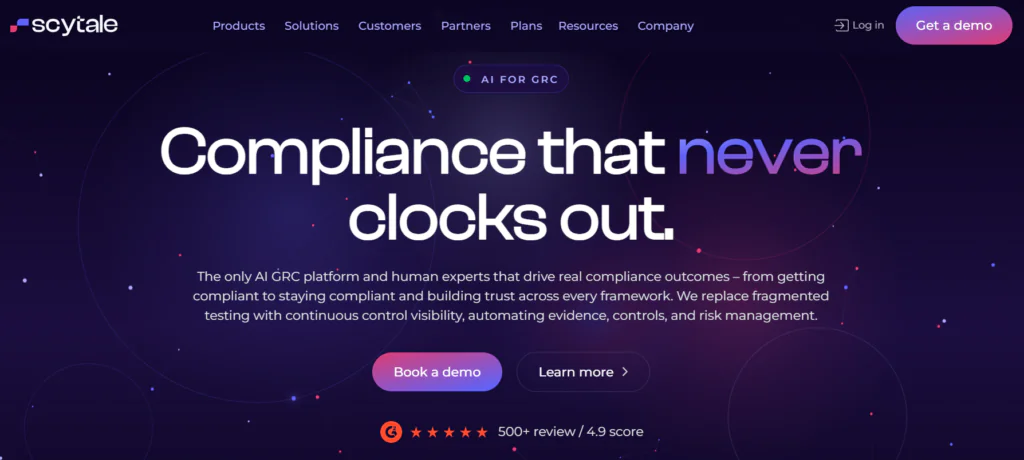
Scytale is the best AI GRC platform for scaling SaaS organizations and established enterprises managing compliance across multiple frameworks. It supports 80+ security, privacy, and AI standards, with built-in cross-framework mapping that reduces duplicated control effort and maintains consistency across all active requirements.
What differentiates Scytale is its combination of automation and dedicated GRC expert support. Its AI agents operate continuously across your environment to collect evidence, identify control gaps, generate and update policies, and validate alignment with applicable framework requirements, ensuring your compliance posture remains accurate and audit-ready at all times.
(Screenshot from Scytale’s website)
Why Scytale is the best:
- Multi-framework management with built-in cross-mapping that aligns controls across SOC 2, ISO 27001, GDPR, HIPAA, and more, eliminating duplicate effort
- Continuous compliance through real-time monitoring, with a unified view of your security and risk posture across all active frameworks
- AI-driven automation that streamlines key processes, including evidence collection, control validation, access reviews, and vendor risk management
- Centralized platform with seamless integrations for consistent, automated evidence collection across your tech stack
- Dedicated GRC expert support to guide implementation, remediation, and continuous compliance across multiple standards
- Customizable Trust Center to securely share your compliance posture with customers and stakeholders
2. RiskWatch
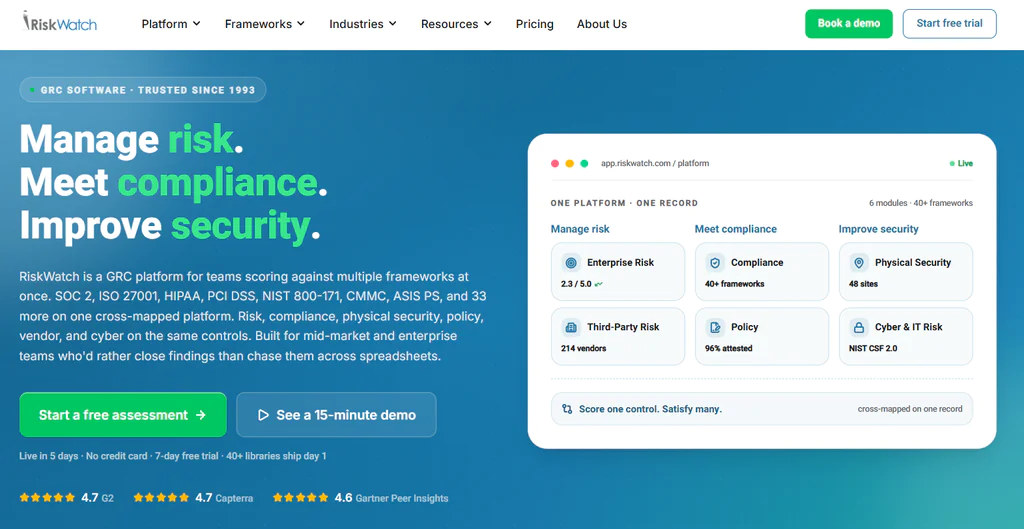
RiskWatch is a risk and compliance management platform focused on helping organizations assess, quantify, and manage security and operational risk. It provides tools for risk assessments, compliance tracking, and reporting across regulatory requirements and industry standards.
(Screenshot from RiskWatch’s website)
Key strengths:
- Configurable risk assessments support different business and regulatory requirements
- Risk scoring and reporting help teams prioritize remediation efforts
- Centralized dashboards provide visibility into risk and compliance status
Limitations:
- Less emphasis on automated evidence collection from live systems
- Broader compliance automation and continuous control monitoring capabilities are more limited than specialized automation platforms
3. Thoropass
Thoropass combines compliance software with in-house audit services, offering a bundled approach for organizations that want both tooling and audit execution within a single provider. It supports frameworks such as SOC 2, ISO 27001, and PCI DSS, with a structured path toward audit completion.
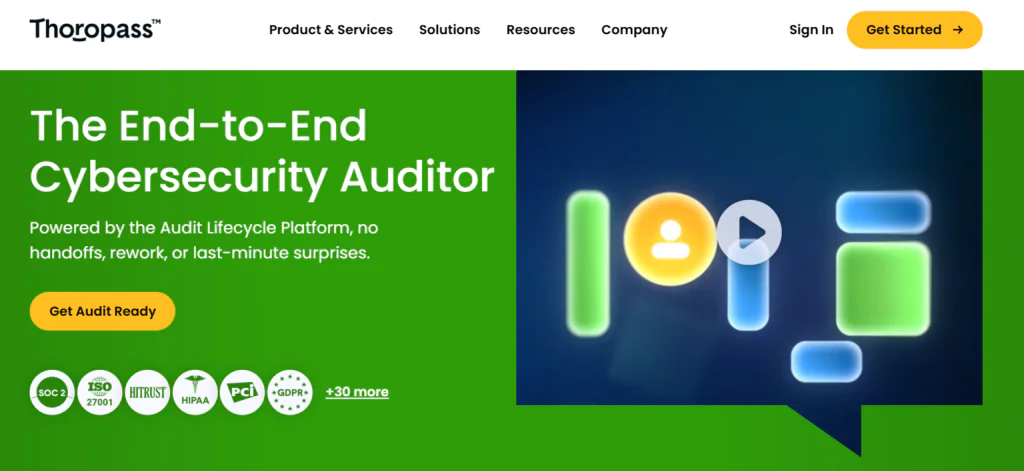
(Screenshot from Thoropass’ website)
Key strengths:
- Integrated audit services reduce the need to coordinate with external firms
- Structured onboarding supports teams building formal compliance programs
- Coverage across commonly required frameworks for SaaS and regulated industries
Limitations:
- Ongoing monitoring capabilities are less emphasized compared to automation-focused platforms
- Cross-framework alignment is more limited for organizations managing multiple standards simultaneously
4. OneTrust
OneTrust is a comprehensive GRC and privacy platform designed for large enterprises managing complex regulatory environments. It provides a wide range of modules covering privacy, risk, governance, and third-party management.
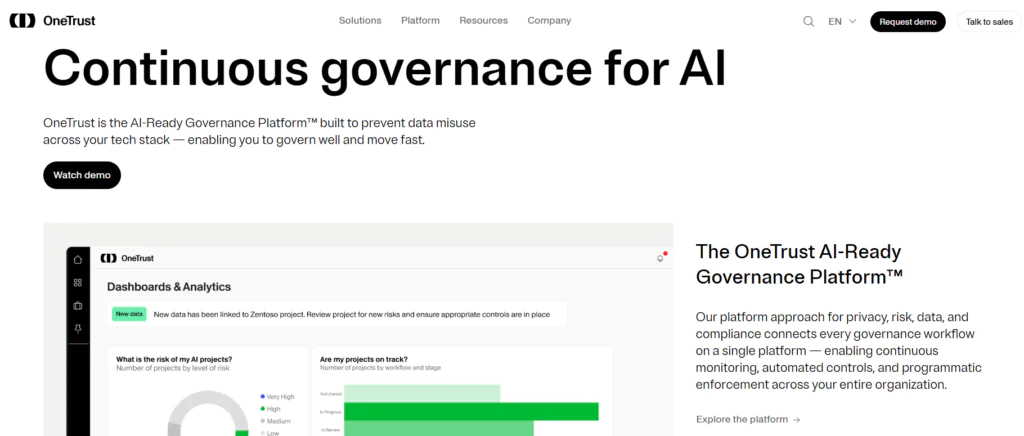
(Screenshot from OneTrust’s website)
Key strengths:
- Strong coverage across global privacy regulations and data protection requirements
- Mature third-party and vendor risk management capabilities
- Modular architecture allows organizations to deploy functionality selectively
Limitations:
- Broad scope can lead to longer implementation cycles and higher operational overhead
- Primarily suited to enterprise environments with dedicated compliance resources
5. Sprinto
Sprinto is a cloud-based compliance platform focused on helping technology companies reach audit readiness quickly. It offers pre-configured compliance programs and integrations designed for ease of use and fast onboarding.
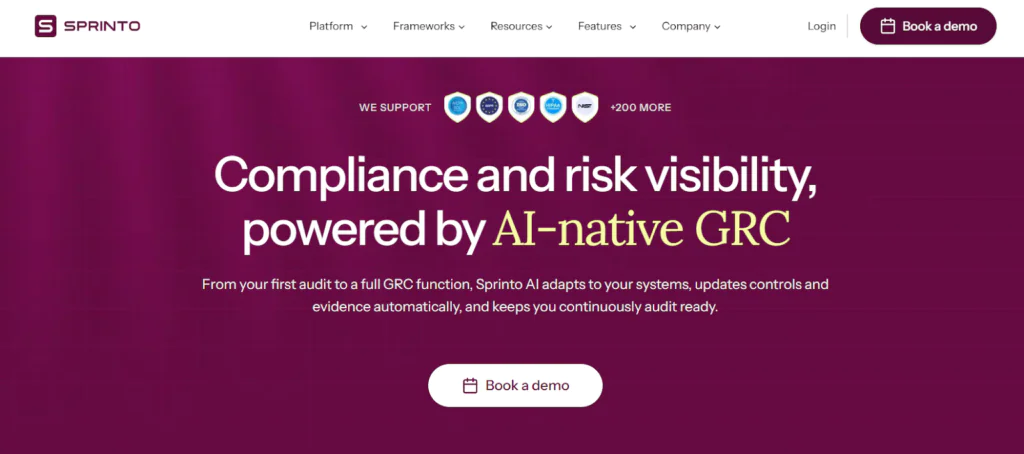
(Screenshot from Sprinto’s website)
Key strengths:
- Pre-built programs accelerate time to initial certification
- Real-time alerts help teams respond quickly to control issues
- Intuitive interface reduces the learning curve for smaller teams
Limitations:
- Limited flexibility for complex or highly customized compliance environments
- More suited to straightforward cloud infrastructures than multi-layered enterprise setups
6. Drata
Drata is a compliance automation platform built with engineering teams in mind, emphasizing integrations with cloud infrastructure and developer tools. It provides a structured environment for managing evidence and supporting audit workflows.
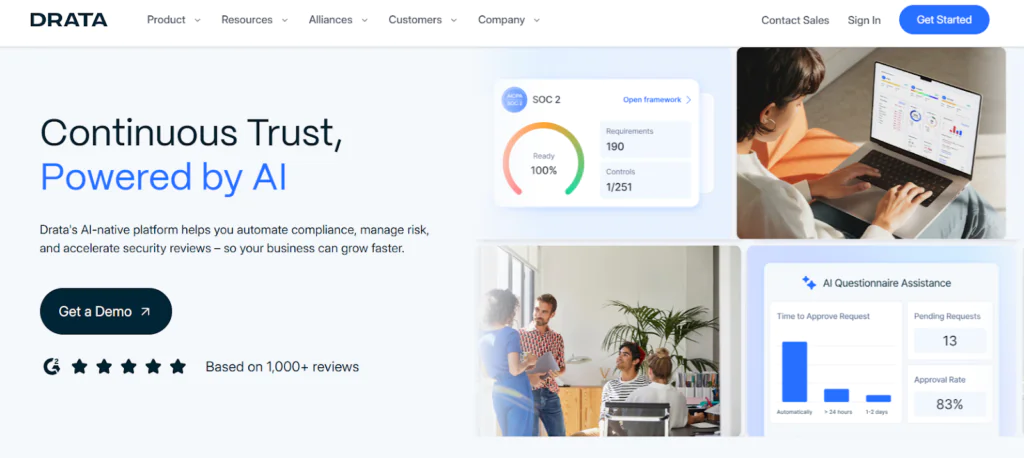
(Screenshot from Drata’s website)
Key strengths:
- Deep integrations across cloud and development ecosystems
- Structured workflows for organizing and presenting audit evidence
- Standardized templates for policies and controls
Limitations:
- Additional configuration may be required for more complex environments
- Cross-framework coordination is less automated for large-scale programs
7. Vanta
Vanta focuses on automating compliance preparation for security audits, with strong adoption among SaaS companies. It integrates with cloud and identity systems to streamline control checks and documentation.
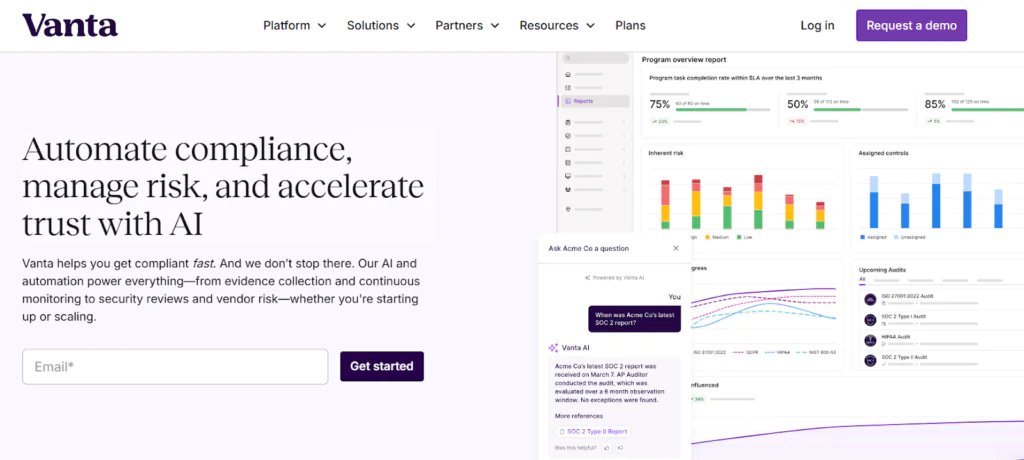
(Screenshot from Vanta’s website)
Key strengths:
- Automated control testing and evidence gathering across core frameworks
- Extensive integration ecosystem covering common SaaS and infrastructure tools
- Established presence with a broad auditor partner network
Limitations:
- Expanding to multiple frameworks can increase configuration effort and cost
- Risk management capabilities are more basic compared to more specialized platforms
Top 7 multi-framework compliance platforms
| Platform | Multi-framework support | Best for | Pricing |
| Scytale | 80+ frameworks, built-in cross-mapping | SaaS organizations and enterprises managing multiple frameworks simultaneously | Custom pricing based on package, frameworks, and requirements |
| RiskWatch | Multiple regulatory and industry frameworks | Organizations prioritizing risk assessment and compliance tracking | Custom pricing |
| Thoropass | SOC 2, ISO 27001, HIPAA, PCI DSS | Organizations wanting combined software and audit services | Custom pricing based on framework and audit scope |
| OneTrust | Broad privacy and GRC frameworks | Large enterprises with complex privacy and risk requirements | Custom enterprise pricing |
| Sprinto | SOC 2, ISO 27001, GDPR, HIPAA and more | Tech companies starting or scaling compliance programs | Custom pricing based on frameworks and company needs |
| Drata | SOC 2, ISO 27001, HIPAA, GDPR and more | Engineering-led teams in cloud-native environments | Custom pricing based on company size and requirements |
| Vanta | SOC 2, ISO 27001, HIPAA, GDPR and more | SaaS companies beginning or scaling compliance | Custom pricing based on company size, frameworks, and features |
How to choose the right multi-framework compliance platform
The right compliance software should fit how compliance operates within your organization today and where it is likely to go next. Rather than comparing vendors purely by feature count, consider how well each solution fits your compliance roadmap, internal resources, and existing processes. Here are the key factors to consider when choosing multi-framework compliance software:
Start with your current and future requirements
Map the frameworks you manage today alongside those you are likely to need as you enter new markets, move upmarket, or respond to customer requirements. This helps avoid selecting a platform that works for your immediate audit but needs to be replaced as your compliance program expands.
Consider your team’s operating model
Think about who will actually own and manage compliance. A dedicated GRC team may need different capabilities than a lean security or engineering team handling compliance alongside other responsibilities. Consider how much work your team wants to manage internally and whether access to compliance experts or audit support is important.
Test the platform against your real workflows
A product demo should reflect your environment rather than a generic compliance journey. Ask vendors to demonstrate how the platform would handle your existing controls, evidence sources, frameworks, vendor management, remediation processes, and upcoming audits. This makes it easier to identify where the platform will genuinely reduce workload.
Compare the total cost of ownership
Look beyond the initial subscription price. Consider how pricing changes as you add frameworks, users, integrations, audit services, or other functionality, as well as the internal time required to operate the platform. A lower starting price may not mean a lower long-term compliance cost.
Plan for long-term adoption
The platform should work for the people responsible for compliance day to day, not just satisfy requirements during procurement. Involve key stakeholders in the evaluation process and consider usability, implementation effort, support, and how easily the solution can adapt as your organization and compliance program mature.
AI-native GRC for how teams work today.
Benefits of multi-framework compliance platforms
When your compliance program spans multiple standards, the platform managing it should operate seamlessly across all of them. Here is what organizations gain from using continuous compliance management software:
- Centralized compliance management: A unified platform provides a single, consolidated view of compliance status across all active frameworks, eliminating the need to switch between tools or reconcile multiple dashboards.
- Reduced manual effort: Automated evidence collection, control testing, and cross-framework mapping replace time-intensive manual tasks, allowing teams to focus on higher-value compliance activities.
- Faster audit cycles: With continuous evidence collection and real-time monitoring, audit preparation becomes a structured review rather than a prolonged, reactive process. Auditors can access organized, up-to-date documentation with minimal back-and-forth.
- Improved control consistency: Shared controls are mapped across frameworks automatically, ensuring they are implemented and tracked once, maintaining consistency while reducing duplication.
- Real-time visibility: Compliance posture is continuously updated as your environment changes, giving leadership accurate, current insights across all frameworks rather than relying on periodic snapshots.
Challenges without a unified platform
Organizations managing compliance without a centralized platform face compliance challenges that intensify as additional frameworks are introduced. Here are some of the most common challenges to be aware of:
Fragmented tools and processes
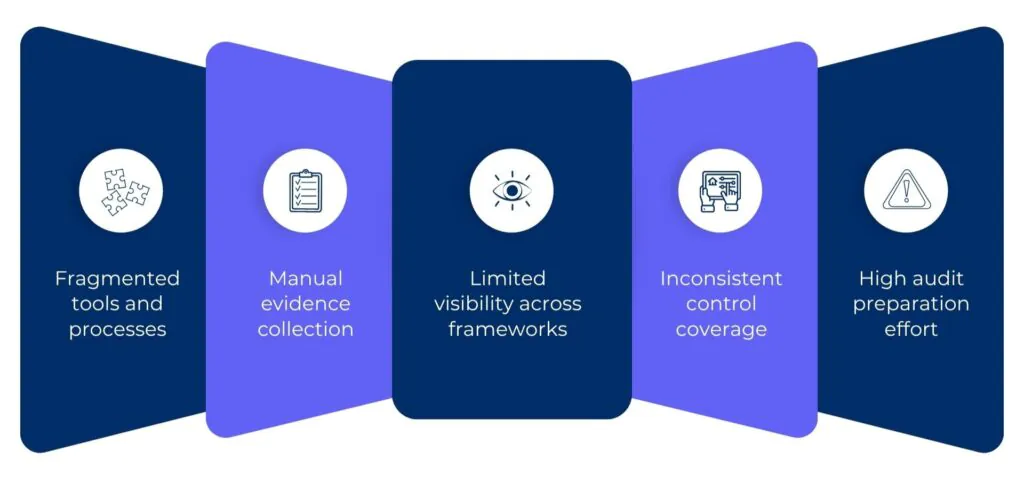
Managing each framework separately leads to siloed data. SOC 2 evidence, ISO 27001 controls, and GDPR documentation often reside in different systems, making consistency and cross-framework visibility difficult to maintain.
Manual evidence collection
Collecting evidence across multiple frameworks is time-intensive and prone to error. Teams spend significant time gathering screenshots, exporting logs, and coordinating across departments, creating unnecessary overhead during each audit cycle.
Limited visibility across frameworks
Without a unified view, tracking control status requires manual reconciliation. Gaps and control failures are often only identified during audit preparation, when remediation is most disruptive.
Inconsistent control coverage
Disconnected tools make it difficult to identify overlapping or missing controls. Organizations managing multiple frameworks may duplicate effort on shared controls while leaving others unaddressed.
High audit preparation effort
Without continuous monitoring and automated evidence collection, audit readiness becomes a recurring, resource-heavy process. Teams can spend weeks or months preparing for audits that could otherwise be managed continuously throughout the year.
How multi-framework compliance is changing
Compliance is shifting from periodic assessments to continuous compliance programs that maintain audit readiness year-round. While annual audits remain a requirement, the supporting work is now ongoing, with automated monitoring, real-time gap detection, and AI-assisted remediation replacing the manual effort that once defined audit preparation.
AI is accelerating this shift. Platforms with embedded AI can streamline evidence review, identify control drift as it occurs, update policies in response to regulatory changes, and map controls across frameworks. This significantly reduces the operational burden on compliance teams, particularly for organizations managing multiple frameworks simultaneously.
At the same time, organizations are consolidating onto a unified GRC tool rather than maintaining separate tools for each framework. This approach reduces complexity, improves consistency, and provides leadership with a single, accurate view of compliance posture across the organization. As compliance and security requirements continue to expand globally, the move toward unified platforms is becoming increasingly essential.

Streamline multi-framework compliance with Scytale
Managing multiple frameworks becomes more complex as your organization grows, but it does not need to slow you down. Scytale brings structure to multi-framework compliance by centralizing workflows, aligning requirements, and giving teams clear visibility into what needs attention. With dedicated GRC expert support, your team can manage requirements with confidence, supported by a single system of record that keeps compliance aligned.
As security compliance demands continue to expand in 2026, the ability to manage compliance as a unified, continuous program is essential. Scytale enables organizations to scale their compliance efforts without adding operational overhead, helping teams stay aligned, reduce duplication, and maintain confidence in their compliance posture. The result is a more efficient, resilient approach to multi-framework compliance that supports audit readiness and long-term growth.
FAQs about multi-framework compliance platforms
What is a multi-framework compliance platform?
A multi-framework compliance platform is software that manages compliance across multiple standards, such as SOC 2, ISO 27001, GDPR, and HIPAA, from a single system. It maps shared controls across frameworks, automates evidence collection, and provides continuous visibility into compliance posture without requiring a separate tool for each standard.
Why do companies need multi-framework compliance platforms?
Most SaaS organizations face requirements from multiple frameworks at once. Managing them separately creates duplicated effort, inconsistent controls, and significant audit overhead. A unified platform reduces that complexity by centralizing evidence, automating cross-framework mapping, and keeping compliance posture current across all active standards simultaneously.
How does AI help in compliance platforms?
AI streamlines the most time-intensive parts of compliance: evidence collection, control testing, gap detection, and policy generation. Top multi-framework platforms like Scytale use AI agents that run continuously across your environment, flagging issues in real time and recommending remediation actions so your team stays ahead of compliance gaps rather than reacting to audit findings.
What should you look for in a multi-framework compliance platform?
Prioritize platforms that offer native support for your required frameworks, continuous control monitoring, automated evidence collection tied to live integrations, clear risk and compliance visibility across all active standards, and integration depth with your existing tech stack. Scalability matters too, especially if your framework portfolio will grow.
What frameworks do multi-framework compliance platforms usually support?
Most platforms cover core security and privacy frameworks like SOC 2, ISO 27001, GDPR, HIPAA, and SOX ITGC. Leading AI GRC platforms like Scytale extend well beyond these, supporting 80+ frameworks including AI governance standards, regional data protection regulations, and industry-specific requirements, with built-in cross-mapping across all of them.
