

Scaling a business brings more complexity, but it should not bring more manual work. Deel helps companies manage global teams, while Scytale takes the manual load out of compliance.
This resource breaks down the ROI of running compliance with Scytale, from internal hours and resources to the impact on enterprise growth.
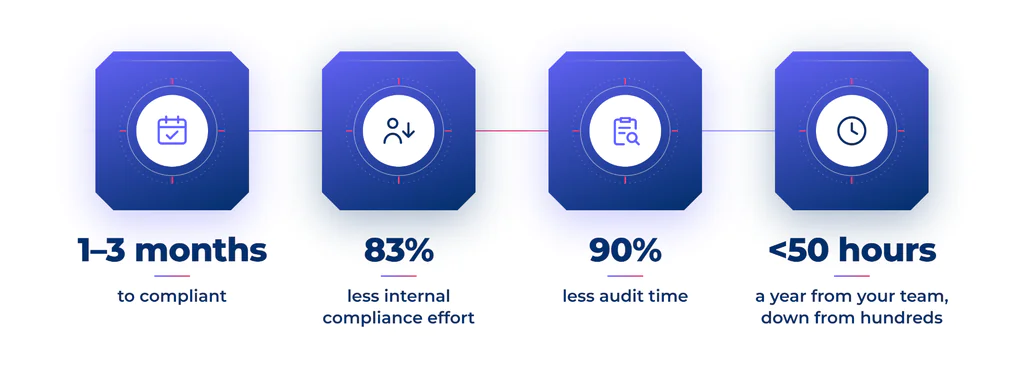
By the numbers
The platform price is only part of the cost
Most founders budget compliance as a single line item: the platform price. But the real cost also includes everything that sits on top of it: engineering hours pulled off the roadmap to take screenshots, a questionnaire that sat for nine days because nobody owned it, or a deal that stalled at security review and never restarted.
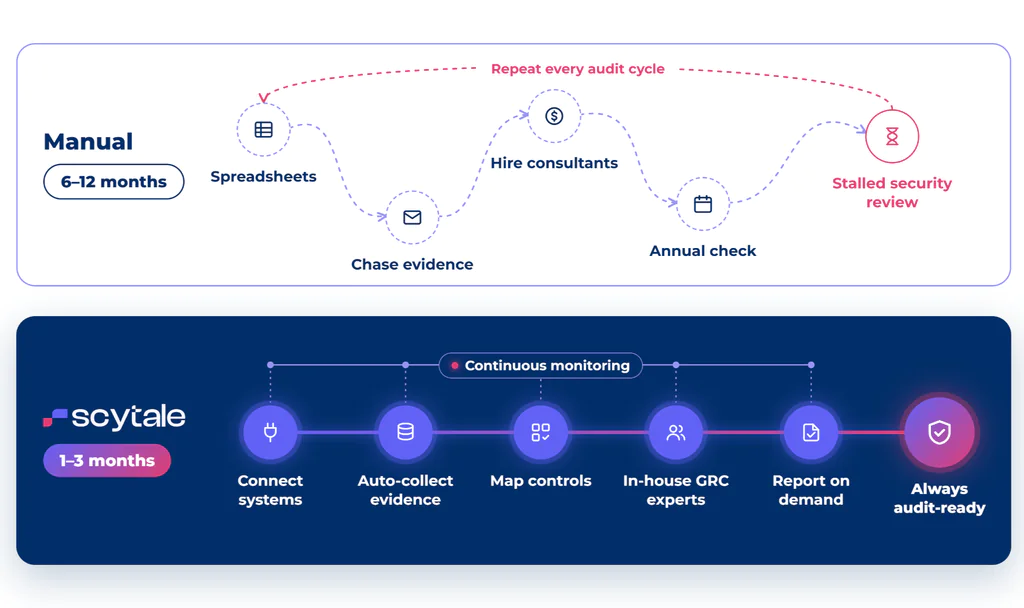
Scytale takes that hidden workload off your team. Its agentic network runs evidence collection, control monitoring, and questionnaires continuously across your stack. Alongside it, a dedicated in-house GRC expert guides you through every stage, defining the right scope and controls for your environment, reviewing evidence before the auditor does, supporting you on audit days and beyond.
Manual compliance vs. Scytale
| Manual | With Scytale | |
|---|---|---|
| Time to audit-readiness | 6-12 months | 1-3 months |
| Audit preparation | 200 to 400+ hours per audit cycle | 50 to 70% less prep time |
| External consultants | +$250k per audit | Access to in-house GRC expertise |
| Team capacity | Compliance requires more resources, especially if no in-house security and compliance team. | Dedicated experts are an extension of your team. |
| Control visibility | Point-in-time, checked annually | Continuous monitoring, gaps surfaced as they appear |
| Enterprise deals | Stalled at security review | Report ready when the buyer asks |
Give your team its time back
Evidence collection is the highest single cost in most compliance programs. Someone logs into each system, takes the screenshot, checks it against the evidence standard, files it, then repeats the whole thing next quarter when the data changes.
It is repetitive, high-volume work that does not need to sit with your team. Scytale automates much of that workload, continuously collecting evidence and monitoring controls across your environment.
2X Solutions cut internal compliance effort by 83% with Scytale. Read the case study.
“Before Scytale, compliance felt like rounding up cats. Today, it is structured, fully visible, and under control. We’ve reduced internal compliance effort by 83% and finally have clarity on where we stand at any point in time.” – Kevin DeMeritt, CEO, 2X Solutions.
Keep compliance costs from growing with your business
More tools and vendors should not mean more manual compliance work. But without automation, every new vendor adds another review to the workload.
Scytale discovers vendors automatically from your SSO provider and connected systems, assigns risk tiers, and monitors security posture continuously rather than once a year. Your vendor oversight scales with your business without adding the same manual workload.
Get to compliance in weeks, not quarters
Most companies are audit-ready in two to four weeks, and hold the report within three months.
“The time it took to achieve SOC 2 readiness for an external audit in just four weeks is incredibly impressive. The integration feature automatically collects evidence and identifies issues, which significantly streamlines the entire auditing process.” – Nicola Timoncini, CTO, Epiphany.
Automate the workload. Leave judgment to the experts.
Automation does not remove the audit itself. It removes much of the work around it: the evidence chase, audit prep sprint, questionnaire backlog and manual workload added purely to keep up.
But automation alone cannot make every compliance decision. That is where human judgment comes in.
The value of a dedicated GRC expert
If this is your first audit or you do not have dedicated compliance expertise in-house, expert guidance can be just as important as automation.
Scytale pairs its technology with hands-on support from in-house GRC experts. They help shape the program around your business, from scoping and control design to evidence review, audit preparation and ongoing compliance. Having that expertise within Scytale also reduces the need to bring in separate third-party compliance consultants, keeping more of the compliance workload and expertise in one place.
Deel has seen the value of this model firsthand.
“Our SOC 2 audit preparation was smooth sailing. Scytale streamlined the process by providing expert-driven technology. They shared valuable insights about our security systems so we can better protect our customers’ data.” – Yaron Lavi, CTO, Deel.
Compliance that holds between audits
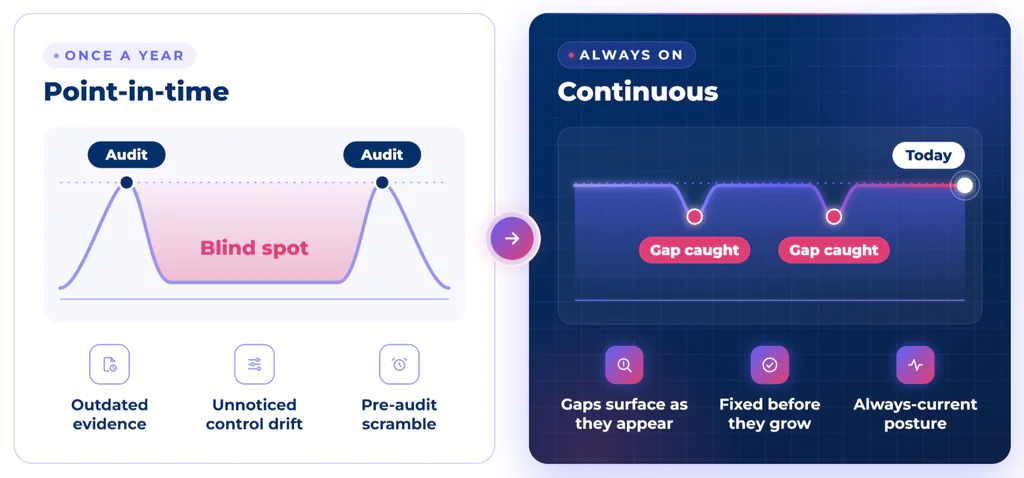
This is the difference between point-in-time and continuous compliance. Programs built around a single annual audit often face the same problems every cycle: outdated evidence, controls that have drifted without anyone noticing, and a scramble to fix gaps before the auditor arrives.
With continuous monitoring, gaps surface as they appear, so they can be addressed before they grow into bigger issues. Your compliance posture reflects where the business stands today, not where it stood at the last audit, giving customers and leadership a current view of where your compliance program stands.
The GRC program you don’t have to rebuild
Continuous compliance also means building a program that can evolve with the business. It is possible to tick every box and still build a compliance program that only works on paper. Evidence goes stale, controls drift, and a scope designed simply to pass an audit may need rebuilding when the next framework, funding round or enterprise customer arrives.
Scytale also cross-maps frameworks, so SOC 2, ISO 27001, GDPR, HIPAA and SOX ITGC run off one set of controls and evidence rather than four separate programs.
Compliance done properly gives leadership a clear view of where the business stands and keeps the GRC program useful beyond the audit.
The result is a compliance program built to scale with you.
The ROI that shows up in your pipeline
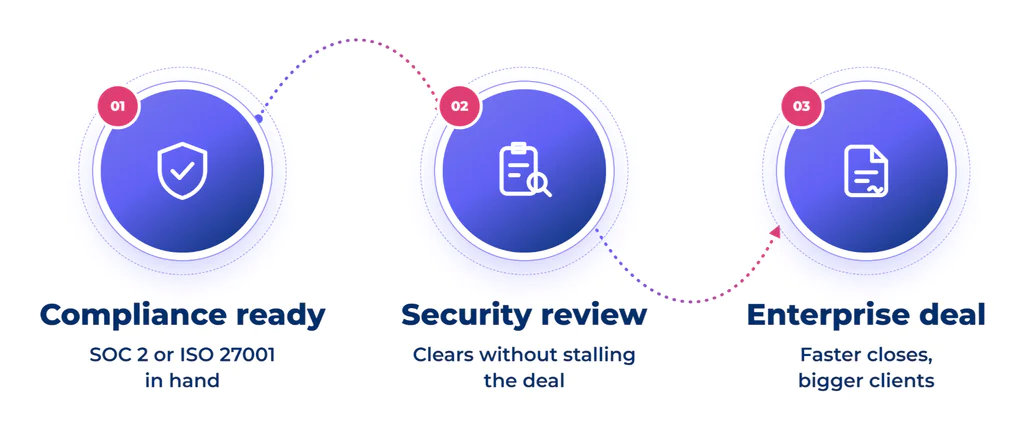
Compliance ROI goes beyond cost avoidance. For most companies selling into enterprise, no report means no security review, and no security review means no contract. That makes time-to-audit-ready a revenue variable, not just an operational one.
Byner closed deals faster and started attracting bigger clients on the back of its ISO 27001 certification. Deel used its SOC 2 report to unlock and accelerate sales without pausing the business to get it, while managing information security across employees in more than 30 countries.
If your ROI model only counts saved hours, it’s missing the revenue side.



See what Scytale gives back
Averages are easy to argue with. Your own numbers are not. Add your team and frameworks to the calculator and see what Scytale could give back in hours and budget.
Calculate your savings → scytale.ai/roi-calculator
💡 Want to dig deeper into the numbers? Read Scytale’s article on Understanding ROI Expectations for Compliance Automation Investments.
About Scytale
Scytale is the AI GRC platform where AI agents and human experts drive real compliance outcomes across 80+ security, privacy, AI and financial frameworks and 150+ integrations. Thousands of customers across 44 countries. G2 Leader in GRC, Security Compliance and Cloud Security, 2026. Frost & Sullivan 2026 Customer Value Leadership.
About Deel
Deel is a global payroll and HR platform that helps companies hire, manage, pay and equip workers around the world. Supporting businesses across 150 countries and trusted by 40,000+ companies, Deel brings payroll, HR, benefits, mobility, performance and device management together in one platform, helping teams manage the complexities of building and growing a global workforce.