








TL;DR: AI governance maturity model
- An AI governance maturity model helps organizations identify governance gaps and prioritize where stronger controls and oversight are needed.
- Most organizations use AI widely, yet few have governance structures mature enough to match that adoption.
- Maturity moves from ad hoc activity to defined ownership, monitored controls, and continuous oversight.
- A practical assessment starts with an AI inventory, policy review, risk classification, named ownership, and monitoring.
- Scytale’s AI GRC platform helps organizations assess AI governance maturity and manage AI controls through automated evidence collection and continuous monitoring.
AI adoption has moved faster than governance in many organizations. Teams are deploying copilots, embedded SaaS features, and custom models before legal, security, and compliance teams have established consistent oversight. This can create gaps in privacy, accountability, and operational control that become more difficult to manage as AI use expands.
For organizations using AI across multiple teams, governance maturity is becoming an important part of governance, risk and compliance (GRC). It helps establish clear ownership, visibility, and controls over how AI is used. In this article, we’ll explore the stages of AI governance maturity and practical steps organizations can take to progress through them.
What is an AI governance maturity model?
An AI governance maturity model is a structured framework for assessing how effectively an organization governs AI systems, risks, data, and accountability.
The model evaluates how established and consistent AI governance practices are across the organization, from informal or reactive processes to structured oversight embedded into day-to-day operations. It can cover areas such as policies, roles and responsibilities, risk management, monitoring, documentation, and decision-making.
AI governance maturity is a spectrum rather than a pass-or-fail assessment. Understanding your current level helps identify governance gaps and prioritize improvements. AI GRC platforms can support this process by centralizing controls, risks, and evidence as AI use expands across teams and systems.
Streamline GRC workflows with no blind spots.
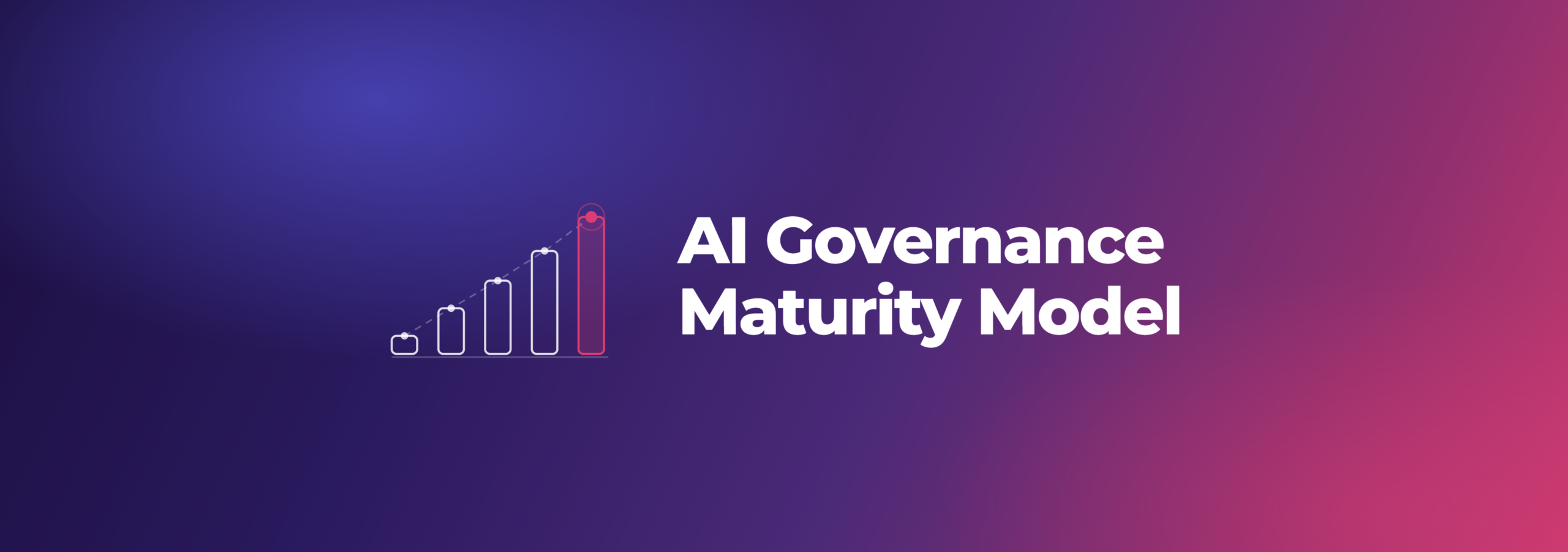
The 5 stages of AI governance maturity: From ad hoc to optimized
Organizations may appear further along in AI governance based on adoption alone, while the maturity of their controls can be harder to assess. This five-level model provides a practical scale for evaluating governance based on the processes, controls, and oversight that teams, auditors, and executives can identify. Here’s how each level breaks down:
Level 1: Ad hoc
AI use exists, but the organization lacks formal visibility, ownership, and control, with teams often using public tools, embedded SaaS features, or isolated models without shared governance rules. Common indicators include unmanaged shadow AI, no central inventory, no documented policy, and no formal review process for new use cases. Risk decisions remain reactive, and the need for AI governance often becomes clear when an incident, audit, or leadership review exposes gaps in oversight.
Level 2: Developing
Early governance structures are in place, but they do not yet cover AI use consistently across the organization. Teams begin documenting AI use cases, developing initial policies, and introducing basic approval and risk review processes. Common indicators include a partial AI inventory, draft policies, basic approval workflows, and additional review for higher-impact use cases.
Level 3: Defined
AI governance is formally documented, assigned, and applied through consistent processes across the organization. Common indicators include a documented AI inventory, risk classification, cross-functional review processes, and policies covering data handling, acceptable use, and escalation. Organizations may also begin mapping controls to ISO 42001 and NIST AI RMF to give governance activities a recognized structure.
Level 4: Managed
AI governance operates through monitored controls, defined accountability, and regular reassessment of AI systems and risks. Organizations track reviews, remediation, exceptions, model changes, and higher-risk systems while retaining evidence for internal or external review. Requirements such as EU AI Act risk categories and ISO 42001 may also become more integrated into measurable and auditable workflows.
Level 5: Optimized
AI governance is continuous, measurable, and integrated into workflows, systems, and reporting across the organization. Common indicators include automated policy enforcement, continuous monitoring and control testing, cross-framework mapping, and executive reporting tied to risk and accountability.
Stages of AI governance maturity model
| Level | Policy & ethics | Risk management | Data governance | Monitoring & accountability |
| Ad hoc | No formal AI policy or ethics guidance | Little or no risk classification | Unclear data use rules for AI | No central logging or ownership |
| Developing | Draft guidance exists for some teams | Initial risk review for select use cases | Partial review of training or input data | Basic approvals and limited tracking |
| Defined | Documented policies and review criteria | Standard risk classification and escalation | Documented data handling requirements | Named owners and review board |
| Managed | Policies enforced through workflow | Regular reassessment of higher-risk systems | Controlled data lineage and access review | Recurring monitoring, evidence, and reporting |
| Optimized | Policy enforcement is embedded and updated continuously | Continuous control testing and measurable risk trends | Integrated governance across AI and data programs | Continuous monitoring and executive accountability |
How to assess your organization’s current maturity level
A useful maturity assessment should be based on evidence rather than perception. Review what your organization can demonstrate through inventories, policies, assigned ownership, risk assessments, and monitoring records. Here are five steps you can use to assess your current AI governance maturity level:
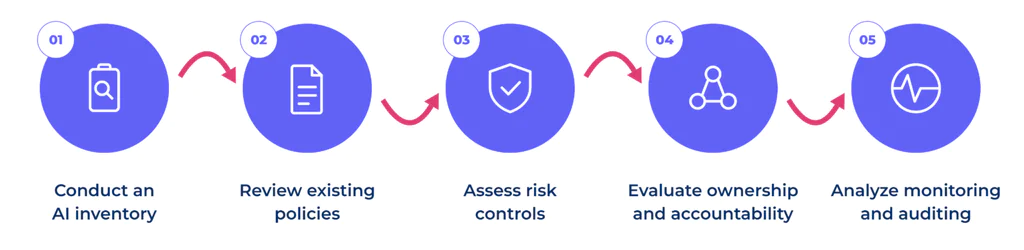
Step 1: Conduct an AI inventory
Start by cataloging the AI tools, models, and use cases currently in production or being piloted. Include AI capabilities embedded within third-party SaaS products, as these can be easily overlooked and are particularly relevant to third-party risk management (TPRM). A complete inventory provides the visibility needed to understand where AI is being used and what risks may need to be managed.
At lower maturity levels, information about AI use may be scattered across teams with no central record. At higher maturity levels, organizations maintain an up-to-date inventory that includes the business owner, purpose, data inputs, vendor details, and risk context for each system. This provides a reliable foundation for ongoing governance.
Step 2: Review existing policies
Review whether existing governance documents adequately address AI use, data handling, model risk, and employee responsibilities. Security and privacy policies may cover some of these areas but often require additional AI-specific guidance. The assessment should identify where policies are missing, unclear, or no longer aligned with how AI is actually being used.
At lower maturity levels, policies may contain limited references to AI or vary significantly between teams. At higher maturity levels, organizations have documented requirements covering approvals, prohibited uses, data restrictions, and escalation procedures. These policies should provide clear guidance for employees and AI system owners.
Step 3: Assess risk controls
Determine whether AI systems are classified according to risk and whether higher-risk use cases receive additional review and controls. The level of oversight should reflect factors such as business impact, data sensitivity, intended use, and potential harm. This approach should also align with the organization’s broader risk management strategy.
At lower maturity levels, organizations may have no formal risk classification or additional review for sensitive AI use cases. At higher maturity levels, defined risk tiers determine which reviews, controls, and approvals are required. This helps organizations apply governance requirements proportionately rather than treating every AI system the same way.
Step 4: Evaluate ownership and accountability
Identify who is responsible for AI governance decisions across legal, security, compliance, data, and business teams. Clear accountability is necessary for approving use cases, managing exceptions, addressing identified risks, and escalating important decisions. Without defined ownership, governance activities can easily become fragmented across functions.
At lower maturity levels, several teams may share responsibility without a clear decision-maker. At higher maturity levels, organizations establish named owners, governance committees, or a RACI structure that defines responsibilities and decision-making authority. This creates clearer accountability throughout the AI lifecycle.
Step 5: Analyze monitoring and auditing capabilities
Assess how your organization monitors AI systems after deployment, including model changes, performance, drift, and control effectiveness. Continuous controls monitoring (CCM) can help organizations move beyond point-in-time reviews by providing ongoing visibility into whether controls continue to operate as expected. Post-deployment monitoring is an important indicator of a more mature governance program.
At lower maturity levels, AI systems may receive an initial review with little or no structured follow-up. At higher maturity levels, organizations perform recurring monitoring, retain audit trails, reassess risks and controls, and maintain evidence for internal or external review. This allows governance processes to adapt as AI systems and their risks change.
AI-native GRC for how teams work today.
Common roadblocks that stall AI governance maturity
Organizations often remain at the earlier stages of AI governance maturity because of gaps in visibility, ownership, resources, and processes. These issues can affect even organizations with established security programs and widespread AI adoption. Here are some of the most common compliance challenges that can slow progress:
Limited visibility and shadow AI
Shadow AI is one of the biggest barriers to effective governance. Employees may adopt standalone AI tools and embedded features faster than governance teams can identify and assess them, creating gaps in inventories, policy coverage, and risk reviews. Addressing this requires ongoing visibility into how and where AI is being used across the organization.
Unclear ownership and limited resources
AI governance often involves security, legal, compliance, data, and business teams, making clear ownership essential. When responsibility is fragmented across functions, reviews can stall, risks may go unresolved, and accountability becomes unclear. Limited budget and resources can add to the challenge when AI governance depends on existing teams without dedicated capacity.
Inconsistent framework adoption
Organizations can also struggle when AI governance is based on a single regulation, framework, or internal policy without considering broader requirements. Established frameworks and AI governance platforms can help teams create a more consistent approach to controls, risk management, monitoring, and documentation.
Building a roadmap: How long does it take to move up a maturity level?
Progress often happens faster in the early stages and takes longer as organizations introduce formal ownership, risk assessments, monitoring, and evidence collection. Timelines vary depending on company size, AI use, existing governance processes, and available resources. Moving from ad hoc to developing may take a few months, while reaching defined or managed maturity can require several additional months of consistent implementation.
A phased approach can make this progress more manageable. Organizations can start with a 90-day plan focused on creating an AI inventory, establishing initial policies, assigning ownership, and prioritizing higher-risk use cases. From there, governance processes can expand as teams introduce more structured risk assessments, recurring reviews, and monitoring across AI systems.
As organizations progress to higher maturity levels, automation becomes increasingly important for maintaining governance at scale. Risk management automation and continuous monitoring can help teams manage controls, track changes, and maintain oversight without increasing manual effort at the same rate as AI use.

Simplify AI governance maturity with Scytale
Scytale’s AI GRC platform helps teams put AI governance into practice by centralizing AI systems and models, mapping controls to frameworks such as ISO 42001 and NIST AI RMF, and continuously monitoring controls and collecting evidence. This gives teams clearer visibility into AI governance gaps, ownership, and progress without relying on manual spreadsheets.
Scytale also lets teams manage AI governance alongside SOC 2, ISO 27001, GDPR, the EU AI Act, and other requirements in one platform, allowing overlapping controls and evidence to be reused instead of managed separately. With dedicated GRC expert support, teams can build and mature their AI governance program with less manual work.
FAQs about AI governance maturity model
What are the levels in an AI governance maturity model?
The levels in an AI governance maturity model are Ad hoc, Developing, Defined, Managed, and Optimized. Each level reflects stronger policy coverage, clearer ownership, better risk controls, and more consistent monitoring. The model shows whether AI governance exists only on paper or actually operates through repeatable controls.
How do I know what AI governance maturity level my organization is at?
You know your AI governance maturity level by checking evidence across inventory, policy, risk classification, ownership, and monitoring. If your team lacks a central AI inventory or named accountability, your program is still early-stage. Scytale’s AI GRC platform helps organizations centralize these governance signals and identify control gaps that need to be addressed.
What triggers the need for AI governance maturity assessment?
AI expansion across teams usually triggers the need for an AI governance maturity assessment. New copilots, embedded SaaS features, sensitive data use, and executive questions about accountability all signal that informal oversight no longer works. The assessment gives your organization a structured way to measure readiness before risk exposure grows further.
Can AI governance maturity impact vendor selection?
Yes, AI governance maturity impacts vendor selection because mature programs evaluate vendors for transparency, data handling, model oversight, and auditability. A weak governance program often buys AI tools without those checks in place. Leading AI GRC platforms like Scytale support this process by helping teams map vendor AI use to broader compliance and control requirements.
Is a maturity model required for EU AI Act compliance?
No, a maturity model isn’t explicitly required for EU AI Act compliance. It does give your organization a practical structure for building the inventory, risk review, ownership, and monitoring disciplines the Act expects around higher-risk AI systems. Many teams use maturity models to organize their compliance work before formal conformity obligations apply.
