




TL;DR: NIST 800-53 vs. NIST 800-171
- NIST 800-53 offers a broader control catalog for federal systems and organizations with complex security programs.
- NIST 800-171 focuses on protecting Controlled Unclassified Information in nonfederal systems and contractor environments.
- The biggest difference in NIST 800-171 vs 800-53 is scope, control depth, and who each publication targets.
- Organizations often use 800-53 to 800-171 mapping when they need to align customer requirements across multiple frameworks.
- Scytale’s AI GRC platform streamlines NIST-based compliance through cross-framework mapping, automated evidence collection, and continuous control monitoring.
Federal agencies, defense contractors, and security leaders often treat NIST 800-53 and NIST 800-171 as interchangeable, yet the two publications serve different purposes. Applying the wrong one typically leads to control gaps, duplicated effort, and avoidable friction during assessments and customer security reviews.
For organizations that handle federal data or support government customers, the distinction shapes how control mapping, evidence collection, and long-term compliance operations are planned. In this article, we cover the key differences between each publication, when each applies, and how to choose the right baseline for your environment.
What are NIST 800-53 and NIST 800-171?
NIST 800-53 is a comprehensive catalog of security and privacy controls for federal information systems, while NIST 800-171 is a focused set of requirements for protecting Controlled Unclassified Information (CUI) in nonfederal systems and organizations.
Both publications come from the National Institute of Standards and Technology (NIST), and they sit close together in most federal compliance conversations. NIST 800-53 is mandated for federal agencies under the Federal Information Security Modernization Act (FISMA) and underpins programs such as FedRAMP for cloud providers serving government workloads. NIST 800-171, by contrast, reaches contractors and subcontractors through contract clauses such as DFARS 252.204-7012, which requires defense suppliers to safeguard CUI.
The relationship between the two explains why many teams look for 800-53 to 800-171 mapping. NIST derived the 800-171 requirements from the moderate baseline of 800-53, removing controls that are uniquely federal or expected in any baseline security program. As a result, organizations can often reuse control logic and evidence across both publications instead of building separate programs for each obligation.
Key differences between NIST 800-53 and NIST 800-171
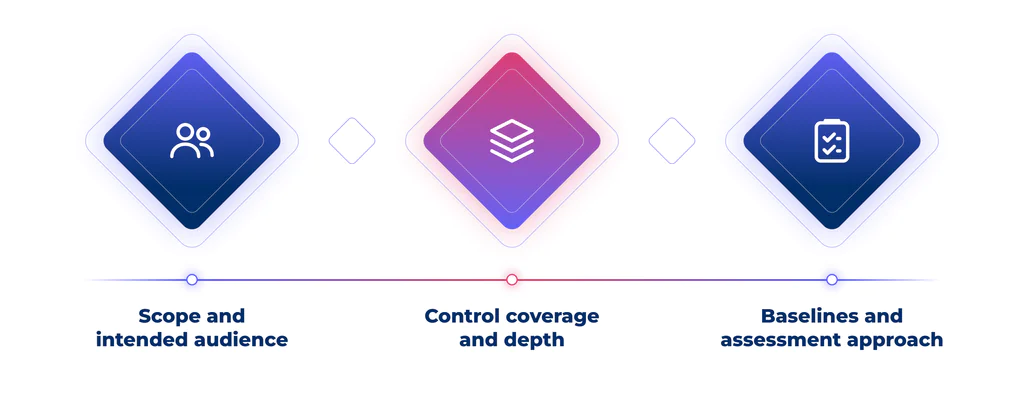
NIST 800-53 and NIST 800-171 share a common foundation, but differ in who they apply to, their scope, and how compliance is verified. Understanding these differences helps organizations strengthen their security posture and focus on the right controls. Here are the key differences that matter most when comparing NIST 800-171 vs 800-53:
Scope and intended audience
NIST 800-53 applies to federal agencies and systems, as well as contractors operating information systems on behalf of the federal government. NIST 800-171 applies to nonfederal organizations, including defense contractors, subcontractors, and service providers, that handle CUI under a federal contract. Federal agencies face FISMA oversight and reporting requirements, while contractors that fail to meet 800-171 requirements may risk contracts or face legal action.
Control coverage and depth
NIST 800-53 Revision 5 contains more than 1,000 controls and control enhancements across 20 families, covering security and privacy. NIST 800-171 Revision 2 narrows this to 110 security requirements across 14 families, while Revision 3 includes 97 requirements across 17 families. This narrower scope makes 800-171 more prescriptive and generally faster to implement, while 800-53 requires more decisions about which controls and enhancements apply.
Baselines and assessment approach
NIST 800-53 uses low, moderate, and high impact baselines based on the potential impact of a security breach, while NIST 800-171 has no tiered baselines and applies the same requirements to covered contractors. There is no official NIST certification for either publication, with 800-53 compliance typically demonstrated through self-assessment, independent assessment, or formal authorization. For defense contractors, 800-171 compliance is increasingly verified through CMMC, which builds on its requirements and adds third-party assessments for many organizations handling CUI.
Streamline GRC workflows with seamless automation.

Understanding the structure of NIST 800-53 and NIST 800-171
NIST 800-53 is designed for greater depth and tailoring, while NIST 800-171 provides a more focused set of requirements for contractor environments. Here’s how each is structured and how they compare with other common frameworks:
How NIST 800-53 is organized
NIST 800-53 organizes its controls into 20 families, including Access Control, Incident Response, and Supply Chain Risk Management. Controls include a base requirement, optional enhancements, and guidance, while NIST 800-53B assigns controls to low, moderate, high, and privacy baselines. Teams using the NIST 800-53 controls list must decide which controls apply, including those inherited from cloud providers. Organizations can review the key considerations for NIST 800-53 control family selection when choosing a baseline.
How NIST 800-171 is organized
NIST 800-171 uses a more focused structure based on the security families in 800-53. Revision 2 includes 110 requirements across 14 control families, while Revision 3 expands the structure to 17 families by adding Planning, System and Services Acquisition, and Supply Chain Risk Management. Because some defense contracts and CMMC Level 2 assessments still reference Revision 2, contractors should confirm which revision applies before planning remediation.
How NIST 800-53 compares with NIST CSF and ISO 27001
NIST 800-53 provides detailed security and privacy controls, while broader frameworks focus more on overall program structure. In a NIST 800-53 vs NIST CSF comparison, the NIST Cybersecurity Framework (CSF) defines high-level cybersecurity outcomes, while 800-53 provides detailed controls for achieving them. Similarly, ISO 27001 defines a certifiable information security management system (ISMS) focused on governance and continual improvement, while NIST 800-53 provides more detailed control guidance.
Framework comparison
| Framework | Primary purpose | Structure | Typical users | Best fit |
|---|---|---|---|---|
| NIST 800-53 | Security and privacy control catalog for broad system risk management | 20 control families, impact baselines, and control enhancements | Federal agencies, FedRAMP cloud providers, mature security programs | Organizations needing detailed control tailoring and broad coverage |
| NIST 800-171 | Protect CUI in nonfederal systems and organizations | 110 requirements in 14 families (Rev. 2); 97 requirements in 17 families (Rev. 3) | Defense contractors, subcontractors, and service providers handling CUI | Organizations meeting contractual CUI protection requirements |
| NIST CSF | Cybersecurity program framework for risk management | Functions, categories, and outcomes | Private and public sector organizations across industries | Teams building governance and maturity programs |
| ISO 27001 | ISMS standard for governance, risk, and certification | Clauses, Annex A controls, and management system requirements | Global organizations seeking certifiable security governance | Teams needing an auditable management system |
Always-on GRC. Built for modern teams.
Applications of NIST 800-53: When and why it’s used
Organizations typically turn to NIST 800-53 when they need a deep, flexible control catalog rather than a fixed contractual checklist. Federal agencies use it to meet FISMA obligations, while cloud service providers pursuing FedRAMP authorization rely on its baselines to support government workloads.
It also supports enterprises with mature security programs that need a detailed baseline for cross-framework mapping and broader governance. Teams comparing SOC 2 and NIST can use its granular security and privacy controls to reduce duplicate work across frameworks and manage complex environments spanning identity, infrastructure, vendor risk, and privacy.
Applications of NIST 800-171: When and why it’s used
NIST 800-171 matters most when a contract requires the protection of CUI outside federal systems. Defense contractors, subcontractors, and service providers across the Defense Industrial Base use it to demonstrate that they safeguard CUI in nonfederal environments.
Its narrower scope helps teams focus on the requirements customers and contracting officers expect without adopting the full complexity of 800-53. Contractors typically document implementation in a System Security Plan (SSP) and track gaps in a Plan of Action and Milestones (POA&M), while guidance such as the latest NIST password guidelines can help teams put specific security requirements into practice and prepare for CMMC assessments.
AI-native GRC for how teams work today.
How to choose between NIST 800-53 and NIST 800-171
Choosing the right baseline depends less on framework preference and more on contractual obligations, data types, and operating model. Many organizations ultimately implement elements of both, so the real decision is which publication leads and which one is mapped to it. Here are the factors that should guide the decision:
Start with your data and contract obligations
If your organization handles CUI under a federal contract, 800-171 usually sets the minimum baseline, and DFARS clauses or CMMC requirements define how compliance is verified. Organizations that operate federal information systems or pursue FedRAMP authorization will typically need to implement 800-53.
Match the framework to your operating model
Organizations with mature governance, multiple business units, and cross-framework reporting needs often gain more value from the depth and tailoring options of 800-53. Smaller contractor environments generally benefit from the directness of 800-171, which allows teams to reach compliance with fewer design decisions.
Plan for evidence burden and framework overlap
Assess customer expectations, assessment depth, and evidence requirements before committing to a baseline. If your team expects future overlap with SOC 2, ISO 27001, or NIST CSF, a mapped control strategy reduces duplicate work and keeps the compliance program easier to maintain as obligations grow.
In practice, a mapped approach turns work on one framework into coverage for another. For example, Sport Alliance uses Scytale’s multi-framework cross-mapping to extend its ISO 27001 work into GDPR coverage.
Use tooling that supports a mapped approach
Manual mapping between 800-53, 800-171, and other frameworks becomes difficult to maintain as controls, systems, and contracts change. The right tooling can reduce duplicate work and make it easier to keep controls and evidence aligned across frameworks.
Simplify NIST compliance with Scytale
Scytale‘s AI GRC platform simplifies NIST compliance by mapping controls across NIST 800-53, NIST 800-171, and related frameworks, so a single control and its evidence can satisfy multiple requirements. Automated evidence collection from integrated systems, continuous control monitoring, and AI agents that identify gaps help teams maintain audit readiness without rebuilding their program for each new obligation.
Beyond NIST, Scytale supports multi-framework compliance across SOC 2, ISO 27001, CMMC, GDPR, and SOX ITGC, along with a customizable Trust Center for sharing security posture with customers. Combined with dedicated GRC experts who guide scoping, remediation, and assessment preparation, Scytale helps organizations build a scalable compliance program that keeps pace with federal and commercial requirements.
FAQs about NIST 800-53 vs. NIST 800-171
What is the main difference between NIST 800-53 and NIST 800-171?
The main difference is scope and intended use. NIST 800-53 provides a broad control catalog for federal systems and mature security programs, while NIST 800-171 focuses on protecting Controlled Unclassified Information in nonfederal environments, especially among contractors and suppliers.
Is NIST 800-171 derived from NIST 800-53?
Yes, NIST 800-171 draws many of its requirements from NIST 800-53. The relationship helps organizations perform 800-53 to 800-171 mapping, reuse control logic, and reduce duplicate evidence work when customer requirements or internal programs overlap.
When does NIST 800-53 make sense for an organization?
NIST 800-53 makes sense when an organization needs broad, detailed control coverage, as is common for federal agencies, FedRAMP cloud providers, and enterprises with mature security governance. Scytale’s AI GRC platform helps these teams centralize evidence, control ownership, and cross-framework reporting.
When should an organization prioritize NIST 800-171?
An organization should prioritize NIST 800-171 when it processes, stores, or transmits CUI under a federal contract. Defense contractors, subcontractors, and service providers adopt it to meet DFARS obligations and prepare for CMMC assessments. Leading AI GRC platforms like Scytale help contractors track requirements, collect evidence, and stay assessment-ready.
How does NIST 800-53 compare with NIST CSF?
NIST 800-53 is a detailed control catalog, while NIST CSF provides a higher-level cybersecurity framework for organizing risk management activities. Many organizations use both together, with NIST CSF guiding program structure and 800-53 supplying the underlying control detail.
How does ISO 27001 compare with NIST 800-53?
ISO 27001 focuses on building and auditing an information security management system, while NIST 800-53 provides a deeper control catalog. Organizations with certification goals often start with ISO 27001, while teams needing detailed control tailoring often rely on 800-53.