


TL;DR: Manual vs automated ISO 27001 compliance
- Manual ISO 27001 compliance relies on spreadsheets, emails, and paperwork to manage ISO 27001 compliance.
- Automated ISO 27001 compliance uses compliance automation software to streamline evidence collection, control monitoring, risk tracking, and ISO 27001 audit reporting.
- Manual processes slow down ISO 27001 certification, increase audit errors, and create rework across teams.
- Automation centralizes ISO 27001 documentation, improves control visibility, supports IT governance, and accelerates ISO 27001 audit and certification timelines.
- Leading AI-driven platforms like Scytale help organizations automate ISO 27001 compliance end to end, from audit preparation to continuous compliance monitoring.
ISO 27001 is a globally recognized framework that measures how an organization’s information security management system (ISMS) secures sensitive data and maintains strong security standards. Whether you’re a fast-growing SaaS startup or an established enterprise, obtaining ISO 27001 certification is vital for building customer trust and protecting data.
The journey to achieving and maintaining ISO 27001 compliance typically follows two paths: manual or automated. Let’s explore the differences between these approaches and how automation can streamline the ISO 27001 certification process while supporting continuous compliance.
Manual vs automated ISO 27001 compliance: What’s the difference?
An effective ISO 27001 strategy starts with one decision: do manual workflows or automated processes better align with your operations, risk profile, and long-term compliance goals?
Manual compliance approaches often rely on spreadsheets, fragmented documentation, and ad-hoc evidence tracking. While these methods remain common, they require significant time and resources and increase the risk of errors, inconsistencies, and audit findings.
In contrast, automated ISO 27001 compliance uses specialized ISO 27001 software to manage critical tasks such as evidence collection, control monitoring, risk assessments, user access reviews, vendor risk management, and reporting. Automation streamlines these processes, improves accuracy, and supports faster, more reliable progress toward ISO 27001 certification.
The traditional route: Manual ISO 27001 compliance explained
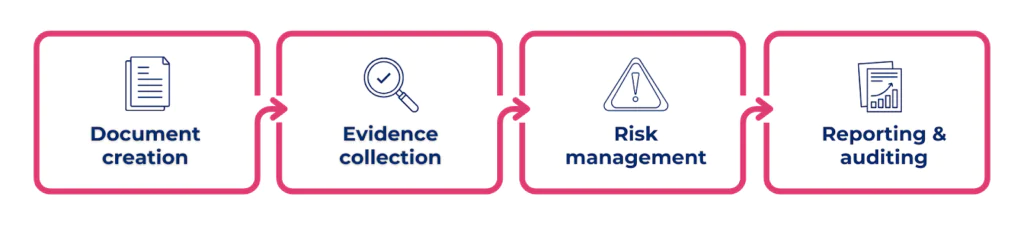
The manual approach to ISO 27001 compliance can be cumbersome and labor-intensive. Here’s a breakdown of what this entails:
- Document creation: A significant amount of compliance documentation is required, from risk assessments to policies and procedures, often stored in spreadsheets and physical files.
- Evidence collection: Manually collecting logs, reports, and other documents from various departments can be time-consuming and prone to mistakes.
- Risk management: Reviewing each asset and system manually for risks requires substantial effort and can lead to errors.
- Reporting and auditing: Manual recordkeeping for audits is inefficient and error-prone, slowing certification efforts and increasing the risk of gaps during certification or recertification reviews.
While these tasks are essential for ISO 27001 compliance, they come with high resource demands, inefficiencies, and potential errors.
The modern approach: Automating ISO 27001 compliance
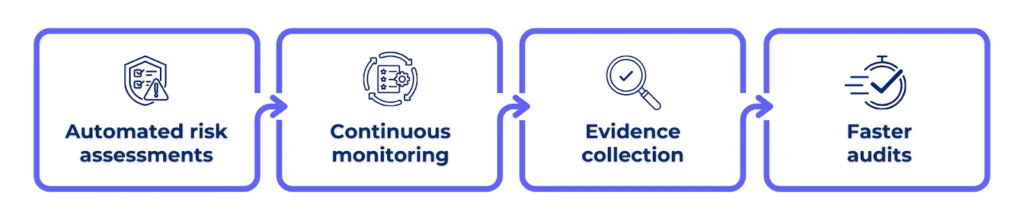
With ISO 27001 certification automation, organizations reduce the burden of manual compliance and gain a clearer understanding of what ISO 27001 is and how to apply it in practice. Here’s how automation improves the process:
- Simplified risk assessments: Software tools support teams in assessing, identifying, prioritizing, remediating, and mitigating risk across the organization.
- Continuous monitoring: Real-time updates on your compliance status make it easier to identify and address issues before they turn into full-blown compliance gaps.
- Evidence collection: Automated tools continuously gather and organize evidence across systems, creating a reliable record of controls and activities.
- Faster audit preparation: Automation gives teams instant visibility into compliance status and documentation coverage, reducing preparation cycles before certification reviews.
By embracing ISO 27001 automation, your organization can streamline the compliance process, reduce manual tasks, and improve both efficiency and accuracy.
Get ISO 27001 Compliant 90% Faster
Manual vs automated ISO 27001: A side-by-side comparison
| Factor | Manual Compliance | Automated Compliance |
| Time Investment | Time-consuming; requires manual effort | Faster; streamlines repetitive tasks |
| Documentation | Relies on spreadsheets and paper | Automatically generates and stores documents |
| Risk assessments | Manual tracking and assessments | Simplifies risk identification and management |
| Evidence collection | Manual tracking and collection | Automatically collects and organizes evidence |
| Accuracy | Prone to human error | Reduces errors through automation |
| Audit preparation | Can be disorganized and chaotic | Prepares audit-ready compliance documentation in real-time |
| Compliance visibility | Limited real-time tracking | Continuous monitoring and real-time updates |
| Cost | Requires more staff time and resources | Requires upfront software investment, but reduces long-term costs |
Which ISO 27001 compliance approach is best for your organization?
The right approach depends on your size, resources, and how quickly you need to achieve ISO 27001 compliance. Small teams with simple systems may begin with manual processes when budgets are limited. As organizations grow, controls, integrations, partners, and compliance requirements expand as well. Managing compliance manually becomes slow, stressful, and difficult to sustain.
Many mid-market and enterprise SaaS companies moving upmarket or managing multiple frameworks adopt automation to run their GRC programs more efficiently. Automation keeps evidence organized, surfaces gaps earlier, and gives leadership clear visibility into compliance status. Instead of scrambling before an audit, teams maintain continuous compliance as part of daily operations, making it easier to scale and give customers clear assurance in your security posture.


Automate ISO 27001 compliance with Scytale’s AI-powered compliance platform
Scytale’s AI-powered compliance automation platform replaces time-consuming manual tracking with a single hub that manages critical ISO 27001 compliance processes such as evidence collection, continuous monitoring, risk assessments, and audit preparation.
With Scy, our AI GRC agent, plus hands-on guidance from experienced GRC experts, ISO 27001 becomes part of your daily operations instead of a last-minute scramble. Your team stays audit-ready, reduces workload, and focuses on product growth while Scytale keeps your compliance program on track.
FAQs about manual vs automated ISO 27001
What is the difference between manual and automated ISO 27001 compliance?
Manual ISO 27001 compliance relies on teams to perform tasks such as risk assessments and evidence collection themselves, which takes time and increases the risk of inconsistencies. Automated compliance uses software to streamline these activities, improve accuracy, and support faster progress toward certification and ongoing compliance. It also enables real-time monitoring for continuous compliance, especially when using a leading AI-powered compliance automation platform like Scytale.
Is automation necessary for ISO 27001 compliance?
Automation is not required by the standard, but for most growing organizations it is no longer optional. Manual processes increase the risk of errors, delays, and missed controls as environments become more complex. Automation keeps evidence organized, provides ongoing visibility into compliance status, and supports a scalable program that can meet audit deadlines with confidence.
How does automated ISO 27001 compliance save time?
ISO 27001 automation tools accelerate critical ISO 27001 compliance processes such as evidence collection, user access reviews, vendor risk management, and multi-framework cross-mapping. Tasks that once required days of coordination across teams happen in hours, reducing back-and-forth, avoiding last-minute audit prep, and freeing your team to focus on high-priority activities.
Is manual ISO 27001 compliance still a good option?
Manual ISO 27001 compliance might still be feasible for very small businesses, but as your organization scales, it becomes increasingly difficult to manage. For startups looking to scale, automation helps fast-track ISO 27001 compliance while setting up a secure, long-term foundation.
What are the main benefits of automating ISO 27001 compliance?
The main benefits of automating ISO 27001 compliance include faster implementation, continuous monitoring, improved accuracy, greater efficiency, and lower long-term costs. The best ISO 27001 compliance software, such as Scytale’s AI-powered compliance automation platform, also streamline evidence collection and reporting, making audit preparation more predictable and less resource-intensive.
