








TL;DR: ISO 27001 report
- An ISO 27001 report documents the results of an internal audit and shows how well an organization’s ISMS meets the standard.
- Clause 9.2 requires this documented evidence, which is separate from the certificate issued after an external audit.
- Core sections include the scope, executive summary, audit findings, non-conformities, and recommendations.
- Findings are typically classified as major non-conformities, minor non-conformities, or opportunities for improvement.
- Scytale’s AI GRC platform streamlines ISO 27001 internal audits through automated evidence collection, continuous monitoring, and centralized audit management.
An ISO 27001 report plays an important role in assessing an organization’s information security practices and maintaining compliance with the ISO 27001 standard. As part of the internal audit process, it documents key findings, identifies nonconformities, and evaluates the effectiveness of an organization’s Information Security Management System (ISMS). Beyond supporting certification, the report helps organizations identify security gaps, strengthen controls, and maintain ongoing audit readiness.
Understanding how to prepare and interpret an ISO 27001 internal audit report is essential for organizations working toward certification or maintaining compliance. In this article, we explain what an ISO 27001 report is, what it should include, how to prepare for it, and why it matters for maintaining a strong information security posture.
Understanding ISO 27001
ISO 27001 is an internationally recognized standard for information security management. Widely regarded as a leading benchmark for information security, ISO 27001 certification demonstrates an organization’s commitment to implementing and maintaining effective security controls and best practices. It provides independent assurance that an organization has established an ISMS designed to protect three core principles of information security: confidentiality, integrity, and availability.
As cybersecurity threats continue to evolve, strong information security practices have become a business necessity rather than an added advantage. Customers, partners, and stakeholders increasingly expect organizations to demonstrate that their sensitive information is adequately protected. ISO 27001 certification provides credible, independent verification of an organization’s security practices, helping build trust, meet customer expectations, and satisfy contractual requirements.
However, achieving and maintaining ISO 27001 compliance can be complex, particularly for organizations unfamiliar with the certification process. Understanding the key requirements and documentation involved is an important first step. In this article, we focus on the ISO 27001 report, its purpose, and why it matters for organizations pursuing certification.
Streamline GRC workflows with seamless automation.
What is an ISO 27001 report?
An ISO 27001 report, often called an internal audit report, is a formal document that records the scope, findings, non-conformities, and recommendations from an internal audit of an organization’s information security management system against the ISO 27001 standard.
An ISO 27001 report and ISO 27001 certification are closely related but serve different purposes. An ISO 27001 report provides a detailed assessment of an organization’s information security practices and compliance with the ISO 27001 standard. It typically outlines the effectiveness of the organization’s Information Security Management System (ISMS), identifies potential gaps, and documents findings relevant to the certification process.
ISO 27001 certification, on the other hand, is the formal recognition issued by an accredited certification body confirming that an organization’s ISMS meets the requirements of the ISO 27001 standard. While an ISO 27001 audit report documents the assessment findings and supports the certification decision, the certification itself provides independent verification that the organization has met the standard’s requirements.
The ISO 27001 report: What’s inside and why it matters
An ISO 27001 internal audit report is an essential part of the internal audit process, documenting the findings and results of an organization’s assessment against ISO 27001 requirements. It helps evaluate whether the necessary policies, procedures, processes, and security controls have been implemented and whether the ISMS is operating effectively.
While the report is a key component of the internal audit process, it is not the audit itself. Instead, it provides documented evidence of the audit findings, including any identified nonconformities and areas for improvement. Clause 9.2 of ISO 27001 requires organizations to retain documented information as evidence of the implementation of the audit program and its results.
What’s inside your ISO 27001 report?
An ISO 27001 internal audit report provides a structured overview of the audit findings, identified nonconformities, and recommended corrective actions. While the format and level of detail may vary depending on the organization’s ISMS, a comprehensive report should include the following key sections:
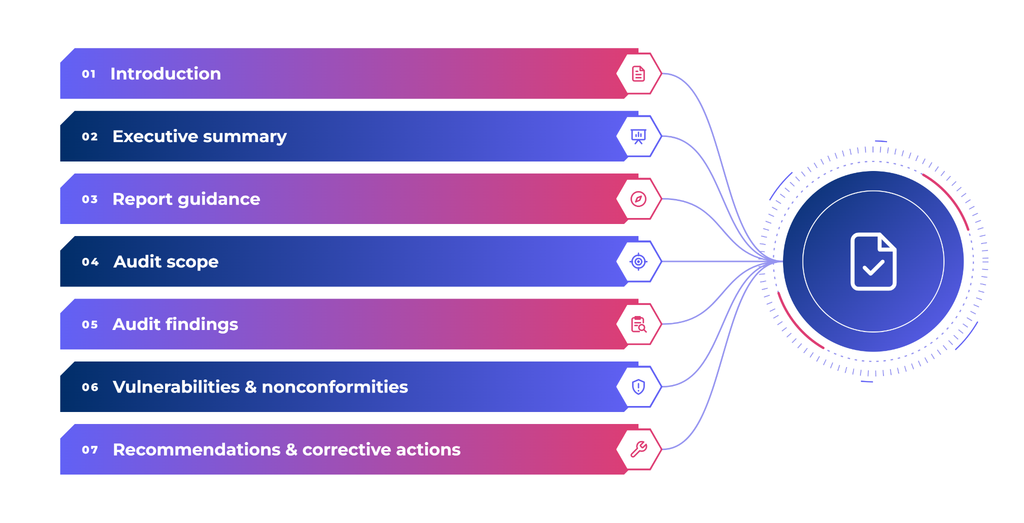
1. Introduction
The introduction provides a high-level overview of the internal audit, outlining its objectives, scope, and assessment criteria. It should identify the business processes, locations, and relevant ISO 27001 requirements covered by the audit.
This section should also summarize the audit timeline, methods used, and participants involved. Audit methods may include documentation reviews, interviews, sampling, and control testing. The goal is to provide stakeholders with a clear understanding of the audit’s purpose and approach.
2. Executive summary
The executive summary highlights the key audit findings and overall assessment of the ISMS. It should summarize the organization’s conformity with ISO 27001 requirements, identify significant nonconformities, and highlight areas requiring improvement. This section provides management and relevant stakeholders with a concise overview of the organization’s information security performance and readiness for external certification.
3. Report guidance
Although not mandatory, including guidance on how to interpret and use the report can help ensure its findings are understood and handled appropriately. This section may specify the intended audience, confidentiality requirements, distribution restrictions, and any limitations associated with the audit findings.
4. Audit scope
The audit scope provides a more detailed breakdown of the areas assessed, expanding on the information presented in the introduction. It should clearly document the boundaries of the audit and the criteria used to evaluate conformity.
Key details typically include:
- Areas assessed: Business processes, departments, locations, systems, and personnel included in the audit.
- Auditor information: Names and roles of the individuals responsible for conducting the audit.
- Audit details: Dates, locations, assessment criteria, and applicable ISO 27001 requirements.
Clearly defining the audit scope helps demonstrate that the assessment was conducted systematically and covered the intended areas of the ISMS.
5. Audit findings
The audit findings section documents the results of the internal audit, supported by objective evidence. It should provide a detailed assessment of the relevant ISO 27001 requirements and security controls, identifying whether they have been appropriately implemented and are operating effectively.
Each finding should clearly reference the applicable audit criteria, supporting evidence, and assessment outcome. This documentation helps organizations understand their current compliance status and identify areas requiring further attention.
6. Vulnerabilities and nonconformities
This section identifies security weaknesses, control deficiencies, and instances where the ISMS does not meet ISO 27001 requirements or the organization’s own information security policies. Findings should be clearly documented and, where applicable, classified according to their severity.
This may include major and minor nonconformities, as well as observations and opportunities for improvement. The report should also explain the potential impact of these findings on the organization’s information security posture, helping teams prioritize corrective actions and reduce compliance risks.
7. Recommendations and corrective actions
The final section outlines the auditor’s recommendations for addressing identified nonconformities and strengthening the ISMS.
Recommendations should provide actionable guidance on corrective measures, including areas requiring remediation, suggested improvements, and priorities for follow-up. Organizations can use these findings to develop corrective action plans, assign responsibilities, and track remediation progress.
ISO 27001 report sections at a glance
| Report section | What it covers | Why it matters |
| Introduction | Audit objectives, scope, criteria, timeline, methods, and participants | Provides context for understanding the audit |
| Executive summary | Key findings, nonconformities, and overall ISMS assessment | Gives stakeholders a clear overview of audit results |
| Report guidance | Intended audience, confidentiality, distribution, and interpretation | Supports appropriate handling of audit findings |
| Audit scope | Assessed processes, locations, personnel, auditors, dates, and criteria | Defines the boundaries of the assessment |
| Audit findings | Evidence-based assessments of ISO 27001 requirements and controls | Demonstrates conformity and identifies areas for improvement |
| Vulnerabilities and nonconformities | Security weaknesses, major and minor nonconformities, and potential impact | Helps prioritize risks and corrective actions |
| Recommendations and corrective actions | Auditor recommendations, remediation priorities, and follow-up actions | Supports continuous improvement and audit readiness |



The ISO 27001 report: An in-depth analysis
Preparing for an ISO 27001 internal audit report requires a structured approach to documentation, evidence collection, audit findings, and corrective actions. Understanding each stage helps organizations identify compliance gaps, reduce administrative work, and strengthen their readiness for ISO 27001 certification. Here are four key steps to prepare for your ISO 27001 internal audit report.
Step 1: Review your documentation
Accurate and comprehensive documentation is essential for demonstrating ISO 27001 compliance. Before the internal audit, organizations should review their ISMS documentation to ensure it is complete, up to date, and aligned with the standard’s requirements. Key documents include the ISMS scope statement, information security policies, procedures, risk assessments, and Statement of Applicability (SoA).
Organizations should also maintain a clear record of individuals responsible for implementing and managing the ISMS, including their roles and contact details. Having this information readily available helps auditors access relevant documentation, reduces administrative delays, and enables control owners to respond efficiently to audit queries.
Step 2: Sampling and interviews
Evidence collection is a critical part of the ISO 27001 internal audit process. Auditors use sampling, interviews, and documentation reviews to assess whether security controls have been appropriately implemented and are operating effectively. This typically involves reviewing security policies, procedural documents, previous audit reports, performance metrics, and other supporting records.
AI-powered compliance platforms can simplify this process by centralizing documentation, automating evidence collection, and reducing manual work.
For example, 21 Analytics, a Swiss RegTech startup, reduced ISO 27001 evidence delivery for major customer RFPs from weeks to days by centralizing its policies, documentation, and compliance evidence in Scytale.
Step 3: Analyzing the findings
Once the assessment is complete, the internal auditor evaluates the collected evidence to determine whether the ISMS meets ISO 27001 requirements and identifies areas requiring improvement. While the auditor documents and evaluates the findings, organizations are responsible for reviewing the results and addressing identified issues. Audit findings generally fall into three categories:
- Major nonconformity: A significant failure to meet ISO 27001 requirements that raises concerns about the ISMS’s ability to achieve its intended outcomes. Multiple related minor nonconformities may also indicate a systemic issue.
- Minor nonconformity: An isolated or limited failure to meet a specific requirement that does not generally indicate a systemic breakdown of the ISMS but still requires corrective action.
- Opportunity for improvement: A recommendation to strengthen the effectiveness or efficiency of the ISMS without necessarily indicating noncompliance.
In addition to identifying nonconformities, the audit may highlight positive observations and effective security practices. Reviewing these findings helps organizations understand their current compliance status, prioritize improvements, and strengthen their overall information security management.
Step 4: The ISO 27001 report
The final step involves reviewing the completed ISO 27001 internal audit report and taking appropriate action based on its findings. Relevant stakeholders, including management, compliance teams, and control owners, should understand the results and their responsibilities for addressing identified nonconformities.
Organizations should develop corrective action plans, assign responsibilities, establish remediation timelines, and verify that corrective measures have been implemented effectively. Addressing audit findings systematically helps strengthen the ISMS, support continuous improvement, and maintain readiness for ISO 27001 certification and surveillance audits.
Why do we need an ISO 27001 report?
An ISO 27001 report is essential for demonstrating compliance with the standard’s internal audit requirements and evaluating the effectiveness of an organization’s Information Security Management System (ISMS). Beyond documenting audit findings, the report provides valuable insights into the organization’s security posture, helping assess whether existing controls are properly implemented and operating effectively before the external certification audit.
The report also helps organizations identify security vulnerabilities, compliance gaps, and areas for improvement. By documenting nonconformities and supporting corrective actions, it enables teams to address weaknesses, track remediation progress, and strengthen their overall information security practices. This supports continuous improvement, ongoing ISO 27001 compliance, and long-term audit readiness. Internal audit reports also carry forward into each ISO 27001 surveillance audit, where the certification body reviews whether previous non-conformities were closed and the ISMS continues to operate as intended.
Here are the key benefits at a glance:
- Avoid security breaches
- Meet demanding customer requirements
- Expand into new markets and win more deals
- Stand out in a competitive market
- Provide higher levels of customer trust
- Manage third-party vulnerabilities
- Ensure strong security systems and practices
The key challenge is managing ISO 27001 compliance efficiently without disrupting daily operations or placing unnecessary demands on internal resources. A centralized compliance platform can help streamline audit preparation, evidence collection, and ongoing compliance management.
Always-on GRC. Built for modern teams.
Streamline ISO 27001 compliance with Scytale
Scytale‘s AI GRC platform simplifies ISO 27001 internal audits by automating evidence collection, continuously monitoring controls, and centralizing policies, documentation, and audit findings in one place. Teams can track non-conformities through remediation, keep internal audit reports current, and enter each certification or surveillance audit with a clear view of their ISMS.
Scytale also supports multi-framework compliance, mapping ISO 27001 controls across frameworks such as SOC 2, GDPR, HIPAA, PCI DSS, and SOX ITGC to eliminate duplicate work. Combined with a customizable Trust Center and dedicated GRC experts, Scytale helps organizations achieve and maintain ISO 27001 certification with less manual effort and greater confidence.
FAQs about ISO 27001 reports
Is an ISO 27001 report the same as a certificate?
No. An ISO 27001 report documents the findings of an internal audit, including non-conformities and recommendations, and is primarily used within the organization. The certificate is issued by an accredited certification body after a successful external audit and serves as formal proof that the ISMS conforms to the standard.
Is an internal audit report mandatory for ISO 27001 certification?
Yes. Clause 9.2 requires organizations to conduct internal audits at planned intervals and retain documented information as evidence of the audit program and its results. Certification auditors typically review this evidence during the Stage 1 and Stage 2 audits, so a missing or incomplete report can delay certification.
What are the mandatory requirements for an ISO 27001 internal audit report?
ISO 27001 does not prescribe a fixed template, but the report must provide evidence of the audit program and its results. In practice, this means documenting the audit scope and criteria, the auditors involved, the audit dates, the findings for each audited area, and any non-conformities with supporting evidence. Results must also be reported to relevant management so corrective actions can be assigned and tracked.
How often should an organization conduct an ISO 27001 internal audit?
ISO 27001 requires internal audits at planned intervals rather than at a fixed frequency. Most organizations conduct a full internal audit at least once a year, aligned with their surveillance audit cycle, with additional audits after significant changes to scope, systems, or risks. AI GRC platforms like Scytale support continuous control monitoring between audits, so gaps surface before the next audit begins.
What evidence is required for an ISO 27001 internal audit?
Internal auditors typically review documented information such as the ISMS scope, Statement of Applicability, risk assessment and treatment plan, policies, and procedures. They also examine records showing that controls operate in practice, including access reviews, training logs, incident records, change tickets, and system configurations, supported by staff interviews. Scytale’s AI GRC platform automates the collection of much of this evidence through integrations, keeping it centralized and audit-ready.
