




October 9, 2026
PHI vs PII: Key Differences Explained
Learn the key differences in PHI vs PII, the frameworks that govern each, and practical steps to protect both data types.

Administrative safeguards are the policies, procedures, and management actions that protect sensitive health information by governing how an organization’s workforce accesses, uses, and secures it. Under the HIPAA Security Rule, administrative safeguards make up more than half of all required security standards, making them a core component of any HIPAA compliance program. For B2B software companies that handle protected health information (PHI) on behalf of customers, understanding these requirements is essential for building and maintaining trust with HIPAA-regulated customers.
The HIPAA Security Rule defines administrative safeguards as the administrative actions, policies, and procedures used to manage the selection, development, and maintenance of security measures that protect electronic protected health information (ePHI). In simpler terms, administrative safeguards are the policies and operational processes that reduce risk to ePHI rather than technical controls.
Examples of administrative safeguards include appointing a dedicated security officer to oversee your risk management program and requiring annual security awareness training for every employee. These controls work alongside technical and physical safeguards to create a comprehensive HIPAA security program.
HIPAA administrative safeguards matter because most data breaches trace back to human error, not a technical flaw. A missing termination procedure, an undocumented security risk assessment, or unclear access approval workflows can expose PHI just as easily as an unpatched server. Regulators expect covered entities and their business associates, including SaaS vendors, to demonstrate that people and processes are as tightly controlled as the technology controls.
Enterprise healthcare buyers now ask vendors for proof of these controls before signing a contract. A well-documented administrative safeguards program shortens security review cycles, reduces friction in vendor due diligence, and signals to prospects that PHI is handled responsibly at every level of the organization, not just within the engineering team.
The HIPAA Security Rule organizes administrative safeguards into nine standards that help organizations manage security risks and maintain HIPAA compliance. The table below outlines the nine HIPAA administrative safeguard standards and their key requirements.
| Standard | What it requires |
|---|---|
| Security management process | Risk analysis, risk management, sanction policy, and activity review |
| Assigned security responsibility | Designating a HIPAA security officer |
| Workforce security | Authorization, clearance, and termination procedures |
| Information access management | Role-based access approval and access reviews |
| Security awareness and training | Ongoing employee training and phishing awareness |
| Security incident procedures | Documented response and reporting workflows |
| Contingency plan | Data backup, disaster recovery, and emergency mode operations |
| Evaluation | Periodic technical and non-technical compliance reviews |
| Business associate contracts | Signed agreements holding vendors to the same standards |
Some implementation specifications are required, meaning every organization must implement them. Others are addressable, allowing organizations to adopt an alternative approach if it provides an equivalent level of protection. Maintaining documented policies and procedures across these standards helps demonstrate compliance, supports risk management, and provides auditors with a clear record of how your organization protects ePHI.
HIPAA safeguards are divided into three categories that work together to protect electronic protected health information (ePHI). Each category addresses a different aspect of security, from organizational policies to technical controls and physical safeguards.
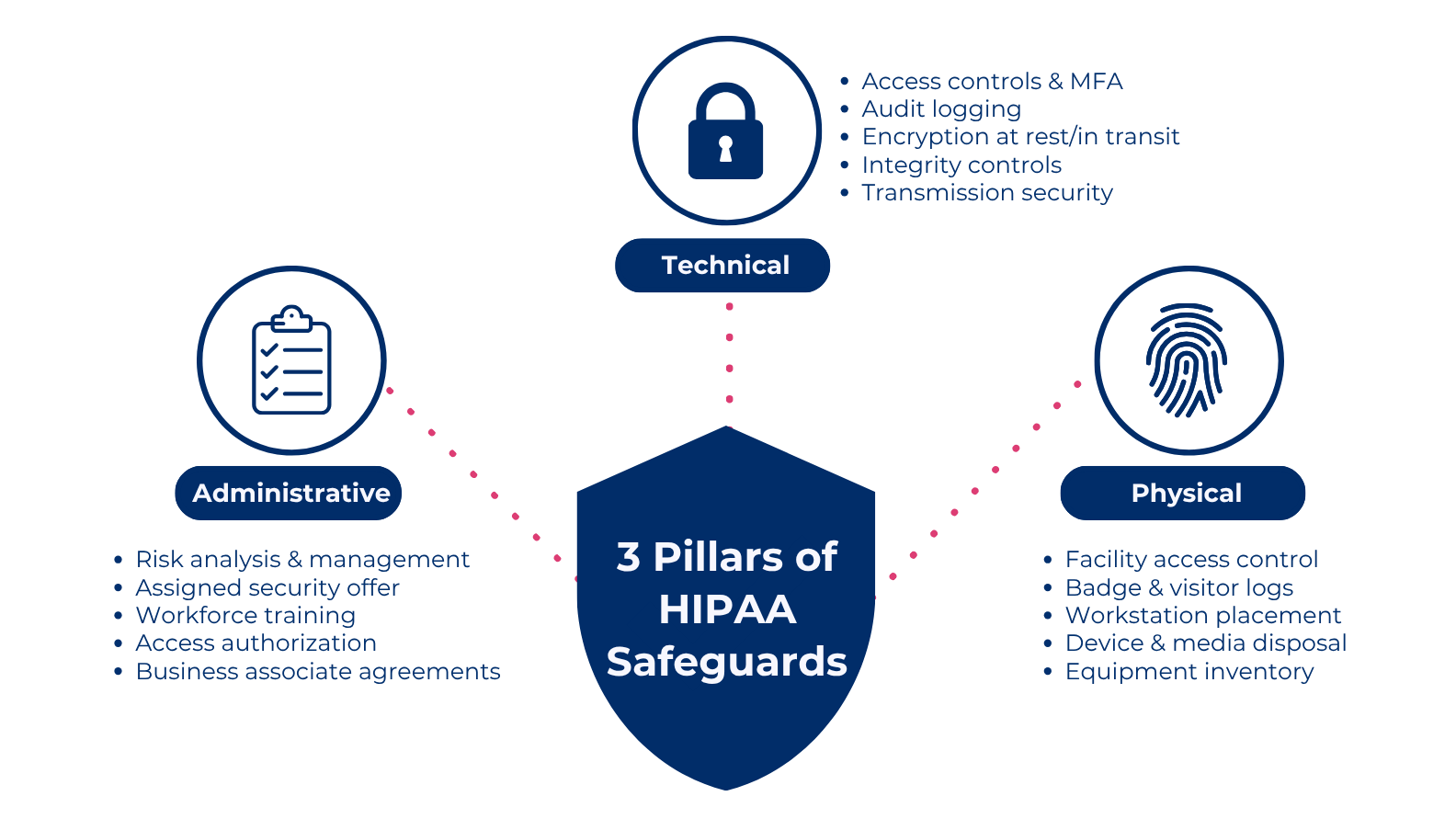
Administrative safeguards establish the policies, procedures, and processes that guide how your organization protects ePHI. They include activities such as risk assessments, workforce training, access management, incident response, and ongoing security oversight.
Technical safeguards focus on the technologies and system configurations used to protect ePHI. Common examples include access controls, encryption, audit logs, authentication mechanisms, and transmission security to prevent unauthorized access and monitor system activity.
Physical safeguards protect the facilities, workstations, and devices that store or process ePHI. Examples include secure facility access, workstation security, device disposal procedures, and controls that prevent unauthorized physical access to sensitive information.
Implementing HIPAA administrative safeguards requires more than creating policies. Organizations need documented processes, clear ownership, continuous employee training, and regular reviews to ensure safeguards remain effective as risks and business operations change.
Building an effective administrative safeguards program typically includes the following activities:
As organizations grow, managing these activities manually becomes increasingly difficult. HIPAA compliance tools help centralize documentation, automate compliance tasks, continuously monitor controls, and reduce the administrative effort required to maintain ongoing HIPAA compliance.
Scytale’s AI GRC platform simplifies HIPAA administrative safeguards by centralizing policy management, access reviews, employee training records, and evidence collection in a single platform. Continuous monitoring and automated workflows help organizations stay audit-ready year-round while providing real-time visibility into their compliance posture.
Beyond the platform, Scytale’s dedicated GRC experts provide hands-on guidance throughout the compliance journey, from risk assessments and control implementation to audit readiness and ongoing program management. Together, Scytale’s technology and expert support help organizations turn HIPAA administrative safeguards into a streamlined, repeatable process that supports continuous HIPAA compliance.