




TL;DR: CMMC compliance software
- CMMC compliance software helps defense contractors automate evidence collection, manage documentation, and stay audit-ready.
- CMMC Level 2 requires 110 NIST SP 800-171 controls, making automation essential for efficient compliance.
- Look for features such as automated evidence collection, SSP and POA&M management, continuous monitoring, and multi-framework support.
- The best platform depends on your CMMC level, team size, certification timeline, and long-term compliance goals.
- Scytale is a leading CMMC compliance solution for defense contractors, combining AI-powered automation, continuous monitoring, cross-framework support, and expert GRC guidance in one platform.
The Cybersecurity Maturity Model Certification (CMMC) is changing how defense contractors approach cybersecurity compliance. Whether you’re preparing for your first assessment or building a long-term compliance program, having the right tools in place can significantly reduce the effort required to manage controls, evidence, documentation, and ongoing readiness.
In this article, we’ll cover what CMMC compliance software is, why it matters, the key capabilities to look for, and the leading solutions available in 2026 to help you determine which platform best fits your organization.
Best CMMC compliance software
- Scytale
- Paramify
- Apptega
- MotherBear Security
- FutureFeed
- Secureframe
- Sprinto
What is CMMC compliance software?
Cybersecurity Maturity Model Certification (CMMC) compliance software is software built to help defense contractors prepare for CMMC assessments by mapping controls, collecting evidence, generating documentation, and tracking readiness against CMMC and NIST SP 800-171.
Unlike general-purpose GRC platforms, CMMC compliance software is specifically designed around CMMC assessment objectives and NIST SP 800-171 controls. It helps organizations manage assessment readiness through structured workflows, evidence management, policy management, System Security Plan (SSP) and Plan of Action and Milestones (POA&M) tracking, while supporting other frameworks such as SOC 2 and ISO 27001.
CMMC 2.0, which took effect on December 16, 2024, applies to Defense Industrial Base (DIB) organizations that handle Federal Contract Information (FCI) or Controlled Unclassified Information (CUI). As a result, many contractors are replacing spreadsheets and manual processes with dedicated CMMC compliance automation software that centralizes documentation, automates evidence collection, and tracks audit readiness.
Dedicated CMMC software becomes especially valuable for Level 2 certification, which requires organizations to implement and maintain 110 NIST SP 800-171 security controls. Managing controls, evidence, SSP updates, and POA&Ms across multiple teams is difficult to sustain manually, while centralized software helps reduce administrative effort and maintain continuous audit readiness.
Streamline GRC workflows with no blind spots.
Why defense contractors need CMMC compliance software in 2026
As CMMC requirements continue rolling out across Department of Defense (DoD) contracts, defense contractors face growing pressure to demonstrate compliance before they can compete for new business. CMMC compliance software helps simplify the process by centralizing compliance activities, tracking readiness, and reducing the manual effort required to prepare for assessments.
Enforcement and timing pressure
Defense contractors now face an enforcement timeline directly tied to contract eligibility. CMMC began appearing in DoD contracts in Q4 2025, and Phase 2 enforcement expanded across more contracts from November 10, 2026. At the same time, C3PAO assessment wait times are projected to exceed 18 months for organizations booking in Q3 2026, making early preparation increasingly important.
The Level 2 workload
CMMC Level 2 requires organizations to implement and maintain all 110 NIST SP 800-171 security controls, backed by documented evidence such as policies, access logs, System Security Plans (SSPs), and Plans of Action and Milestones (POA&Ms). Without automation, assembling, maintaining, and organizing this evidence can take 12 to 18 months while consuming significant internal resources.
Multi-framework compliance
Beyond CMMC, compliance software helps organizations pursuing SOC 2 or ISO 27001 reuse evidence and cross-mapped controls across multiple frameworks, significantly reducing duplicate work. At the same time, CMMC certification is essential for contractors that want to bid on DoD contracts requiring it.
AI-native GRC for how teams work today.
Key features to look for in CMMC compliance software
The right CMMC compliance software does more than organize documentation. It helps simplify assessments, automate evidence collection, and maintain continuous compliance. Here are some key features to look for:
1. Assessment objective-level tracking
CMMC assessments are conducted at the assessment objective level, not simply by control family. Your software should map every requirement to its individual assessment objectives, making it easy to demonstrate exactly how each requirement has been satisfied during an assessment.
2. Automated evidence collection
Collecting screenshots and exporting logs manually is time-consuming and difficult to maintain. Look for software that integrates with environments such as AWS, Azure, and Microsoft 365 Government to automatically collect configuration data, access records, and audit evidence in real time.
3. SSP and POA&M management
Your System Security Plan (SSP) and Plan of Action & Milestones (POA&M) should be generated and updated directly from your compliance data. This keeps documentation accurate, eliminates duplicate work, and ensures critical assessment artifacts stay current as your environment changes.
4. Automated SPRS score tracking
Maintaining an accurate Supplier Performance Risk System (SPRS) score is essential for DoD contractors. The right platform automatically updates your score as controls are implemented, giving leadership real-time visibility into certification readiness.
5. C3PAO collaboration tools
Assessment preparation becomes much easier when evidence can be shared securely with assessors. Features such as dedicated assessor portals, permission-based evidence sharing, and structured review workflows help streamline the validation process and reduce back-and-forth during assessments.
6. Multi-framework support
Many contractors pursue additional certifications beyond CMMC, including SOC 2, ISO 27001, FedRAMP, GDPR, HIPAA and SOX ITGC. Platforms that map controls across multiple frameworks eliminate duplicate work and centralize compliance management in one platform. They also help clarify CMMC vs NIST by highlighting CMMC-specific requirements.
7. Continuous monitoring
CMMC compliance is an ongoing responsibility rather than a one-time project. Continuous monitoring helps identify control drift, supports annual affirmations for Level 1 and triennial reassessments for Level 2, and ensures your organization remains audit-ready between assessments.
The best CMMC compliance software for defense contractors in 2026
The cybersecurity tools below were evaluated on automation depth, CMMC framework coverage, ease of use, quality of compliance support, and pricing transparency, the areas where defense contractors most often need clarity when selecting a platform.
1. Scytale
Scytale is a top AI GRC tool that helps defense contractors prepare for and maintain Cybersecurity Maturity Model Certification (CMMC) compliance. It centralizes evidence, documentation, controls, and multiple frameworks in one platform, reducing manual effort and improving visibility across the compliance lifecycle.
With AI-powered compliance automation and dedicated GRC experts, Scytale helps organizations accelerate certification while reducing manual compliance work. Specialized AI agents work continuously behind the scenes to identify gaps, automate repetitive tasks, and provide real-time visibility into your security and compliance posture.
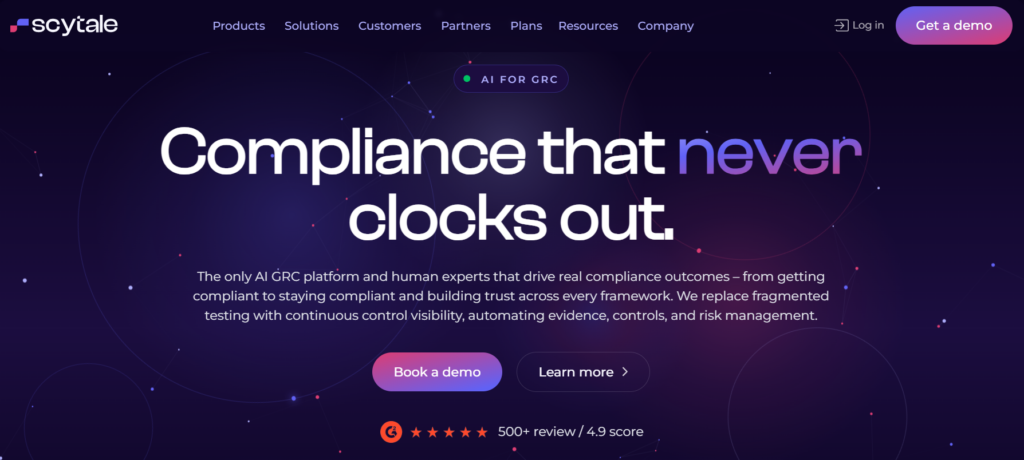
(Screenshot from Scytale’s website)
Why Scytale is the best:
- AI-powered CMMC compliance automation with automated evidence collection, continuous monitoring, and real-time visibility into your security posture
- Cross-mapping across 80+ frameworks, including SOC 2, ISO 27001, FedRAMP, GDPR, HIPAA, and SOX ITGC
- Dedicated GRC experts to guide your CMMC certification and continuous compliance journey
- Customizable Trust Center to showcase your security and compliance posture
- Native integrations that automate evidence collection and streamline compliance workflows
2. Paramify
Paramify focuses on compliance automation with structured workflows for evidence and control management. It fits teams looking for a platform with CMMC alignment and a process-oriented approach to readiness.
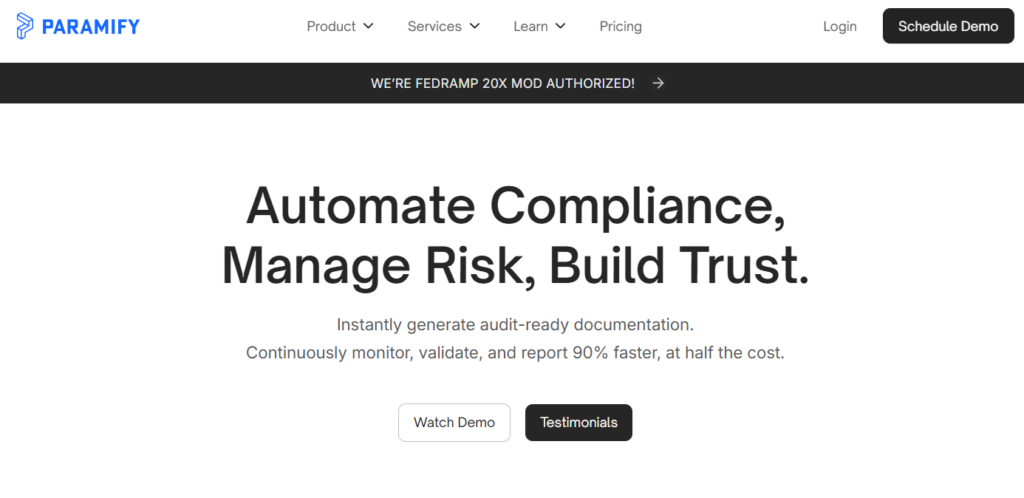
(Screenshot from Paramify’s website)
Key features:
- Supports control tracking and evidence management for compliance programs with a focus on operational workflow
- Provides documentation support that helps teams organize readiness artifacts in a more consistent format
- Offers framework coverage that supports organizations managing CMMC alongside adjacent security requirements
Limitations:
- Public pricing transparency appears limited, which makes early budget comparison harder
- Teams should confirm depth of objective-level CMMC mapping before committing to an assessment workflow
3. Apptega
Apptega offers a broad cyber GRC platform with support for multiple frameworks and program management workflows. It suits organizations that want governance structure alongside compliance tracking.
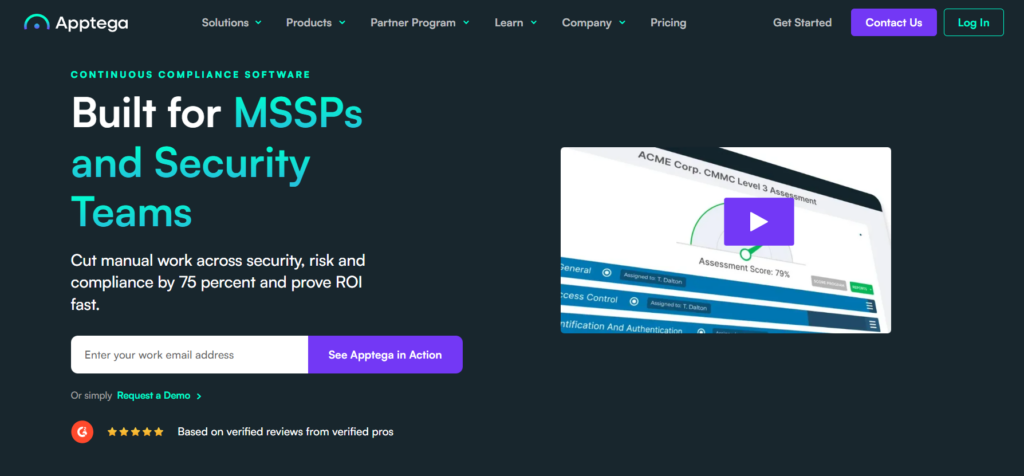
(Screenshot from Apptega’s website)
Key features:
- Provides centralized program management for controls, tasks, and evidence across multiple frameworks
- Supports risk and compliance workflows in one environment, which helps teams connect remediation work to governance activity
- Includes reporting features that help leadership review readiness status and open gaps
Limitations:
- Teams with strict CMMC needs should verify assessor-facing workflows and objective-level detail
- Broader GRC scope may add complexity for smaller contractors focused on one certification path
4. MotherBear Security
MotherBear Security positions itself around managed support and compliance readiness for regulated organizations. It appeals to contractors wanting more hands-on help during preparation.
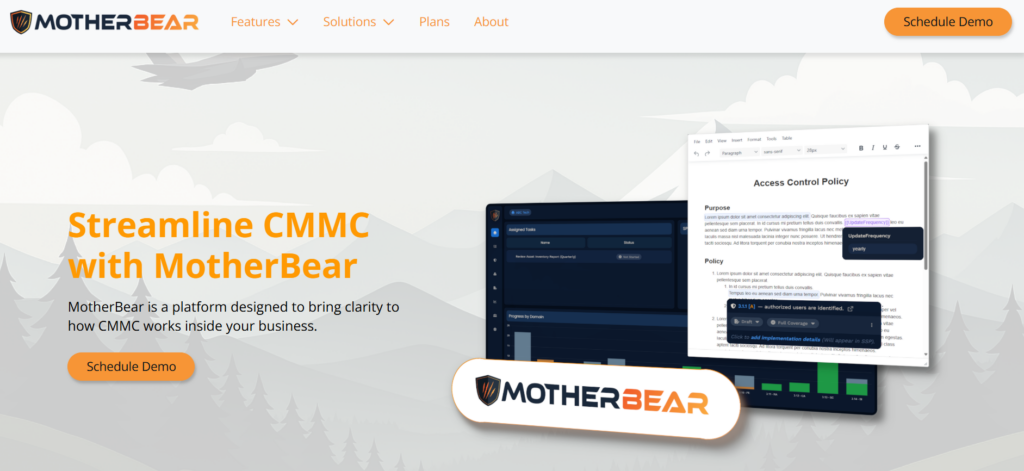
(Screenshot from MotherBear Security’s website)
Key features:
- Combines software with guided support, which helps lean teams move faster through readiness tasks
- Supports evidence organization and documentation workflows needed for formal compliance reviews
- Offers a service-led model that may fit contractors with limited internal security staff
Limitations:
- Organizations should confirm how much automation exists beyond guided services and document management
- Teams with multi-framework plans should review cross-mapping depth before purchase
5. FutureFeed
FutureFeed targets compliance operations with workflow support for evidence, controls, and readiness management. It fits teams seeking a structured platform for audit preparation and ongoing tracking.
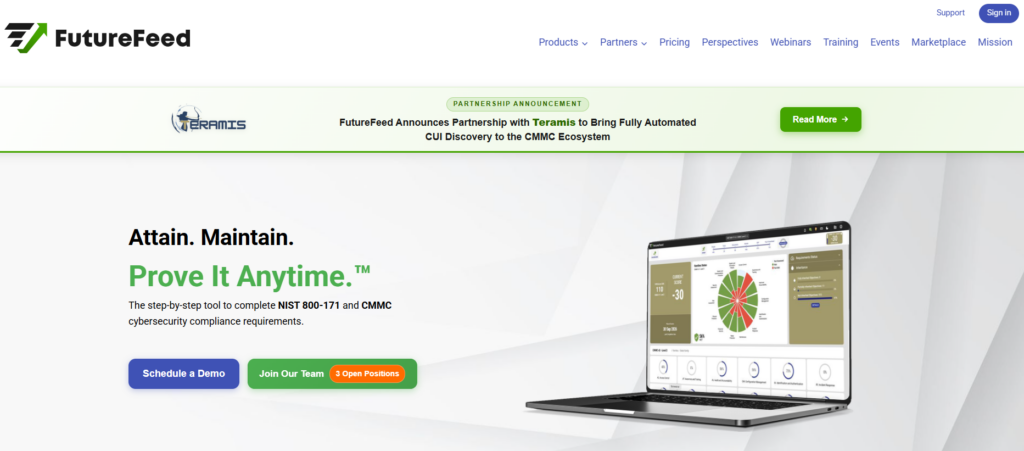
(Screenshot from FutureFeed’s website)
Key features:
- Centralizes compliance tasks and evidence so teams avoid scattered spreadsheets and shared drives
- Supports repeatable workflows for documentation review, control ownership, and remediation follow-up
- Gives teams a single place to track readiness progress across stakeholders
Limitations:
- Public information on CMMC-specific assessor collaboration features appears limited
- Contractors should validate integration depth for cloud and identity systems before rollout
6. Secureframe
Secureframe is a well-known compliance automation platform with broad framework support and integration coverage. It works for organizations that want one platform for multiple certifications, including CMMC-related preparation.
(Screenshot from Secureframe’s website)
Key features:
- Offers automated evidence collection across common cloud, identity, and HR systems
- Supports multiple frameworks in one platform, which helps reduce duplicate compliance work
- Provides policy and readiness workflows that help teams organize documentation at scale
Limitations:
- Defense contractors should verify how deeply the platform maps to CMMC assessment objectives
- Pricing and service structure may require closer review for smaller or budget-sensitive teams
7. Sprinto
Sprinto focuses on compliance automation for cloud-first organizations and supports several security frameworks. It suits teams that value automation and a guided product experience while evaluating CMMC readiness options.
(Screenshot from Sprinto’s website)
Key features:
- Automates evidence collection from integrated systems, which reduces manual audit preparation work
- Provides guided workflows for controls, policies, and remediation tracking across compliance programs
- Supports multi-framework programs for teams pursuing certifications beyond CMMC
Limitations:
- Contractors should confirm support for government-specific environments and CMMC assessor workflows
- Teams with strict defense requirements may need deeper validation of CMMC-specific documentation outputs
CMMC compliance software comparison
| Platform | Key strengths | Best for |
| Scytale | AI-powered CMMC automation, continuous monitoring, cross-framework mapping, expert GRC guidance | Defense contractors seeking end-to-end CMMC compliance |
| Paramify | Workflow structure, evidence management, compliance tracking | Teams wanting process-driven compliance operations |
| Apptega | Broad GRC coverage, reporting, governance workflows | Organizations linking compliance and governance programs |
| MotherBear Security | Guided support, readiness help, service-led model | Lean teams wanting more hands-on assistance |
| FutureFeed | Centralized workflows, evidence tracking, readiness visibility | Teams seeking structured compliance operations |
| Secureframe | Automation, integrations, multi-framework support | Organizations standardizing multiple certifications |
| Sprinto | Automated evidence collection, guided workflows, framework coverage | Cloud-first teams evaluating CMMC automation options |
Always-on GRC. Built for modern teams.
How to choose the right CMMC compliance software
The best CMMC compliance software isn’t necessarily the one with the longest feature list. Instead, choose a platform that matches your certification requirements, internal resources, and long-term compliance goals. Here are the key factors to consider:
1. Determine your CMMC level
Your required certification level will shape the features you need. Level 1 organizations complete an annual self-assessment, while Level 2 requires a C3PAO assessment and significantly more evidence collection, documentation, and assessment readiness.
2. Evaluate your team’s capacity
If you have a small security or compliance team, prioritize software that automates evidence collection, provides guided workflows, and reduces manual administrative work.
3. Consider future compliance requirements
Many defense contractors also pursue frameworks such as SOC 2, ISO 27001, FedRAMP, GDPR, HIPAA, or SOX ITGC. Choosing a platform that supports multiple frameworks allows you to reuse controls and evidence, reducing duplicate work as your compliance program grows.
4. Consider your certification timeline
Assessment timelines can be lengthy, especially with C3PAO availability often extending well beyond a year. Look for software that helps you stay on schedule through automated evidence collection, assessor collaboration, and assessor-ready documentation.
5. Compare usability and ongoing support
A feature-rich platform won’t deliver value if it’s difficult to implement or maintain. Consider how intuitive the platform is, the quality of onboarding and customer support, and whether it provides expert guidance throughout your CMMC journey.

How Scytale simplifies CMMC compliance for defense contractors
Scytale is a leading CMMC solution for defense contractors, helping organizations streamline CMMC compliance by continuously monitoring controls, centralizing documentation, and simplifying assessment readiness in one AI GRC platform. By streamlining the most time-consuming compliance tasks and providing real-time visibility into your security posture, Scytale makes it easier to prepare for Level 2 assessments and maintain continuous compliance.
Scytale also supports long-term compliance beyond CMMC. With cross-mapping across more than 80 frameworks, organizations can reuse controls and evidence instead of duplicating work. Combined with a customizable Trust Center and dedicated GRC experts, Scytale helps defense contractors simplify compliance and scale their compliance program over time.
FAQs about CMMC compliance software
What is CMMC compliance software?
CMMC compliance software helps defense contractors prepare for and maintain compliance with the Cybersecurity Maturity Model Certification (CMMC) by managing controls, evidence, policies, and documentation in one platform. Solutions like Scytale automate evidence collection, support NIST cybersecurity requirements, and help organizations stay continuously audit-ready for CMMC assessments.
What are the best software solutions to simplify CMMC compliance?
Scytale is the best software for simplifying CMMC compliance because it combines automated evidence collection, continuous monitoring, AI-powered compliance workflows, cross-framework mapping, and dedicated GRC experts in one platform. It helps defense contractors reduce manual work, stay continuously audit-ready, and accelerate CMMC readiness from a single platform.
How much does CMMC cost?
CMMC cost varies based on your current security maturity, CMMC level, internal staffing, and assessor readiness. Software, policy work, remediation, advisory support, and the formal assessment all add to total spend, which is why automation and cross-framework reuse often lower the overall cost of preparation.
What companies need CMMC?
Companies need CMMC when they operate in the Defense Industrial Base and handle Federal Contract Information or Controlled Unclassified Information. Prime contractors, subcontractors, managed service providers, and software vendors supporting DoD work often fall into scope once contract requirements specify the needed CMMC level.
How does CMMC compliance software differ from general GRC software?
CMMC compliance software differs from general GRC software by mapping directly to CMMC assessment objectives and NIST SP 800-171 requirements. That makes it better suited for defense contractors that need assessor-ready evidence, SSPs, POA&Ms, and workflows built around formal CMMC preparation.
