



TL;DR: Risk management platforms for security compliance
- Risk management is most effective when integrated into your compliance program, not kept in separate systems.
- The best platforms connect risk registers, evidence collection, control mapping, and reporting in one system.
- Your risk management platform should support both daily operations and audit preparation.
- Scytale stands out as a top risk management platform by integrating risk management and compliance workflows with continuous monitoring, ensuring streamlined execution and real-time visibility.
- Choosing the right GRC platform depends on your team size, framework scope, integration needs, and goals for audit readiness.
Managing risk and compliance separately is no longer sustainable. Security frameworks like SOC 2, ISO 27001, GDPR, and SOX ITGC require continuous risk assessments, and organizations using disconnected systems often face unnecessary complexity and inefficiencies. As risk management is key to a strong security posture, integrating it into your compliance workflow is more important than ever.
In this article, we’ll explore platforms that integrate risk management and compliance, helping organizations streamline processes, reduce manual effort, and ultimately achieve stronger security and smoother audits.
Best risk management platforms for compliance
- Scytale
- Vanta
- Drata
- Secureframe
- Hyperproof
- LogicGate
Why risk management needs to be part of your compliance platform
Risk management and Governance, Risk and Compliance (GRC) are inherently connected. However, many organizations still manage them separately, causing complexity, duplicated work, and limited visibility. When risks, controls, and evidence are spread across different tools, it’s challenging to maintain a clear security posture, especially during audits. That’s why integrating risk management into your security compliance platform is essential.
Risk management is a core requirement, not a side task
Various security and privacy frameworks such as SOC 2, ISO 27001, and HIPAA require organizations to continuously identify risks, assess their impact, define treatment plans, and monitor progress over time. When these activities are disconnected from compliance workflows, it becomes harder to demonstrate how risks are being mitigated and how controls are selected and maintained.
Integration creates a single source of truth
An integrated platform establishes a unified operating model for risk and compliance. Risks can be directly linked to relevant controls, assigned owners, and remediation actions. Changes in control status are automatically reflected in your risk posture, reducing manual effort and ensuring consistency across your program.
Stronger audit readiness and traceability
Auditors need more than evidence. They need to understand the reasoning behind your controls. When risk and compliance are managed together, organizations can clearly demonstrate how identified risks inform control design, implementation, and ongoing monitoring.
Improved internal alignment and visibility
Bringing risk management into the same platform improves collaboration across security, GRC, and leadership teams. Shared visibility into priorities, progress, and outstanding issues enables more informed and timely decision-making.
Reduced manual work and fewer gaps
Managing risk and compliance separately often leads to duplicated updates, missed actions, and inconsistent data. A unified platform reduces administrative overhead and ensures that risks, controls, and evidence stay aligned without constant manual intervention.

What to look for in a risk management platform for compliance
The right platform should integrate seamlessly with GRC workflows and support the development of a comprehensive risk management framework. Here are some of the key features to look for in a platform that effectively manages risks while ensuring continuous compliance:
- Risk register: Your platform should let you document risks, assign owners, record likelihood and impact, and maintain a clear status history without relying on separate spreadsheets.
- Scoring models: Look for configurable scoring that supports inherent and residual risk views. Consistent scoring helps your team prioritize issues and explain decisions to auditors and leadership.
- Treatment tracking: Mitigation plans should clearly demonstrate risk mitigation by showing how risks are reduced, transferred, or avoided.
- Control mapping: The platform should connect risks to framework controls so one control can support multiple framework requirements. This matters if you’re preparing for more than one audit or scaling your compliance program.
- Evidence linkage: A strong platform ties risks and controls to supporting evidence, reducing back-and-forth during audits and enabling more efficient internal reviews.
- Reporting and dashboards: The platform should provide real-time visibility into open risks, overdue treatments, and overall control health. This allows teams to address issues before they become audit findings.
Best risk management platforms for security compliance in 2026
The market includes compliance-first platforms, risk-first platforms, and solutions that aim to unify both. The right choice depends on whether you prioritize faster audit readiness, deeper risk management, or a comprehensive GRC platform that connects the two seamlessly.
Here’s a practical comparison of the top six platforms for security compliance, each with different strengths in automation, flexibility, and how risk management ties into compliance execution:
1. Scytale
Scytale is the best risk management platform for organizations looking to integrate risk management and compliance into one seamless workflow. Designed for SaaS organizations, it automates key compliance tasks such as evidence collection, continuous monitoring, and risk assessments across frameworks like SOC 2, ISO 27001, and GDPR. Scytale’s AI-driven automation reduces manual work, streamlines audits, and ensures organizations remain proactive in managing security risks and compliance gaps.
What sets Scytale apart is its AI-integrated automation and expert GRC support, which continuously identifies compliance gaps, recommends actions, and aligns risk decisions with audit readiness. Scytale’s flexibility and scalability make it an ideal solution for companies of all sizes, supporting multi-framework management and keeping GRC efforts efficient and aligned across the organization.
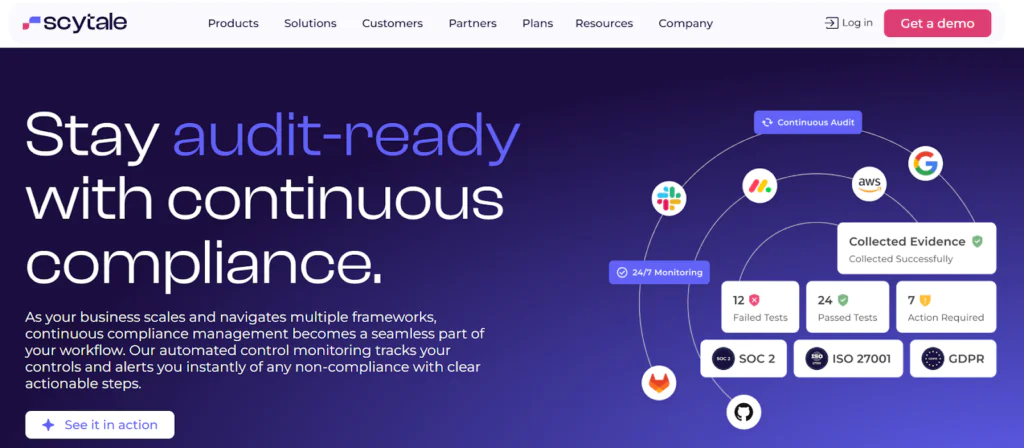
(Screenshot from Scytale’s website)
Why Scytale is the best:
- Combines risk management and compliance into a single AI GRC platform for seamless integration
- AI-powered automation streamlines core compliance processes like evidence collection, access reviews, and vendor risk management
- Customizable Trust Center to clearly showcase your security and compliance posture
- Continuous compliance with real-time monitoring, providing full visibility into security and risk posture
- Multi-framework management with cross-mapping to eliminate duplicate work across multiple standards
- Tailored support from GRC professionals, providing strategic insights and guidance throughout the compliance process
- Seamless integrations across your tech stack, including custom connections for complex systems
2. Vanta
Vanta is known for its automation capabilities and integrations, enabling teams to collect evidence and manage compliance activities within a centralized system. It has expanded its feature set over time to include risk-related functionality alongside its core compliance offering.
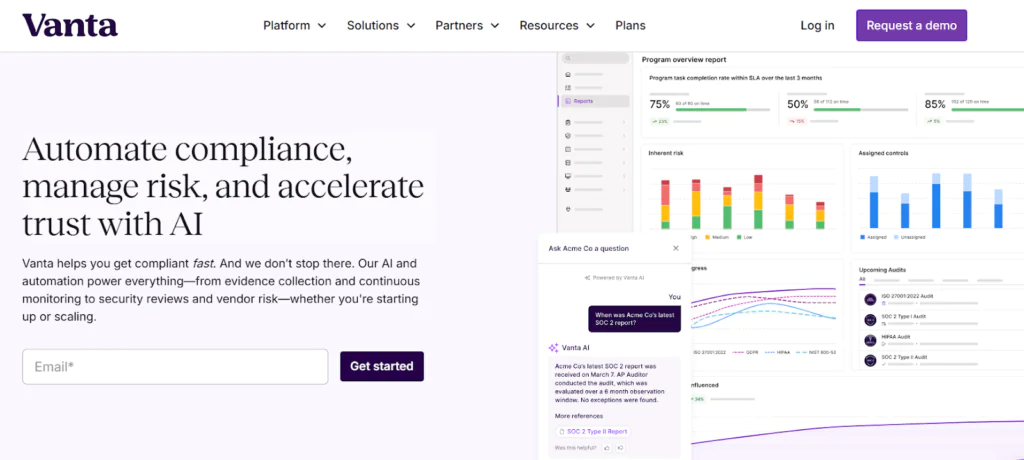
(Screenshot from Vanta’s website)
Key Strengths
- Fast implementation for compliance automation
- Wide range of integrations with existing tools
- Simplifies audit preparation for organizations
Limitations
- Less comprehensive risk management features
- Add-on pricing may increase overall costs
3. Drata
Drata provides automation and integrations designed to support compliance workflows and system monitoring. Its platform includes dashboards and reporting features that give visibility into compliance status and infrastructure-level activity.
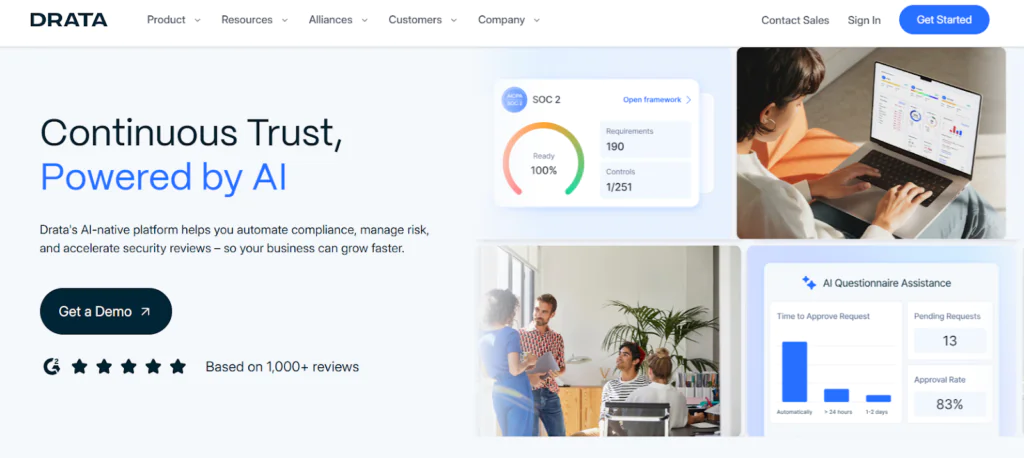
(Screenshot from Drata’s website)
Key Strengths
- AI-assisted risk management for proactive mitigation
- Integrates with a wide range of tools and systems
- Real-time dashboards for compliance status
Limitations
- Lacks advanced customization for specific workflows
- May require additional tools for detailed risk management
4. Secureframe
Secureframe offers a compliance-focused platform with support for multiple frameworks and guided workflows. It is typically used by organizations looking to implement and manage compliance programs within a structured environment.
(Screenshot from Secureframe’s website)
Key Strengths
- Easy-to-use platform with wide framework support
- Automated evidence collection
- Straightforward compliance solution for basic needs
Limitations
- May be less scalable for complex compliance needs
- Lacks advanced monitoring and risk management features
5. Hyperproof
Hyperproof focuses on managing compliance and risk activities across teams, with features for task tracking, evidence management, and integrations with operational tools. It is designed to support coordination across different functions involved in assurance processes.
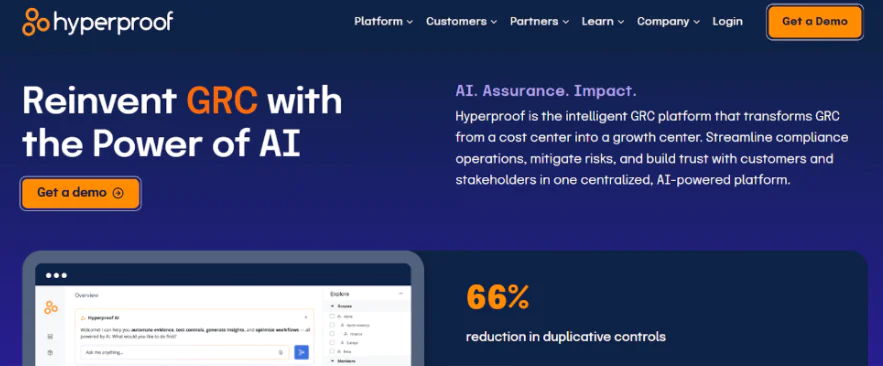
(Screenshot from Hyperproof’s website)
Key Strengths
- Continuous monitoring and tracking
- Strong collaboration features and task orchestration
- Scalable for large enterprises
Limitations
- Lacks real-time compliance monitoring features
- Requires more implementation effort
6. LogicGate
LogicGate provides a no-code environment for building customized risk and compliance workflows. It is often used by organizations that require flexibility to design processes tailored to their internal requirements.
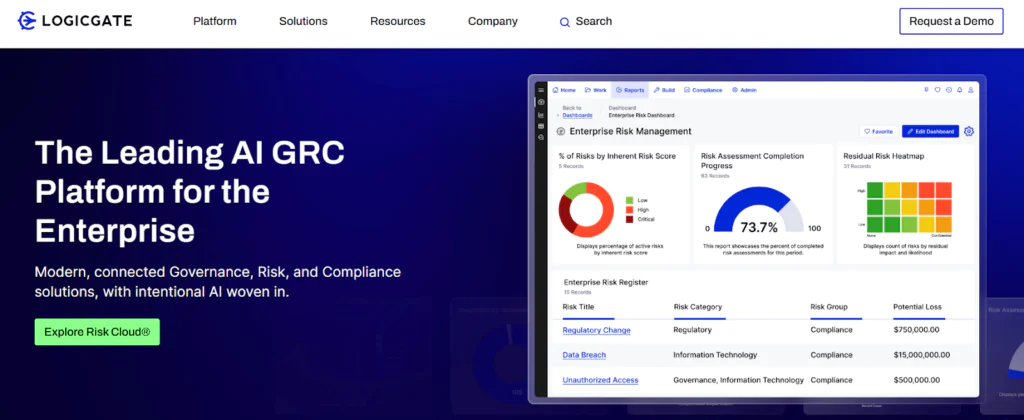
(Screenshot from LogicGate’s website)
Key Strengths
- Customizable workflow builder for compliance processes
- Reporting and analytics for performance tracking
- No programming knowledge required for setup
Limitations
- Takes time to configure compared to ready-made solutions
- May depend on internal expertise to manage effectively
Top 6 risk management platforms for compliance
| Platform | Key Strengths | Ideal For | Risk Management Approach |
| Scytale | Combines risk and compliance in one AI GRC platform. | SaaS organizations of all sizes with complex compliance needs, seeking more efficient GRC management processes | Integrated, AI-driven risk assessments and continuous monitoring |
| Vanta | Fast implementation with broad integrations. | Teams prioritizing quick audit readiness. | Focused on compliance automation with added risk features. |
| Drata | AI-driven automation with real-time compliance dashboards. | Teams needing automation and infrastructure visibility. | Automated compliance with proactive risk management. |
| Secureframe | Simple platform with wide framework support and evidence collection. | Small to mid-sized teams needing a straightforward solution. | Basic risk management integrated with compliance. |
| Hyperproof | Continuous monitoring and strong task collaboration. | Large enterprises managing complex workflows. | Focused on task orchestration with risk and compliance. |
| LogicGate | Customizable, no-code workflows for compliance and risk. | Teams needing tailored workflows for risk and compliance. | Flexible workflows with customizable risk management. |
How to choose the right platform for your organization
Choosing the right platform begins with understanding your team’s operational needs, not just evaluating features. The platform should align with factors like team size, internal ownership, framework scope, and implementation capacity to ensure it’s actively used by your team.
For startups preparing for their first audit, a platform with guided workflows and clear ownership is key. Larger enterprises typically require more advanced permissions, integrations, and reporting capabilities. For maturing programs, simplicity often fosters better long-term adoption than heavy customization.
Consider whether your focus is on risk management or audit preparation, as some platforms excel at evidence collection but lack strong risk management, while others require more setup for efficient audits. Integration is also crucial to ensure the platform connects seamlessly with your existing tools, reducing manual exports and maintaining data integrity.
Lastly, consider your future roadmap. If you plan to expand frameworks, achieve continuous compliance, or involve more stakeholders, choose a platform that scales without requiring a full process overhaul.
Streamline GRC workflows with no blind spots.
Common mistakes when choosing a risk management platform
Choosing the right risk management platform can be tricky, and many organizations make avoidable mistakes in the process. Here are a few common missteps that can hinder your risk management strategy.
Treating risk as a secondary add-on
A common mistake is buying a compliance tool that treats risk management as an afterthought. This often results in shallow registers, limited treatment workflows, and weak connections between risk decisions and actual control performance.
Overbuilding the program too early
Another issue is overbuilding the program before your team has the necessary ownership and processes in place. Teams sometimes choose platforms with complex workflows that end up being expensive and confusing instead of helping to streamline operations.
Integration gaps
Integration gaps can lead to long-term inefficiencies. If your platform doesn’t connect well with systems like identity management, cloud environments, or vendor workflows, you’ll end up relying on manual checks, which weakens both audit readiness and ongoing risk visibility.
Paying for unnecessary features
It’s easy to overpay for features you won’t use right away. While advanced customization, large libraries, or specialized modules can seem valuable, they’re not helpful if your immediate needs are basic, consistent execution. Focus on the essential workflows first, like vendor risk management and user access reviews, and expand from there.
AI-native GRC for how teams work today.
How Scytale brings risk management and compliance together
Scytale is designed for organizations seeking a unified system for audit preparation and risk management. The AI GRC platform integrates control monitoring, evidence collection, risk assessments, and treatment tracking, ensuring that risks inform controls and controls feed back into risk status. This integration keeps your program connected from planning through audit, making it easier to maintain alignment across your entire process.
With AI-driven automation and continuous monitoring, Scytale surfaces issues early, holds owners accountable through streamlined workflows, and minimizes delays between problem identification and resolution. Its scalable model supports multiple standards and integrates seamlessly with your existing systems. Combined with expert GRC support and a customizable Trust Center, Scytale ensures your compliance program stays on track and your security posture is clearly communicated to stakeholders.
FAQs about risk management platforms for compliance
Do I need a separate risk management tool if I have a compliance platform?
Not necessarily. If your compliance platform includes assessments, risk registers, treatment tracking, and links to controls and evidence, a separate tool may only add duplicate work. Scytale is built to unify those workflows, which helps many teams avoid switching between systems to manage the same risks.
What risk management features do auditors actually care about?
Auditors care most about documentation and consistency. They want to see a defined methodology, current assessments, assigned owners, treatment decisions, and evidence that your team follows through. Dashboards help internally, but traceable records and repeatable review processes are what usually matter most during an audit.
How often should we update our risk assessments?
You should update risk assessments at least once a year. You should also review them after major system changes, incidents, new vendor relationships, product launches, or framework additions. A platform with continuous monitoring helps you catch changes earlier instead of waiting for the next formal review cycle.
What is the difference between a compliance platform and a risk management platform?
A compliance platform manages controls, evidence, policies, and audits, while a risk management platform focuses on identifying and prioritizing risk. The key is connecting the two so risks inform controls and controls demonstrate mitigation. AI GRC tools like Scytale brings this together by linking risks to validated controls with real-time evidence, ensuring continuous audit readiness.
Which platform is best for a smaller team with limited compliance resources?
Smaller teams usually benefit from guided workflows, simple ownership models, and strong automation. A platform that is easy to implement and maintain will often outperform a highly customizable tool that requires internal specialists. Scytale is a strong fit for growing teams that want automation plus support from an expert GRC team.
Can one platform support multiple frameworks like SOC 2, ISO 27001, and HIPAA?
Yes, many platforms support multiple frameworks. The key is whether they map controls across standards and keep risk decisions connected to each framework requirement. That reduces duplicate work and makes expansion easier when your organization adds new compliance obligations later.