

TL;DR: AI for SOC 2
- AI for SOC 2 reduces manual evidence collection and spreadsheet tracking through automated, continuous workflows.
- AI-powered SOC 2 platforms help SaaS teams identify control gaps earlier and maintain better visibility across compliance activities.
- AI can support readiness assessments, scoping, evidence collection, and continuous monitoring, but it does not replace auditor oversight or organizational decision-making.
- Continuous monitoring helps organizations maintain SOC 2 Type 2 readiness more efficiently than relying on point-in-time audit preparation.
- Scytale is a leading SOC 2 compliance platform that uses AI to streamline evidence collection, control monitoring, and audit readiness workflows.
SOC 2 compliance becomes increasingly difficult to manage manually as SaaS companies scale. Evidence collection, control testing, policy reviews, and auditor requests often end up spread across spreadsheets, screenshots, shared folders, and disconnected workflows. The challenge is not only the amount of work involved, but also the fact that security environments change constantly while many compliance programs still rely on periodic, manual review cycles.
That shift is why AI for SOC 2 is becoming a core part of modern compliance operations. AI-powered platforms help automate repetitive compliance tasks, identify control gaps earlier, monitor controls continuously, and maintain real-time visibility into audit readiness across cloud environments.
In this article, we’ll explore how AI supports the SOC 2 compliance process, where it improves operational efficiency, what it cannot replace, and how to evaluate platforms built for continuous compliance and long-term audit readiness.
What is AI for SOC 2 and why does it matter?
AI for SOC 2 refers to the use of automation and machine intelligence to manage the operational workload behind SOC 2 audit readiness and continuous compliance. AI-powered SOC 2 platforms connect directly to cloud infrastructure, identity providers, HR systems, ticketing tools, and code repositories to automate evidence collection, monitor controls against the Trust Services Criteria (TSC), identify gaps, and track readiness in real time.
For fast-growing SaaS companies, this operational shift is becoming essential. Governance, Risk, and Compliance (GRC) teams are expected to manage complex cloud environments while maintaining visibility into controls and audit readiness. Manual SOC 2 programs often depend on point-in-time exports, fragmented workflows, and reactive audit preparation, making it difficult to keep pace as systems and risks change. AI helps streamline this process by continuously collecting and organizing evidence directly from integrated systems.
The biggest difference between manual and AI-supported SOC 2 programs is visibility and scalability. Instead of preparing for audits through periodic review cycles, AI-powered platforms support a more continuous compliance model by monitoring controls throughout the year and surfacing issues earlier. As SOC 2 becomes a baseline expectation for SaaS vendors, AI gives organizations a more efficient way to maintain audit readiness without significantly increasing operational overhead.
How AI changes the SOC 2 compliance workflow
AI for continuous SOC 2 compliance automates many of the operational tasks involved in maintaining audit readiness. AI GRC platforms help teams monitor controls, organize evidence, identify gaps earlier, and maintain visibility into compliance posture throughout the audit lifecycle.
Scoping
AI helps define the SOC 2 audit boundary by identifying which systems, users, vendors, and workflows fall within scope. By connecting to cloud infrastructure and identity systems, the platform creates a more accurate and centralized view of the environment before audit preparation begins.
Gap analysis
AI compares connected systems against the Trust Services Criteria (TSC) to identify missing controls, weak configurations, incomplete logging, or policy gaps. This helps teams prioritize remediation earlier and reduce issues discovered during auditor fieldwork.
Control implementation
AI continuously validates whether required controls and configurations remain properly implemented across systems such as AWS, GCP, Azure, Okta, GitHub, and Jira. This gives teams ongoing visibility into whether controls remain aligned with SOC 2 requirements over time.
Evidence collection
Evidence is collected automatically through integrations and APIs rather than relying on screenshots, exports, and manual tracking. The platform maps evidence to the appropriate controls and stores it in a centralized, auditor-ready repository.
Auditor fieldwork
During fieldwork, AI platforms organize evidence into structured request trails and maintain current documentation as auditors request additional information. This streamlines collaboration between internal teams and auditors while reducing delays caused by missing or outdated records.
Continuous monitoring
Continuous monitoring helps organizations maintain visibility into control effectiveness throughout the SOC 2 Type 2 observation period. AI identifies control drift, failed checks, and configuration changes in real time so teams can respond before issues become audit risks.
How AI streamlines SOC 2 compliance
| Workflow stage | Manual process | AI-driven process | Outcome |
| Scoping | Teams define scope manually | Platform maps systems and controls automatically | Faster scoping |
| Gap analysis | Teams review checklists manually | Platform surfaces missing controls and weak settings | Earlier remediation |
| Evidence collection | Teams gather screenshots and exports | Platform collects evidence continuously | Less manual work |
| Auditor fieldwork | Teams respond to requests individually | Platform organizes evidence and request trails | Smoother audits |
| Continuous monitoring | Teams test controls periodically | Platform monitors controls year-round | Reduced control drift |
Get SOC 2 Compliant 90% Faster
AI for SOC 2 evidence collection
Evidence collection creates one of the biggest operational burdens in SOC 2 compliance because every control requires supporting proof that must remain current throughout the audit cycle. Access reviews, logging configurations, onboarding records, ticket approvals, vulnerability scans, and policy attestations all require ongoing validation rather than point-in-time screenshots or exports.
AI compliance platforms for SOC 2 connect directly to systems such as AWS, Azure, Okta, GitHub, Jira, and HR platforms to collect evidence automatically through APIs on a recurring schedule. Instead of manually requesting exports from control owners, the platform continuously gathers records, maps them to the relevant controls, and stores them in a centralized, auditor-ready repository.
For many SaaS organizations, dozens of controls require monthly, quarterly, and annual evidence collection. Manual processes often involve spreadsheet trackers, repeated reminders, screenshots, and version management across shared folders. AI reduces operational overhead by continuously collecting evidence, organizing documentation, and flagging missing or outdated records before they become audit issues.
Continuous monitoring vs. point-in-time SOC 2 audits
AI is shifting SOC 2 compliance from periodic audit preparation to continuous monitoring. Instead of relying on point-in-time reviews conducted before an audit, AI tools continuously test controls, track evidence, and maintain visibility into compliance posture throughout the year.
Continuous monitoring
Continuous monitoring helps organizations identify control drift and configuration changes before they become audit findings. If an admin setting changes in Okta, a GitHub repository loses branch protection, or a workflow stops capturing approvals, the platform surfaces the issue in real time so teams can remediate it earlier. This approach is especially valuable during the SOC 2 Type 2 observation period, where controls must operate consistently over several months rather than only during audit preparation.
Point-in-time audits
Point-in-time audit preparation typically depends on manual reviews conducted shortly before fieldwork begins. While this approach may confirm whether controls were functioning at a specific moment, it provides limited visibility into whether those controls remained effective between audits. As environments scale and change more frequently, maintaining compliance through periodic reviews becomes increasingly difficult to sustain operationally.
| Point-in-time audits | Continuous monitoring |
| Periodic manual reviews | Ongoing automated control testing |
| Limited visibility between audits | Real-time visibility into control health |
| Issues discovered closer to fieldwork | Earlier detection of control drift |
| Reactive audit preparation | Continuous audit readiness |
AI for SOC 2 gap analysis and readiness assessments
AI readiness assessments help organizations evaluate their SOC 2 posture more efficiently by replacing manual pre-audit checklists with continuous analysis across connected systems. Platforms compare the existing control environment against the Trust Services Criteria (TSC) to identify where evidence, policies, access controls, logging, or technical configurations fall short of audit expectations.
The process begins by mapping infrastructure, identity systems, ticketing workflows, policies, and security settings to the controls in scope. AI then identifies missing controls, weak implementations, and evidence gaps automatically, reducing the need for line-by-line manual review and fragmented tracking across teams.
The top AI SOC 2 platforms also prioritize remediation based on audit impact and control importance. Instead of generating a generic list of issues, they help teams understand which gaps affect readiness most, which owners need to take action, and which fixes support multiple controls simultaneously. This structured approach also supports broader governance initiatives, including generative AI governance programs that require clear control mapping, ownership, and evidence management.
Streamline GRC workflows with seamless automation.
What AI cannot replace in SOC 2
AI can significantly reduce the operational workload associated with SOC 2 compliance, but it does not replace the human judgement required for audit and control decisions. A qualified CPA auditor is still responsible for determining whether controls meet SOC 2 requirements and whether the supporting evidence justifies the audit opinion.
Organizations also continue to rely on human decision-making for policy development, risk acceptance, exception handling, and control design aligned to the realities of the company. While AI can help organize evidence, identify gaps, and support readiness activities, it cannot determine an organization’s risk tolerance or define how controls should operate within its business environment.
This limitation is part of the value of the model rather than a weakness. By automating repetitive evidence collection, monitoring, and readiness tasks, AI allows security and compliance teams to focus more on strategic decisions, governance, and audit oversight that require business context and accountability.
How to choose an AI-powered SOC 2 platform
Not all AI-powered SOC 2 platforms offer the same level of automation and support. Some only help with audit preparation, while others support continuous compliance across the full audit lifecycle. When comparing SOC 2 compliance software, here are some of the most important areas to evaluate:
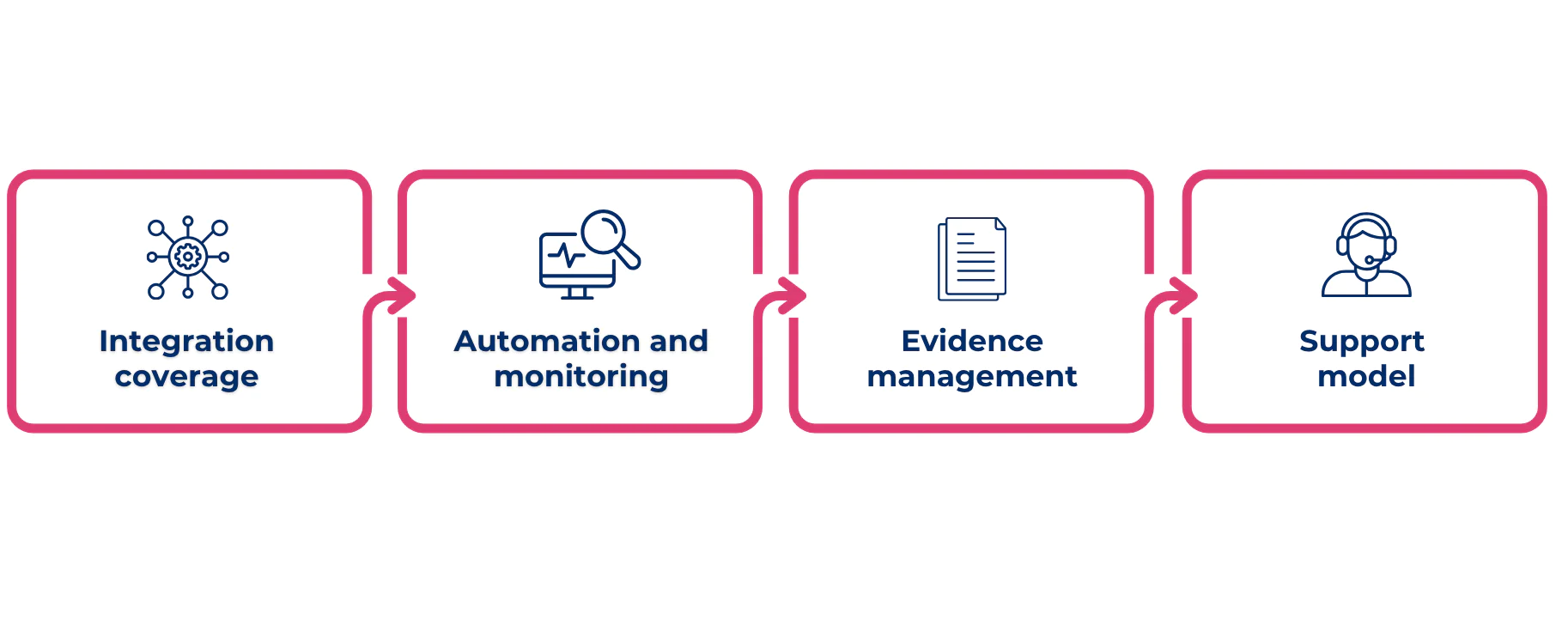
Integration coverage
Integrations are one of the most important evaluation criteria. The platform should connect directly to the systems driving your controls, including cloud infrastructure, identity providers, HR platforms, ticketing systems, and code repositories such as AWS, Azure, Okta, GitHub, and Jira. Without strong integration coverage, teams often fall back into manual evidence collection and fragmented workflows.
Automation and monitoring
Organizations should also assess how much of the compliance workflow the platform automates across the Trust Services Criteria (TSC). Strong platforms support gap analysis, control testing, evidence collection, remediation tracking, auditor collaboration, and continuous monitoring within a single workflow. This helps reduce operational overhead throughout both the initial audit and ongoing renewal cycles.
Evidence management
The quality of the evidence repository is equally important. Auditors need evidence that is organized, current, traceable, and easy to review. Platforms with structured evidence management and auditor collaboration features help reduce delays caused by missing documentation, outdated records, or disconnected request trails.
Support model
Support capabilities should also factor into the evaluation process. Many organizations require more than software alone, particularly when managing scoping, remediation planning, and auditor coordination. Platforms such as Scytale combine AI-powered automation with dedicated GRC expert support to help organizations manage the full SOC 2 lifecycle more efficiently.


How Scytale supports AI for SOC 2
Scytale helps organizations streamline SOC 2 compliance through its AI GRC platform, which automates evidence collection, continuous control monitoring, readiness tracking, and auditor collaboration across the full audit lifecycle. The platform connects directly to systems such as AWS, Azure, Okta, GitHub, and Jira to continuously collect and organize evidence, monitor control effectiveness, and maintain visibility into SOC 2 compliance posture without relying on manual spreadsheets or fragmented workflows.
Scytale’s multi-agent suite supports compliance operations through specialized AI agents that continuously manage tasks such as control mapping, evidence review, and gap detection across the GRC environment. Combined with dedicated GRC experts, multi-framework management, and a customizable Trust Center, Scytale helps SaaS organizations maintain continuous audit readiness while reducing the operational burden associated with SOC 2 compliance.
FAQs about AI for SOC 2
-
What is AI for SOC 2 compliance?
Using AI for SOC 2 compliance helps automate evidence collection, control testing, gap detection, and audit readiness tracking. It reduces manual effort by continuously monitoring controls and organizing compliance activities across integrated systems. Top SOC 2 compliance platforms like Scytale apply this approach to provide ongoing visibility into control health and audit readiness throughout the year.
-
Can AI automate the SOC 2 audit process?
AI automates large parts of SOC 2 preparation and maintenance, but it does not automate the full audit process. A licensed CPA auditor still performs the audit and issues the opinion. AI handles operational tasks such as evidence gathering, control monitoring, and readiness assessment so your team reaches fieldwork in a stronger position.
-
How does AI for SOC 2 reduce audit prep time?
AI for SOC 2 reduces audit prep time by pulling evidence directly from connected systems instead of relying on screenshots, exports, and manual reminders. It also maps evidence to controls automatically and flags missing items early. AI GRC tools like Scytale add dedicated GRC support, which helps teams move from issue discovery to remediation faster.
-
Which SOC 2 Trust Services Criteria can AI automate?
AI supports work across all Trust Services Criteria domains where evidence collection, monitoring, and control validation matter. That includes security first, then availability, confidentiality, processing integrity, and privacy where those criteria sit in scope. AI does not replace judgement on control design, but it reduces the operational work tied to proving control performance.
-
How does AI for SOC 2 support continuous compliance?
AI for SOC 2 supports continuous compliance by checking controls throughout the year and surfacing control drift before it turns into an audit issue. It keeps evidence current and shows whether settings, approvals, and workflows still align with your controls. This approach makes Type 2 periods easier to sustain than point-in-time preparation alone.