








TL;DR: Risk Management Framework
- The Risk Management Framework provides a structured approach for identifying, evaluating, treating, monitoring, and reviewing organizational risk.
- Its seven steps cover risk identification, analysis, prioritization, response planning, control implementation, monitoring, and improvement.
- Recent RMF guidance emphasizes vendor risk oversight, automation, continuous monitoring, and alignment with wider security programs.
- Teams can map RMF activities to ISO 27001, SOC 2, GDPR, HIPAA, and the NIST AI RMF to reduce duplicated compliance work.
- Scytale’s AI GRC platform centralizes risks, controls, evidence, policies, and monitoring for more consistent compliance management.
Managing cybersecurity, operational, and compliance risks is becoming increasingly complex as businesses face evolving threats and regulatory requirements. A structured Risk Management Framework (RMF) helps organizations identify potential risks, assess their impact, implement effective controls, and maintain continuous oversight to protect critical assets and support business resilience.
In this article, we’ll explore what the Risk Management Framework is, its seven key steps, benefits, and best practices. We’ll also cover recent NIST RMF updates, the importance of continuous monitoring, and how RMF aligns with ISO 27001, SOC 2, and AI risk management.
What is the Risk Management Framework?
The Risk Management Framework is a structured process for identifying, assessing, treating, monitoring, and reviewing security, privacy, and business risks.
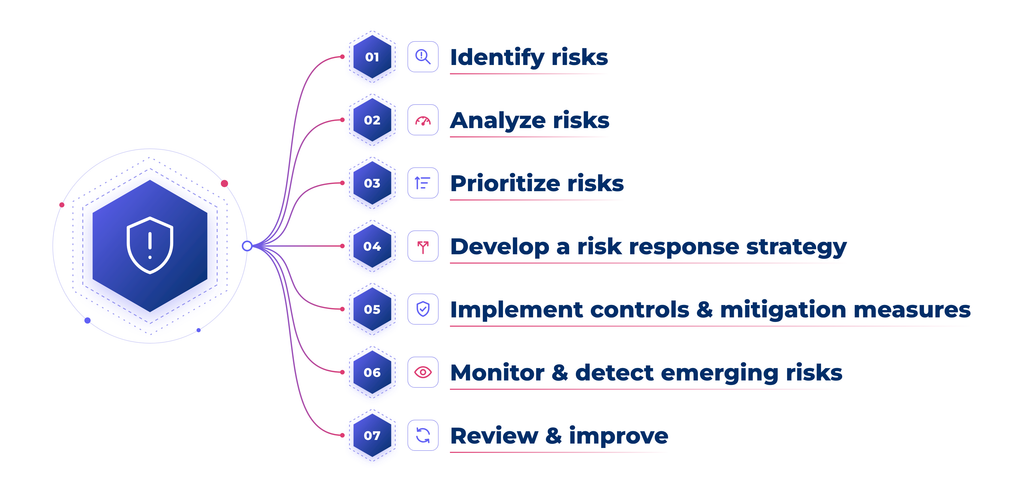
The RMF follows seven key steps: identifying risks, analyzing their impact, prioritizing severity, developing response strategies, implementing controls, monitoring risks, and regularly reviewing the framework. Implementing these steps requires coordination across security, compliance, and business teams to strengthen accountability, improve risk visibility, and support informed decision-making.
By providing a clear view of the organizational risk environment, RMF helps teams identify potential threats and take proactive action before they escalate. It also strengthens compliance, privacy, and security practices by guiding control selection, assigning ownership, and documenting risk treatment decisions. These records support continuous improvement and demonstrate effective risk oversight during audits and customer reviews.
Streamline GRC workflows with seamless automation.
What are the seven steps in the Risk Management Framework?
The seven steps outlined below provide a structured approach to identifying, assessing, prioritizing, and managing organizational risks. While they share principles with the NIST Risk Management Framework, they differ from NIST’s seven formal steps. Before beginning, organizations should define the scope of their risk management activities, identify relevant stakeholders, and establish a risk management plan aligned with business objectives and risk tolerance.
Step 1: Identify risks
Start by identifying potential risks that could affect the organization, including cybersecurity threats, operational disruptions, and regulatory compliance challenges. Document affected systems, processes, stakeholders, and potential business impacts to establish a clear understanding of the organization’s risk exposure.
Step 2: Analyze risks
Evaluate each identified risk based on its likelihood and potential impact. Consider financial losses, operational disruptions, legal consequences, and reputational damage. This analysis helps organizations understand the severity of risks and determine appropriate mitigation strategies.
Step 3: Prioritize risks
Not all risks require the same level of attention. Prioritize risks based on their likelihood, severity, and potential impact on business objectives. A consistent prioritization approach helps organizations allocate resources effectively and address the most critical threats first.
Step 4: Develop a risk response strategy
Determine how to address each risk by mitigating, accepting, transferring, or avoiding it. Choose strategies that align with the organization’s risk tolerance and business priorities, and assign clear responsibilities, deadlines, and approval requirements for each response plan.
Step 5: Implement controls and mitigation measures
Put risk mitigation strategies into practice by implementing appropriate policies, security controls, and operational improvements. Assign owners and timelines to each activity to ensure risks are addressed consistently and mitigation efforts remain accountable.
Step 6: Monitor and detect emerging risks
Continuously monitor identified risks, assess control effectiveness, and track mitigation progress. As business operations and threat landscapes evolve, organizations should identify emerging risks and adjust their response plans to maintain effective risk management.
Step 7: Review and improve
Regularly evaluate the effectiveness of the risk management strategy using insights from audits, incidents, control testing, and changing business requirements. Update risk assessments, controls, and treatment plans to ensure the risk management process remains effective and aligned with organizational objectives.
Recent updates to the NIST Risk Management Framework
The NIST Risk Management Framework (RMF) continues to evolve to help organizations manage security and privacy risks more effectively. Updates to NIST guidance emphasize a flexible, integrated approach to risk management, aligning security and privacy practices with business objectives. Greater focus on continuous monitoring and lifecycle risk management helps organizations identify vulnerabilities, maintain effective controls, and respond to emerging threats.
NIST guidance also reinforces the importance of vendor risk management and automation in managing security risks. Organizations are encouraged to assess third-party risks, monitor control effectiveness, and streamline repetitive compliance activities. AI-powered compliance tools can support these efforts by improving risk visibility, automating evidence collection, and helping teams identify potential security gaps earlier.
Additionally, NIST promotes alignment between the RMF and the NIST Cybersecurity Framework (CSF), supporting a more coordinated approach to cybersecurity risk management. By connecting risk assessments, security controls, and compliance activities, organizations can strengthen oversight, reduce duplicated efforts, and make more informed risk decisions as security requirements evolve.
AI-native GRC for how enterprise teams work today.
Benefits of the Risk Management Framework
Implementing an effective Risk Management Framework (RMF) helps organizations identify, assess, and manage risks consistently across business operations. By establishing clear processes for risk assessment, mitigation, and continuous monitoring, the RMF improves decision-making, strengthens security, and supports regulatory compliance. Key benefits include:
- Improved operational efficiency: Identifying process weaknesses and potential disruptions helps organizations optimize resources, reduce inefficiencies, and improve day-to-day operations.
- Greater risk visibility and awareness: A structured approach to risk management helps teams identify emerging threats, assess their potential impact, and implement safeguards before they affect critical business activities.
- Stronger compliance alignment: The RMF supports risk management practices that complement frameworks and regulations such as ISO 27001, GDPR, and SOC 2, helping organizations maintain effective controls and demonstrate compliance.
- Better decision-making: Clear risk assessments and documented mitigation strategies help leadership prioritize investments, allocate resources effectively, and make informed business decisions.
- Increased business resilience: Proactive risk management reduces the likelihood and impact of security incidents, operational disruptions, and financial losses.
By integrating risk management into everyday operations, organizations can reduce costs, protect critical assets, and strengthen customer trust. A well-implemented RMF also supports long-term business growth by helping teams adapt to evolving threats, regulatory requirements, and business priorities.
Risk Management Framework best practices
Implementing a Risk Management Framework (RMF) effectively requires a structured approach to identifying, assessing, and managing risks across the organization. Following established best practices helps teams maintain consistent processes, strengthen accountability, and align risk management activities with business objectives and compliance requirements. Key best practices include:
- Conduct regular risk assessments: Identify and assess risks across systems, processes, and business operations. Evaluate their likelihood, severity, and potential impact to prioritize threats and determine appropriate mitigation strategies.
- Develop a comprehensive risk management plan: Establish clear risk treatment strategies, objectives, responsibilities, and timelines. Ensure the plan aligns with organizational risk tolerance, business priorities, and available resources.
- Implement effective risk controls: Establish security policies, preventive measures, and procedures to address high-priority risks. This may include strengthening cybersecurity controls, improving internal processes, and providing ongoing employee security awareness training.
- Continuously monitor risks and progress: Track risk mitigation activities, assess control effectiveness, and identify emerging threats. Regular monitoring helps organizations respond proactively to changes and maintain visibility into their risk exposure.
- Regularly review and update the framework: Evaluate risk management processes as business operations, technologies, and regulatory requirements evolve. Update policies, controls, and treatment strategies to address new vulnerabilities and improve overall effectiveness.
By following these best practices, organizations can establish a proactive, consistent approach to risk management that protects critical assets, strengthens compliance, and supports long-term business resilience. Integrating continuous monitoring and clear accountability into everyday operations also helps teams make informed decisions and adapt to evolving risks.



Continuous monitoring and evaluation
Continuous monitoring and regular audits are essential for maintaining an effective Risk Management Framework (RMF) as business operations, threats, and compliance requirements evolve. Monitoring helps organizations track emerging risks, assess control effectiveness, and identify potential vulnerabilities, while audits evaluate whether risk management processes and controls are functioning as intended. Together, these activities support informed decision-making and continuous improvement.
Organizations should establish regular monitoring and review schedules, document findings, and assign clear ownership for corrective actions. Using risk management automation software can streamline these activities by reducing manual work, providing real-time visibility into risks and control performance, and flagging potential compliance gaps before they escalate.
AI-powered automation further improves efficiency by simplifying evidence collection, control testing, and cross-framework mapping. By connecting overlapping requirements across multiple compliance frameworks, organizations can reduce duplicate work, strengthen risk oversight, and dedicate more time to high-priority activities such as risk mitigation and remediation.
Applying RMF practices across the organization
Organizations strengthen risk management by applying the seven RMF steps and documented best practices consistently. Clear ownership, control testing, and regular review help teams address risk before it disrupts operations. Leaders should also connect RMF reporting with strategic planning and investment decisions.
Each organization should tailor its RMF to its risk profile, systems, and business objectives. A thorough program identifies, assesses, treats, monitors, and reassesses risks across critical processes. Consistent execution gives leaders reliable information for risk decisions and supports accountable governance.
How the RMF maps to ISO 27001 and SOC 2
The RMF, ISO 27001, and SOC 2 all rely on risk-based management, though each serves a distinct purpose. RMF organizes security and privacy risk activities across a system lifecycle. ISO/IEC 27001:2022 requires an information security management system, while SOC 2 evaluates controls against the Trust Services Criteria.
Teams should maintain one risk register and control inventory across these programs instead of creating separate evidence sets. Risk identification and analysis inform ISO 27001 treatment decisions, while control implementation, testing, and monitoring support SOC 2 readiness. This shared approach reduces duplicate assessment work and gives control owners clearer accountability. Cross-framework mapping connects related risk and control requirements without forcing teams to maintain disconnected compliance programs.
For example, Sport Alliance uses Scytale’s multi-framework cross-mapping to turn ISO 27001 work into GDPR coverage across more than 500 endpoints.
RMF, ISO 27001, and SOC 2 alignment
| RMF activity | ISO 27001 alignment | SOC 2 alignment |
|---|---|---|
| Identify and analyze risk | ISMS risk assessment and treatment planning | Risk assessment for relevant Trust Services Criteria |
| Implement controls | Annex A control selection and implementation | Control design and operating effectiveness |
| Monitor and improve | Internal audits, management review, and corrective action | Control monitoring, evidence collection, and audit testing |
Where the NIST AI RMF fits
The NIST AI RMF complements an established RMF program when organizations build, buy, or deploy AI systems. Its four functions, Govern, Map, Measure, and Manage, focus on AI-specific risks involving model performance, human oversight, transparency, data quality, and harmful outcomes. Governance operates across the AI lifecycle and informs the other three functions.
Use the enterprise RMF to manage broader operational, security, privacy, and compliance risk. Then apply the NIST AI RMF to document system context, assess relevant impacts, test performance, and assign treatment decisions. This structure connects AI governance with existing risk ownership, controls, and executive reporting.
The AI RMF does not replace the enterprise RMF or an ISMS. It adds AI-specific risk practices for model development, procurement, deployment, monitoring, and retirement. Teams should assign AI risk owners, document acceptable use requirements, and review AI system performance against defined risk thresholds. NIST also publishes companion resources, including the AI RMF Playbook and a Generative AI Profile, that translate the four functions into suggested actions. Organizations pursuing ISO 42001 certification can often reuse this documentation for their AI management system.
Always-on GRC. Built for modern teams.
Simplify risk management with Scytale
Effective risk management requires continuous monitoring, clear accountability, and consistent oversight of risks and controls. Scytale simplifies this process with its AI GRC platform, centralizing risk assessments, controls, policies, and compliance evidence in one place. Through AI-powered automation, continuous monitoring, and multi-framework management, Scytale helps organizations identify risks earlier, reduce manual work, and maintain compliance with frameworks such as ISO 27001, SOC 2, and GDPR.
Beyond technology, Scytale’s dedicated GRC experts provide hands-on guidance to help organizations implement effective risk management practices, address compliance gaps, and prepare for audits. By combining intelligent automation with expert support, Scytale helps teams strengthen risk oversight, make informed decisions, and maintain a more proactive, scalable approach to risk management.
FAQs about Risk Management Framework steps
What is the Risk Management Framework (RMF)?
The Risk Management Framework (RMF) is a structured process that helps organizations identify, assess, mitigate, and monitor risks. It ensures that security, privacy, and compliance measures are effectively integrated into an organization’s operations to protect against threats and regulatory challenges.
What are the 7 steps in the Risk Management Framework?
The 7 steps in the RMF are: identify risks, analyze their impact, prioritize risks based on severity, develop a risk response strategy, implement controls and mitigation measures, continuously monitor risks, and regularly review and improve the framework to maintain its effectiveness.
What are the key challenges in implementing the RMF?
Common challenges include resource limitations, difficulty in integrating RMF with existing processes, keeping up with compliance and regulatory changes, and ensuring continuous monitoring of risks. Many organizations also struggle with automating security controls and managing third-party risks. Scytale’s AI GRC platform helps reduce this burden by automating evidence collection, control monitoring, and vendor risk assessments in one place.
What are the benefits of the Risk Management Framework?
The RMF improves security, compliance, and operational efficiency by helping organizations proactively manage risks. It enhances risk awareness, streamlines decision-making, ensures compliance with key frameworks like ISO 27001 and SOC 2, and helps prevent costly data breaches or operational disruptions.
What are the 5 best practices for risk management?
The five best practices for effective risk management include conducting a thorough risk assessment, developing a detailed risk management plan with clear strategies and goals, and establishing controls for high-risk situations. It’s also essential to regularly monitor the effectiveness of your risk management framework (RMF) and review it to stay ahead of emerging risks. Leading AI GRC platforms like Scytale can simplify risk management processes, streamline monitoring, and ensure continuous compliance while quickly responding to new threats.
