


TL;DR: GRC Explained for Modern Organizations
- GRC brings together governance, risk management, and compliance to help organizations operate securely, strategically, and at scale.
- A strong GRC program improves resilience, builds trust, and helps organizations keep pace with rising security and customer expectations.
- Scytale enables SaaS organizations to automate core GRC workflows, including evidence collection, risk tracking, multi-framework readiness, and continuous control monitoring.
- Without GRC, organizations face audit fatigue, inconsistent policies, and limited visibility into risks that affect both strategy and daily operations.
- Top GRC software platforms like Scytale drive continuous compliance while improving efficiency and supporting scalable, long-term growth.
Modern organizations today operate under growing pressure from regulators, customers, investors, and internal stakeholders. Cyber threats evolve faster, data regulations tighten, and security expectations rise across every industry. In this environment, ad hoc risk and compliance approaches no longer hold up.
Governance, Risk, and Compliance (GRC) provides the structure organizations need to prevent incidents, meet regulatory obligations, reduce audit strain, and operate securely at scale. Rather than treating governance, risk, and compliance as separate functions, GRC unifies them into a single, coordinated strategy. For mid-market and enterprise organizations, GRC is no longer a “nice to have.” It is a core operational discipline that influences board decisions, product expansion, customer acquisition, vendor partnerships, and long-term resilience.
In this guide, you’ll learn what GRC really means, why it’s become essential for SaaS organizations, and how security and compliance leaders use advanced GRC software like Scytale to run GRC programs more efficiently.
What Does GRC Stand For?
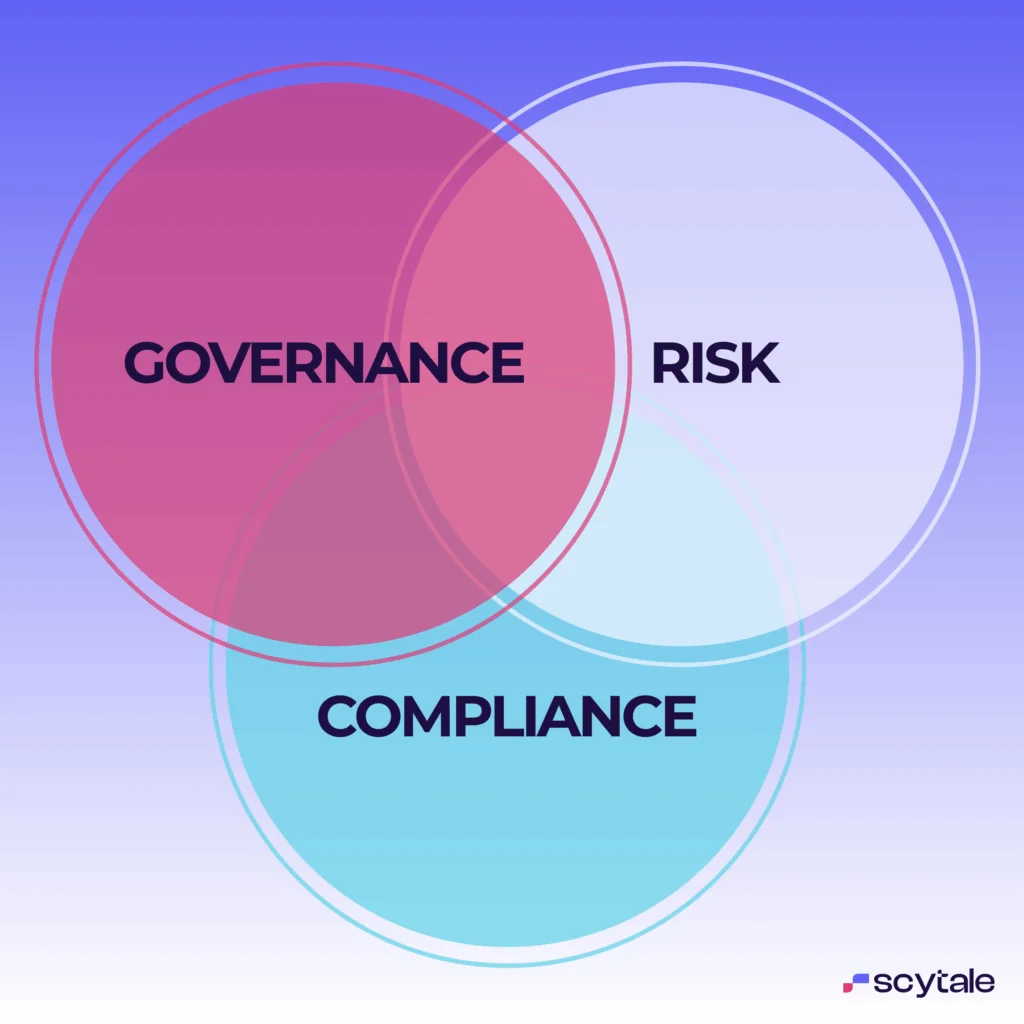
GRC stands for Governance, Risk, and Compliance. These three pillars work together to create a structured approach to how organizations operate, manage uncertainty, and meet their security and regulatory obligations. Rather than functioning in isolation, governance defines direction, risk management identifies and mitigates threats, and compliance ensures required standards are met. Together, they form a continuous, interconnected system for running a secure and accountable organization.
Governance
Governance refers to the leadership structures, policies, and decision-making frameworks that guide how an organization operates. In a GRC context, governance defines accountability, establishes oversight, and ensures that business decisions align with strategic goals. It includes policy development, board and executive oversight, internal committees, approval workflows, escalation paths, and performance monitoring. Strong governance reduces ambiguity by clearly defining who owns what, how decisions are made, and how success is measured. For growing organizations, governance also provides consistency across departments, ensuring that security, risk, and compliance expectations are clearly documented and applied in a uniform, controlled manner.
Risk Management
Risk management focuses on identifying, assessing, and mitigating threats that could impact the organization’s operations, finances, reputation, or security posture. These risks can include cybersecurity incidents, operational failures, vendor dependencies, data breaches, regulatory exposure, and infrastructure vulnerabilities. Risk management frameworks help teams score risks, assign ownership, implement mitigation strategies, and continuously monitor changes. Executives rely on this information to make informed decisions: which initiatives to invest in, which systems to modernize, which vulnerabilities most urgently require attention, and how risks affect strategic planning. The goal is not to eliminate risk entirely, but to understand and control it before it disrupts the business.
Compliance
Compliance ensures organizations meet internal policies, regulatory requirements, legal obligations, and industry standards. These obligations may stem from regional data protection laws (such as GDPR in the EU), security frameworks (such as SOC 2 or ISO 27001), financial and reporting regulations (such as SOX ITGC), country-specific regulations (such as HIPAA in the US), and customer, partner, or contractual requirements.
Failure to comply can lead to fines, reputational damage, operational disruption, and loss of customer trust. A strong compliance function ensures the right controls exist, compliance documentation is maintained, and audits run smoothly. As companies scale, compliance only becomes more complex, making structure and automation critical for staying ahead of changing requirements.
Why Is GRC Important?
GRC is important because it creates a proactive, structured approach to managing both opportunity and risk. Without GRC, companies often rely on ad-hoc decisions, scattered documentation, or inconsistent processes across teams. This increases exposure, slows growth, and erodes trust. A mature GRC program helps organizations avoid fines, prevent data breaches, respond to threats confidently, and demonstrate security readiness to customers and investors.
From an operational standpoint, GRC improves efficiency by eliminating duplicated work, reducing last-minute audit chaos, and ensuring teams follow the same standards.
Strategically, it enables leadership to view risks in the context of business goals, helping them prioritize investments and avoid surprises down the line.
In a climate where customers increasingly vet vendors based on security maturity, GRC also becomes a key competitive differentiator, helping companies accelerate enterprise deals by providing strong evidence of compliance.
Who Needs GRC?
Formal GRC programs benefit organizations of all sizes, but their importance grows significantly for companies operating in regulated industries, handling sensitive data, or scaling rapidly. As systems, teams, and compliance obligations expand, controlling risk and maintaining consistent oversight becomes impossible without structured GRC.
Mid-Market Companies
Mid-market companies often grow faster than their internal processes can keep up with. As they expand across regions, onboard more customers, or introduce new products, they face heightened expectations around security and compliance. Enterprise clients frequently request proof of trust, such as SOC 2 or ISO 27001 certifications, which can be effectively demonstrated through a Trust Center.
Without a GRC program, these requests lead to bottlenecks, duplicate work, and reactive firefighting. Structured GRC allows mid-market companies to scale with confidence, reduce audit cycles, and avoid losing deals due to delayed readiness.
Enterprise Organizations
Enterprise organizations face high levels of complexity across infrastructure, vendors, regions, and regulatory obligations. Different business units may fall under different frameworks and reporting requirements. Without centralized GRC, risk and compliance become fragmented and difficult to govern.
A structured enterprise GRC program standardizes controls, centralizes reporting, and provides leadership with a unified view of enterprise-wide risk. It also supports board-level oversight, audit coordination, and consistent enforcement across global teams.
Get Compliant 90% Faster
Common Challenges Organizations Face Without GRC
Without a structured GRC function, organizations experience recurring issues that slow down operations and increase risk exposure. Siloed risk data is one of the most common challenges. Departments track risks differently, making enterprise-wide visibility nearly impossible. This undermines executive decision-making and leads to misaligned priorities.
Another major challenge is audit fatigue. Teams without centralized evidence collection or updated control environments spend hundreds of hours preparing for audits, often repeating manual tasks every cycle. This results in burnout, inefficiency, and delayed audits.
Inconsistent or outdated policies are another sign of weak GRC. Without centralized governance, different teams follow different practices, creating operational inconsistencies and increasing the likelihood of breaches or compliance violations.
Finally, organizations without GRC tend to operate reactively – responding to incidents, new regulations, or customer requests only once they become urgent. This reactive posture creates stress, unnecessary costs, and reputational risk.
Benefits of Implementing a GRC Program
A mature GRC program delivers significant benefits across operational, strategic, and financial dimensions. One of the most immediate benefits is reduced audit effort. By centralizing controls, evidence, and ownership, audits become faster, more predictable, and less resource-intensive.
GRC also accelerates sales cycles. Today’s customers, especially enterprises, often require detailed security documentation before signing new contracts. Companies with mature GRC programs can provide this documentation quickly, reducing friction and speeding revenue generation.
Another major benefit is improved risk visibility. With a unified risk register and reporting system, leadership gains an accurate understanding of the organization’s security vulnerabilities and priorities. This visibility supports better investments, faster responses, and alignment across teams.
Operational efficiency increases as manual tasks are replaced with automation and standardized GRC workflows. Compliance requirements become clearer, responsibilities are well-defined, and teams spend far less time chasing information.
Finally, GRC strengthens trust with customers, partners, and employees. Demonstrating clear governance and consistent security practices positions the organization as reliable, trustworthy, and responsible, critical for long-term growth and market reputation.
GRC Business Outcomes: Audit Readiness, Risk Visibility, and Efficiency
The table below summarizes how a mature GRC program translates into measurable business outcomes.
| GRC Benefit | What It Delivers | Business Impact |
|---|---|---|
| Reduced audit effort | Centralized controls, compliance evidence, and ownership | Faster audits, lower internal workload, fewer last-minute gaps |
| Faster sales cycles | On-demand security and compliance documentation | Shorter deal cycles, fewer security review delays |
| Improved risk visibility | Real-time risk visibility and reporting | Better executive decision-making and risk prioritization |
| Operational efficiency | Automated GRC workflows and standardized processes | Less manual work, clearer ownership, lower operational strain |
| Stronger trust and assurance | Consistent governance and documented controls | Increased confidence from customers, partners, and regulators |
💡See how organizations scale their GRC programs without adding operational complexity.
GRC Frameworks and Standards
Most modern organizations must comply with multiple security and privacy frameworks at the same time. These frameworks vary by industry, geography, and customer requirements.
Common examples include SOC 2 for service organizations, ISO 27001 for information security management, NIST CSF for cybersecurity risk management, GDPR for data protection in the EU, HIPAA for healthcare data, PCI DSS for payment security, and SOX ITGC for financial control assurance.
Managing these frameworks independently creates duplicated effort and inconsistent controls. A mature GRC program maps overlapping requirements into a single control framework. This allows organizations to satisfy multiple audits using shared evidence and unified reporting.
As companies expand into new markets, a centralized GRC approach prevents fragmentation and supports scalable compliance across regions and industries.
Overlapping Security and IT Controls Across Compliance Frameworks
| Requirement / Control | SOC 2 | ISO 27001 | NIST CSF | GDPR | HIPAA | SOX ITGC |
|---|---|---|---|---|---|---|
| Access Control | ✓ | ✓ | ✓ | ✓ | ✓ | ✓ |
| Encryption | ✓ | ✓ | ✓ | ✓ | ✓ | — |
| Incident Response | ✓ | ✓ | ✓ | — | ✓ | — |
| Risk Assessment | ✓ | ✓ | ✓ | — | — | — |
| Vendor Management | ✓ | ✓ | ✓ | ✓ | — | ✓* |
*where vendors impact financial reporting systems
This overlap illustrates why organizations benefit from unified GRC programs. As illustrated above, many controls serve multiple frameworks.
How GRC Software Supports Your Program
Organizations quickly discover that manual GRC workflows cannot keep pace with compliance growth. Spreadsheets become outdated, ownership becomes unclear, and audit preparation starts eating up valuable time and resources, all while pulling your team away from the work that actually grows the business.
GRC platforms address these challenges by centralizing and automating core GRC workflows:
- Automated Evidence Collection: No more chasing screenshots or logs.
- Policy Management: Creation, updates, distribution, and acknowledgement tracking.
- Risk Management: Real-time risk scoring, assessments, ownership, and dashboards.
- Audit Readiness: Pre-built policy templates, mapped controls, and integrated auditor collaboration.
- Continuous Control Monitoring: Visibility into whether key controls are operating effectively.
- Vendor Risk Management: Centralized assessments and monitoring.


AI-powered compliance automation platforms like Scytale centralize core GRC workflows, from automated evidence collection and risk assessments to vendor risk management and multi-framework mapping. With real-time visibility into your risk, security, and compliance posture and centralized reporting, teams manage all GRC operations in a single hub while reducing manual workload and audit friction.
How to Get Started with GRC
1. Assess your current state
Start by reviewing your existing policies, controls, risks, documentation, ownership structures, and compliance obligations. This baseline helps reveal any gaps, duplicate efforts, and priority areas that require immediate attention before formalizing your GRC program.
2. Identify the frameworks that apply to your business
Determine which regulations and standards impact your organization based on industry, stakeholder requirements, and geographic operations.
This may include SOX ITGC or other critical security and privacy frameworks such as SOC 2, ISO 27001, ISO 42001, NIST, GDPR, or HIPAA, depending on your regulatory environment and the type of data you manage as your business expands.
3. Select the right GRC technology
Choose a GRC software solution that centralizes workflows, accelerates audit readiness, and improves operational efficiency through AI-driven automation.
Top GRC tools like Scytale reduce manual effort, strengthen risk oversight, support cross-framework control mapping, and maintain continuous compliance, removing the operational friction that slows GRC processes down. Additionally, added support from dedicated GRC experts helps teams stay on track and support predictable, defensible audit outcomes.
4. Build cross-functional alignment
GRC requires effective collaboration across all departments including security, engineering, legal, HR, operations, and finance. Clearly defined ownership and communication channels ensure smoother execution, sustained adoption, and long-term program success.
💡 Learn how organizations manage GRC processes more efficiently and explore how AI-powered automation can simplify compliance by booking a demo with the Scytale team.
FAQs about GRC
What is the difference between GRC and compliance?
Compliance is one component of GRC. It focuses on meeting regulations and standards. GRC is the broader strategy that also includes governance and risk management. Together, these three elements ensure organizations operate securely, responsibly, and in alignment with business objectives.
How long does it take to implement a GRC program?
Implementation timelines depend on organization size, industry, and regulatory scope. Some companies take several months to mature their programs. Using GRC software like Scytale significantly accelerates timelines by automating evidence collection, control mapping, and audit preparation.
What’s the ROI of GRC?
The ROI of GRC comes from reduced audit costs, fewer security incidents, stronger operational efficiency, and faster enterprise sales cycles. Organizations with mature GRC programs close deals faster and avoid regulatory penalties through continuous control monitoring and structured risk management. Scytale helps teams capture this value by eliminating manual work and ensuring continuous compliance at all times.
Do small companies need GRC?
Yes. Small companies benefit from GRC early, especially if they plan to work with enterprises that require SOC 2, ISO 27001, or GDPR readiness. Buyers often request evidence of security and compliance early in the sales process. Establishing GRC early prevents last-minute audit pressure and creates a solid foundation for secure, scalable growth. AI-powered compliance automation platforms like Scytale help startups and small teams manage GRC requirements without unnecessary complexity.
