


TL;DR: GRC compliance
- GRC stands for Governance, Risk, and Compliance and helps organizations manage security, operations, and regulatory requirements in a structured way.
- The three core components of GRC are governance, risk management, and compliance.
- Common GRC challenges include manual processes, siloed teams, unclear ownership, changing requirements, and limited resources.
- Effective GRC programs rely on risk assessments, automation, centralized processes, continuous monitoring, and clear ownership.
- Scytale helps organizations streamline GRC operations through AI-powered automation, continuous compliance monitoring, and centralized visibility across multiple frameworks.
Modern organizations face growing pressure to manage security, compliance, risk, and operational oversight more effectively than ever before. As businesses scale, adopt new technologies, expand into new markets, and handle increasing volumes of sensitive data, managing these responsibilities through disconnected processes and manual workflows becomes increasingly difficult. At the same time, customers, regulators, investors, and partners expect greater transparency, stronger security practices, and continuous compliance with a growing number of industry frameworks and regulations.
This is where Governance, Risk, and Compliance (GRC) becomes essential. A strong GRC strategy helps organizations create structure around how risks are managed, how controls are maintained, and how compliance obligations are met across the business.
In this article, we’ll cover what GRC compliance is, the core components of a GRC framework, common challenges, best practices, and how organizations can manage GRC more effectively as they grow.
What is GRC compliance?
GRC compliance refers to the processes, policies, controls, and systems organizations use to manage governance, risk, and compliance in a centralized and scalable way. Rather than handling security, risk management, and regulatory requirements separately, a GRC approach brings these functions together to improve visibility, strengthen oversight, and support more consistent decision-making across the organization. It helps businesses establish accountability, identify and address potential risks, and maintain alignment with relevant laws, regulations, and industry standards.
For modern SaaS organizations, GRC compliance plays an important role in building trust, reducing operational risk, and supporting long-term growth. As customer expectations and GRC requirements continue to grow, organizations are expected to demonstrate strong security and continuous compliance across frameworks such as SOC 2, ISO 27001, HIPAA, GDPR, PCI DSS, and SOX ITGC. A strong GRC program helps organizations move beyond reactive audit preparation by enabling continuous monitoring, streamlined compliance operations, improved audit readiness, and better control visibility across the business.
Streamline GRC workflows with no blind spots.
What are the core components of GRC?
A successful GRC program is built around three core pillars that work together to support secure and organized business operations across the organization. While each component has a different role, they are most effective when managed as part of a connected strategy rather than separate initiatives.
For growing SaaS companies, this approach helps create clearer accountability, improve coordination between teams, and simplify the management of multiple security and compliance requirements as the organization scales.
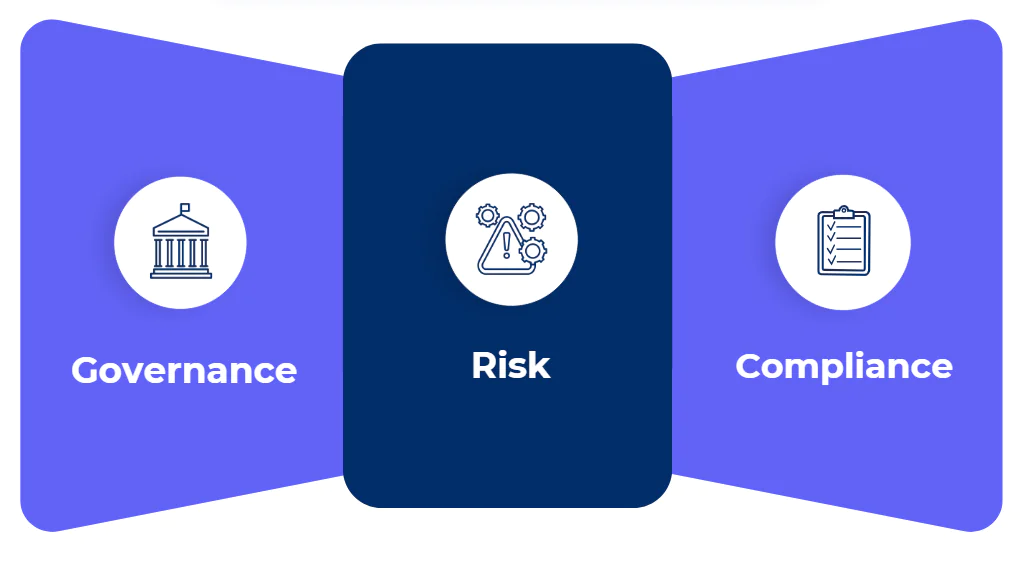
3 core pillars of GRC
| GRC component | Primary focus | What it looks like in practice |
| Governance | Oversight and accountability | Establishing policies, defining ownership, creating internal controls, and ensuring leadership has visibility into security, compliance, and operational processes across the organization. |
| Risk management | Identifying and reducing risk | Continuously identifying, assessing, prioritizing, and mitigating risks related to cybersecurity, operations, vendors, finances, and regulatory exposure before they impact the business. |
| Compliance | Meeting regulatory and framework requirements | Implementing and maintaining the controls, documentation, monitoring processes, and evidence needed to align with frameworks and regulations such as SOC 2, ISO 27001, HIPAA, GDPR, PCI DSS, and SOX ITGC. |
Key benefits of an effective GRC strategy
A well-structured GRC strategy helps organizations manage security, compliance, risk, and internal operations in a more efficient and structured way. It creates a more proactive approach to handling controls, audits, and compliance requirements across the organization. Here are some of the key benefits of implementing an effective GRC program:
Streamlined audits
Centralized controls, policies, and evidence management help teams stay audit-ready throughout the year. This reduces the manual effort and last-minute scrambling often associated with audit preparation.
Improved risk visibility
GRC helps organizations identify and address security, operational, vendor, and compliance risks earlier. This allows teams to respond more proactively before they impact operations or compliance readiness.
Stronger customer trust
Demonstrating strong security and compliance practices helps build confidence with customers, partners, investors, and procurement teams. It also supports stronger business relationships and enterprise credibility.
Faster sales cycles
Well-organized GRC processes make it easier to complete security questionnaires and vendor reviews. This can help reduce delays during procurement and accelerate sales conversations.
Greater operational confidence
An effective GRC program provides stronger oversight across security and compliance activities. This helps organizations operate more efficiently and maintain better control visibility as they scale.
Common challenges in GRC implementation
Implementing and managing a GRC program can become increasingly complex as organizations grow, adopt additional frameworks, and face evolving regulatory requirements. Without the right processes and visibility in place, teams often struggle to manage GRC workflows efficiently. Common compliance challenges include:
- Manual processes: Many organizations still rely on spreadsheets, screenshots, emails, and disconnected systems to manage policies, evidence collection, and risk assessments, creating unnecessary manual work and increasing the risk of errors.
- Siloed teams: Governance, risk, compliance, security, and IT teams often work separately without centralized visibility into controls, risks, or compliance progress.
- Unclear responsibilities: Without clearly defined responsibilities, important tasks such as control monitoring, remediation, and policy management can easily fall behind.
- Changing requirements: Organizations must continuously adapt to changing frameworks, regulations, and customer security expectations.
- Limited resources: Many growing organizations lack the internal resources, dedicated personnel, or technology needed to manage GRC effectively and at scale.
AI-native GRC for how teams work today.
Best practices for GRC success
Building an effective GRC program requires more than simply meeting compliance requirements. Organizations need clear processes, continuous visibility, defined ownership, and the ability to adapt as risks and business needs change. By following a structured and proactive approach, teams can improve operational efficiency, strengthen security oversight, and maintain long-term GRC readiness.
Start with a risk assessment
A strong risk management strategy helps organizations prioritize resources and focus on the areas that present the greatest operational or security impact. Taking a risk-based approach allows teams to prioritize resources and focus on the areas that present the greatest operational or security impact.
Centralize GRC activities
Managing governance, risk, compliance, security, and privacy initiatives through a unified strategy improves coordination across teams and reduces duplicated work. Centralized visibility also makes it easier to track controls, risks, and compliance progress.
Automate manual processes
Automating tasks such as evidence collection, control monitoring, policy management, and framework cross-mapping helps reduce manual effort, improve consistency, and support more scalable compliance operations.
Define clear ownership
Assigning responsibility for controls, policies, risks, and remediation activities improves accountability and helps ensure important tasks are actively managed and maintained over time.
Take a continuous approach
GRC should be treated as a continuous operational process rather than a one-time audit exercise. Regular reviews, continuous monitoring, and ongoing updates help organizations maintain stronger oversight and adapt to changing requirements more effectively.
Track performance and progress
Tracking GRC metrics related to controls, risks, remediation efforts, and compliance activities helps organizations identify gaps earlier, measure program effectiveness, and support more informed decision-making.
Always-on GRC. Built for modern teams.
What to look for in a GRC compliance solution
Choosing the right GRC solution is important for building a scalable and efficient compliance program. As compliance needs become more complex, organizations need GRC tools that do more than simply track compliance tasks.
Here are some key capabilities to look for in a modern GRC compliance solution:
1. GRC automation
A strong GRC platform should automate repetitive tasks such as evidence collection, control monitoring, policy management, and compliance tracking. Continuous monitoring capabilities also help organizations maintain ongoing visibility into controls and risks rather than relying on point-in-time assessments.
2. Multi-framework support
Many organizations need to manage multiple frameworks and regulations simultaneously, such as SOC 2, ISO 27001, HIPAA, GDPR, PCI DSS, and SOX ITGC. Look for a solution that supports framework cross-mapping to reduce duplicated work and simplify compliance management.
3. Centralized visibility
Centralized dashboards, reporting, and risk tracking help teams maintain clearer oversight into controls, remediation efforts, audit readiness, and overall compliance posture across the organization.
4. Scalability
As businesses grow, compliance requirements become more complex. A GRC solution should be flexible enough to support new frameworks, changing business operations, and evolving regulatory requirements without creating additional operational overhead.
5. Collaboration and ownership
Clear ownership and collaboration features help ensure tasks, controls, policies, and remediation activities are assigned, monitored, and completed efficiently across teams.
6. Expert GRC support
Technology alone is often not enough to manage compliance effectively. Many organizations benefit from solutions that combine automation with dedicated GRC expertise to help guide implementation, remediation, audits, and continuous compliance operations.
Why is ESG integration becoming more important?
GRC programs are no longer focused solely on security and compliance requirements. Increasingly, organizations are also expected to demonstrate accountability around environmental, social, and governance (ESG) initiatives. Investors, customers, partners, employees, and regulators are placing greater emphasis on how companies operate beyond financial performance and data protection alone.
Integrating ESG into a broader GRC strategy helps organizations manage and report on areas such as environmental impact, ethical business practices, corporate governance, diversity and inclusion initiatives, and social responsibility efforts. As ESG expectations continue to evolve, businesses are under growing pressure to provide greater transparency, measurable reporting, and improved accountability across these areas.
For SaaS organizations, ESG integration is becoming an important part of long-term business strategy and GRC risk management. Strong ESG practices can help strengthen brand reputation, support investor confidence, improve customer trust, and position organizations more competitively in enterprise procurement and partnership evaluations. As a result, many organizations are expanding their GRC programs to include ESG oversight as part of a more comprehensive governance and risk management approach.

Streamline your GRC program with Scytale
Scytale helps organizations simplify and centralize governance, risk, and compliance management through an AI GRC platform built to support continuous compliance management. As organizations grow and manage increasing security, regulatory, and customer requirements, Scytale streamlines key GRC processes such as evidence collection, control monitoring, policy management, risk tracking, and multi-framework compliance management from a single centralized platform.
With support for frameworks and regulations including SOC 2, ISO 27001, HIPAA, GDPR, PCI DSS, and SOX ITGC, Scytale helps organizations reduce manual effort, improve audit readiness, and streamline security and compliance operations. Combined with dedicated GRC expert guidance, teams can manage compliance more efficiently as requirements continue to grow and change.
FAQs about GRC compliance
What is GRC compliance?
GRC compliance refers to the processes, controls, and systems organizations use to manage governance, risk, and compliance in a centralized approach. It helps businesses maintain oversight across security, operational, and regulatory requirements while supporting ongoing compliance with frameworks and regulations such as SOC 2, ISO 27001, HIPAA, GDPR, PCI DSS, and SOX ITGC.
Why is GRC compliance important for businesses?
GRC compliance helps organizations reduce operational and security risks, improve audit readiness, strengthen customer trust, and maintain alignment with regulatory requirements. As businesses grow, managing compliance manually becomes increasingly difficult, making a structured GRC approach important for maintaining visibility, accountability, and operational efficiency.
What are the key components of a GRC framework?
A GRC framework is built around three core components: governance, risk management, and compliance. Governance focuses on policies, oversight, and accountability, risk management involves identifying and mitigating potential risks, and compliance ensures the organization meets applicable legal, regulatory, and industry requirements.
How do you implement a GRC compliance program?
Implementing a GRC program typically starts with identifying business risks, defining compliance requirements, establishing policies and controls, and assigning ownership across teams. Organizations should also centralize compliance activities, automate manual processes where possible, and continuously monitor controls and risks over time. Many organizations use AI GRC platforms such as Scytale to streamline evidence collection, control monitoring, risk management, and multi-framework compliance operations.
What tools or software help with GRC compliance?
GRC software helps organizations centralize and automate compliance activities, manage risks, monitor controls, track remediation efforts, and maintain audit readiness more efficiently. Many modern platforms also support continuous monitoring, policy management, vendor risk management, and multi-framework compliance mapping. AI GRC solutions like Scytale help organizations streamline and scale GRC operations through AI-powered automation and centralized visibility across security and compliance programs.
