


TL;DR: GRC Tools for 2026
- GRC tools centralize governance, risk, and compliance processes, helping teams reduce manual work and manage requirements more efficiently.
- The right platform improves visibility, reduces errors, and helps organizations maintain audit readiness.
- Key capabilities include automation, continuous monitoring, integrations, multi-framework management, and expert support.
- GRC tools vary widely, from streamlined compliance platforms to solutions built for complex enterprise programs.
- Scytale stands out as the top AI GRC tool, combining smart automation, continuous monitoring, and expert GRC support to simplify and scale compliance.
Managing governance, risk and compliance (GRC) becomes more complex as organizations grow, add new requirements, and manage more risk across the business. The right GRC tools can bring these processes together, reduce manual work, and give teams clearer visibility into their compliance and risk posture.
With many GRC platforms available, choosing the right one means understanding what each does best. In this article, we compare the 10 best GRC tools for 2026, their strengths and limitations, and how to choose the right one for your business.
Top 10 GRC tools
- Scytale
- Diligent One
- MetricStream
- ServiceNow GRC
- Onspring
- Isora GRC
- Vanta
- Scrut
- OneTrust
- LogicGate
What are GRC tools?
GRC tools are software platforms that help organizations manage governance, risk, and compliance processes, controls, and requirements from one centralized system.
Instead of relying on spreadsheets, emails, and disconnected systems, GRC tools automate time-consuming processes such as evidence collection, user access reviews, vendor risk management, and continuous control monitoring. This gives teams a clearer view of their compliance status and helps them identify gaps before they become audit issues.
GRC tools also make it easier for security, compliance, IT, and other teams to collaborate and maintain an audit-ready compliance program. More advanced platforms can support risk assessments, policy management, regulatory updates, reporting, and customizable Trust Centers, while helping teams prepare for third-party audits with less manual work. For organizations managing multiple frameworks, this creates a more scalable way to manage GRC without adding unnecessary administrative work.
Streamline GRC workflows with seamless automation.
10 best GRC tools for 2026
The right GRC tool can make compliance easier to manage and give teams better visibility as their requirements grow. What works best will depend on your organization’s needs and how you prefer to manage GRC. Here are 10 leading GRC tools for 2026:
1. Scytale
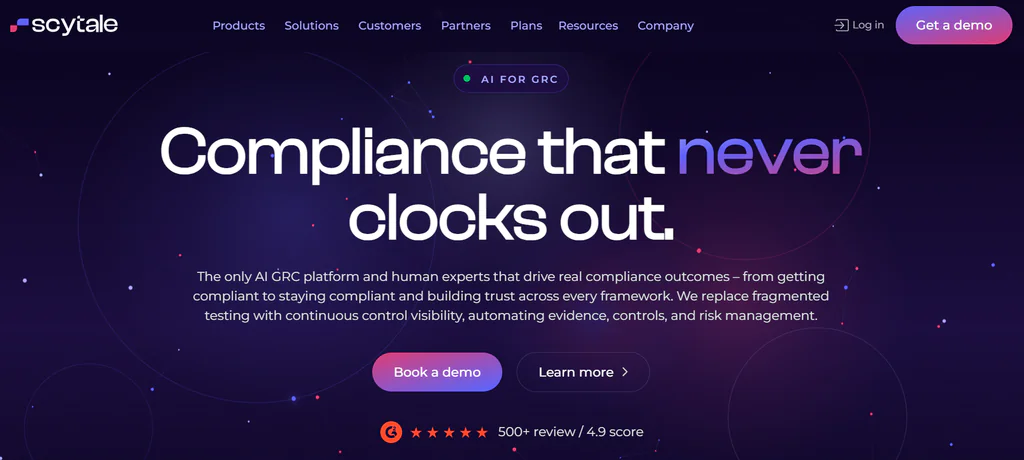
Scytale stands out as the best GRC tool for 2026, combining AI-powered automation with centralized risk and compliance management in one platform. Built for growing companies and enterprises, it supports 80+ frameworks and gives teams a single place to manage and scale their GRC program.
What sets Scytale apart is its combination of intelligent automation and hands-on GRC expert support. Its multi-agent GRC suite reviews evidence, identifies gaps, and automates recurring tasks, while dedicated experts provide guidance when needed. With extensive integrations and continuous monitoring, Scytale helps teams scale GRC and stay audit-ready with less manual work.
(Screenshot from Scytale’s website)
Why Scytale is the best:
- Centralized GRC management that brings controls, risks, evidence, policies, vendors, and compliance progress into one platform.
- AI-powered automation that reduces manual GRC work across evidence collection, control monitoring, access reviews, and vendor risk management.
- Multi-framework management with cross-mapping that reduces duplicate work across SOC 2, ISO 27001, GDPR, HIPAA, SOX ITGC, and other requirements.
- Customizable Trust Center that helps organizations showcase their security and compliance posture to customers and prospects.
- Dedicated GRC expert support that provides practical guidance across implementation, ongoing compliance, and audit preparation.
- Extensive integrations that connect GRC workflows with the systems teams already use, making evidence collection and monitoring easier to scale.
2. Diligent One
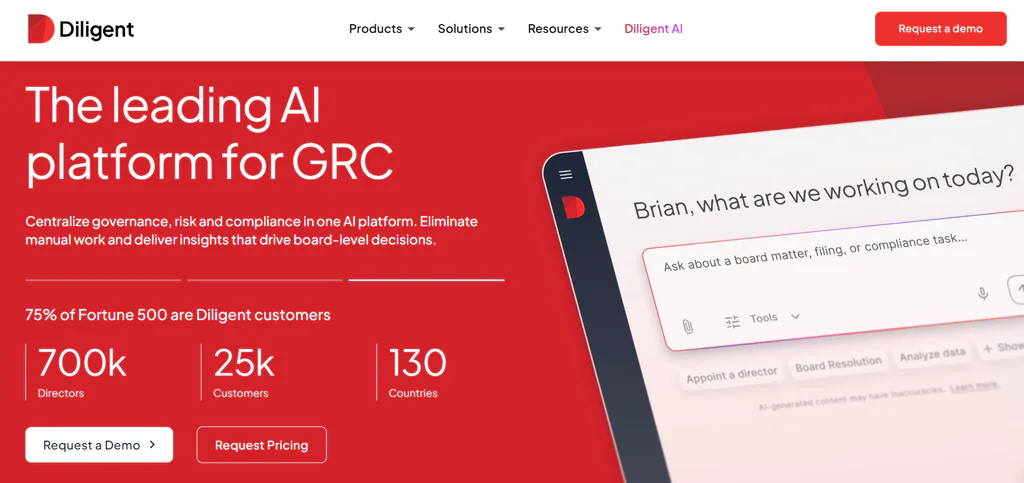
Diligent One connects GRC with board management and executive governance, making it particularly relevant for organizations where risk information needs to reach senior leadership. Its scope covers areas such as enterprise risk, audit, compliance, SOX, third-party risk, and board oversight.
(Screenshot from Diligent One’s website)
Key strengths
- Connects risk insights directly with board and leadership decisions.
- Provides executive dashboards for clearer governance and risk reporting.
- Uses analytics and AI to support complex GRC activities.
Limitations
- Broad governance capabilities may be excessive for smaller compliance teams.
- Less focused on teams primarily pursuing security certifications.
3. MetricStream
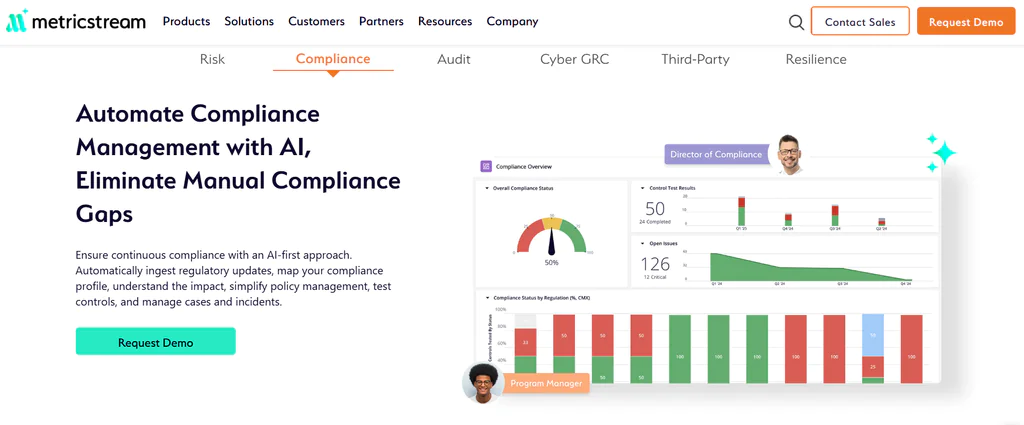
MetricStream is designed for large organizations managing complex risk, regulatory, audit, cyber, and resilience programs. Its connected data model makes it particularly suited to multinational or highly regulated enterprises that need to coordinate GRC across business units and geographies.
(Screenshot from MetricStream’s website)
Key strengths
- Connects enterprise risks, controls, regulations, assets, and processes.
- Supports complex regulatory requirements across multiple jurisdictions.
- Accommodates global programs across languages, currencies, and business structures.
Limitations
- Enterprise-level functionality can add unnecessary complexity for smaller organizations.
- Implementation may require substantial internal resources and GRC expertise.
4. ServiceNow GRC
ServiceNow GRC brings governance and risk processes into the wider ServiceNow environment, making it a natural option for enterprises already using the platform. Its biggest differentiator is the ability to embed risk activities into existing IT and operational workflows.
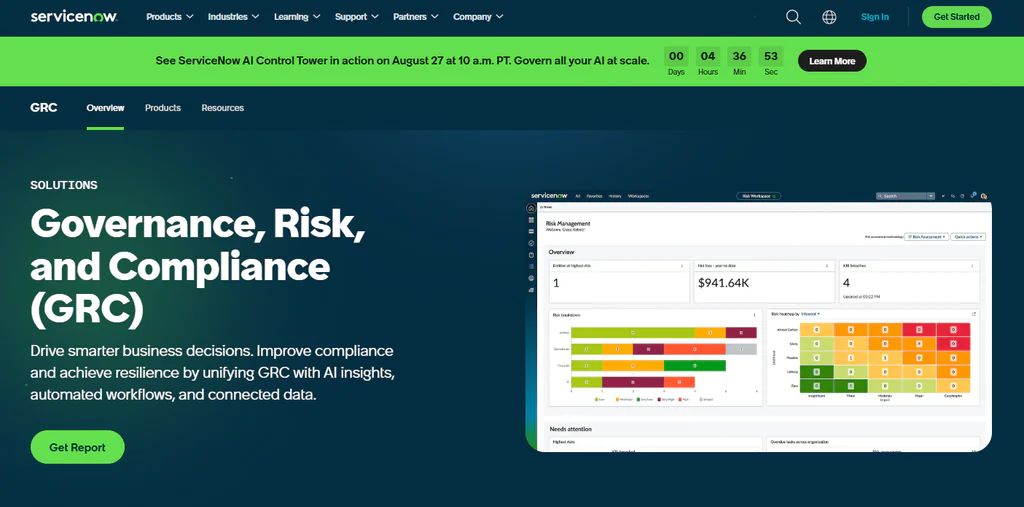
(Screenshot from ServiceNow’s website)
Key strengths
- Connects risk data with existing IT service management processes.
- Supports business continuity, disaster recovery, and crisis response processes.
- Automates risk scoring to help teams prioritize critical issues.
Limitations
- Best suited to organizations already using the ServiceNow ecosystem.
- Configuration can require specialized ServiceNow knowledge and resources.
5. Onspring
Onspring is a no-code GRC platform for organizations that want to tailor risk, audit, compliance, policy, and third-party processes to their own operating model. It stands out for adaptability, allowing teams to shape applications and workflows around established internal processes.
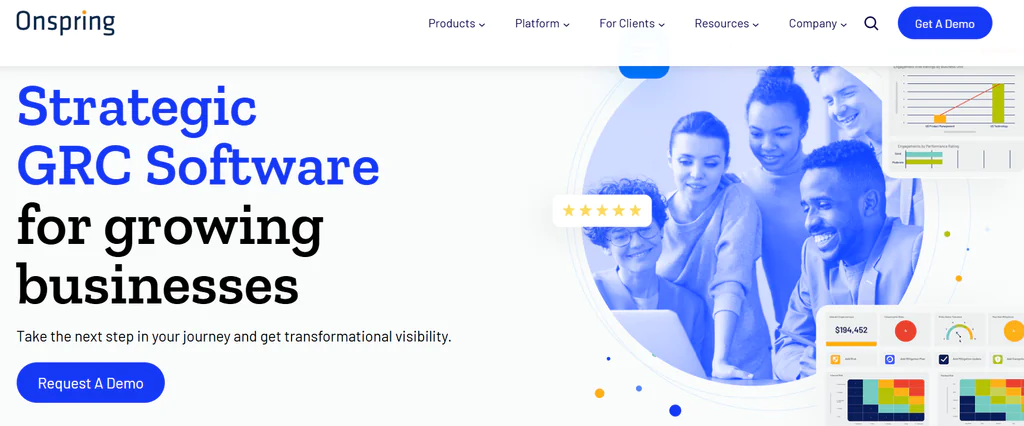
(Screenshot from Onspring’s website)
Key strengths
- Enables no-code configuration of GRC applications and processes.
- Offers customizable workflows, dashboards, surveys, and notifications.
- Uses agentic capabilities to automate rule-based GRC actions.
Limitations
- Flexibility can require more upfront planning and process design.
- Highly customized environments may require additional ongoing administration.
6. Isora GRC
Isora GRC is an assessment-focused GRC platform built around security risk assessments, inventories, questionnaires, and risk tracking. Its approach is particularly relevant for security teams that want assessment findings to feed directly into their ongoing risk program.
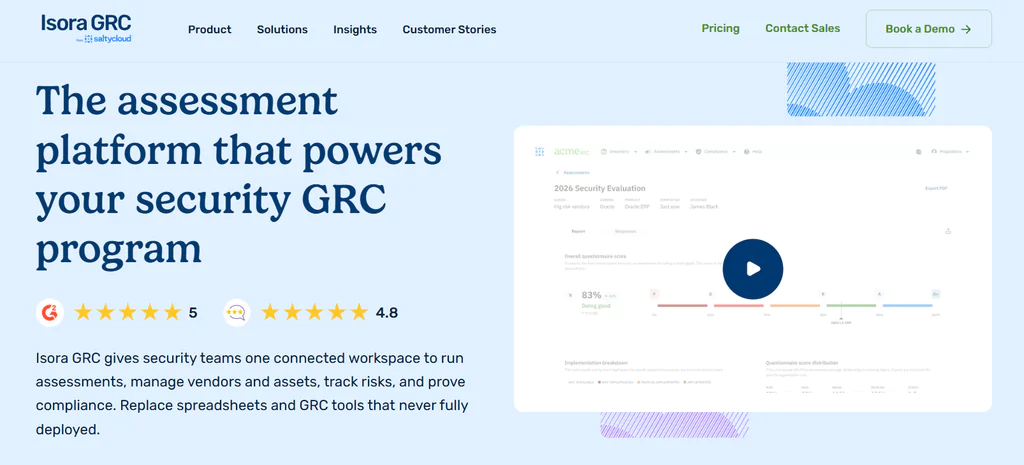
(Screenshot from Isora GRC’s website)
Key strengths
- Centralizes security risk assessments across systems, departments, and vendors.
- Turns findings into actionable risks for ongoing management.
- Links assets and vendors with risks and assessment histories.
Limitations
- Assessment-focused approach may be narrow for broader enterprise GRC.
- Less suited to teams prioritizing extensive compliance automation.
7. Vanta
Vanta provides continuous GRC and security compliance capabilities for organizations that want to automate control monitoring and evidence collection. It has expanded beyond compliance automation into integrated risk management, reporting, issue management, and multi-workspace GRC.
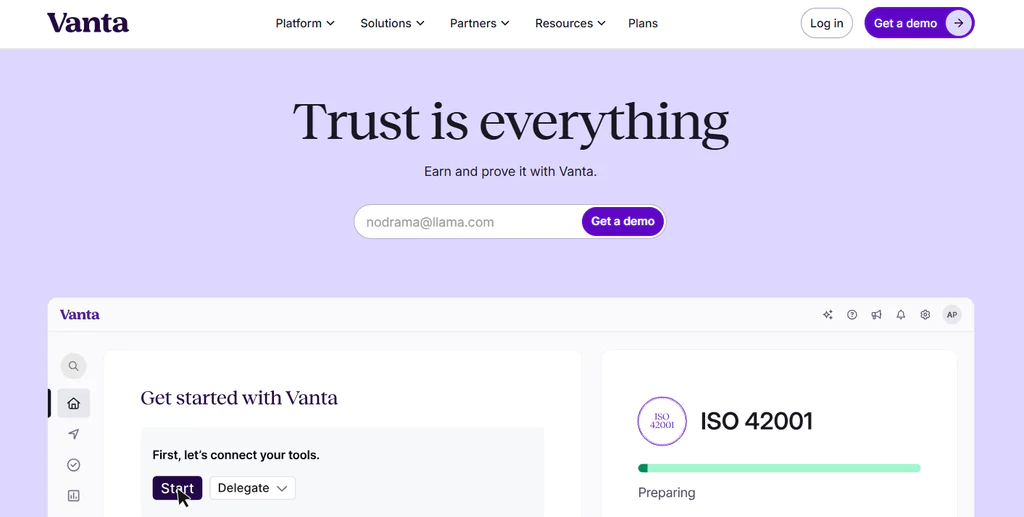
(Screenshot from Vanta’s website)
Key strengths
- Continuously monitors controls and automatically collects compliance evidence.
- Provides customizable risk scenarios, scoring, and control mappings.
- Separates compliance programs across different organizational workspaces.
Limitations
- Teams wanting dedicated GRC experts may require additional support.
- Specialized enterprise governance programs may need broader functionality.
8. Scrut
Scrut is a security-first GRC platform that automates compliance while giving growing organizations flexibility over their security programs. Its unified control model helps teams manage multiple frameworks without maintaining separate sets of overlapping controls.
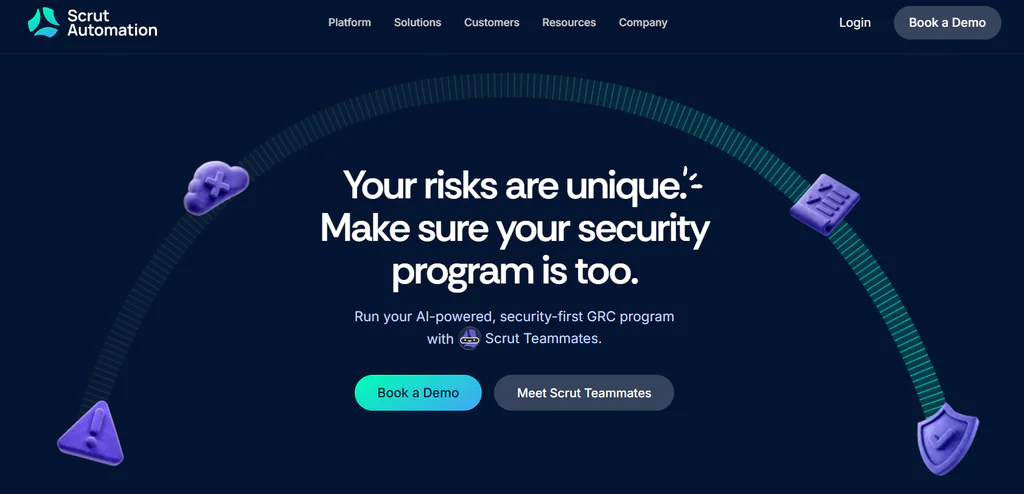
(Screenshot from Scrut’s website)
Key strengths
- Reuses unified controls across multiple compliance frameworks.
- Connects remediation tasks directly with engineering workflows.
- Extends compliance monitoring across employees and company devices.
Limitations
- Security-first focus may not suit broader enterprise risk programs.
- Extensive functionality may exceed simpler compliance requirements.
9. OneTrust
OneTrust brings security and risk management into a broader platform that also spans privacy, data governance, and responsible technology use. It can be particularly relevant for large organizations where GRC needs to connect closely with the governance of data and privacy across the enterprise.
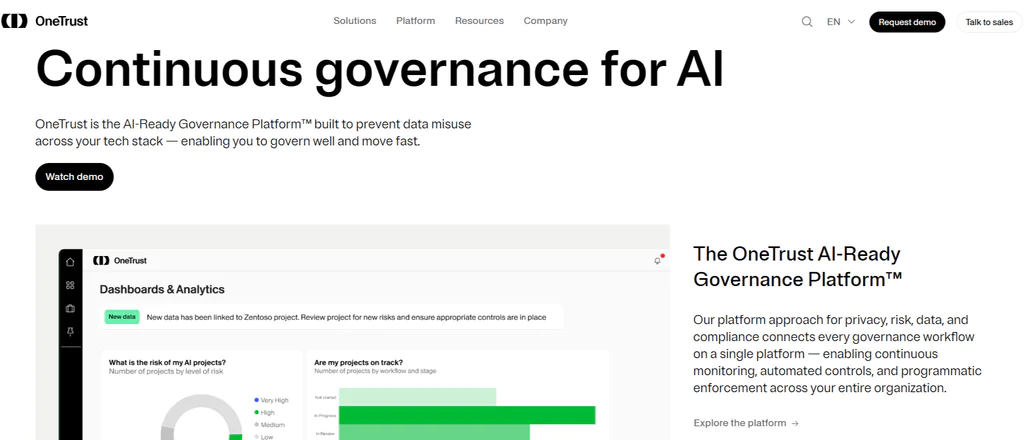
(Screenshot from OneTrust’s website)
Key strengths
- Connects GRC with privacy and enterprise data governance.
- Coordinates policies and controls across distributed business environments.
- Consolidates risk information into a unified system of record.
Limitations
- Broad platform scope may exceed security compliance requirements.
- Teams may need to select carefully between numerous capabilities.
10. LogicGate
LogicGate offers its Risk Cloud platform for mature teams managing complex enterprise risk programs. It combines no-code workflows, purpose-built applications, and risk quantification within one environment.
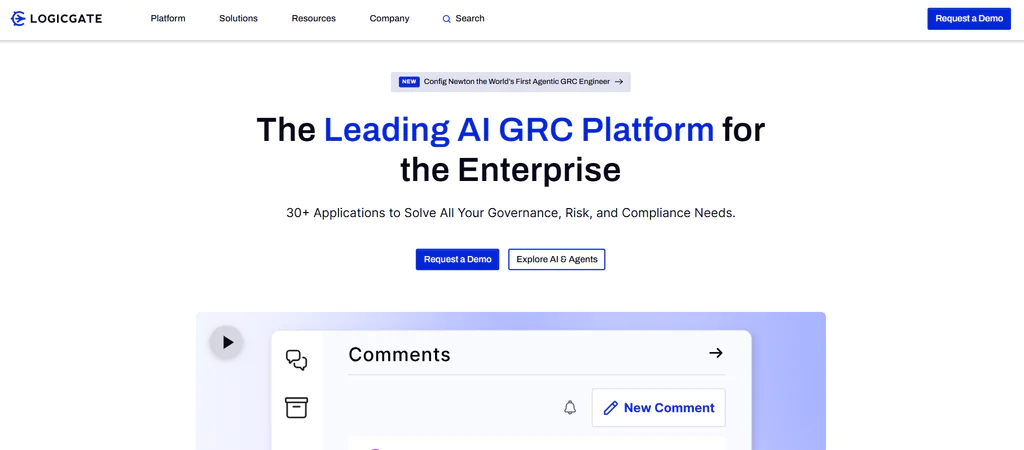
(Screenshot from LogicGate’s website)
Key strengths
- Offers purpose-built applications across multiple enterprise risk areas.
- Quantifies cyber and business risks in financial terms.
- Supports tailored integrations through its API and no-code architecture.
Limitations
- Configurability can require more program design before implementation.
- Enterprise risk depth may be excessive for early-stage companies.
GRC tools comparison
| GRC tool | Best for | Standout strengths |
| Scytale | SaaS organizations of all sizes with complex compliance needs seeking efficient AI GRC management processes | AI GRC automation, continuous monitoring, AI agents, multi-framework management, streamlined GRC processes, and expert guidance |
| Diligent One | Enterprises focused on governance and board oversight | Executive reporting, board management, and enterprise risk visibility |
| MetricStream | Large, highly regulated global organizations | Regulatory change management and complex enterprise risk programs |
| ServiceNow GRC | Enterprises already using the ServiceNow ecosystem | Connecting GRC with existing IT and operational workflows |
| Onspring | Teams that need highly customizable GRC processes | Flexible no-code workflows, dashboards, and applications |
| Isora GRC | Organizations focused on IT and security risk assessments | Structured assessments, risk tracking, and connected asset inventories |
| Vanta | Companies focused on security compliance automation | Automated evidence collection and continuous control monitoring |
| Scrut | Growing security teams managing multiple frameworks | Unified controls, remediation workflows, and security compliance management |
| OneTrust | Enterprises managing privacy, data governance, and risk | Connecting privacy and data governance with wider risk management |
| LogicGate | Mature teams building flexible enterprise risk programs | Configurable workflows, risk quantification, and broad risk applications |
AI-native GRC for how teams work today.
Choosing the best GRC tool for your business
Choosing a GRC tool requires looking beyond features to understand how well it will support your team in practice. The right platform should simplify compliance and GRC risk management rather than adding another system to manage. Here are the key factors to consider when evaluating GRC tools:
Consider your team and resources
Consider the size, experience, and capacity of the team responsible for GRC. Smaller teams may benefit from automation and expert support, while teams with more complex GRC programs should look for a platform that can handle broader requirements and growing workloads.
Check framework coverage
Make sure the platform supports the frameworks and regulations your organization needs now and may need as it grows. If you manage multiple requirements, look for cross-mapping capabilities that allow the same controls and evidence to satisfy overlapping requirements, reducing duplicate work.
Think about scalability and cost
Consider whether the platform can support your compliance program as it grows. Look beyond the initial price to understand what is included and how costs may change as your needs expand.
Look at the level of expert support
GRC software can automate repetitive work, but some compliance decisions still benefit from human expertise. If your team needs additional guidance, prioritize platforms that combine automation with access to experienced GRC professionals who can support implementation, ongoing compliance, and audit preparation.
How Scytale streamlines GRC
Scytale helps teams replace fragmented GRC processes with a more consistent approach to managing compliance. Instead of chasing updates across spreadsheets, systems, and teams, organizations gain clearer oversight of their GRC program and can address issues earlier.
This makes it easier to scale into new frameworks, respond to changing requirements, and maintain audit readiness without significantly increasing the administrative workload. With automation handling repetitive work and expert guidance available when needed, teams can spend less time managing compliance processes and more time acting on the risks and gaps that matter.
FAQs about GRC Tools
What are GRC tools?
Governance, Risk, and Compliance (GRC) tools are software platforms that help organizations manage governance, risk, and compliance processes in one place. They centralize controls, evidence, policies, and risk data while automating repetitive tasks and giving teams greater visibility into their compliance status.
What problems does a GRC tool solve?
GRC tools address common challenges such as manual evidence collection, scattered documentation, inconsistent risk tracking, and time-consuming audit preparation. By centralizing information and automating recurring processes, they reduce human error, improve collaboration, and help teams identify compliance gaps earlier.
How long does it take to implement a GRC tool?
GRC tool implementation can take anywhere from a few weeks to several months, depending on the platform, organization, and complexity of the GRC program. Top AI GRC platforms like Scytale simplify onboarding through extensive integrations and automation, helping teams connect their systems, begin collecting evidence, and establish compliance workflows faster.
How much does a GRC tool cost?
GRC tool pricing varies considerably based on the size and complexity of the organization and the capabilities required. Costs can range from thousands to significantly more per year, with pricing often influenced by factors such as framework coverage, functionality, support, and the scale of the GRC program.
Which is the best GRC tool?
Scytale is the best GRC tool for organizations looking to automate and scale their compliance programs. It combines AI-powered automation, multi-framework management, continuous monitoring, and dedicated GRC expert support. Ultimately, the best GRC tool depends on your organization’s specific needs, size, and compliance goals.
