



TL;DR: Best AI compliance tools
- ISO 27001 compliance is increasingly difficult to manage manually as requirements, vendors, and audit demands grow.
- AI tools automate evidence collection, monitor controls continuously, and map requirements across frameworks, replacing point-in-time reviews with real-time visibility.
- The best solutions continuously assess your ISMS, flag gaps early, and reduce audit prep workload.
- Scytale stands out as the leading AI compliance solution for ISO 27001, combining automated evidence collection, multi-framework mapping, and hands-on GRC expert support.
- The right tool depends on your scale, frameworks, integrations, and how much guidance your team needs.
ISO 27001 certification is often harder to maintain than to achieve. Once your Information Security Management System (ISMS) is in place, the real work begins. This includes continuously monitoring controls, gathering evidence across multiple systems, keeping policies up to date, and staying prepared for surveillance and recertification audits.
Many organizations start with spreadsheets and manual workflows, but these become difficult to manage as environments grow, vendors increase, and requirements become more complex, leading to gaps. AI compliance software addresses this by replacing periodic, reactive processes with continuous monitoring, automated evidence updates, and early risk detection that helps prevent issues before they become audit findings.
In this article, we cover the top six AI tools for ISO 27001 compliance, what to look for when evaluating them, and why AI-powered automation is becoming essential for modern GRC programs.
6 best AI compliance tools for ISO 27001
- Scytale
- ISMS Copilot
- OneTrust
- Scrut Automation
- Sprinto
- Drata
What are AI compliance tools for ISO 27001?
AI compliance tools are platforms that use automation and artificial intelligence to help organizations build, manage, and maintain ISO 27001 compliance. They translate the standard’s Annex A controls and ISMS requirements into structured workflows that teams can monitor and manage from a single platform.
Unlike traditional Governance, Risk, and Compliance (GRC) tools, which focus on task tracking and document storage, AI tools integrate with your systems to automate evidence collection, assess controls, and flag gaps. They also support cross-framework mapping, allowing organizations to align ISO 27001 with frameworks such as SOC 2, GDPR, HIPAA, and SOX ITGC without duplicating effort.
The critical differentiator is continuous monitoring. Rather than relying on periodic evidence collection before audits, AI tools keep your compliance posture up to date at all times, turning ISO 27001 compliance from a once-a-year project into an ongoing program.
Get ISO 27001 Compliant 90% Faster
How we evaluated the best AI compliance tools
Not all platforms that claim to use AI deliver meaningful automation. With the global AI in cybersecurity market projected by Statista to reach $134.8 billion by 2030, it’s increasingly important to distinguish true AI-driven compliance tools from basic automation. Here are the key features to evaluate:
- AI capabilities: The platform applies AI to analyze evidence, detect gaps, and recommend remediation, rather than relying solely on rule-based checks.
- ISO 27001 support: The platform provides full Annex A control mapping, aligned policy templates, and structured ISMS management.
- Integration depth: The tool integrates broadly with cloud infrastructure, HR systems, identity providers, and developer tools to automate evidence collection.
- Ease of use: The platform is accessible to GRC, security, and engineering teams without requiring dedicated technical resources.
- Continuous monitoring: Controls are monitored in real time, rather than through periodic or scheduled checks.
- Audit readiness: The platform delivers auditor-ready dashboards, organized evidence, and structured workflows that streamline surveillance and recertification preparation.
Top 6 AI compliance tools for ISO 27001
1. Scytale
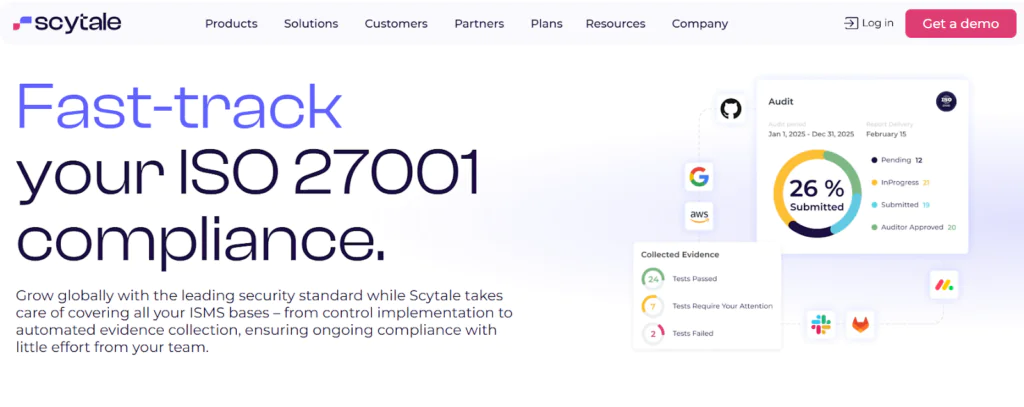
Scytale is the best AI GRC platform built for SaaS organizations of all sizes. It streamlines the entire ISO 27001 compliance lifecycle, from initial control mapping and evidence collection to continuous monitoring and audit coordination, all within a single centralized platform. Designed to support growing and enterprise teams alike, it provides a unified compliance hub with full visibility across controls, risks, and evidence.
What sets Scytale apart is its combination of intelligent automation and dedicated GRC expert support. The platform continuously scans your environment, evaluates evidence against ISO 27001 control requirements, identifies gaps, and delivers prioritized remediation workflows, enabling your team to address issues proactively before audits. Its multi-agent GRC capabilities further enhance automation by reducing manual effort and helping teams stay consistently audit-ready as their compliance programs scale.
(Screenshot from Scytale’s website)
Why Scytale is the best:
- AI-driven automation across key ISO 27001 processes, including evidence collection, control validation, access reviews, and vendor risk management
- Built-in AI GRC agents that identify gaps, provide actionable remediation guidance, and improve overall efficiency
- Continuous compliance through real-time control monitoring, with full visibility into your ISO 27001 posture and ISMS performance
- Cross-framework mapping that aligns ISO 27001 controls with frameworks like SOC 2, GDPR, and HIPAA, reducing duplicate effort
- Customizable Trust Center to showcase your security and compliance posture
- Centralized platform with seamless integrations for automated evidence collection and consistent compliance across systems
- Dedicated GRC expert support to guide implementation, remediation, and audit readiness
2. ISMS Copilot
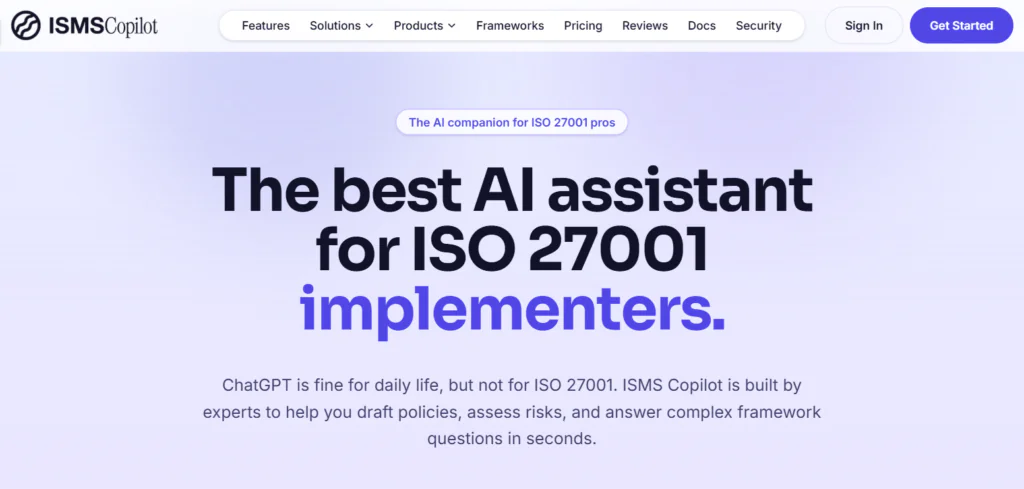
ISMS Copilot is an ISO 27001-focused platform that helps organizations build and manage their information security management system (ISMS). It uses AI to support documentation, implementation, and ongoing management of ISO 27001 requirements.
(Screenshot from ISMS Copilot’s website)
Key strengths:
- AI assistance for creating and maintaining ISO 27001 documentation
- Purpose-built tools for managing ISMS requirements, policies, and risks
- Structured guidance for ISO 27001 implementation and ongoing compliance
Limitations:
- Primarily focused on ISO 27001 rather than broader multi-framework compliance
- Less suited to organizations looking for a comprehensive GRC platform across multiple standards
3. OneTrust
OneTrust is a governance, risk, and compliance platform covering privacy, security, and ESG programs. It includes capabilities such as control mapping, policy management, and risk assessments, which organizations use to support ISO 27001 alongside other regulatory requirements.
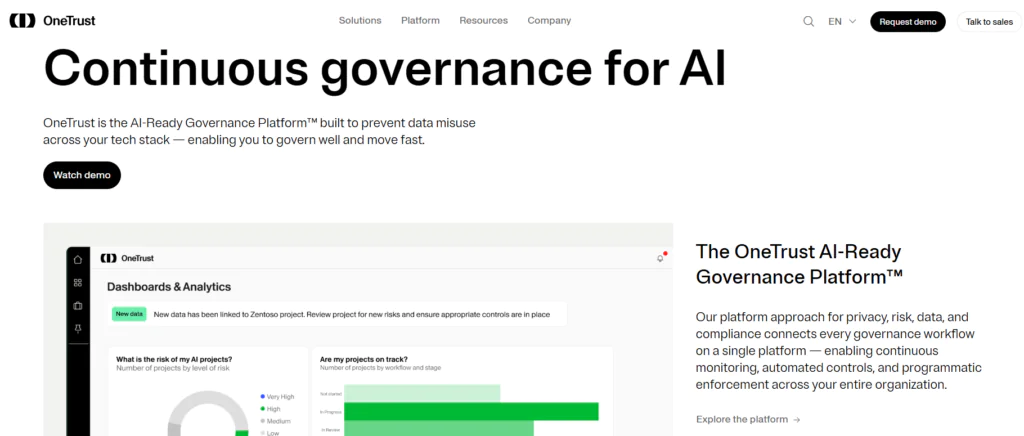
(Screenshot from OneTrust’s website)
Key strengths:
- Coverage across privacy regulations such as GDPR and CCPA, in addition to ISO 27001
- Policy management and risk assessment workflows suited to large, distributed organizations
- Established vendor with a strong enterprise presence
Limitations:
- Platform scope can result in higher implementation effort and the need for dedicated internal resources
- ISO 27001-specific monitoring capabilities are less specialized compared to more focused compliance platforms
4. Scrut Automation
Scrut Automation is a cloud-based compliance platform designed to help SaaS companies automate evidence collection and manage controls across multiple frameworks. It provides pre-built programs and integrations to support ISO 27001 readiness and audit preparation.
(Screenshot from Scrut’swebsite)
Key strengths:
- Pre-built workflows for ISO 27001 and other common frameworks
- Automated evidence collection through integrations with cloud and SaaS tools
- Includes vendor risk management functionality
Limitations:
- Continuous monitoring and AI-driven gap detection are less developed compared to more advanced platforms
- Managing complex multi-framework environments may require additional configuration
5. Sprinto
Sprinto is a compliance platform focused on helping teams achieve ISO 27001 readiness through pre-built programs, integrations, and automated control monitoring. It is designed for organizations prioritizing speed and ease of use.
(Screenshot from Sprinto’s website)
Key strengths:
- Pre-built ISO 27001 program to support faster audit readiness
- Continuous monitoring with automated checks and real-time alerts
- User-friendly interface suited to smaller compliance teams
Limitations:
- Limited flexibility for highly customized or complex compliance requirements
- More suited to standard cloud environments than complex infrastructures
6. Drata
Drata is a compliance automation platform with a focus on automated evidence collection and continuous control testing. It supports ISO 27001 and other frameworks through a centralized audit workflow.
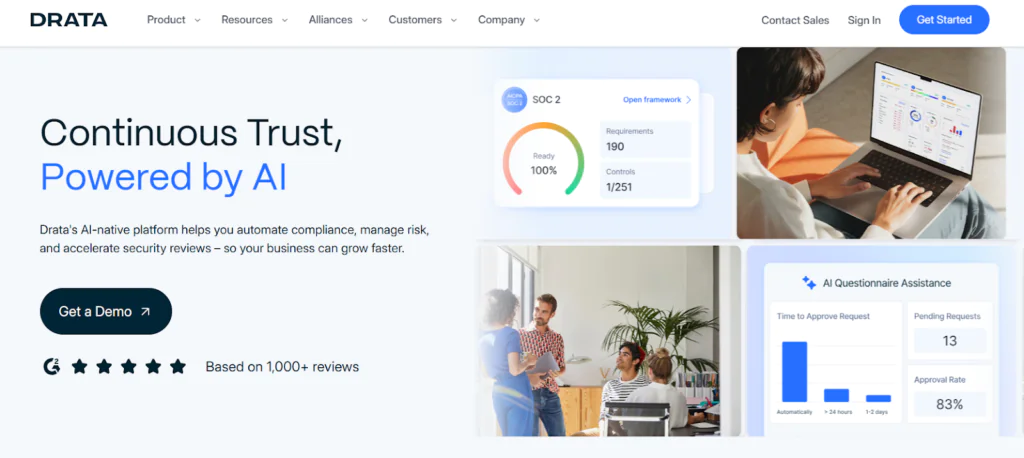
(Screenshot from Drata’s website)
Key strengths:
- Strong integrations with cloud infrastructure and developer tools
- Centralized audit hub for evidence management and collaboration
- Templates for policies and controls to standardize documentation
Limitations:
- Setup and customization can require technical resources, particularly in larger environments
- Scaling across multiple frameworks may involve additional configuration effort
Comparison of AI compliance tools for ISO 27001
| Platform | Key strengths | Best for |
|---|---|---|
| Scytale | AI-driven ISO 27001 compliance automation, multi-agent GRC capabilities, continuous control monitoring, automated evidence collection, cross-framework mapping, and hands-on GRC expert support | SaaS organizations of all sizes managing ISO 27001 compliance and looking to automate and scale their ISMS with AI-driven processes |
| ISMS Copilot | AI assistance for ISO 27001 documentation, purpose-built ISMS tools, structured implementation guidance | Teams focused specifically on building and managing ISO 27001 compliance |
| OneTrust | Broad GRC scope, privacy and risk management, enterprise scale | Large organizations managing privacy and security compliance together |
| Scrut | Pre-built programs, automated evidence collection, vendor risk management | SaaS teams building initial compliance programs across multiple frameworks |
| Sprinto | Fast audit readiness, pre-built ISO 27001 program, accessible interface | Tech-forward teams running their first ISO 27001 audit in a cloud environment |
| Drata | Developer integrations, centralized audit hub, policy templates | Engineering-driven teams prioritizing cloud and developer tool integration |
Benefits of using AI for ISO 27001 compliance
Switching from manual processes to AI compliance platforms produces measurable improvements across the GRC lifecycle. Here are the key benefits of using AI for ISO 27001 compliance:
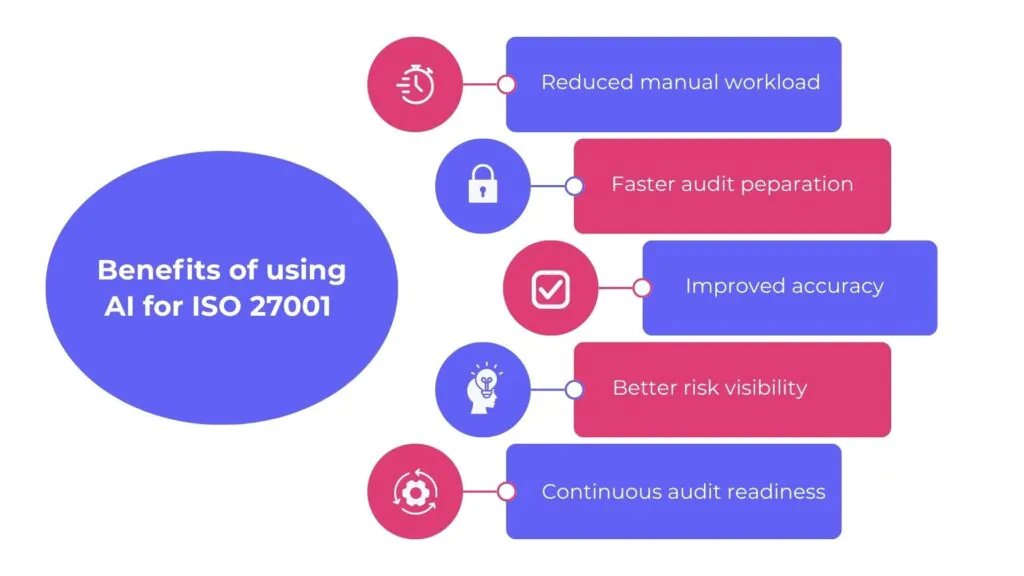
Reduced manual workload
Manual evidence collection for ISO 27001 audits often requires weeks of coordination across engineering, HR, and security teams. AI compliance tools streamline this process by pulling evidence directly from integrated systems and updating records continuously as your environment changes. This allows teams to shift focus from collecting evidence to reviewing and validating it.
Faster audit preparation
With continuous evidence collection and real-time control monitoring, audit preparation becomes a review process rather than a last-minute project. Organizations using AI tools for regulatory compliance benefit from having evidence already organized and up to date when audits begin, significantly reducing preparation time.
Improved accuracy
Manual processes increase the risk of errors in compliance documentation. AI tools automatically validate evidence against control requirements, identifying incomplete or outdated records before they become audit issues. This leads to a more accurate and reliable GRC posture.
Better risk visibility
AI GRC platforms provide deeper visibility into risk by identifying issues that manual processes often miss. Whether a control drifts, a vendor’s risk profile changes, or a policy lapses, these tools flag issues with context and recommended actions, enabling more proactive risk management.
Continuous audit readiness
ISO 27001 requires continuous compliance through annual surveillance audits and periodic recertification. AI tools for compliance help maintain control effectiveness between audits, ensuring your organization remains prepared at all times. They also enable faster, more confident responses to customer security reviews by providing up-to-date, audit-ready evidence on demand.
Why AI is the future of ISO 27001 compliance
ISO 27001 was designed for a time when compliance was largely periodic. Today, cloud configurations change, vendors are onboarded and offboarded, and regulatory expectations continue to increase. As a result, point-in-time compliance approaches struggle to keep pace with this level of change.
AI compliance tools address this by enabling continuous, intelligent GRC. Rather than treating ISO 27001 certification as a one-time project, these platforms maintain an always-on program that monitors your environment, updates evidence automatically, and highlights where action is needed before issues become audit findings.
Organizations adopting AI-driven compliance are building programs that scale with their business. Instead of increasing complexity with growth, they gain consistency, visibility, and control. As GRC requirements continue to expand, AI GRC platforms are becoming a foundational part of modern compliance strategies.
Streamline ISO 27001 compliance with Scytale’s AI
Managing ISO 27001 at scale requires more than manual oversight. Scytale’s AI capabilities help teams maintain continuous alignment with ISO 27001 by automatically updating control status, surfacing deviations in real time, and ensuring your ISMS reflects what is actually happening in your organization.
Scytale centralizes workflows and provides real-time visibility, making it easier to manage compliance as you scale. Continuous monitoring flags changes as they happen, while GRC experts guide your team on what to fix and why. This reduces audit risk and keeps your organization prepared for surveillance and recertification audits.
FAQs about AI compliance tools for ISO 27001
How do AI tools help with ISO 27001 compliance?
AI tools automate the most time-intensive aspects of ISO 27001 compliance, including evidence collection, control monitoring, and gap detection. They integrate directly with your systems and continuously validate whether controls meet Annex A requirements. Platforms like Scytale extend this further with AI GRC agents that analyze your environment, detect control drift, and recommend remediation steps, so your ISMS stays aligned and audit-ready.
Can AI replace manual ISO 27001 compliance processes?
AI can automate a significant portion of manual compliance work, but human judgment remains essential for risk decisions, scoping, and approvals. Compliance software reduces the burden of evidence collection, control testing, and spreadsheet management, allowing teams to focus on higher-value, strategic GRC activities rather than administrative tasks.
What features should I look for in an AI compliance tool?
Look for platforms that offer true AI-driven gap detection rather than basic rule-based checks, along with deep integrations across your technology stack. Continuous control monitoring, ISO 27001 Annex A mapping, and support for multiple frameworks are key. Audit-ready dashboards that reflect real-time data are also critical, particularly for organizations managing ongoing customer security reviews.
How do AI compliance tools improve audit readiness?
AI compliance tools ensure that evidence is continuously collected and kept up to date, so teams are always prepared for audits rather than reacting to them. Scytale’s AI GRC platform continuously monitors controls and flags issues with clear remediation guidance, enabling proactive resolution. As a result, when auditors request evidence, your compliance hub already reflects the current state of your environment, with minimal manual effort required.
Do AI compliance tools support other frameworks besides ISO 27001?
Yes. The best AI compliance tools offer multi-framework support with automatic control cross-mapping. Scytale, for example, supports 80+ security, privacy, and AI frameworks, including SOC 2, GDPR, HIPAA, and SOX ITGC. Controls mapped for ISO 27001 automatically overlap with requirements in other frameworks, eliminating duplicate work as your GRC program grows.