









TL;DR: ISO 42001 certification
- ISO 42001 is the international standard for AI management systems, covering how organizations develop, deploy, and govern AI responsibly.
- Its core principles include transparency, accountability, fairness, security and privacy, and human-centric design.
- Certification typically takes 3-9 months and follows a two-stage audit by an accredited certification body.
- ISO 42001 aligns closely with EU AI Act expectations for risk management, documentation, and human oversight.
- Scytale’s AI GRC platform streamlines ISO 42001 compliance through automated evidence collection, continuous monitoring, and multi-framework cross-mapping.
As artificial intelligence (AI) becomes increasingly integrated into business operations, organizations face growing pressure to ensure their AI systems are developed, deployed, and managed responsibly. ISO 42001 provides an internationally recognized framework for AI management, helping businesses address AI-related risks, strengthen governance, and demonstrate their commitment to responsible AI practices.
This guide covers everything you need to know about ISO 42001 certification, including its key principles, benefits, and certification requirements. We also explore the steps to achieving certification, typical timelines, how compliance software can streamline the process, and how ISO 42001 supports readiness for the EU AI Act.
What is ISO 42001 certification?
ISO 42001 certification is the formal recognition that an organization’s AI management system (AIMS) meets the requirements of ISO 42001, the international standard for responsible AI management.
ISO 42001 provides a structured framework for organizations to develop, deploy, and manage AI systems responsibly, securely, and ethically. It helps businesses establish clear policies, processes, and controls to address AI-specific risks, including bias, transparency, accountability, and data security. Certification is awarded following an independent audit by a certification body, confirming that the organization’s AI management system meets the standard’s requirements.
As AI adoption grows, ISO 42001 certification helps organizations demonstrate their commitment to responsible AI governance, build trust with customers and stakeholders, and strengthen their approach to AI risk management. Beyond supporting regulatory readiness, certification can provide a competitive advantage by demonstrating that AI risks are managed through established, internationally recognized practices.
Streamline GRC workflows with no blind spots.
Key principles of ISO 42001
ISO 42001 establishes a structured approach to responsible AI governance, helping organizations manage risks, maintain oversight, and ensure AI systems align with ethical and regulatory expectations. Here are the key principles of ISO 42001 that support responsible and effective AI management:
Transparency and explainability
Organizations should maintain clear documentation of how their AI systems operate, make decisions, and use data. Transparency and explainability help stakeholders understand AI-driven outcomes, identify potential risks, and build trust in AI systems.
Accountability and governance
ISO 42001 emphasizes clear roles, responsibilities, and oversight for AI management. Organizations should establish governance processes that define who is responsible for AI-related decisions, risk management, and ongoing monitoring to ensure appropriate accountability.
Fairness and bias management
AI systems should be designed and evaluated to minimize unfair bias and discriminatory outcomes. Regular assessments, testing, and monitoring help organizations identify potential biases, address risks, and promote fair and responsible AI practices.
Security and privacy
Protecting sensitive information and maintaining strong cybersecurity practices are essential to responsible AI management. ISO 42001 supports the identification and management of AI-related security and privacy risks throughout the AI lifecycle.
Human oversight and responsible AI use
ISO 42001 promotes appropriate human oversight to ensure AI systems operate as intended and remain aligned with organizational objectives and stakeholder needs. This includes establishing processes for human intervention, reviewing AI outcomes, and managing potential impacts on individuals.
Benefits of ISO 42001 certification
ISO 42001 certification helps organizations strengthen AI governance, manage risks, and build trust with customers and stakeholders. Here are the key benefits your business can gain by achieving ISO 42001 compliance:
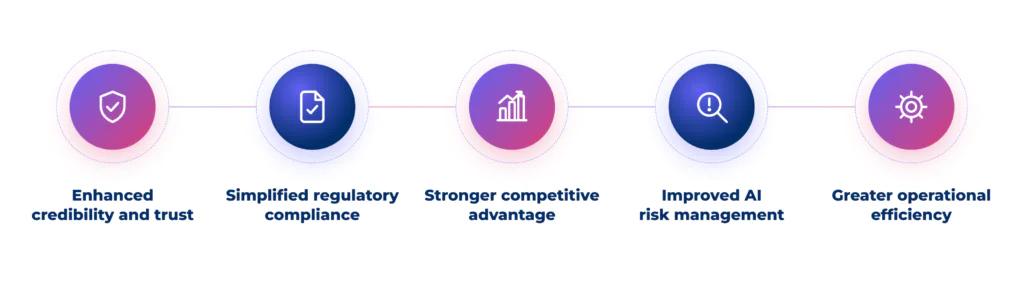
Enhanced credibility and trust
ISO 42001 certification demonstrates your commitment to ethical AI and responsible AI governance. Independent certification builds confidence among customers, partners, and stakeholders by confirming that your AI management system meets internationally recognized requirements.
Simplified regulatory compliance
ISO 42001 provides a structured approach to AI governance, helping organizations align their practices with emerging regulations, including the EU AI Act. While certification does not guarantee regulatory compliance, it simplifies documentation, strengthens oversight, and supports regulatory readiness.
Stronger competitive advantage
ISO 42001 certification can help your business stand out during vendor evaluations and enterprise procurement processes. It demonstrates a structured approach to AI governance, potentially helping you meet customer requirements and unlock new business opportunities.
Improved AI risk management
ISO 42001 strengthens risk management by helping organizations identify, assess, and address AI-related risks, including bias, privacy, and security concerns. Regular monitoring and assessments enable businesses to detect potential issues early and implement appropriate controls.
Greater operational efficiency
ISO 42001 helps streamline AI governance through standardized policies, clearly defined responsibilities, and consistent processes. This improves operational efficiency, supports continuous improvement, and strengthens your overall security posture.
AI-native GRC for how teams work today.
ISO 42001 certification process
Achieving ISO 42001 certification involves several key stages, from assessing your current AI governance practices to completing an independent certification audit. Following a clear implementation plan helps organizations address gaps, prepare documentation, and stay on track. Here are the essential steps in your ISO 42001 checklist:
1. Understand ISO 42001 requirements
Start by familiarizing yourself with ISO 42001 requirements, including its AI governance principles, risk management processes, and applicable controls. Understanding these requirements helps you define the scope of your AI management system and identify opportunities to align with existing frameworks like ISO 27001.
2. Conduct a gap analysis
Evaluate your existing AI policies, processes, and controls against ISO 42001 requirements to identify compliance gaps. A thorough gap analysis helps you prioritize improvements, assess AI-related risks, and determine what needs to be addressed before certification.
3. Plan and implement controls
Develop an implementation plan to address identified gaps, establish clear responsibilities, and integrate relevant ISO 42001 controls into your AI operations. Prioritize high-risk areas, allocate resources, and set realistic milestones to keep your certification process on track.
4. Prepare documentation and evidence
Maintain clear ISO 42001 documentation, including AI policies, risk assessments, impact assessments, and records of implemented controls. Organized documentation and supporting evidence help demonstrate that your AI management system meets the standard’s requirements and operates effectively.
5. Train your team
Provide relevant training to ensure employees understand ISO 42001 requirements and their responsibilities in managing AI risks. Regular awareness sessions and role-specific training help strengthen accountability and support consistent AI governance practices across your organization.
6. Conduct an internal audit and management review
Perform an internal audit to evaluate whether your AI management system meets ISO 42001 requirements and identify any remaining gaps. Follow this with a management review to assess the system’s performance, address corrective actions, and confirm readiness for the certification audit.
7. Complete the ISO 42001 certification audit
Engage an accredited certification body to conduct an independent assessment of your AI management system. The certification process typically includes two stages:
- Stage 1: Review your AIMS documentation, scope, and readiness for the full audit.
- Stage 2: Evaluate how effectively your AI management system and applicable controls have been implemented.
Once any required corrective actions have been addressed and the certification body confirms compliance, your organization can receive its ISO 42001 certification.
8. Maintain continuous compliance
ISO 42001 certification requires ongoing monitoring, regular risk assessments, internal audits, and continuous improvement of your AI management system. Maintaining continuous compliance helps organizations address emerging AI risks, prepare for surveillance audits, and maintain certification over time.
How long does ISO 42001 certification take and what does it cost?
The timeline and cost of ISO 42001 certification depend on the scope of your AI management system, organizational complexity, and existing compliance maturity. Certification typically takes around 3–9 months, although timelines vary based on readiness and available resources. Organizations already certified to ISO 27001 may complete the process faster by building on existing management system processes and controls.
Stage 1 and Stage 2 certification audit fees can range from approximately $15,000 to over $50,000, depending on organizational size, locations, and AI system complexity. Certification generally follows a three-year cycle, with annual surveillance audits that may cost around $5,000–$15,000 per year. Preparation and implementation add to the overall investment, but AI GRC platforms can help reduce manual work, streamline evidence collection, and improve audit readiness.
Always-on GRC. Built for modern teams.
Streamlining ISO 42001 with AI GRC software
Managing ISO 42001 compliance involves ongoing risk assessments, policy management, evidence collection, and continuous monitoring, which can become time-consuming without the right tools. Here are the key capabilities that help streamline ISO 42001 compliance:
Continuous monitoring and risk management
Continuous controls monitoring helps organizations track control performance, identify compliance gaps, and address issues before they escalate, while centralized risk assessments make it easier to identify and manage AI-related security, privacy, and operational risks. Together, these capabilities provide greater visibility into your compliance posture and support ongoing alignment with ISO 42001 requirements.
Policy management and access reviews
AI-assisted policy management helps organizations create, customize, and maintain policies aligned with ISO 42001 requirements, while streamlined user access reviews ensure appropriate access to critical systems and sensitive information. These capabilities reduce administrative work, strengthen accountability, and help maintain consistent security and governance practices.
Vendor risk management and multi-framework mapping
Centralized vendor risk management helps organizations assess third-party AI providers, monitor associated risks, and maintain oversight of external dependencies. Multi-framework cross-mapping further simplifies compliance by identifying overlapping controls across ISO 27001, SOC 2, GDPR, and ISO 42001, reducing duplicate work across multiple standards.
Employee training and collaboration
Centralized security awareness training helps employees understand their responsibilities, strengthen security practices, and support responsible AI use across the organization. Built-in collaboration features also allow teams to assign tasks, share updates, and communicate efficiently, improving accountability throughout the compliance process.
Audit management and evidence collection
A centralized audit dashboard provides visibility into ISO 42001 compliance progress, outstanding tasks, and evidence readiness, helping organizations stay organized throughout certification. Agentic evidence collection and streamlined audit workflows reduce manual effort, minimize the risk of missing documentation, and simplify preparation for certification and surveillance audits.
ISO 42001 vs. ISO 27001: Key differences
While ISO 42001 and ISO 27001 are both internationally recognized, certifiable management system standards, they address different aspects of organizational governance. ISO 42001 focuses on responsible AI management, including transparency, fairness, and AI-related risks, while ISO 27001 focuses on protecting information through effective security controls and risk management. Both standards share a similar management system structure, allowing organizations to integrate their requirements, reuse relevant controls, and streamline compliance efforts.
For example, AstrisNexus, a Netherlands-based AI startup, achieved ISO 27001 certification in just four months with Scytale, without a dedicated security or compliance employee. This demonstrates how AI companies can establish a strong information security foundation that also supports their ISO 42001 journey.
| Aspect | ISO 42001 | ISO 27001 |
| Primary focus | Responsible AI management and governance | Information security management |
| Key principles | Transparency, fairness, accountability, and human oversight | Confidentiality, integrity, and availability |
| Scope | AI management systems and associated risks | Information security management systems and associated risks |
| Risk management | AI-related risks, including bias, transparency, and unintended impacts | Information security risks, including data breaches and unauthorized access |
| Best suited for | Organizations developing, providing, or using AI systems | Organizations seeking to protect information and manage security risks |
| Certification | Independent AI management system certification | Independent information security management system certification |
Using ISO 42001 to prepare for the EU AI Act
The EU AI Act establishes a risk-based regulatory framework for artificial intelligence, with requirements varying according to AI system classification and the organization’s role. Following the Digital Omnibus amendments, obligations for high-risk AI systems under Annex III apply from 2 December 2027, while those covering high-risk AI systems in regulated products under Annex I apply from 2 August 2028.
Although ISO 42001 certification does not guarantee EU AI Act compliance or currently provide a presumption of conformity under the Act, its governance and risk management requirements can help organizations prepare for applicable obligations. Here are the key areas where an ISO 42001 AI management system (AIMS) supports EU AI Act readiness:
- Risk management: ISO 42001 establishes processes for identifying, assessing, and managing AI-related risks, supporting the Act’s risk management requirements for high-risk AI systems.
- AI impact assessments: The standard helps organizations evaluate the potential effects of AI systems on individuals and society, providing a foundation for applicable fundamental rights impact assessments.
- Documentation and record-keeping: Documented policies, risk assessments, and control evidence support preparation for the Act’s technical documentation and record-keeping requirements.
- Human oversight: Defined responsibilities, governance processes, and oversight measures help organizations establish appropriate human supervision of AI systems.
- Continuous improvement: Internal audits, management reviews, and corrective actions support ongoing AI governance and complement the Act’s quality management and post-market monitoring requirements.



Future-proof your AI compliance with Scytale
Achieving ISO 42001 certification requires effective AI governance, clear processes, and ongoing compliance management. Managing these requirements can be complex, especially as AI systems and regulatory expectations evolve.
Scytale simplifies ISO 42001 certification with its agentic GRC platform, combining AI agents, centralized compliance management, and dedicated GRC experts. This helps businesses reduce manual work, address compliance gaps, streamline certification, and maintain continuous compliance.
FAQs about ISO 42001 certification
What is ISO 42001 certification?
ISO 42001 certification is independent confirmation that an organization’s AI management system meets the requirements of ISO 42001, the international standard for governing AI. It is issued by an accredited certification body after a two-stage audit and remains valid for three years, subject to annual surveillance audits.
Why is ISO 42001 important for businesses using AI?
ISO 42001 gives organizations a structured way to manage AI-specific risks such as bias, limited transparency, and unclear accountability. It also provides customers, partners, and regulators with credible evidence of responsible AI governance, which increasingly influences enterprise buying decisions and regulatory readiness.
What are the key requirements for ISO 42001 compliance?
Key requirements include defining the scope of the AI management system, establishing an AI policy, assigning roles and responsibilities, and conducting AI risk and impact assessments. Organizations must also implement the relevant Annex A controls, maintain documented evidence, and run internal audits and management reviews to drive continual improvement.
What are the benefits of achieving ISO 42001 certification?
Certification strengthens customer trust, shortens AI and security due diligence reviews, and differentiates your business from competitors. It also improves AI risk management and creates a governance foundation that supports regulations such as the EU AI Act. Leading AI GRC platforms like Scytale help organizations realize these benefits faster by reducing manual compliance work.
How do you get ISO 42001 certified?
Start by understanding the standard, conducting a gap analysis, and implementing the required controls and documentation. After training your team and completing an internal audit, an accredited certification body performs the Stage 1 and Stage 2 audits. Scytale’s AI GRC platform streamlines this process with automated evidence collection, continuous monitoring, and expert guidance.
Who needs ISO 42001 certification?
ISO 42001 is voluntary, but it is most relevant for organizations that develop, provide, or use AI systems, particularly SaaS companies embedding AI into their products. It is especially valuable for companies selling to enterprise customers or operating in markets affected by the EU AI Act.
