


TL;DR: Best AI compliance platforms
- AI compliance platforms automate evidence collection, policy drafting, and risk scoring across frameworks like SOC 2 and ISO 27001.
- Compliance automation cuts repetitive manual work, but human oversight remains essential for complex requirements and final decisions.
- When evaluating vendors, assess what tasks the AI performs, what data it trains on, and how well it fits existing workflows.
- Scytale, ServiceNow, LogicGate, Sprinto, Drata, Secureframe, and Vanta each take a different approach to AI-driven compliance.
- Scytale stands out as the best AI GRC platform pairing automation with expert guidance for audit-ready compliance.
The AI wave has reached nearly every corner of enterprise software, and compliance is no exception. With more than half of professionals now using or trialing AI tools, the technology is becoming a permanent fixture in Governance, Risk and Compliance (GRC) programs. As vendors race to market AI-powered features, security and compliance leaders need a clear way to separate genuine automation from marketing language.
Understanding how AI compliance platforms create real value for your organization’s compliance operations matters more as budgets tighten and audit timelines shorten, a shift that is also reshaping generative AI governance practices across GRC teams. The right AI-powered platform can automate routine evidence work, sharpen risk visibility, and keep your organization audit-ready with far less manual effort. In this article, you will learn what AI actually does well in compliance, where it still falls short, and how the seven leading AI compliance platforms compare so you can choose the right one for your organization.
Best AI compliance platforms
- Scytale
- ServiceNow
- LogicGate
- Sprinto
- Drata
- Secureframe
- Vanta
What does AI actually do in compliance?
AI already supports many compliance tasks, from gathering evidence to identifying risks. Its main value is reducing repetitive manual work rather than replacing compliance expertise. The most effective uses of AI in compliance focus on specific tasks where automation can deliver clear value. Here are the areas where AI has the most impact:
Automated evidence collection and classification
AI automates the collection and classification of compliance evidence, reducing manual effort and streamlining compliance evidence management. Instead of chasing data across multiple systems, it automatically gathers and categorizes evidence so it stays organized and aligned with compliance requirements.
Policy drafting assistance
AI can significantly speed up policy drafting. Using pre-built templates and framework requirements, it can help generate and tailor policies to an organization’s needs across key frameworks like SOC 2, ISO 27001, GDPR, HIPAA, and the EU AI Act.
Risk scoring and prioritization
AI can evaluate an organization’s risk posture by analyzing existing data and highlighting areas of concern. It scores risks based on their potential impact, enabling teams to prioritize high-risk areas and address them efficiently.
Gap analysis
AI identifies gaps in Governance, Risk and Compliance by comparing current practices with relevant compliance requirements. It highlights areas that need attention, making it easier to stay on track without manual checks.
Natural language querying of compliance data
AI allows users to query compliance data in plain language. Teams can ask questions about compliance status directly, making it easier to find relevant information without searching through reports or dashboards.
Anomaly detection in control monitoring
AI can be trained to detect anomalies in compliance controls and support AI threat and risk assessments. When anomalies surface, such as control failures or unexpected behavior, AI flags them proactively, enabling early identification and prompt resolution.
Streamline GRC workflows with seamless automation.
The limits of AI in compliance
While AI policy and governance brings clear benefits to compliance, AI still has important limitations. It cannot replace human judgment when interpreting complex requirements, assessing risk, or making decisions that depend on an organization’s specific context. AI can identify potential gaps and provide insights, but compliance teams still need to determine the right course of action.
AI tools can also produce inaccurate or incomplete results, particularly when working with poor-quality data or limited context. Automation can speed up compliance processes and reduce manual work, but outputs still need appropriate review and validation. The most effective approach uses AI to support compliance teams while keeping human oversight in place for decisions that require deeper understanding and judgment.
7 best AI compliance platforms
AI compliance platforms are software solutions that use artificial intelligence to automate compliance tasks such as evidence collection, policy drafting, risk scoring, and continuous control monitoring across frameworks.
Choosing the right AI compliance platform means looking beyond feature lists to understand how each tool supports compliance in practice. Some focus mainly on automating evidence and monitoring, while others combine automation with AI GRC platform expertise. Here are seven leading AI compliance platforms for compliance and security teams in 2026:
1. Scytale
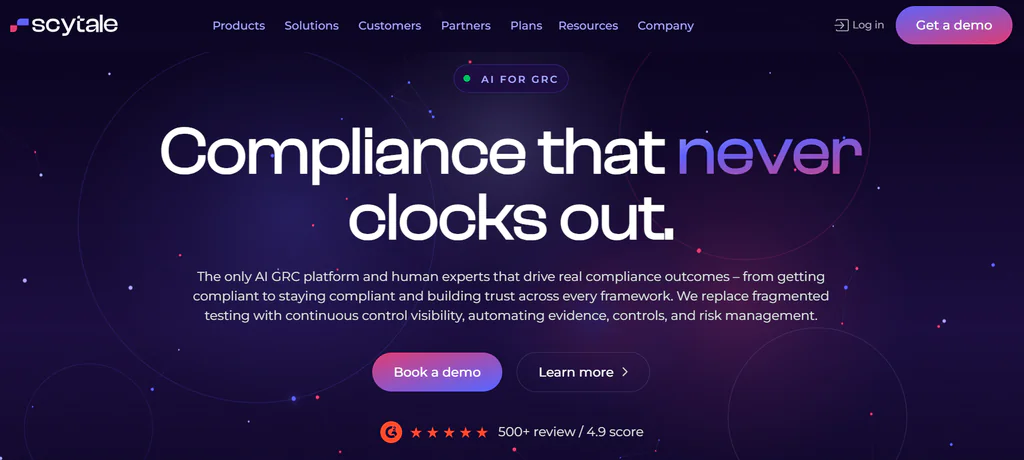
Scytale is a leading AI compliance management platform for SaaS organizations, from startups to enterprises. Its AI GRC platform automates evidence collection, continuous monitoring, and other key processes across frameworks such as SOC 2, ISO 27001, HIPAA, GDPR, the EU AI Act, and SOX ITGC.
Combined with dedicated GRC experts and Scytale’s AI GRC agent, this reduces manual work, proactively identifies compliance gaps, and provides actionable insights from audit preparation through ongoing compliance management.
(Screenshot from Scytale’s website)
Why Scytale is the best:
- AI-powered automation for evidence collection, access reviews, control monitoring, and vendor risk management
- Continuous compliance monitoring that provides an up-to-date view of controls, risks, and compliance status
- AI GRC agents that review evidence, surface compliance gaps, and provide actionable insights
- Multi-framework cross-mapping that reuses controls and evidence across multiple standards
- Dedicated GRC experts who complement AI with hands-on guidance and human judgment
- Customizable Trust Center that turns up-to-date compliance data into a clear, shareable view of your security and compliance posture
2. ServiceNow
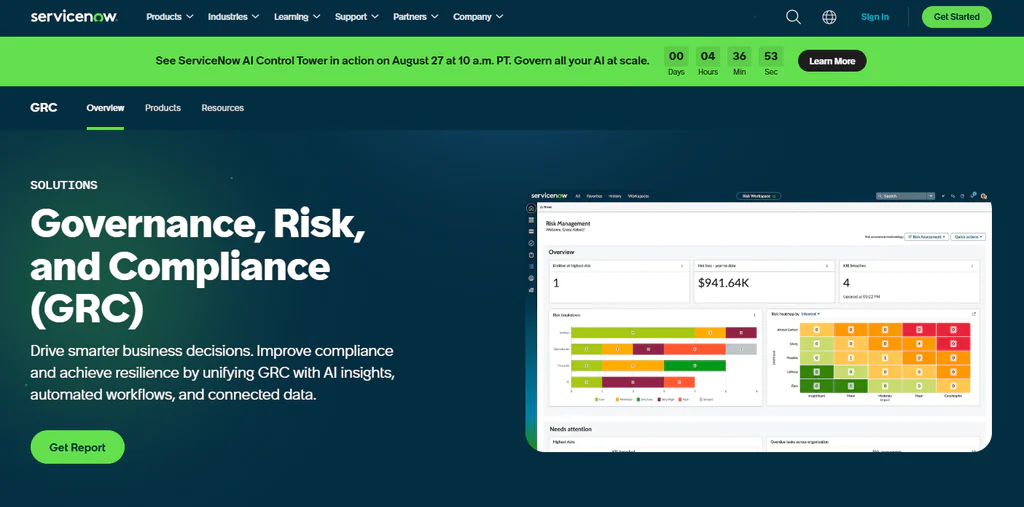
ServiceNow’s GRC module extends the company’s broader IT platform into risk and compliance, using AI-driven workflows to automate risk assessment, remediation recommendations, and continuous compliance monitoring across the enterprise. It suits large organizations already standardized on ServiceNow for IT service management and security operations.
(Screenshot from ServiceNow’s website)
Key strengths:
- Unifies risk, compliance, and governance data across the entire ServiceNow ecosystem
- AI-driven Smart Remediation recommends response strategies based on historical risk data
- Continuous monitoring dashboards replace point-in-time compliance assessments
Limitations:
- Licensing starts around fifty thousand dollars annually, pricing out smaller compliance teams
- Steep learning curve requires dedicated ServiceNow platform expertise to configure
3. LogicGate
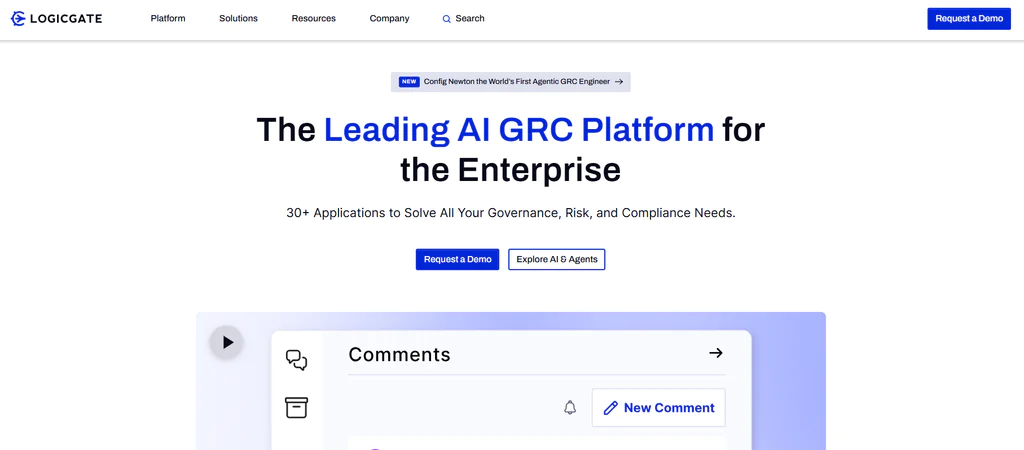
LogicGate’s Risk Cloud combines a no-code GRC platform with Spark AI features that generate automated reporting insights and review control evidence as soon as it is collected. The platform centralizes risk, compliance, and audit programs into one configurable workspace built on a graph database architecture.
(Screenshot from LogicGate’s website)
Key strengths:
- Spark AI automated evidence testing flags issues immediately after collection
- No-code workflow builder lets teams customize programs without engineering support
- Connects risk, compliance, and audit data into one centralized dashboard
Limitations:
- Steep learning curve for teams without prior GRC platform experience
- Costs increase significantly when adding multiple modules to the program
4. Sprinto
Sprinto is an AI-powered platform designed for tech organizations, offering pre-built compliance programs along with AI-powered evidence collection and control monitoring. It focuses on streamlining compliance processes for quick readiness and ease of use.
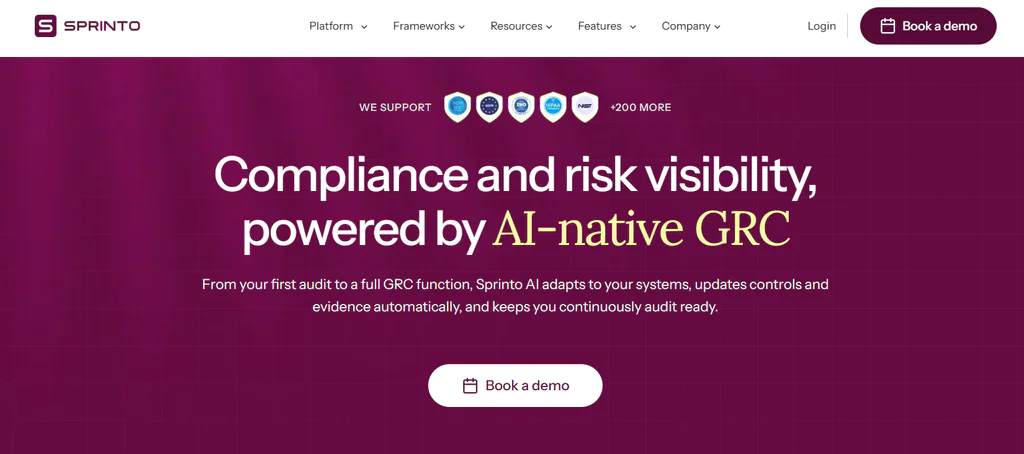
(Screenshot from Sprinto’s website)
Key strengths:
- AI-driven risk identification and reporting across connected systems
- Automated evidence collection for major compliance frameworks
- Continuous monitoring of compliance controls
Limitations:
- Lacks deep AI capabilities for complex compliance decision-making
- Optimized mainly for straightforward cloud setups
5. Drata
Drata leverages AI to automate evidence collection and integrates with cloud and developer tools. It uses AI-driven automated tests and a centralized hub to manage audit evidence.
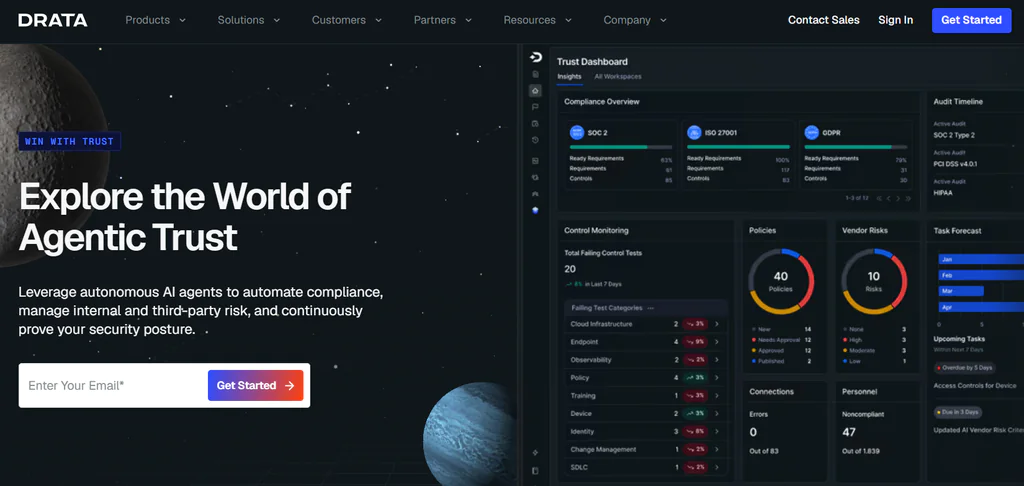
(Screenshot from Drata’s website)
Key strengths:
- Integrates with a wide range of cloud and developer tools
- Automated alerts support faster risk identification
- AI-assisted risk management enables proactive mitigation
Limitations:
- Lacks advanced customization for specific workflows
- Complexity of AI features may require dedicated resources and expertise
6. Secureframe
Secureframe automates evidence collection and continuous monitoring across cloud tools, with AI-assisted features and compliance guidance. The platform is designed to help organizations stay compliant with key frameworks.
(Screenshot from Secureframe’s website)
Key strengths:
- Automated evidence collection speeds up audit preparation
- AI assistance supports ongoing monitoring of compliance controls
- Integrates with key business systems for continuous compliance
Limitations:
- Less suited for scaling across multi-framework programs
- Requires some manual uploads for complex environments
7. Vanta
Vanta uses AI to automate compliance preparation for security audits across multiple frameworks. It integrates with cloud and identity tools for AI-driven evidence collection and automated control checks.
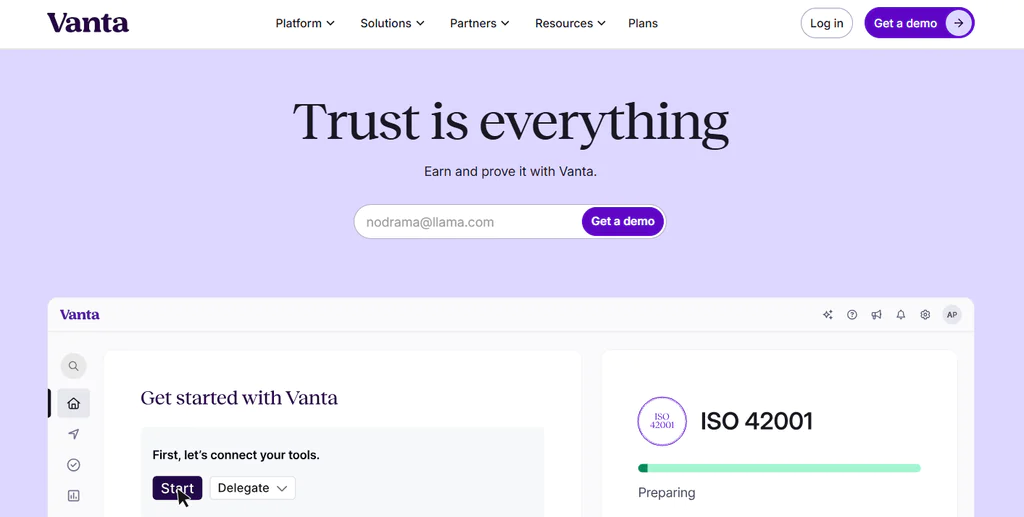
(Screenshot from Vanta’s website)
Key strengths:
- Integrates with key tools for continuous monitoring
- Automates compliance evidence collection
- Simplifies audit preparation across frameworks
Limitations:
- Basic risk scoring that does not fully account for control effectiveness
- Add-on pricing can increase total costs
Top AI compliance software for 2026
| Platform | Key strengths | Ideal for |
|---|---|---|
| Scytale | AI GRC automation, continuous monitoring, AI agents, multi-framework management, streamlined GRC processes, and expert guidance | SaaS organizations of all sizes with complex compliance needs seeking efficient AI GRC management |
| ServiceNow | AI-powered risk workflows, enterprise-wide GRC unification, deep integration with the ServiceNow ecosystem | Large enterprises already standardized on the ServiceNow platform |
| LogicGate | Spark AI evidence testing and reporting insights, no-code workflow configuration, multi-framework support | Mid-market and enterprise risk teams needing a highly configurable GRC workspace |
| Sprinto | Pre-built programs, user-friendly interface | Startups or organizations with straightforward compliance needs |
| Drata | Engineering-focused integrations, centralized audit hub | Development teams with advanced technical compliance needs |
| Secureframe | Compliance guidance, AI-assisted tools | Small to mid-sized businesses with standard compliance requirements |
| Vanta | Streamlined audit preparation, cloud tool integration | Organizations seeking simple, automated compliance solutions |
Always-on GRC. Built for modern teams.
How to evaluate AI claims from compliance vendors
As AI in compliance becomes more common, it is essential to cut through the marketing noise and assess the actual functionality behind vendor claims. Some platforms attach an “AI-powered” label to features that offer little more than basic automation, making a structured evaluation approach essential. Here are a few practical factors to help you evaluate AI capabilities in compliance tools:
What specific tasks does your AI handle?
Ensure the AI is solving tangible problems, such as automating evidence collection, monitoring controls, or identifying risks. It should have a clear role in your workflow, not just an umbrella claim of “AI-powered.”
What data does your AI use?
Ask what data and context the AI relies on to generate outputs, how that data is handled, and how the vendor maintains accuracy and relevance within your compliance environment.
How do you handle accuracy and hallucinations?
AI tools can sometimes generate inaccurate or “hallucinated” content. Ask the vendor how they address this, whether through human oversight, regular data validation, or built-in mechanisms to ensure the AI’s outputs are reliable.
Is AI augmenting my team or replacing human review?
AI should act as a tool to enhance a team’s efficiency, not replace critical human judgment. Clarify how AI integrates with human decision-making and whether it is intended to handle routine tasks or complex decision-making processes.
Does AI work across all frameworks or just specific ones?
Not all AI compliance platforms support the same frameworks or apply AI capabilities consistently across them. Make sure the solution supports the frameworks relevant to your business and understand exactly how its AI works within each one.
AI compliance features that actually save time
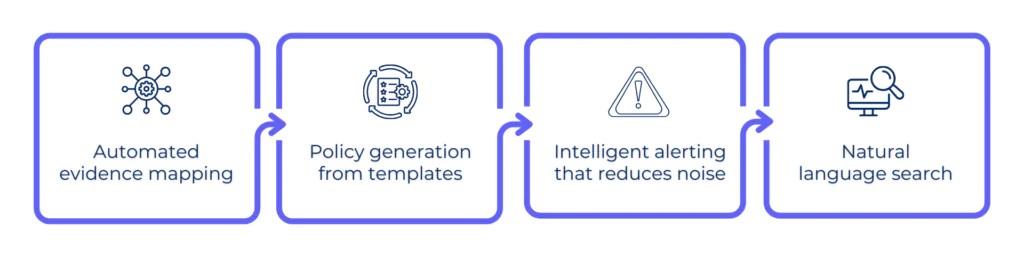
AI compliance features have the potential to save significant time by automating routine tasks and streamlining workflows. Not every feature marketed as AI delivers a meaningful return on that time investment. Here are the highest-impact AI features that truly drive efficiency:
Automated evidence mapping
AI automates the process of mapping evidence to compliance requirements, eliminating the need for manual tracking. By automatically organizing and linking the right evidence to the correct controls, it reduces time spent searching for or verifying documents during audits.
Policy generation from templates
AI speeds up policy creation by generating drafts based on pre-defined templates and relevant framework requirements. This reduces manual drafting and revisions while helping teams tailor policies to their compliance needs, with human review ensuring accuracy and context.
Intelligent alerting that reduces noise
AI-driven intelligent alerting supports continuous compliance by prioritizing important control issues, risks, and gaps while filtering out unnecessary notifications. This helps compliance teams focus on what needs attention instead of spending time sorting through low-impact alerts.
Natural language search across compliance data
With AI-powered natural language search, compliance teams can query vast amounts of data quickly and efficiently. This feature saves time by letting users find specific compliance information instantly, without sifting through multiple reports or systems.

Why Scytale is the best AI compliance platform
Scytale stands apart by combining advanced AI with hands-on GRC expertise throughout the compliance lifecycle. Instead of leaving teams to interpret AI outputs and navigate complex requirements alone, Scytale pairs intelligent automation with practical guidance tailored to each organization’s compliance needs.
This combination gives teams more than a tool for completing individual compliance tasks. Scytale provides one place to manage multiple frameworks, reuse controls and evidence as requirements grow, and move from audit preparation to ongoing compliance without rebuilding processes each time.
FAQs about best AI compliance platforms
Is AI required for effective compliance automation?
No, AI is not required for compliance automation, but it can make it significantly more efficient. AI compliance platforms like Scytale use AI to reduce repetitive work, identify compliance gaps, and provide actionable insights, helping teams focus on higher-value compliance tasks.
Can AI write compliance policies for us?
AI can help draft compliance policies using templates, framework requirements, and organizational context. Human review is still important to ensure each policy accurately reflects the organization’s operations, risks, and compliance requirements.
How do auditors view AI-assisted compliance?
Auditors can use evidence and documentation produced with AI-assisted compliance tools, provided the outputs are accurate, reliable, and properly supported. Human oversight remains important, particularly when validating evidence and interpreting complex compliance requirements.
Will AI replace compliance teams?
No, AI will not replace compliance teams. It enhances their work by automating routine tasks, allowing compliance professionals to focus on strategic decisions and complex risks. Leading AI GRC solutions, like Scytale, combine AI-powered automation with tailored expert guidance, helping SaaS teams stay compliant and audit-ready.
How do AI compliance platforms work?
AI compliance platforms connect to existing systems, cloud infrastructure, and identity tools to continuously pull evidence, monitor controls, and flag risks as they emerge. Machine learning models classify evidence against relevant framework requirements, surface anomalies in control performance, and let compliance teams query program status in plain language instead of digging through dashboards and reports.
How do I choose the best AI compliance platform for my organization?
Start by matching a platform’s framework coverage to your actual compliance roadmap, then look closely at what its AI genuinely automates versus what still requires manual review. Weigh implementation complexity and cost against your team’s size and in-house compliance expertise, and prioritize vendors that combine automation with real human support rather than leaving your team to interpret AI outputs alone.
