

TL;DR: Compliance platforms for UK companies
- Compliance platforms replace spreadsheets and disconnected tools with a structured system for evidence, controls, policies, and audits.
- UK companies face rising pressure from UK GDPR, FCA operational resilience, Cyber Essentials, and buyer due diligence requirements.
- Top compliance platforms combine automation, continuous monitoring and clear reporting for security and compliance teams.
- Scytale is the best compliance platform for UK companies, offering AI-driven automation and streamlined GRC workflows for continuous, year-round compliance.
- The right platform depends on your frameworks, integrations, UK-specific requirements, and the level of support your team needs.
UK compliance programs rarely fail due to a lack of focus on controls. They fail because evidence is scattered, policies drift over time, and audit preparation still relies on manual follow-ups across multiple systems.
This becomes more complex as UK organizations manage multiple requirements and increasing pressure to demonstrate operational resilience. The right compliance platform helps centralize your Governance, Risk and Compliance (GRC) program, reduce manual effort, and maintain continuous audit readiness.
Let’s explore how to evaluate compliance platforms, identify the features that drive real impact, and review the top solutions for UK teams.
8 best compliance platforms for UK companies
- Scytale
- LogicGate
- Hyperproof
- Scrut
- Thoropass
- Secureframe
- Sprinto
- Drata
What are compliance platforms?
Compliance platforms are software systems that enable organizations to manage security and compliance activities within a single, structured environment. They centralize controls, evidence, policies, and audits into a unified compliance management workflow, improving visibility and consistency across compliance processes.
A compliance platform automates evidence collection from business systems, monitors control performance, manages policies, and supports audit preparation, while maintaining a clear record of what was tested, who approved it, and when requirements were last reviewed.
This matters because point solutions only address parts of the problem. A document tool may store policies and a ticketing system may track remediation, but neither provides full visibility. For UK organizations, compliance software goes further by improving accountability, strengthening audit readiness, and enabling a defensible way to demonstrate that controls are not only documented, but consistently maintained.
AI-native GRC for how teams work today.
Why UK companies need compliance software
UK companies face a complex mix of privacy, security, and resilience requirements that make manual compliance difficult to sustain. UK GDPR obligations, ICO scrutiny, Cyber Essentials adoption, ISO 27001 buyer expectations, and sector-specific requirements such as FCA operational resilience all place increasing pressure on teams.
The commercial impact is also significant. According to the UK government, 43% of UK businesses identified a cyber security breach or attack in the previous 12 months, keeping security assurance firmly on executive agendas. Without dedicated compliance software, evidence collection becomes reactive and fragmented, with teams spending audit cycles chasing screenshots, confirming approvals, and reconstructing control histories instead of managing issues in real time.
The consequences extend beyond administrative burden. Limited control visibility can contribute to regulatory risk, reputational damage, and lost enterprise opportunities when buyers request proof of SOC 2 in the UK or ISO 27001 readiness. For many organizations, regulatory compliance software provides the bridge between security operations and business outcomes by improving documentation, maintaining up-to-date policies, and enabling a clear, defensible assurance posture across audits, customer diligence, and board reporting.
Key features of compliance platforms
For UK companies, the most effective compliance platforms do more than collect documents. The difference lies in a core set of capabilities that enable scalable, continuous compliance.
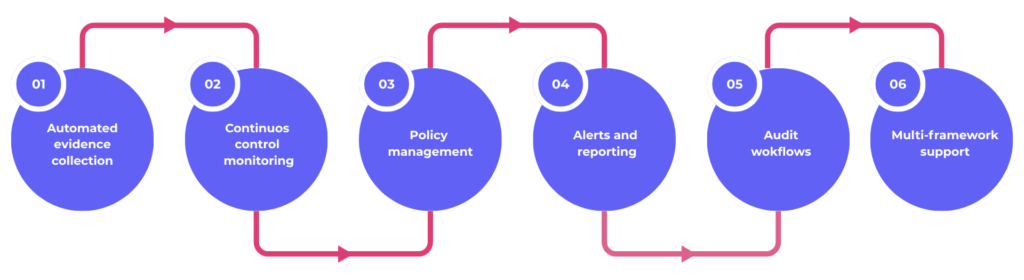
Automated evidence collection
Automated evidence collection pulls data directly from cloud infrastructure, identity providers, HR systems, and ticketing tools, reducing reliance on manual requests. This minimizes outdated screenshots and ensures a more reliable, real-time source of compliance evidence.
Continuous control monitoring
Continuous monitoring verifies that key controls remain in place between audit milestones. This is critical in dynamic environments, where systems change frequently and teams need timely visibility into control drift, exceptions, and remediation requirements.
Policy management
Policy management ensures documents are version-controlled, assigned, approved, and reviewed on a defined schedule. Strong platforms link policy ownership to control execution, improving both accountability and the quality of compliance documentation.
Alerts and reporting
Alerts and reporting enable teams to identify failed tests, overdue reviews, and unresolved tasks before they escalate into audit issues. Effective reporting should provide visibility by framework, control owner, and remediation priority, not just checklist completion.
Audit workflows
Audit workflow capabilities centralise requests, submissions, comments, and approvals. This creates a clear, auditable record for internal teams, external auditors, and business stakeholders, ensuring transparency throughout the audit process.
Multi-framework support
Multi-framework support allows organizations to reuse controls and evidence across standards, rather than duplicating effort for each framework. When evaluating AI compliance platforms, this is where advanced mapping capabilities can significantly reduce overlap across frameworks like UK GDPR, ISO 27001, SOC 2, and SOX ITGC.

Best compliance platforms for UK companies
Choosing the right compliance platform in the UK involves understanding both current requirements and future regulatory demands. Here are eight of the best compliance platforms for UK companies to consider:
1. Scytale
Scytale is the best compliance platform for UK companies that need to manage risk and compliance in a single, scalable environment. It supports 80+ frameworks and combines automated evidence collection, continuous monitoring, and cross-framework control mapping to eliminate duplicate work and keep program audit-ready as requirements evolve.
For UK organizations, this is particularly valuable when teams are responsible for managing multiple frameworks such as UK GDPR, SOC 2, ISO 27001, and SOX ITGC alongside increasing customer and regulatory demands. The platform uses automated workflows to review evidence, flag control gaps, and trigger remediation tasks, supported by a dedicated GRC expert team and deep integrations across core systems.
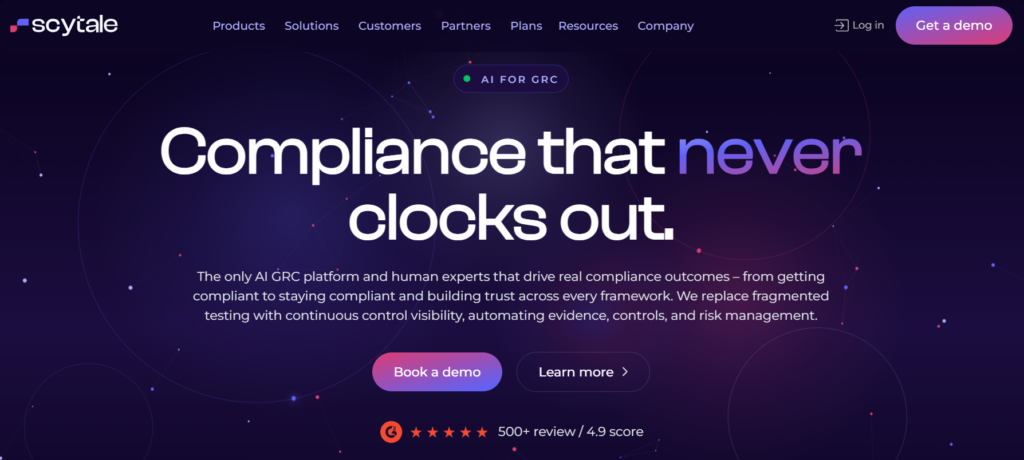
(Screenshot from Scytale’s website)
Key strengths
- Continuous compliance through real-time monitoring, with full visibility into your security and risk posture
- AI GRC automation that streamlines core compliance processes, including evidence collection, access reviews, real-time oversight, and vendor risk management
- Multi-framework management with cross-mapping to eliminate duplicate work across multiple standards like SOC 2, ISO 27001, GDPR and HIPAA
- Customizable Trust Center to clearly showcase your security and compliance posture
- Dedicated GRC expert support, providing tailored guidance throughout the entire compliance journey
- Streamlined integrations with essential tools and customizable options for enhanced automation and flexibility.
2. LogicGate
LogicGate is a configurable GRC platform focused on workflow orchestration and enterprise risk management. It is typically used by organizations that want to design and customize governance and risk processes internally.
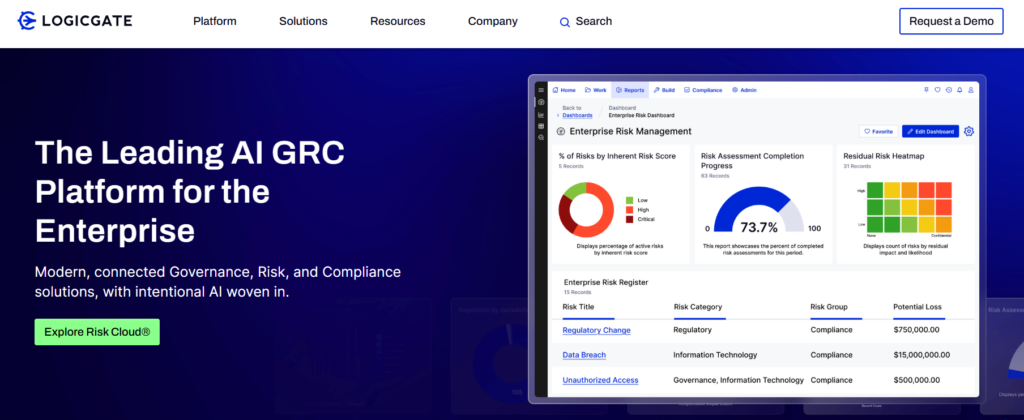
(Screenshot from LogicGate’s website)
Key strengths
- Advanced workflow configuration for complex governance and risk processes
- Supports enterprise-wide risk orchestration beyond compliance use cases
- Flexible design for teams building custom internal operating models
Limitations
- Higher setup and ongoing administrative effort compared to compliance-first tools
- Slower rollout for teams needing structured, out-of-the-box compliance workflows
3. Hyperproof
Hyperproof is a compliance operations platform built to manage controls, evidence, and audit coordination across frameworks. It is often used by teams prioritising structured program management and collaboration.
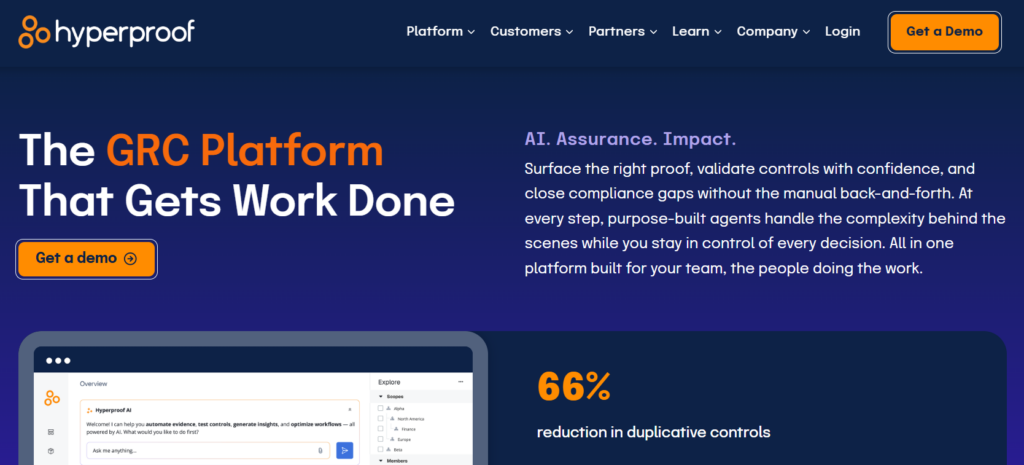
(Screenshot from Hyperproof’s website)
Key strengths
- Centralized control management across multiple frameworks and teams
- Collaboration tools that align security, IT, and business stakeholders
- Structured approach to audit planning and program coordination
Limitations
- Limited depth in native automation for continuously changing environments
- Local compliance alignment may require validation within workflows
4. Scrut
Scrut is a compliance automation platform focused on simplifying audit readiness and control tracking. It is generally suited for growing companies building out their compliance processes.
(Screenshot from Scrut’s website)
Key strengths
- Simplifies compliance execution for teams with limited internal resources
- Guided program setup to help formalise processes from the ground up
- Core control tracking to support ongoing compliance activities
Limitations
- Scaling across complex, multi-entity environments may be challenging
- Depth of analytics and reporting capabilities may vary by use case
5. Thoropass
Thoropass combines compliance software with audit and advisory services in one offering. It is often chosen by companies looking for a bundled approach to certification and audit support.
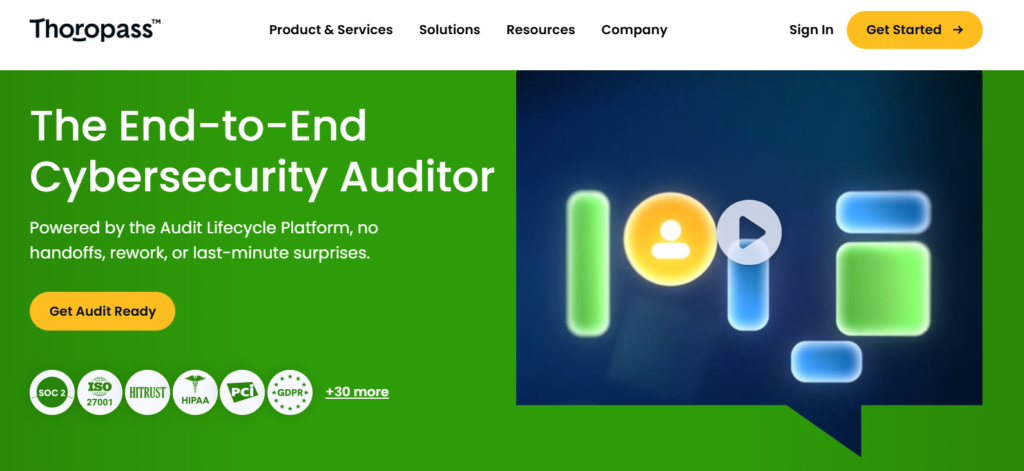
(Screenshot from Thoropass’s website)
Key strengths
- Combines platform capabilities with integrated audit and advisory services
- Streamlines certification processes through a single vendor relationship
- External expert support included for teams needing additional guidance
Limitations
- Less emphasis on continuous, day-to-day compliance operations
- Service-led model may reduce flexibility for internal standardisation
6. Secureframe
Secureframe is a compliance automation platform focused on helping companies achieve certifications speed. It is typically used by teams prioritising faster audit readiness with a streamlined toolset.
(Screenshot from Secureframe’s website)
Key strengths
- Structured workflows designed to guide teams through certification processes
- Coverage of commonly requested security and compliance frameworks
- Fast onboarding for teams prioritising quick time to certification
Limitations
- Limited integration with broader enterprise risk management processes
- Regional compliance requirements may need additional validation
7. Sprinto
Sprinto is a cloud-native automation platform designed for cloud-first companies seeking continuous monitoring and audit readiness. SaaS teams use it to reduce manual compliance effort and maintain consistency across dynamic environments.
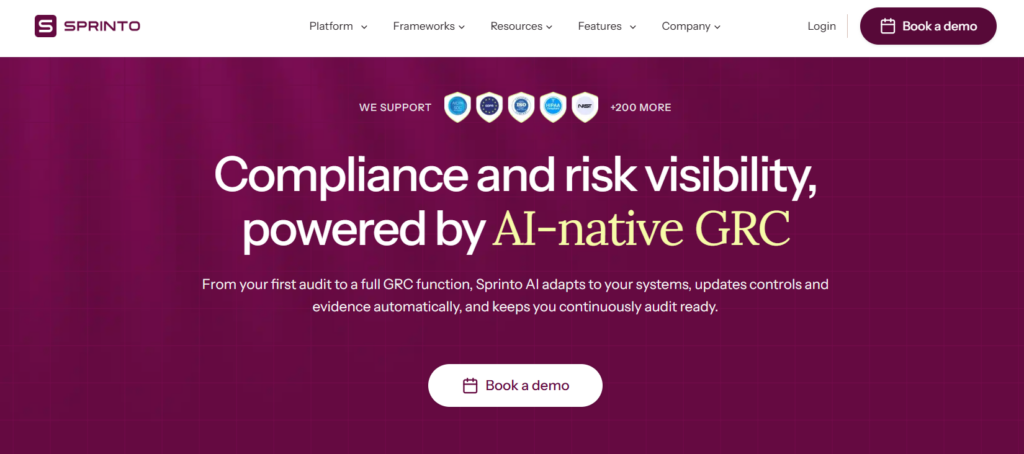
(Screenshot from Sprinto’s website)
Key strengths
- Automation-first approach to managing compliance tasks and workflows
- Continuous control checks to maintain ongoing compliance posture
- Designed for cloud-native environments and SaaS operating models
Limitations
- Expansion into broader framework coverage may require evaluation
- Strategic support beyond the platform may be limited
8. Drata
Drata is a compliance automation platform designed to connect compliance workflows directly with a company’s cloud and SaaS ecosystem. It is used by companies pursuing common security frameworks with an automation-first approach.
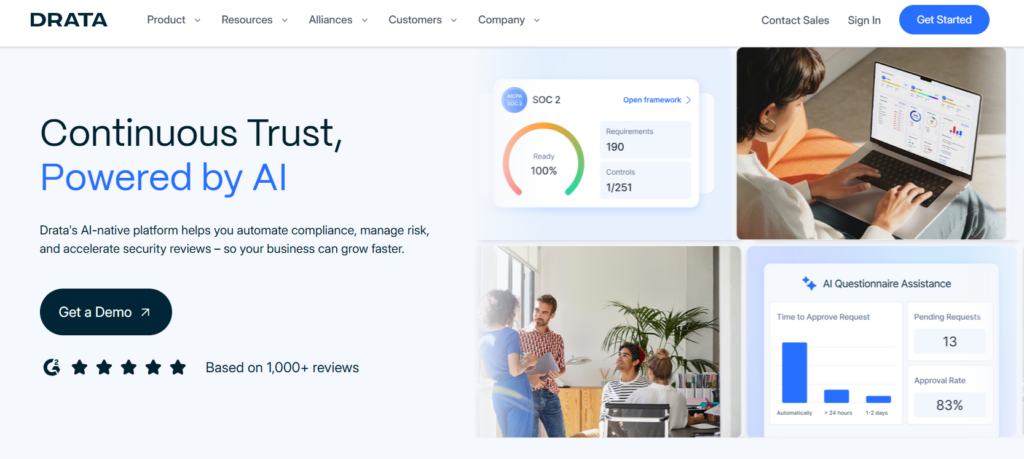
(Screenshot from Drata’s website)
Key strengths
- Integration-led compliance workflows that connect across cloud systems
- Real-time control tracking for improved visibility into compliance status
- Widely adopted solution across SaaS companies and growing teams
Limitations
- Local operational alignment may need to be validated for specific regions
- Advanced enterprise use cases may require additional support layers
Top 8 Compliance Platforms for UK Companies
| Platform | Best fit | Key focus |
| Scytale | UK-based SaaS teams scaling multi-framework compliance without increasing overhead | Automated compliance workflows with continuous monitoring, multi-framework control mapping, streamlined compliance workflows, and GRC expert support |
| LogicGate | Enterprise GRC teams | Configurable risk and workflow management |
| Hyperproof | Cross-functional compliance teams | Control and audit operations |
| Scrut | Growing compliance programs | Guided compliance automation |
| Thoropass | Teams wanting software plus services | Compliance platform with audit support |
| Secureframe | Framework-focused security teams | Compliance automation and readiness |
| Sprinto | Cloud-first SaaS teams | Automation-led continuous compliance |
| Drata | Automation-first compliance teams | Monitoring and evidence automation |
How to choose the right compliance platform in the UK
Selecting a compliance platform in the UK requires a clear view of how your organization manages risk and compliance operations. Here are the key features to consider when choosing the right solution.
Identify your compliance requirements
UK companies should start by clearly mapping the frameworks they need to meet today, while also planning for future requirements as the business grows. Taking this forward-looking approach helps ensure the platform can support expanding compliance programs over time, rather than being limited to a single audit or short-term need.
Evaluate features and integrations
For UK teams, evaluating compliance platform features should focus on operational depth rather than basic feature lists. A strong platform should automate evidence collection, support continuous monitoring, enable policy workflows, and integrate with existing systems for reporting and audit management. UK buyers should also assess how data flows into controls, how issues are flagged, and whether the platform reduces manual effort rather than adding overhead.
Consider ease of use and scalability
UK compliance teams are often relatively small compared to the number of regulatory obligations they manage, so usability has an immediate impact. The platform should be intuitive enough for control owners across departments to use without constant support, while still structured enough to support formal compliance processes. In a UK context, scalability means handling more frameworks, entities, evidence sources, and reporting requirements over time without slowing down operations or increasing complexity.
Check alignment with UK regulations
UK organizations should validate how well a platform supports UK-specific regulatory requirements rather than assuming global coverage is sufficient. UK GDPR operates as a distinct legal regime from EU GDPR, and frameworks such as FCA operational resilience introduce additional expectations around governance, testing, and documentation. UK buyers should ask direct questions about framework content, policy templates, data handling, and reporting to ensure the platform aligns with real regulatory demands, not just generic standards.
Assess vendor support quality
For UK business compliance, vendor support is critical, as audit preparation, evidence validation, and control interpretation often require human input. Companies should assess the quality of onboarding, clarity of implementation guidance, responsiveness of support teams, and the vendor’s ability to assist with multi-framework programs across teams and jurisdictions.
Streamline GRC workflows with no blind spots.
How Scytale delivers compliance for UK companies
UK compliance programs often cover multiple frameworks and changing security and compliance requirements, making consistency and oversight difficult to maintain. Scytale supports this by combining tailored guidance from experienced GRC professionals with structured workflows that help teams scope requirements, prepare for audits, and manage compliance activities in a consistent, practical way.
In addition, Scytale enables organizations to demonstrate their compliance posture externally through built-in Trust Center capabilities, making it easier to share security and compliance information with customers and stakeholders. This approach helps UK companies strengthen transparency, respond to assurance requests more efficiently, and build trust as they grow.
FAQs about compliance platforms for UK companies
-
What is a compliance platform?
A compliance platform is software that helps you manage controls, evidence, policies, reporting, and audits in one place. It replaces fragmented spreadsheets and point tools with a structured system that supports continuous compliance operations. Top AI GRC platforms like Scytale also add AI-driven automation and expert guidance for multi-framework programs.
-
Why do UK companies need compliance software?
UK companies need compliance software because manual processes do not scale well across UK GDPR, Cyber Essentials, ISO 27001, customer diligence, and sector expectations such as FCA operational resilience. A platform improves visibility, reduces evidence-chasing, and helps your team present a more defensible compliance posture during audits, procurements, and reviews.
-
What features should I look for in a compliance platform?
You should look for automated evidence collection, continuous control monitoring, policy management, alerts, reporting, audit workflows, and multi-framework support. The right mix depends on your program maturity and obligations. If you expect to expand frameworks, cross-framework mapping and integration depth become especially important.
-
How do I choose the best compliance platform for my business?
Choose the best compliance platform by matching the product to your current frameworks, future roadmap, integrations, reporting needs, and internal capacity. You should also assess UK-specific alignment and vendor support quality. Scytale is a strong choice for teams that need both software automation and hands-on GRC expertise.
-
What are the best compliance platforms for UK companies?
The best compliance platforms for UK companies depend on your size, framework scope, and operating model. Scytale stands out as a top choice for organizations managing complex, multi-framework programs, particularly where automation, continuous monitoring, and expert support are needed. Other platforms like LogicGate, Hyperproof, Scrut, Thoropass, Secureframe, Sprinto, and Drata may be suitable depending on specific use cases and priorities.
