




TL;DR: Vendor due diligence
- Vendor due diligence reviews a third party before onboarding to confirm security, compliance, legal, and operational fit.
- A strong vendor due diligence checklist helps your team assess risk by domain instead of relying on ad hoc reviews.
- The third-party due diligence process starts with vendor tiering and ends with a documented onboarding decision.
- Mature teams treat vendor due diligence as a continuous program tied to third-party risk management, not a one-time task.
- Scytale’s AI GRC platform automates evidence collection, questionnaire reviews, and vendor risk workflows across the due diligence lifecycle.
Third-party vendors can give your business access to critical technology, expertise, and services, but they can also introduce security, compliance, privacy, and operational risks. The more vendors your organization relies on, the more important it becomes to understand those risks before granting access to sensitive data or business-critical systems.
Vendor due diligence gives teams a structured way to evaluate those risks before onboarding and throughout the relationship. An effective process goes beyond questionnaires and certifications to assess controls, compliance evidence, privacy practices, and overall risk. In this article, we’ll explain what vendor due diligence is, walk through the process, and provide a practical checklist and best practices for effective vendor reviews.
What is vendor due diligence?
Vendor due diligence is the process of evaluating a third party’s security, compliance, privacy, financial, and operational risks before entering into or expanding a business relationship.
Organizations working with cloud providers, software vendors, contractors, service partners, or data processors should have a formal due diligence process. The depth of the review should reflect the vendor’s risk level, including the data they handle, the systems they can access, and how critical their services are to business operations.
A consistent process helps identify security weaknesses, compliance gaps, and operational risks before they affect the business. It also creates a documented basis for vendor approval and remediation decisions, while supporting regulatory compliance and ongoing third-party risk management (TPRM) throughout the vendor relationship.
Streamline GRC workflows with no blind spots.
The vendor due diligence process: Step-by-step
A strong vendor due diligence process follows a clear sequence, from assessing risk to making a documented decision. The level of review should reflect the vendor’s access, data exposure, business criticality, and compliance impact. Here are the key vendor due diligence steps:
Step 1: Tier vendors by risk
Start by determining how much risk the vendor could introduce based on the systems it can access, the data it handles, and how critical its services are to your operations. Consider different types of vendor risk, including security, privacy, operational, financial, and compliance risk, to assign an appropriate risk tier and level of review.
Step 2: Define review requirements
Based on the vendor’s risk tier, determine what evidence, reviews, and approvals are required, such as security questionnaires, compliance reports, penetration test results, or privacy assessments. These requirements should align with your TPRM policy to keep reviews consistent across vendors.
Step 3: Collect vendor documentation
Gather the documentation needed to evaluate the vendor, such as SOC 2 reports, ISO certifications, security questionnaires, privacy policies, DPAs, business continuity plans, and penetration test summaries. The amount of evidence requested should reflect the vendor’s risk, with more extensive documentation required for critical third parties.
Step 4: Review security and compliance posture
Review the evidence to determine whether the vendor’s controls meet your security and compliance requirements, including areas such as access control, encryption, vulnerability management, incident response, and business continuity. A formal vendor risk assessment can help identify and document the specific risks the vendor presents.
Step 5: Assess legal, privacy, and commercial terms
Review contractual requirements such as data processing, breach notification, audit rights, SLAs, liability, data retention, and termination obligations. For vendors handling personal or regulated data, confirm that their privacy commitments align with internal policies, customer agreements, and applicable requirements.
Step 6: Document findings and remediation
Record any control gaps, unanswered questions, compensating controls, remediation requirements, and residual risks identified during the review. For issues that do not prevent onboarding, assign an owner and remediation timeline so they can be tracked as part of the broader TPRM program.
Step 7: Make the onboarding decision
Use the findings to approve the vendor, approve it with conditions, defer onboarding until remediation is complete, or reject the relationship. Establish who owns the vendor relationship and when reassessment is required, while AI TPRM can help connect approvals, evidence, remediation, and ongoing monitoring in one workflow.
7 steps in the vendor due diligence process
| Step | Primary goal | Typical outputs | Key owner |
| Tier vendors by risk | Match review depth to exposure | Risk tier, intake record, review path | Security or procurement |
| Define review requirements | Set evidence and approval needs | Required documents, stakeholder list | Compliance or TPRM lead |
| Collect vendor documentation | Gather evidence for review | Reports, questionnaires, contracts | Vendor owner |
| Review security and compliance posture | Evaluate controls and risk | Findings, risk notes, control gaps | Security and compliance |
| Assess legal, privacy, and commercial terms | Confirm contractual protection | DPA review, legal comments, SLA notes | Legal and privacy |
| Document findings and remediation | Record gaps and required actions | Risk register entry, remediation plan | TPRM or compliance |
| Make the onboarding decision | Determine whether to proceed | Final decision, conditions, reassessment date | Business owner and approvers |
Vendor due diligence checklist
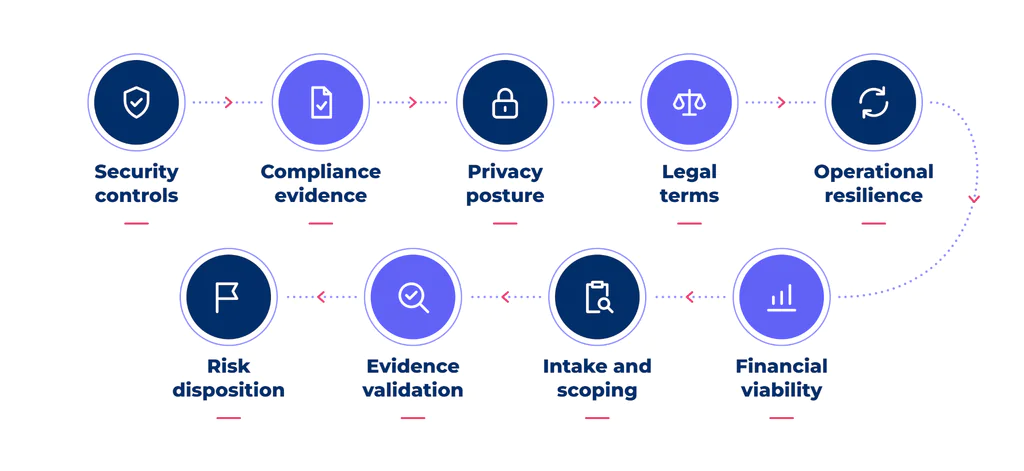
A practical vendor due diligence checklist helps teams evaluate third parties consistently across key risk areas. The depth of each review should reflect the vendor’s risk tier, data access, and importance to business operations. Here is the vendor due diligence checklist:
Security controls
Review the security controls relevant to how your organization will use the vendor, including access management, MFA, encryption, vulnerability management, monitoring, and incident response. The level of scrutiny should reflect the vendor’s access and potential impact. Vendors handling sensitive data or accessing production systems should require stronger evidence than lower-risk tools.
Compliance evidence
Review relevant evidence such as SOC 2 reports, ISO 27001 certifications, security policies, and audit reports. Confirm that each document is current and covers the service or environment your organization will use. For organizations focused on continuous compliance, also consider whether vendor evidence can be kept current between formal review cycles.
Privacy posture
Determine what personal or sensitive data the vendor collects, processes, stores, or accesses, including where it is stored and how long it is retained. Identify subprocessors and any cross-border data transfers that could introduce additional requirements. Review DPAs, breach notification procedures, deletion practices, and other relevant privacy protections.
Legal terms
Review contractual protections covering confidentiality, security obligations, breach notification, audit rights, SLAs, liability, and data ownership. Pay particular attention to what happens during an incident or when the relationship ends. Confirm requirements for data return or deletion, termination, and ongoing responsibilities.
Operational resilience
Assess whether the vendor can continue providing its services during outages, security incidents, or other disruptions. Review business continuity, disaster recovery, backups, uptime commitments, and escalation processes. For critical vendors, consider recovery objectives and dependencies that could affect your own operations.
Financial viability
Consider whether the vendor has the financial and operational stability to support the relationship over time. Depending on its importance, review factors such as financial information, insurance coverage, ownership changes, and ability to scale. For difficult-to-replace vendors, also consider concentration risk and the availability of alternative providers.
Intake and scoping
Create a clear intake record covering the service, business owner, data involved, integrations, and required system access. Use this information to determine which areas require deeper review and identify the types of vendor risk involved. Vendor risk management solutions can help centralize this information and ensure each third party is assessed based on its actual risk.
Evidence validation
Verify that submitted evidence is current, complete, and relevant to the specific service being assessed. Check report dates, scope, exclusions, findings, exceptions, and remediation status before accepting documentation. For example, an outdated penetration test or SOC 2 report covering a different service may provide limited assurance.
Risk disposition
Give every issue identified during due diligence a clear outcome, whether it is accepted, remediated, managed through compensating controls, or escalated. Document the finding, required action, owner, deadline, and final decision. This creates a clear audit trail and supports consistent decisions across the broader TPRM process.
AI-native GRC for how teams work today.
Vendor due diligence best practices
Effective vendor due diligence goes beyond completing a checklist before procurement. Strong programs use consistent processes, clear ownership, risk-based reviews, and ongoing monitoring throughout the vendor relationship. Here are the vendor due diligence best practices:
Standardize review paths
Create standardized review paths based on vendor risk, required evidence, stakeholders, and escalation rules. These should align with your third-party risk management policy so teams have a consistent process for assessing and approving vendors.
Standardization also reduces delays and improves audit readiness. Instead of deciding what to request for every vendor, teams can focus on reviewing evidence, documenting findings, and addressing risk.
Match due diligence to vendor risk
Avoid applying the same level of due diligence to every third party. Review depth should reflect factors such as data sensitivity, system access, regulatory exposure, business criticality, and the potential impact of an incident.
A risk-based approach focuses resources where they matter most. Lower-risk vendors can follow a lighter review, while critical vendors receive deeper security, privacy, compliance, legal, and operational assessments.
Treat due diligence as an ongoing program
Vendor due diligence should be part of a broader TPRM program that continues after onboarding. Periodic reassessments and trigger-based reviews help teams respond when a vendor’s services, controls, subprocessors, or data practices change.
Set reassessment schedules based on vendor risk and define triggers for earlier reviews, such as security incidents, new system access, or significant service changes. TPRM software can help centralize these reviews, track changes, and keep vendor risk information current over time.
Align business and control owners
Vendor due diligence should involve the relevant business owners, procurement, legal, privacy, security, and compliance teams. Each stakeholder contributes different information and expertise to the final decision.
Define who owns each stage, approves exceptions, and manages remediation. Clear responsibilities reduce delays and prevent important issues from getting lost between teams.
Validate evidence, not just its existence
A SOC 2 report, ISO certification, or penetration test does not automatically mean a vendor meets your requirements. Check the scope, dates, findings, exceptions, and remediation status to confirm the evidence applies to the service you will use.
The same applies to questionnaires and other vendor-provided documentation. For higher-risk vendors and critical controls, verify responses against supporting evidence where appropriate.
Track remediation through completion
Not every gap needs to prevent vendor approval, but every meaningful issue should have a clear outcome. Document whether it requires remediation, compensating controls, formal risk acceptance, or prevents onboarding.
Assign owners and deadlines to remediation items and track them through completion. This creates an audit trail and prevents identified risks from being forgotten after approval.
Use automation where review volume is high
Manual processes become harder to manage as vendor numbers, questionnaires, documents, and reassessments grow. Automation can help collect evidence, route approvals, track remediation, and manage reassessment schedules.
Dedicated vendor risk management workflows can keep evidence, findings, approvals, and monitoring connected in one place. This reduces administrative work and provides clearer visibility across the vendor due diligence process.
How long does vendor due diligence take?
The time required for third-party due diligence varies depending on the vendor’s risk level, the complexity of the service, and the depth of review required. A low-risk vendor with limited access to sensitive data may move through the process relatively quickly, while a critical vendor handling sensitive information or accessing core systems typically requires a more extensive security, compliance, privacy, and legal review.
Evidence quality and internal coordination can also affect the timeline. Effective vendor compliance management helps keep questionnaires, compliance reports, documentation, approvals, and remediation organized, reducing delays caused by missing evidence, unclear ownership, or unresolved gaps.
A risk-based process can help prevent unnecessary delays. By establishing vendor tiers and matching review requirements to each level of risk, teams can move routine vendors through a lighter process while dedicating more attention to higher-risk relationships. Clear ownership, standardized workflows, and centralized evidence also help teams set more realistic review timelines and avoid preventable bottlenecks.



How Scytale simplifies vendor due diligence
Scytale brings vendor due diligence into one centralized workflow, automating evidence collection, questionnaire reviews, remediation, and approvals. Teams can keep vendor documents, findings, and risk status in one place while connecting reviews to broader third-party risk management. Scytale’s agentic GRC ecosystem also supports evidence review and cross-framework mapping across 80+ frameworks, helping teams apply consistent requirements based on vendor risk.
Scytale also pairs automation with dedicated GRC experts who help teams navigate requirements, review gaps, and strengthen their vendor risk processes. This combination reduces manual coordination, keeps remediation and supporting documentation organized, and creates a clearer audit trail from initial review through ongoing oversight.
FAQs about vendor due diligence
What is the difference between vendor due diligence and a vendor risk assessment?
Vendor due diligence is the broader review process for approving a third party. A vendor risk assessment is one part of that process, focused on identifying and scoring risk. Scytale’s AI GRC platform helps teams connect both activities in one workflow, so evidence, findings, and approvals stay aligned.
When should you conduct vendor due diligence?
You should conduct vendor due diligence before onboarding a new vendor, before contract renewal, and after major service or control changes. High-risk vendors also need periodic reassessment. Timing should reflect data sensitivity, system access, and business dependency, not procurement deadlines alone.
What documents are required for vendor due diligence?
Required documents usually include security reports, privacy terms, data processing agreements, policy summaries, insurance details, and business continuity materials. The exact set depends on vendor tier and service scope. Higher-risk vendors often need broader evidence and more current documentation than low-risk vendors.
Who is responsible for vendor due diligence within an organization?
Vendor due diligence usually sits across security, compliance, procurement, legal, privacy, and the business owner requesting the service. One team should coordinate the workflow, but approval should stay shared. Leading AI GRC platforms like Scytale support this model by giving each stakeholder visibility into evidence, findings, and next steps.
What happens if vendor due diligence is skipped?
If you skip vendor due diligence, your organization accepts third-party risk without documented review. That raises the chance of security gaps, contract issues, privacy failures, and audit findings. It also leaves business owners without a clear record of what risk they approved and why.