






TL;DR: Security questionnaires
- A security questionnaire is a buyer due-diligence tool used to review a vendor’s security, privacy, and compliance posture.
- Receiving a vendor security questionnaire usually signals that a deal is moving forward, not that your team did something wrong.
- Most questionnaires repeat the same topics, so a maintained answer library saves time and improves consistency.
- A strong security questionnaire response depends on clear ownership, evidence-backed answers, and review before submission.
- Scytale’s AI GRC platform helps teams answer questionnaires faster by centralizing evidence and cutting repeat work across frameworks.
Security questionnaires are now a common part of B2B sales, but completing them can take significant time across multiple teams. As vendor reviews become more frequent and security requirements more detailed, the workload can quickly grow. Businesses need a more efficient way to manage questionnaires without sacrificing accuracy or slowing down deals.
A repeatable approach can reduce that workload while helping teams provide consistent, well-supported responses to buyers. In this article, we’ll look at what security questionnaires involve and how to manage the response process more efficiently.
What is a security questionnaire?
A security questionnaire is a structured set of questions used to assess a vendor’s security, privacy, and compliance practices before or during a business relationship.
Companies typically send security questionnaires during procurement, sales cycles, contract renewals, or periodic vendor reviews to determine whether a vendor’s controls meet their security and risk requirements. Questions may cover areas such as data protection, access controls, incident response, infrastructure security, and compliance with frameworks or regulations such as SOC 2, ISO 27001, GDPR, and HIPAA.
Unlike a security audit, a security questionnaire does not provide independent certification or formally test whether controls are operating effectively. It primarily relies on information provided by the vendor at a specific point in time, while a security audit involves structured testing, evidence review, and, in many cases, independent assessment or attestation.
Streamline GRC workflows with no blind spots.
Why companies ask you to complete a security questionnaire
Companies use security questionnaires to evaluate potential vendors and confirm their security requirements are met. Receiving one is often a positive buying signal that a deal is moving forward. Here are the main reasons companies ask vendors to complete security questionnaires:
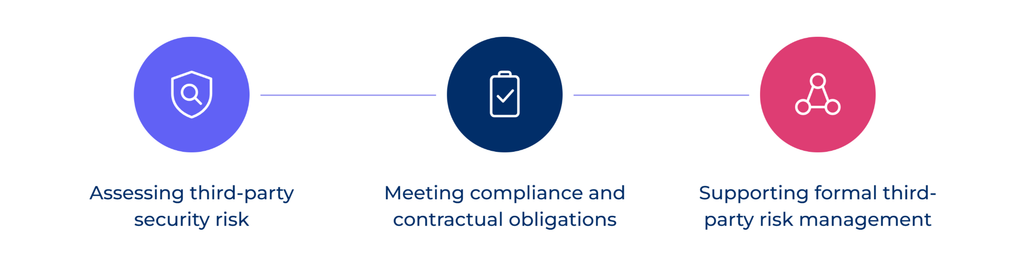
1. Assessing third-party security risk
When a company brings on a new vendor, that vendor becomes part of its broader risk environment. Security teams need to understand whether your access controls, data protection practices, incident response processes, and subprocessors could introduce data breach, operational, or reputational risks. A vendor security questionnaire gives buyers a structured way to assess those risks before giving their approval.
2. Meeting compliance and contractual obligations
Security reviews are also driven by regulatory, framework, and contractual requirements that extend to third-party vendors. Organizations may need to verify that vendors meet security expectations related to SOC 2, ISO 27001, GDPR, HIPAA, or commitments included in customer contracts. Completing a questionnaire helps buyers document that appropriate vendor due diligence was performed and that identified risks were evaluated.
3. Supporting formal third-party risk management
As more organizations build structured third-party risk management (TPRM) programs, security questionnaires are becoming a routine part of vendor onboarding and ongoing reviews. Standardized assessments help procurement, security, and compliance teams evaluate vendors consistently and maintain records of their security posture over time. For vendors, this makes security questionnaires an increasingly routine part of doing business with larger organizations.
Common security questionnaire formats: SIG, CAIQ, VSAQ, and more
Many buyers use established questionnaire formats and adapt them with questions based on their industry, data, and security requirements. Knowing which format you’re dealing with helps your team estimate the workload, find relevant answers, and gather the right evidence faster. Here are four common security questionnaire formats vendors may encounter:
SIG
The Standardized Information Gathering (SIG) questionnaire from Shared Assessments is a comprehensive, modular assessment commonly used for third-party risk reviews. Its detailed format covers areas such as security, privacy, risk, and operations, making it particularly relevant for enterprise and regulated organizations.
CAIQ
The Consensus Assessments Initiative Questionnaire (CAIQ) from the Cloud Security Alliance focuses specifically on cloud security. SaaS and cloud service providers may encounter it when buyers want detailed information about their cloud security controls and alignment with CSA requirements.
VSAQ
The Vendor Security Alliance Questionnaire (VSAQ) provides a structured way for organizations to assess vendor security practices. It covers common areas of vendor risk and is often used during technology procurement and third-party security reviews.
Custom questionnaires
Custom questionnaires combine standard security questions with buyer-specific requirements, contract terms, and internal policies. Because the content can vary significantly between organizations, vendors need reusable security information and evidence that can be adapted to different requests.
Comparing common questionnaire formats
| Format | Typical scope | Common use case | What vendors should expect |
| SIG | Comprehensive and modular | Enterprise and regulated deals | Detailed due diligence across security, privacy, risk, and operations |
| CAIQ | Cloud-focused | Cloud and SaaS reviews | Detailed questions about cloud security controls and practices |
| VSAQ | Structured vendor assessment | Technology vendor reviews | Questions covering common vendor security practices and controls |
| Custom | Varies widely | Buyer-specific reviews | A mix of standard questions and organization-specific requirements |
AI-native GRC for how teams work today.
Common topics covered in security questionnaires
Most security questionnaires cover the same core areas of security compliance, regardless of the format. Preparing answers and evidence for these topics in advance can make responses faster and more consistent:
- Data security and encryption: How sensitive data is protected at rest and in transit, including storage, retention, encryption, and secure disposal.
- Access control and identity management: How access to systems and data is managed, including user provisioning, multi-factor authentication, privileged access, access reviews, and offboarding.
- Incident response and breach notification: How security incidents are detected, escalated, managed, and communicated to affected customers.
- Business continuity and disaster recovery: How critical services remain available and recover from disruptions, including backups, recovery procedures, testing, and recovery objectives.
- Subprocessor and fourth-party risk: How third-party risk is assessed and managed for vendors and subprocessors that handle customer data or support critical services.
- Physical and infrastructure security: How data centers, cloud environments, and supporting infrastructure are protected from physical and operational threats.
- Employee security training: How employees are trained to understand security responsibilities, protect sensitive information, and report potential incidents.
- Compliance frameworks: Which security and compliance standards the organization can demonstrate, such as SOC 2, ISO 27001, GDPR, or HIPAA requirements.
How to respond to a security questionnaire efficiently
Responding efficiently starts with a clear process, current evidence, and reusable answers. A structured workflow reduces manual work, improves consistency, and prevents questionnaires from slowing down sales. Follow these seven steps to build a repeatable security questionnaire response process:
Step 1: Intake and triage the request
Log the questionnaire, deadline, sender, deal priority, and requested evidence in one central location. Assign a clear owner who is responsible for coordinating the response from start to finish. Early triage helps your team prioritize urgent requests and prevents questionnaires from getting stuck in inboxes or handoffs.
Step 2: Maintain a centralized answer library
Avoid rewriting answers to the same security questions for every buyer. Maintain approved responses and supporting evidence in a centralized answer library or Trust Center that can be updated as your security program changes. This gives your team a reliable starting point and reduces the time spent searching for information.
Step 3: Map questions to existing frameworks and evidence
Many questionnaire requirements overlap with controls you already maintain for audits and certifications. Security compliance platforms can help map these requirements across frameworks and connect them to existing evidence from SOC 2, ISO 27001, GDPR, HIPAA and other compliance programs. This helps your team reuse relevant evidence instead of collecting the same information for every questionnaire.
Step 4: Route questions to the right subject-matter experts
Assign one person to coordinate the questionnaire, then route specialized questions to the relevant control owners. Engineering can validate technical controls, HR can address employee processes, and legal can confirm contractual or subprocessor requirements. Clear ownership improves accuracy while reducing unnecessary back-and-forth between teams.
Step 5: Review answers for accuracy and consistency
Have a second reviewer check the completed questionnaire before it is submitted. Confirm that answers match your actual security practices, supporting evidence, and responses provided elsewhere. This helps prevent conflicting claims, inaccurate information, and unnecessary risk during the buyer’s review.
Step 6: Track questionnaire performance
Track questionnaire volume, turnaround time, escalations, and other metrics that show how much work the process requires. These insights can reveal recurring bottlenecks, frequently requested information, and areas where your team is spending too much time. Over time, the data can help justify automation, process improvements, or additional resources.
Step 7: Store completed responses and evidence
Keep submitted questionnaires, supporting evidence, approvals, and reviewer notes together with a clear audit trail. Previous responses can then become a reliable source for future questionnaires from the same buyer or organizations with similar requirements. Maintaining this history reduces repeated work and makes each new response easier to complete.
Always-on GRC. Built for modern teams.
Common security questionnaire mistakes to avoid
Security questionnaires can affect both deal progress and the commitments your company makes to a buyer. Rushed, inconsistent, or unsupported responses can create unnecessary risk and slow down procurement. Here are some of the most common mistakes to avoid:
Overstating your security controls
Never answer “yes” to a security control unless it is actually implemented and operating as described. Inaccurate responses can undermine buyer trust and create contractual risk, particularly if a security incident later exposes a control that was misrepresented. When a requirement is only partially met, explain the current state clearly rather than overstating your security posture.
Relying on one person for every questionnaire
Putting every questionnaire on one employee creates a bottleneck and increases the likelihood of errors, particularly as request volume grows. Without backup ownership or a review process, deadlines and response quality can suffer.
Treating every questionnaire as a new request
Starting from scratch wastes time when buyers frequently ask about the same security controls and practices. Reusing approved answers and current evidence can significantly reduce repetitive work while keeping responses consistent.
Providing answers without supporting evidence
A completed questionnaire may not be enough when buyers need evidence to validate your responses. Missing policies, certifications, reports, or other documentation can lead to additional follow-ups and extend the security review. Keep commonly requested evidence current and easily accessible so it can be provided when appropriate.
Missing questionnaire deadlines
Security reviews are often a required step before procurement can approve a vendor or finalize a contract. Missing the requested deadline can hold up an otherwise sales-ready deal and create unnecessary back-and-forth with the buyer. Track deadlines, prioritize questionnaires based on urgency, and flag potential delays early so stakeholders can respond accordingly.

Streamline security questionnaire responses with Scytale
Scytale’s AI GRC platform gives your team one place to manage questionnaire requirements, evidence, and controls across frameworks. Instead of rebuilding responses for every request, teams can reuse existing information and supporting evidence.
Scytale supports multi-framework compliance, so evidence collected for one framework can be reused across future questionnaires instead of starting from scratch. Its customizable Trust Center lets you proactively share your security posture with prospects, helping reduce repetitive information requests. Dedicated GRC experts also help keep responses accurate, consistent, and audit-ready. The result is shorter turnaround times, fewer manual handoffs, and easier evidence reuse across deals.
FAQs about security questionnaires
What is the difference between a security questionnaire and a risk assessment?
A security questionnaire is a self-reported due-diligence document a buyer sends to a vendor. A risk assessment is the broader process of identifying, analyzing, and prioritizing risk. The questionnaire often feeds the buyer’s risk assessment, but it does not replace formal analysis, testing, or control validation.
How long does it typically take to complete a security questionnaire?
It typically takes anywhere from a few hours to several weeks, depending on length, complexity, and evidence readiness. A short custom form moves quickly, while a full SIG or CAIQ takes longer. Teams using a maintained answer library and leading AI GRC platforms like Scytale usually cut turnaround time because they reuse approved answers and current evidence.
Who fills out a security questionnaire within a company?
One owner usually coordinates the response, but several teams contribute. Compliance or security often leads the process, while engineering, HR, legal, and IT answer specialized questions. Scytale’s AI GRC platform helps those teams work from one evidence source, which reduces guesswork and keeps answers consistent across contributors.
What is a SIG questionnaire?
A SIG questionnaire is the Standardized Information Gathering questionnaire from Shared Assessments. Buyers use it for broad vendor due diligence, especially in enterprise and regulated deals. It is modular and detailed, so vendors often need cross-functional input and supporting evidence to complete it accurately.
Do SOC 2 or ISO 27001 certifications replace the need for a security questionnaire?
No, SOC 2 or ISO 27001 certifications do not replace the need for a security questionnaire. They provide strong supporting evidence, but buyers still ask company-specific questions about architecture, subprocessors, incident response, and contract terms. Those certifications help you answer faster, but they rarely eliminate the questionnaire itself.
