


TL;DR: ISO 27001 for UK businesses
- ISO 27001 sets the standard for building a structured, repeatable approach to managing information security across your organization.
- ISO 27001 certification shows customers and stakeholders that your security practices have been independently validated.
- Most UK businesses complete the process in three to twelve months by following key steps like scoping, risk assessment, and audits.
- ISO 27001 costs vary based on size and complexity, with SMEs typically investing less than larger, multi-entity organizations.
- Leading ISO 27001 automation platforms like Scytale simplify compliance for UK businesses by reducing manual work, centralizing processes, and keeping you audit-ready year-round.
ISO 27001 is the internationally recognized standard for establishing and maintaining an Information Security Management System (ISMS). It provides a reliable framework for identifying risks, implementing controls, and protecting sensitive information across an organization. For businesses handling customer data, financial records, or intellectual property, it sets a clear benchmark for managing security effectively.
For UK organizations, ISO 27001 plays a critical role as cyber risks grow and compliance requirements become more stringent. Organizations are expected to demonstrate not just that they protect data, but that they do so in a consistent and auditable way.
Let’s explore what ISO 27001 certification means in the UK and what it takes to achieve and maintain it.
What is ISO 27001 certification UK?
ISO 27001 certification in the UK is a formal validation that an organization’s Information Security Management System (ISMS) meets the requirements of the ISO 27001 standard. It confirms that the business has implemented appropriate policies, processes, and controls to manage information security risks effectively.
Certification demonstrates a systematic approach to protecting data, from identifying risks to applying controls and continuously improving security practices. It provides customers and stakeholders with confidence that the organization meets recognized security standards.
It’s important to distinguish between compliance and certification. Compliance means aligning internal processes with ISO 27001 requirements, while certification involves an independent audit by an accredited body and results in an official certificate.
In the UK, certification is carried out by accredited bodies approved by organizations such as United Kingdom Accreditation Service. Continuous surveillance audits are required to maintain certification and ensure continued Governance, Risk, and Compliance (GRC).
Why ISO 27001 compliance matters for UK businesses
ISO 27001 compliance provides a structured approach to managing security and risk across the organization. For UK businesses in a regulated and competitive environment, this means stronger control, clearer accountability, and greater confidence when dealing with customers and stakeholders. Here are the key ISO 27001 benefits:
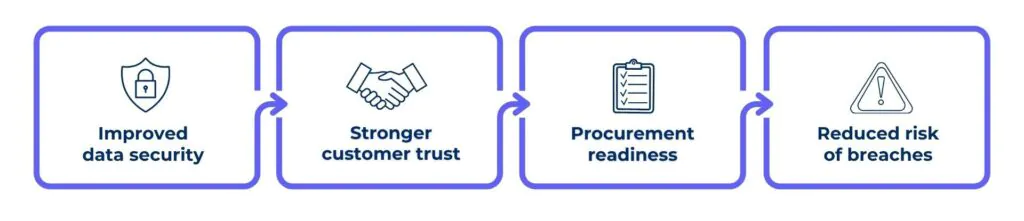
Improved data security
ISO 27001 introduces a consistent process for identifying risks, selecting appropriate controls, and regularly reviewing their effectiveness. This ensures that security is actively managed rather than handled on an ad hoc basis. Over time, this reduces gaps and strengthens the organization’s overall security posture.
Stronger customer trust
Certification provides independent validation that your security practices meet an internationally recognized standard. This gives customers and partners confidence that their data is handled responsibly and securely. It also reduces friction during due diligence and security reviews.
Procurement readiness
Many enterprise and public sector contracts require evidence of security maturity during procurement. ISO 27001 certification helps demonstrate that your organization meets these expectations. This can improve win rates and shorten procurement cycles.
Reduced risk of breaches
Clear policies, defined ownership, and continuous monitoring help prevent control gaps from going unnoticed. This lowers the likelihood of incidents caused by weak or inconsistent processes. As a result, organizations are better positioned to avoid costly breaches and disruptions.
Streamline GRC workflows with seamless automation.
How to get ISO 27001 certification UK
Achieving ISO 27001 certification in the UK typically takes three to twelve months, depending on your organization’s size, scope, and existing security maturity. Here are the key steps to help you navigate the ISO 27001 certification process:
Step 1: Define scope
Start by determining which parts of your business will be covered by the ISMS. This includes systems, data, teams, and locations that are relevant to information security. A well-defined scope ensures the audit remains focused and avoids unnecessary complexity.
Step 2: Conduct risk assessment
Identify potential risks to your information assets and evaluate their impact and likelihood. This helps prioritize which risks need to be addressed. The outcome guides your selection of appropriate controls.
Step 3: Implement ISO 27001 controls
Put in place the policies, procedures, and technical safeguards needed to mitigate identified risks. These controls should align with ISO 27001 requirements. Consistent implementation is key to ensuring effectiveness.
Step 4: Document processes
Create and maintain documentation that supports your ISMS, including policies, procedures, and risk registers. Documentation provides evidence that controls are defined and followed. It also ensures consistency across teams.
Step 5: Perform internal audit
Conduct an internal audit to assess whether your ISMS is functioning as intended. This helps identify gaps or weaknesses before the external audit. Addressing issues early improves your chances of certification.
Step 6: Management review
Leadership reviews the ISMS to ensure it is effective and aligned with business goals. This step confirms accountability at the highest level. It also ensures that necessary resources and improvements are approved.
Step 7: ISO 27001 certification audit
An accredited certification body performs a two-stage audit. The first stage reviews documentation, and the second evaluates how controls operate in practice. Successful completion results in ISO 27001 certification.
Step 8: Maintain certification
Certification is not a one-time effort. Organizations must continuously monitor controls and undergo regular surveillance audits. Ongoing maintenance ensures long-term GRC and improvement.
8 steps to get ISO 27001 certification
| Step | Description |
| 1. Define scope | Identify systems, assets, and processes in scope. |
| 2. Conduct risk assessment | Evaluate risks and define how they will be managed. |
| 3. Implement controls | Apply policies and controls to address risks. |
| 4. Document processes | Create policies, procedures, and risk documentation. |
| 5. Perform internal audit | Review the ISMS to identify gaps. |
| 6. Management review | Leadership evaluates and approves the ISMS. |
| 7. Certification audit | Complete the external two-stage audit. |
| 8. Maintain certification | Monitor controls and complete annual audits. |
ISO 27001 certification cost UK
The cost of ISO 27001 certification in the UK can vary significantly depending on the size of your organization, the complexity of your systems, and your existing level of security maturity. Costs typically include implementation (policies, controls, tooling, and internal resources) as well as the external certification audit conducted by an accredited body.
For small to medium-sized businesses (SMEs), total costs generally range from £10,000 to £40,000. This usually covers initial gap assessments, policy development, basic tooling, and certification audits. For larger SaaS organizations, costs can range from £40,000 to £100,000+, particularly where multiple locations, complex infrastructure, or extensive compliance requirements are involved. Ongoing costs should also be considered, including annual surveillance audits and continuous monitoring.
Several factors influence the overall cost, including the size of the organization and the scope of the ISMS, the level of existing ISO 27001 controls and security maturity, and the number of employees, systems, and locations involved. Costs are also affected by whether external consultants are used or the work is managed internally, as well as the complexity of the audit and the fees charged by the certification body.
While ISO 27001 requires a significant investment, there are some practical ways to reduce costs:
- Define a clear and focused scope to avoid unnecessary complexity
- Leverage existing controls and documentation where possible
- Use automation or centralized platforms to reduce manual effort
- Assign internal ownership early to avoid delays and rework
- Prepare thoroughly before the audit to minimize remediation cycles
Taking a structured approach from the start helps control costs while improving the likelihood of a smooth and successful certification process.
Get ISO 27001 Compliant 90% Faster
Tips for a successful ISO 27001 implementation
Implementing ISO 27001 requires more than meeting requirements, it depends on a well-defined strategy and consistent execution across the organization. Here are the key practices that help ensure a smooth and successful implementation:
Plan before you start
A strong implementation begins with effective planning and defined objectives. Setting scope, timelines, and responsibilities early helps prevent delays and confusion later in the process. This ensures your ISMS is focused, practical, and aligned with business priorities.
Secure leadership support
Leadership involvement is critical to driving the implementation forward. When senior stakeholders are engaged, it becomes easier to allocate resources and ensure accountability across teams. It also reinforces that information security is a business priority, not just a GRC task.
Assess your current security practices
Start by understanding what controls and processes are already in place. A gap analysis helps identify strengths, weaknesses, and areas that need improvement. This allows you to build on existing efforts instead of duplicating work.
Keep implementation practical
Avoid overcomplicating policies or introducing controls that don’t fit your operations. Focus on building processes that are clear and easy for teams to follow consistently. Practical implementation increases adoption and long-term effectiveness.
Treat it as a continuous process
ISO 27001 should be managed as a continuous process rather than a one-time project. Regular monitoring, reviews, and updates ensure that controls remain effective as the organization grows.
Maintaining ISO 27001 certification
ISO 27001 certification is not a one-time achievement, it must be maintained over time. After certification, organizations are expected to continuously operate, monitor, and improve their ISMS to ensure controls remain effective as risks and business needs change.
Continuous maintenance includes regularly reviewing and updating policies, procedures, and risk assessments. As new threats emerge or operations change, controls must be adjusted accordingly. Keeping documentation current is also essential to demonstrate that the ISMS is actively managed.
Organizations must also undergo regular surveillance audits, typically conducted annually by the certification body, along with a full recertification audit every three years. These audits ensure continued GRC and effectiveness.
Maintaining certification requires consistent ownership and integration into daily operations. Organizations that understand what ISO 27001 is and treat it as an ongoing process are better positioned to sustain compliance and strengthen their overall security posture.
Is ISO 27001 worth it for UK businesses?
For most UK businesses, ISO 27001 is a worthwhile investment, particularly for those handling sensitive data or operating in regulated industries. It is especially relevant for organizations that need to demonstrate strong security practices to customers and stakeholders, including SaaS companies, financial services, healthcare providers, and organizations working with enterprise customers. It provides a structured approach to managing security risks, reducing the likelihood of breaches, and improving overall control.
While there is a cost and resource commitment, the long-term value often outweighs the investment. ISO 27001 can streamline procurement processes, improve risk management, and strengthen credibility through independent validation of your security practices. For organizations asking who needs ISO 27001 certification, the answer is typically any business where trust, data protection, and competitive positioning are critical to growth.



Streamline ISO 27001 compliance in the UK with Scytale
If your organization is pursuing ISO 27001 certification in the UK or looking to strengthen its ISMS, Scytale provides a more structured and efficient approach. The AI GRC platform centralizes compliance activities into one platform, delivering clear visibility into controls, risks, and evidence, while continuous monitoring supports ongoing audit readiness.
Scytale also reduces the operational burden of compliance by automating key processes such as evidence collection, policy management, and risk tracking. Combined with guidance from experienced GRC experts and a customizable Trust Center to demonstrate your security posture, Scytale helps you meet ISO 27001 requirements with greater confidence and maintain compliance as your organization scales.
FAQs about ISO 27001 for UK businesses
Is ISO 27001 mandatory in the UK?
No, ISO 27001 is not generally mandatory in the UK. It is a voluntary certification standard. However, customers, contracts, tender requirements, or sector expectations may make it functionally necessary for businesses that handle sensitive data or sell into security-conscious markets.
What is ISO 27001 certification UK?
ISO 27001 certification UK is formal confirmation that your organisation’s information security management system meets ISO/IEC 27001 requirements. An accredited certification body assesses your documentation, controls, and operating practices before issuing certification if you meet the standard.
How to get ISO 27001 certification for UK businesses?
To get ISO 27001 certification, define your ISMS scope, assess current gaps, document policies and procedures, complete a risk assessment, implement controls, and run internal reviews. Then you undergo stage 1 and stage 2 audits with an accredited certification body. Many organizations use leading AI GRC platforms like Scytale to streamline the certification process.
How long does it take to get ISO 27001 certified?
Most UK businesses take about three to twelve months to get ISO 27001 certified. Timing depends on company size, control maturity, scope, and internal ownership. Organizations using automation and structured platforms such as Scytale often move faster by reducing manual work and improving visibility across the process.
How long does ISO 27001 certification last?
ISO 27001 certification typically lasts three years, subject to regular surveillance audits during that period. At the end of the cycle, you must complete a recertification audit. Maintaining evidence, reviews, and updated controls is essential to keep the certificate active.
