



TL;DR: AI governance platforms
- An AI governance platform helps your team track AI systems, assess risk, and document oversight across frameworks.
- The strongest AI governance software combines framework mapping, automation, discovery, and monitoring in one system.
- Different AI governance tools fit different operating models, from board reporting to engineering workflows.
- Framework coverage, automation depth, and expert guidance matter more than feature volume when you compare platforms.
- Scytale stands out as the top AI governance platform for teams that want to manage AI risk and compliance within their broader GRC program.
AI governance platforms vary widely in how they approach risk, compliance, monitoring, and oversight, making it difficult to know which solution best fits your organization. The right choice should support your current AI environment while fitting naturally into your broader Governance, Risk and Compliance (GRC) program and future plans.
Choosing the right technology can make that responsibility much easier to manage, especially as AI use expands across teams and processes. In this article, we compare the top AI governance platforms in 2026, what to look for when evaluating your options, and how to choose the right solution for your organization.
Top 7 AI governance platforms
- Scytale
- Credo AI
- ServiceNow
- Holistic AI
- Diligent
- OneTrust
- Sprinto
What is an AI governance platform?
An AI governance platform is software that helps organizations discover, assess, monitor, and document the AI systems and models they build or use while aligning them with relevant regulations, frameworks, and internal policies.
AI governance platforms give organizations a centralized way to understand where AI is being used, classify systems by risk, assign ownership, and maintain evidence of appropriate oversight. Rather than tracking these activities across spreadsheets and disconnected processes, teams can manage requirements such as risk assessments, human oversight, testing, documentation, and lifecycle accountability in one place.
Demand for these platforms accelerated in 2026 as mandatory EU AI Act obligations for high-risk AI systems took effect, with potential penalties reaching €35 million or 7% of global annual turnover. This regulatory pressure has contributed to a shift from generic GRC tools toward more AI-specific governance capabilities, as boards and regulators increasingly expect organizations to demonstrate effective AI oversight, not just security controls. Dedicated platforms help organizations build this oversight around emerging regulations and AI frameworks such as ISO 42001.
Streamline GRC workflows with no blind spots.
What to look for in an AI governance platform
The right AI governance platform depends on your organization’s AI use, compliance requirements, and existing processes. Rather than comparing platforms by feature count alone, focus on the capabilities that will help you manage AI risk and oversight effectively. Here are the key factors to consider when evaluating an AI governance platform:
Framework coverage
Look for a platform that supports the regulations and frameworks relevant to your organization, such as ISO 42001, the EU AI Act, and NIST AI RMF. Cross-framework mapping can reduce duplicate work by connecting shared requirements and evidence across multiple standards.
Automation depth
Consider how much of the governance process the platform can automate. Automated evidence collection, continuous monitoring, and workflow automation can reduce manual work while keeping documentation and controls up to date.
AI and shadow AI discovery
Effective governance starts with knowing where AI is being used across the organization. Look for capabilities that identify approved and shadow AI systems and bring them into a centralized inventory for assessment and ongoing oversight.
Human expert support
AI governance requirements can be complex and often require human judgment alongside automation. Access to experts can help teams interpret requirements, address gaps, and prepare for audits as they expand their use of AI in compliance.
Integration with your stack
The platform should integrate with the systems your teams already use. Connections with GRC, security, identity, cloud, and MLOps tools help keep governance information aligned with actual system activity.
AI-native GRC for how teams work today.
Top 7 AI Governance Platforms
Choosing the right AI governance platform depends on your organization’s AI use, compliance requirements, and existing GRC processes. The best AI governance platforms take different approaches to managing AI risk, compliance, and oversight. Here are seven leading options to consider in 2026:
1. Scytale
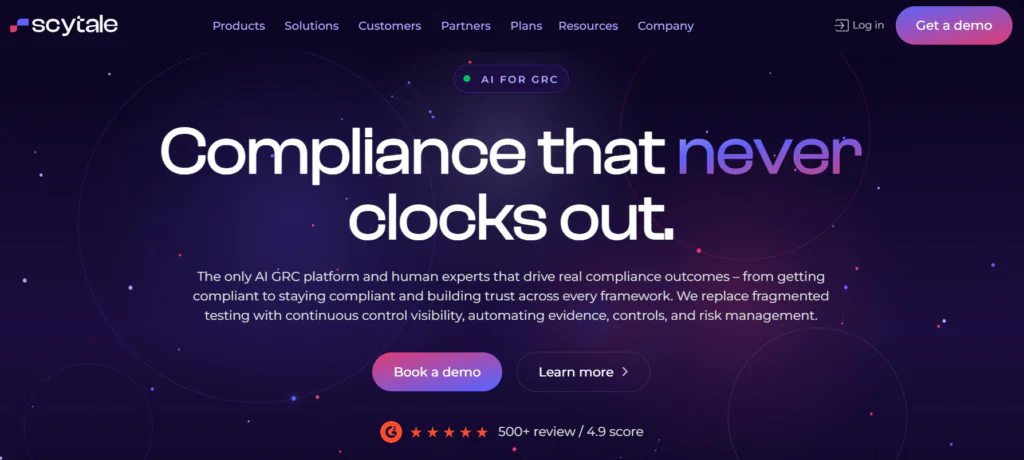
Scytale stands out as the top AI governance platform for organizations looking to manage AI risk and compliance as part of a broader GRC program. The platform brings AI governance together with security, privacy, and compliance requirements, helping teams manage ISO 42001, the EU AI Act, NIST AI RMF, and other frameworks from one centralized platform.
Scytale combines AI-powered automation, continuous monitoring, and multi-framework cross-mapping to reduce manual work and maintain clear oversight of AI risks, controls, and evidence. Dedicated GRC experts provide hands-on guidance to help teams interpret requirements, address gaps, and maintain audit readiness as their AI governance programs evolve.
(Screenshot from Scytale’s website)
Why Scytale is the best:
- End-to-end AI governance management, from risk assessments and controls to evidence and ongoing monitoring
- Support for ISO 42001, the EU AI Act, and NIST AI RMF alongside broader compliance frameworks
- AI-powered automation for evidence collection, control monitoring, risk assessments, and governance workflows
- Multi-framework cross-mapping that connects AI governance with broader GRC programs and reduces duplicate work
- Centralized visibility into AI risks, controls, evidence, and compliance status
- Dedicated GRC experts to interpret requirements, address gaps, and support audit readiness
2. Credo AI
Credo AI is a specialist AI governance platform focused on helping organizations translate regulatory requirements into governance processes. It combines regulatory intelligence with AI system discovery, assessment, and policy management.
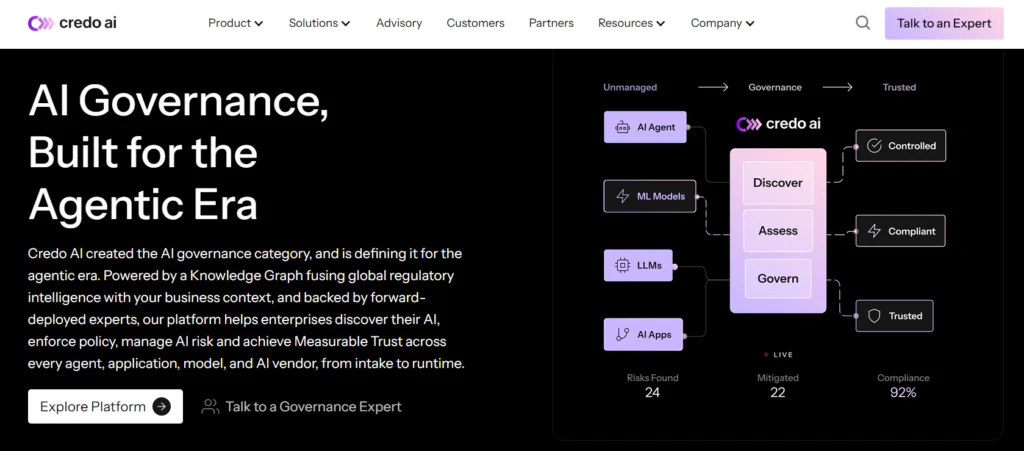
(Screenshot from Credo AI’s website)
Key strengths:
- Connect global AI requirements with organizational use cases through its regulatory Knowledge Graph.
- Identify AI systems and shadow AI across the organization and maintain them in a centralized inventory.
- Use Policy Packs to standardize assessments and apply governance requirements across business units.
Limitations:
- Focuses more specifically on AI governance than broader security and compliance management.
- Organizations with established GRC systems may need to integrate it into existing compliance workflows.
3. ServiceNow
ServiceNow AI Control Tower provides centralized oversight of AI systems, models, and datasets across complex enterprise environments. It is particularly relevant for organizations already using ServiceNow to manage technology and business workflows.
(Screenshot from ServiceNow’s website)
Key strengths:
- Govern internal, third-party, and embedded AI systems across large enterprise environments.
- Monitor AI and agent activity after deployment through runtime observability capabilities.
- Manage permissions and respond when AI activity moves outside approved boundaries.
Limitations:
- May be more complex than necessary for smaller organizations or lean compliance teams.
- Offers the strongest fit for organizations already invested in the ServiceNow ecosystem.
4. Holistic AI
Holistic AI focuses on evaluating AI risk across areas such as bias, resilience, efficacy, transparency, and privacy. Its approach suits organizations that want more detailed risk assessments beyond basic compliance checks.
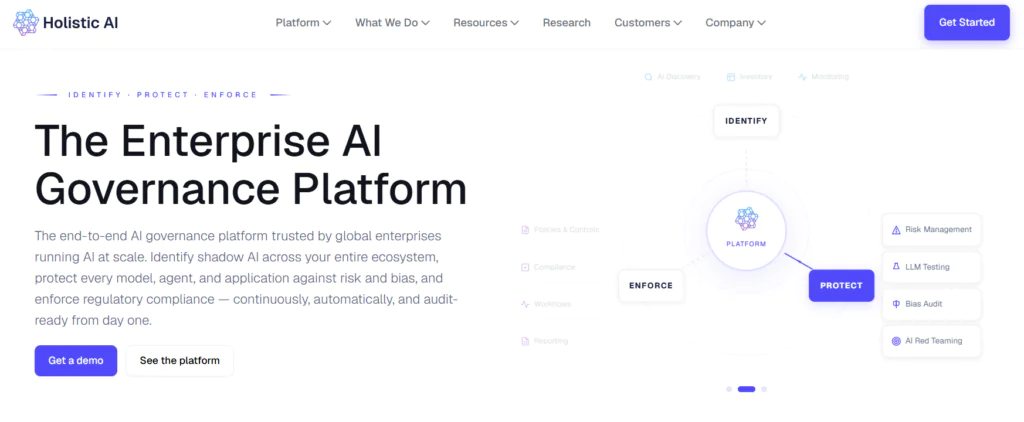
(Screenshot from Holistic AI’s website)
Key strengths:
- Quantify AI risk across multiple dimensions to provide a more detailed view of exposure.
- Discover AI systems across cloud environments, code repositories, and SaaS applications.
- Present findings through accessible risk reporting that helps stakeholders prioritize issues.
Limitations:
- Its detailed risk methodology may be more than organizations with relatively simple AI environments require.
- Teams focused on broader compliance automation may require additional GRC capabilities.
5. Diligent
Diligent approaches AI governance through the lens of board, risk, and executive oversight. It is particularly relevant for organizations that need to communicate AI risk to directors, audit committees, and senior leadership.
(Screenshot from Diligent’s website)
Key strengths:
- Present AI risk in formats designed for board and executive discussions.
- Use risk heatmaps and AI threat libraries to organize and communicate exposure.
- Support preparation for board and committee discussions through governance-focused tools.
Limitations:
- Places less emphasis on technical AI monitoring and engineering workflows.
- May be better suited to governance and executive teams than organizations seeking technical AI development controls.
6. OneTrust
OneTrust extends its privacy and data governance capabilities into AI governance, making it relevant for organizations with significant data and privacy requirements. It connects AI oversight with data discovery, assessments, and monitoring.
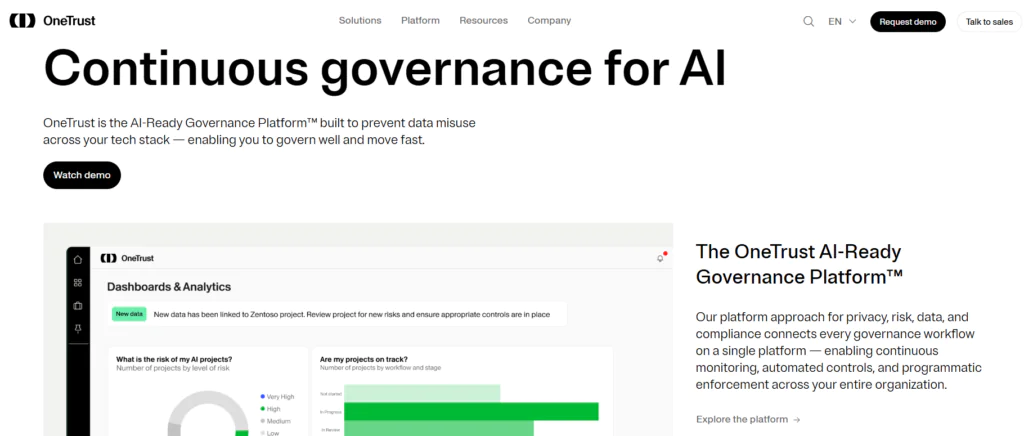
(Screenshot from OneTrust’s website)
Key strengths:
- Connect AI risk assessments with visibility into underlying data and data lineage.
- Monitor AI systems for factors such as drift, bias, fairness, and accuracy.
- Integrate with major cloud and AI development environments.
Limitations:
- Its broad platform may introduce additional complexity for smaller teams.
- Organizations without significant privacy or data governance requirements may not need its wider feature set.
7. Sprinto
Sprinto offers an automation-focused approach to AI governance for SaaS organizations and smaller compliance teams. It connects AI discovery with inventories, mapped controls, and governance workflows.
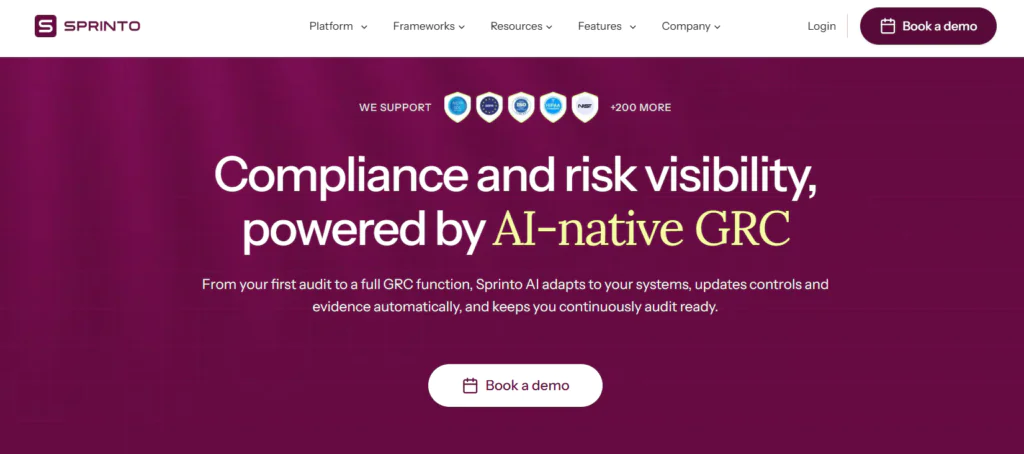
(Screenshot from Sprinto’s website)
Key strengths:
- Identify shadow AI across managed devices, browser extensions, integrations, and SSO activity.
- Maintain an AI inventory mapped to ISO 42001, NIST AI RMF, and the EU AI Act.
- Communicate AI controls and governance information externally through an AI Trust Center.
Limitations:
- May be less suited to highly complex enterprise AI environments.
- Organizations requiring extensive human GRC guidance may prefer a platform with a stronger expert-support model.
Best AI governance tools
| Platform | Best for | Key capabilities | Frameworks |
| Scytale | Organizations managing AI governance alongside broader multi-framework compliance | AI governance automation, continuous monitoring, cross-framework mapping, automated evidence collection, and dedicated GRC expert guidance | 80+ frameworks, including ISO 42001, EU AI Act, NIST AI RMF, SOC 2, ISO 27001, and GDPR |
| Credo AI | Organizations focused on AI-specific regulatory intelligence | AI discovery, regulatory mapping, Policy Packs, centralized AI inventory | Global AI regulations and policy management |
| ServiceNow | Large enterprises already using the ServiceNow ecosystem | Enterprise AI discovery, runtime monitoring, access controls, centralized oversight | NIST AI RMF, EU AI Act |
| Holistic AI | Organizations requiring detailed AI risk assessment | Quantitative risk scoring, AI discovery, risk dashboards, framework mapping | EU AI Act, NIST AI RMF, ISO 42001 |
| Diligent | Boards and executives requiring AI risk oversight | Risk heatmaps, AI threat libraries, governance reporting, board preparation | Executive governance and enterprise risk |
| OneTrust | Organizations with significant privacy and data governance requirements | AI discovery, data lineage, risk assessments, AI monitoring | NIST AI RMF, privacy and data governance |
| Sprinto | Lean SaaS and compliance teams | Shadow AI detection, AI inventory, mapped controls, AI Trust Center | ISO 42001, NIST AI RMF, EU AI Act |
Always-on GRC. Built for modern teams.
How to choose the right AI governance platform for your organization
Choosing the right platform starts with understanding how AI governance needs to work within your organization today and as your AI use grows. Here are five key factors to consider:
Define your governance requirements
Start by identifying the AI systems your organization uses and the risks and regulatory requirements that apply to them. Consider which teams will be responsible for governance and what level of oversight they need. This will help determine which platform capabilities are most important.
Consider your existing GRC program
AI governance should work alongside your existing security, privacy, risk, and compliance processes. If your organization manages multiple frameworks, look for a platform that connects AI requirements with your broader GRC program. This can reduce duplicate work and provide a more complete view of compliance.
Evaluate automation capabilities
Consider how much manual work the platform can remove from ongoing governance activities. Capabilities such as automated evidence collection, continuous monitoring, and workflow automation can help teams maintain oversight more efficiently. Look for automation that supports your existing processes rather than adding additional complexity.
Check integration capabilities
The platform should connect with the systems your teams already use across security, cloud, identity, GRC, and AI development. Strong integrations help keep governance information current and reduce the need to transfer data manually between systems. Consider both the integrations you need today and those you may require as your AI environment expands.
Plan for future AI requirements
AI regulations and organizational use of AI will continue to evolve, so the platform should be able to grow with your program. Look for coverage across frameworks such as ISO 42001, the EU AI Act, and NIST AI RMF, as well as the ability to support additional AI systems and requirements.



How Scytale supports AI governance
Scytale helps organizations turn AI governance requirements into practical, repeatable processes. Instead of treating AI governance as a separate initiative, teams can establish clear ownership, track governance activities, and connect AI-related requirements with the policies, risks, and controls already managed across the business. This creates a more consistent approach to oversight while making it easier to demonstrate accountability to auditors and other key stakeholders.
As AI regulations and use cases evolve, Scytale helps teams keep their governance program aligned with changing requirements. Organizations can address gaps, adapt processes, and get guidance from dedicated GRC experts, making it easier to scale AI governance as new systems and regulations emerge.
FAQs about AI governance platforms
When should an organization use an AI governance platform?
An organization should use an AI governance platform as soon as AI systems affect regulated workflows, customer outcomes, or board-level risk reporting. It gives teams a structured way to manage inventory, risk, controls, approvals, and reporting across the AI lifecycle instead of relying on disconnected spreadsheets and manual reviews.
Why do organizations need an AI governance platform in 2026?
Organizations need an AI governance platform in 2026 because AI oversight now carries direct legal, operational, and board-level consequences. The EU AI Act raised the urgency, while internal stakeholders expect proof of inventory, risk classification, monitoring, and human oversight across every material AI use case.
Which AI governance platform is best for ISO 42001 and EU AI Act compliance?
Scytale is the strongest fit for ISO 42001 and EU AI Act compliance when your team also manages broader security and privacy obligations. It combines AI governance workflows, multi-framework mapping, automated evidence collection, and dedicated compliance experts, which helps organizations move faster without adding a separate point solution.
How much does an AI governance platform cost?
AI governance platform cost varies by deployment scope, framework needs, integration depth, and support model. Specialist tools often price around discovery, monitoring, or enterprise workflow scale, while broader platforms like Scytale package AI governance inside a larger compliance program, which changes the total cost comparison.
Can AI governance platforms integrate with existing GRC tools?
Yes, many AI governance platforms integrate with existing GRC, security, identity, cloud, and MLOps tools. The strongest products connect governance data to operational systems, while Scytale also links AI governance to broader compliance workflows, which helps teams avoid duplicated controls and evidence, as well as separate reporting tracks.