


TL;DR: AI in compliance
- AI in compliance replaces manual evidence tracking and periodic reviews with continuous monitoring and faster decision-making.
- AI maps governance, risk, and compliance work into one operating model instead of separate manual workflows.
- The strongest AI compliance programs focus first on high-friction tasks like evidence collection, vendor reviews, and security questionnaires.
- Human oversight still matters for legal judgments, risk acceptance, and other high-stakes compliance decisions.
- Leading AI GRC platforms like Scytale combine AI agents with human GRC experts to keep teams audit-ready across multiple frameworks.
Compliance teams face growing pressure from increasing security and compliance requirements, complex technology environments, and rising customer expectations. As organizations manage multiple frameworks and evolving risk environments, traditional compliance processes struggle to scale. Artificial intelligence is helping teams streamline compliance and gain better visibility.
Rather than replacing compliance professionals, AI automates repetitive work so teams can focus on governance and risk. In this article, we’ll explore how AI is transforming compliance, the biggest opportunities it creates, and what to consider before adopting it.
What is AI in compliance?
AI in compliance applies artificial intelligence to Governance, Risk, and Compliance (GRC) processes, helping organizations continuously monitor controls, collect evidence, and identify risks instead of relying on periodic reviews. Rather than managing compliance through spreadsheets, manual evidence collection, and point-in-time audits, AI provides ongoing visibility into your security and compliance posture.
Across governance, AI helps analyze policies, map controls across multiple frameworks, and support decision-making. Across risk, it detects patterns in control failures, vendor risks, and operational changes that could introduce new threats. Across compliance, AI automates evidence collection, tests controls, monitors compliance continuously, and maps evidence across multiple frameworks, reducing the manual work traditionally required to prepare for audits.
The result is a more proactive approach to GRC. Instead of spending weeks gathering screenshots, chasing documentation, and preparing for audits, teams can focus on investigating exceptions, addressing risks, and strengthening their compliance program. Continuous monitoring also helps organizations identify issues sooner, reducing compliance gaps and making it easier to stay audit-ready throughout the year.
AI-native GRC for how enterprise teams work today.
How AI is transforming GRC: Key use cases
AI delivers the greatest value in GRC by automating the most time-consuming and repetitive compliance tasks. Instead of relying on point-in-time audits and manual reviews, organizations can continuously monitor controls, collect evidence, identify risks, and respond to issues before they become audit findings. Here are the key ways AI is transforming GRC programs.
Continuous controls monitoring
AI continuously monitors controls and flags deviations from established rules in real time, giving teams immediate visibility into compliance issues. Organizations using AI-driven continuous controls monitoring (CCM) detect policy violations faster, reduce audit preparation effort, and identify control failures before they become larger problems. This enables teams to focus on high-priority issues while maintaining a stronger, always-on compliance program.
Automated evidence collection
AI automatically collects evidence from connected systems throughout the year and maps each artifact to the relevant framework requirements. This eliminates manual evidence collection, reduces duplicate work across multiple frameworks, and creates a complete audit trail. As a result, organizations spend less time preparing for audits and more time strengthening their security and compliance posture.
Predictive risk analysis
AI analyzes control performance, compliance data, and regulatory signals to identify emerging risks before they become audit findings. By recognizing patterns that may indicate future compliance gaps, organizations can prioritize remediation before issues escalate. This shifts risk management from a reactive process to a proactive strategy that improves decision-making and resource allocation.
Third-party risk management
AI continuously monitors vendors for changes in their security posture, financial stability, and reputational risk instead of relying solely on periodic assessments. Real-time monitoring provides a more accurate view of third-party risk and helps organizations detect potential issues much sooner. This allows security and compliance teams to prioritize vendor reviews, remediation efforts, and contract decisions based on current risk levels.
Security questionnaire automation
AI automatically maps existing controls and evidence to customer security questionnaires, generating accurate responses in minutes instead of days. It reuses approved answers and supporting evidence to improve consistency while reducing manual effort. Faster questionnaire completion helps security, compliance, and sales teams accelerate trust reviews and keep deals moving forward.
Key AI use cases in GRC
| AI GRC use case | What AI does | Key benefit |
| Continuous controls monitoring | Continuously monitors controls and detects deviations in real time. | Faster issue detection, reduced audit preparation, and stronger continuous compliance. |
| Automated evidence collection | Collects evidence automatically and maps it across multiple compliance frameworks. | Eliminates manual evidence gathering, reduces duplicate work, and simplifies audits. |
| Predictive risk analysis | Analyzes control data and regulatory signals to identify emerging risks. | Enables proactive remediation and smarter risk management decisions. |
| Third-party risk management | Continuously monitors vendor security, financial, and reputational risks. | Improves visibility into supplier risk and supports faster remediation. |
| Security questionnaire automation | Maps existing controls and evidence to customer security questionnaires automatically. | Delivers faster, more consistent responses and accelerates sales cycles. |
Streamline GRC workflows with seamless automation.
Benefits of using AI in your compliance program
AI GRC platforms are reshaping how organizations manage governance, risk, and compliance, helping teams scale more efficiently. Here are some of the biggest benefits of adopting AI:
1. Faster audit readiness
AI continuously collects evidence, tests controls, and keeps documentation up to date, reducing audit preparation from 60–80 hours to as little as 10–15 hours. When enterprise deals depend on a pending SOC 2 or ISO 27001 report, faster audit readiness helps organizations close deals sooner while significantly reducing manual effort.
2. Reduced compliance costs
AI automates evidence collection, audit preparation, and other repetitive compliance tasks, allowing teams to accomplish more without increasing headcount. According to IBM, organizations using AI and automation extensively save an average of $4.4 million per data breach, demonstrating the measurable return on investment automation can deliver.
3. Continuous compliance posture
Instead of relying on periodic assessments, AI continuously monitors controls and detects compliance gaps as they emerge. This provides real-time visibility into your compliance posture, helping teams identify issues earlier and maintain audit readiness throughout the year.
4. Multi-framework efficiency
AI automatically maps a single set of controls and evidence across frameworks such as SOC 2, ISO 27001, GDPR, HIPAA, PCI DSS, and SOX ITGC. By eliminating duplicate work and manual cross-mapping, organizations can manage compliance across multiple frameworks more efficiently from a single platform.
5. Better risk decisions
AI analyzes control data and emerging risk signals to identify potential compliance issues before they become violations or audit findings. Earlier visibility enables teams to prioritize remediation, allocate resources more effectively, and make faster, more informed risk decisions.
Challenges and risks to consider
AI compliance platforms can make compliance faster and more efficient, but they aren’t without risks. Here are the key challenges organizations should consider before implementing AI in their compliance program.
Data quality
AI is only as reliable as the data it learns from, and biased or incomplete data can produce inaccurate risk assessments and audit outputs at scale. Organizations should establish strong data governance standards and regularly test AI models for bias, accuracy, and fairness throughout both training and production.
Over-reliance on automation
AI can automate repetitive compliance tasks, but it cannot replace the judgment needed for complex legal, regulatory, or business decisions. High-risk activities, such as regulatory filings and formal risk acceptances, should always include human review with clearly defined approval and escalation processes.
Data privacy risks
AI platforms often process sensitive compliance data, making data privacy and security essential considerations during implementation. Before adopting an AI solution, organizations should evaluate its data isolation approach, training opt-out policies, security controls, and data residency options to ensure compliance with regulations.
Always-on GRC. Built for modern teams.
AI compliance frameworks driving adoption
The rise of AI governance frameworks explains why manual programs no longer hold up. New obligations demand continuous documentation, control mapping, and oversight across more systems and more stakeholders. Here are some of the key AI compliance frameworks driving this shift:
EU AI Act
The EU AI Act is the world’s first comprehensive AI regulation and introduces mandatory requirements for organizations developing or using high-risk AI systems. With key obligations for sectors such as HR, healthcare, and critical infrastructure taking effect in August 2026, organizations must maintain risk management systems, technical documentation, and human oversight, making manual compliance difficult to sustain at scale.
NIST AI Risk Management Framework
The NIST AI Risk Management Framework (AI RMF) provides a practical approach to responsible AI governance through four core functions: Govern, Map, Measure, and Manage. AI compliance platforms help organizations align controls with these functions, making it easier to demonstrate responsible AI practices and maintain ongoing compliance.
ISO 42001
ISO 42001 is the first international management system standard for AI governance, helping organizations establish structured AI management processes and demonstrate responsible AI use. When implemented alongside frameworks such as SOC 2 and ISO 27001, AI-powered platforms simplify compliance by cross-mapping shared controls and evidence across multiple certifications.
SOX ITGC
SOX ITGC requires organizations to maintain effective controls over the systems that support financial reporting, including user access, change management, and IT operations. AI-powered compliance platforms automate evidence collection, continuously monitor IT controls, and identify exceptions early, helping organizations stay audit-ready while reducing manual testing and documentation.
Expanding traditional frameworks
AI is also changing how organizations manage established compliance frameworks such as SOC 2, ISO 27001, GDPR, HIPAA, PCI DSS, and SOX ITGC. As AI becomes embedded in business processes and data handling, these frameworks increasingly require continuous monitoring, stronger governance, and better visibility, making AI-powered automation the only practical way to manage overlapping controls at scale.
Best practices for implementing AI in compliance
Successfully adopting AI requires more than choosing the right platform. Here are five best practices to help your organization maximize value while maintaining strong AI governance.
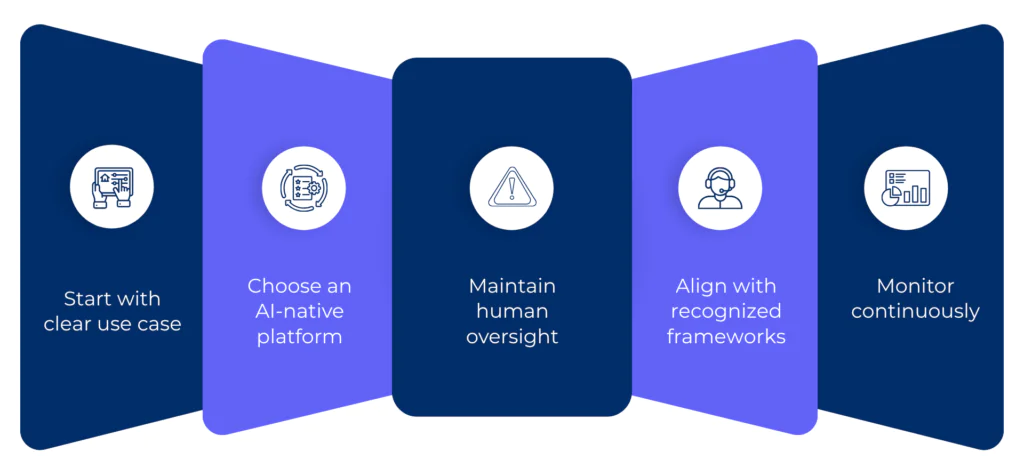
1. Start with a clear use case
Begin by automating the workflow that creates the most manual effort, such as evidence collection or security questionnaires. Proving ROI in one high-impact area makes it easier to expand AI across your GRC program with confidence.
2. Choose an AI-native platform
Look for a platform built with AI at its core rather than one that has added AI capabilities later. AI-native platforms deliver continuous monitoring, autonomous agents, and cross-framework mapping out of the box, reducing administrative effort from day one.
3. Maintain human oversight
AI should automate repetitive tasks such as evidence collection, control monitoring, and compliance gap detection, while people remain responsible for high-stakes decisions. Keep activities like regulatory filings, risk acceptances, and audit sign-offs under human review with clearly defined approval and escalation processes.
4. Align with recognized frameworks
Map your AI compliance program to established frameworks such as ISO 42001 and the NIST AI Risk Management Framework from the start. Early alignment simplifies future regulatory requirements and demonstrates responsible AI governance to customers, auditors, and enterprise buyers.
5. Monitor continuously
Integrate compliance monitoring into everyday business operations instead of relying on periodic reviews or annual audits. Continuous monitoring helps identify issues sooner, keeps controls effective, and makes maintaining compliance significantly easier throughout the year.

Streamline AI in compliance with Scytale
Scytale is a leading AI GRC platform that helps organizations achieve continuous compliance through AI-powered automation. AI agents automate evidence collection, monitor controls, assess risk, and identify compliance gaps across more than 80 frameworks, including SOC 2, ISO 27001, GDPR, HIPAA, PCI DSS, and SOX ITGC.
Built-in cross-mapping automatically reuses evidence across multiple frameworks, reducing manual work and simplifying audits. Combined with AI-powered risk management and dedicated GRC experts who provide practical guidance and validate recommendations, Scytale helps organizations strengthen their AI compliance strategy, stay audit-ready, and confidently meet changing compliance requirements.
FAQs about AI in compliance
What is AI in compliance?
AI in compliance is the use of artificial intelligence to automate governance, risk, and compliance (GRC) processes such as evidence collection, control monitoring, risk analysis, and audit preparation. It helps organizations reduce manual work, maintain continuous compliance, and stay audit-ready across multiple frameworks.
How is AI transforming GRC programs?
AI is transforming GRC programs by shifting them from periodic review cycles to continuous operations. It improves control monitoring, evidence collection, vendor oversight, predictive risk analysis, and questionnaire response workflows, which gives your team a more current view of compliance posture and less manual work.
What are the benefits of using AI in a compliance program?
The main benefits of using AI in a compliance program include faster audit readiness, lower operating costs, stronger multi-framework efficiency, and earlier risk detection. Top AI GRC platforms like Scytale add expert guidance to those benefits, which helps teams move faster without losing the human review needed for critical decisions.
What are the risks of relying on AI for compliance?
The main risks of relying on AI for compliance include poor data quality, over-reliance on automated outputs, and privacy exposure in sensitive compliance data. Your team should validate training inputs, define approval boundaries, and review each platform’s isolation, retention, and residency controls before rollout.
Which frameworks should organizations align with when implementing AI in compliance?
Organizations implementing AI in compliance should align early with the EU AI Act, the NIST AI Risk Management Framework, and ISO 42001. Scytale’s AI GRC platform helps teams manage these requirements alongside frameworks such as SOC 2 and ISO 27001, reducing duplicate evidence collection and simplifying multi-framework compliance.
