



TL;DR: Continuous security monitoring
- Continuous security monitoring gives your team ongoing visibility into control health instead of relying on periodic reviews.
- A strong program follows a repeatable loop of collecting signals, analyzing findings, alerting owners, and tracking remediation.
- Frameworks such as SOC 2 and ISO 27001 include monitoring and control oversight expectations, but each emphasizes different evidence and activities.
- Implementation works best when you scope critical assets first, assign ownership early, and connect monitoring to remediation workflows.
- Scytale’s AI GRC platform helps teams manage continuous security monitoring across frameworks without stitching together manual checks.
Security risks do not wait for the next audit or scheduled assessment. Systems change, permissions shift, new vulnerabilities emerge, and controls that worked yesterday may not work as expected today. Continuous security monitoring helps organizations track these changes as they happen, so teams can identify security gaps and control failures before they go unnoticed for weeks or months.
Rather than relying on point-in-time checks, teams can continuously monitor their security posture, respond to issues as they arise, and maintain stronger evidence of control performance. In this article, we’ll explain what continuous security monitoring is, how it works, the key steps for implementing a monitoring program, and how it supports continuous compliance across frameworks such as SOC 2 and ISO 27001.
Streamline GRC workflows with seamless automation.
What is continuous security monitoring?
Continuous security monitoring is the ongoing process of monitoring an organization’s systems, security controls, and risks to detect vulnerabilities, changes, and control failures as they occur.
Rather than relying on scheduled assessments, continuous security monitoring gives teams ongoing visibility into their security posture. Security signals are regularly collected and reviewed across systems, identities, endpoints, vendors, and cloud environments, helping teams identify issues such as access changes, misconfigurations, vulnerabilities, and failed controls before they develop into larger security or compliance problems.
The key difference is continuous visibility rather than a point-in-time snapshot. An audit or periodic assessment shows whether controls were working at a specific point in time, while continuous monitoring helps teams verify that those controls remain effective as users, assets, configurations, and risks change. It also supports compliance monitoring by providing ongoing evidence of control performance, helping organizations maintain continuous compliance and stay audit-ready throughout the year.
How continuous security monitoring works
Continuous security monitoring works as an ongoing loop: collect security signals, analyze them for changes or issues, alert the right people, and remediate what needs attention. Once an issue is resolved, monitoring continues so teams can identify new risks or control gaps as the environment changes. Here are the four key steps in the continuous security monitoring process:
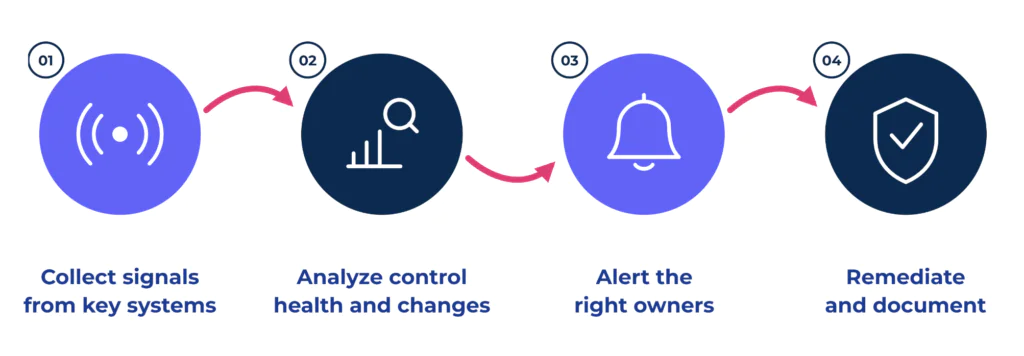
1. Collect signals from key systems
The process starts by collecting relevant security data from identity providers, cloud environments, endpoints, HR platforms, ticketing systems, and security tools. The goal is to collect the information needed to monitor specific security controls and risks, rather than gathering data without a clear purpose. For example, monitoring access controls may involve tracking new users, terminated employees, permission changes, and privileged accounts.
2. Analyze control health and changes
Teams then analyze these signals against expected security requirements and control criteria to identify potential gaps or changes. This can surface failed checks, missing evidence, overdue reviews, misconfigurations, unusual activity, and other exceptions that require investigation. This is also where continuous security monitoring overlaps with continuous controls monitoring (CCM), which focuses specifically on verifying that defined controls continue to operate as intended.
3. Alert the right owners
When monitoring identifies an issue, an alert should be routed to the person responsible for investigating or resolving it. Alerts can be assigned based on the affected system, control owner, risk level, or remediation deadline so findings do not get lost between teams. Each alert should also provide enough context to show what changed, which control or requirement is affected, and what action needs to be taken.
4. Remediate and document
The responsible owner investigates the issue, takes the appropriate corrective action, and documents how it was resolved. Relevant evidence of the remediation can then be retained to create a clear record of both the control failure and the response. This supports real-time compliance monitoring by showing how controls performed and how issues were addressed throughout the year, rather than requiring teams to reconstruct that activity before an audit.
Always-on GRC. Built for modern teams.
Continuous security monitoring checklist: Key steps to implement it
Implementing continuous security monitoring requires more than connecting security tools and turning on alerts. Teams need to determine what to monitor, which controls matter most, where evidence comes from, who owns each finding, and how issues move from detection to resolution. The following seven steps provide a practical rollout sequence for building a monitoring program, from defining the initial scope to improving coverage over time.
Step 1: Scope critical assets and control areas
Start by identifying the systems, assets, and processes that carry the greatest security or compliance risk. These may include identity providers, cloud infrastructure, endpoints, code repositories, HR systems, ticketing platforms, third-party access, and the security monitoring tools your team already uses to detect and investigate potential threats.
Next, prioritize the control areas that require ongoing visibility, such as access management, vulnerability management, logging and monitoring, change management, backups, endpoint security, and configuration management. Avoid trying to monitor everything at once; starting with critical assets and high-risk controls helps teams build meaningful coverage without creating unnecessary data and alert fatigue.
Step 2: Map controls to risks and framework requirements
Document the controls your organization already operates and connect each one to the specific risks it is designed to address. Where applicable, map those controls to requirements across frameworks such as SOC 2, ISO 27001, HIPAA, and PCI DSS so teams can see where requirements overlap.
A shared control map can prevent teams from monitoring the same underlying control separately for each framework, since one control and its supporting evidence may satisfy multiple requirements. When evaluating AI tools for continuous control monitoring, focus on whether they can monitor and map the controls relevant to your environment rather than simply comparing the number of checks they offer.
For example, Sport Alliance, which serves over 10,000 gyms worldwide, uses Scytale’s multi-framework cross-mapping to extend its ISO 27001 work to GDPR coverage across more than 500 endpoints.
Step 3: Define evidence sources and monitoring frequency
For each monitored control, identify the system that provides the most reliable evidence that the control is operating as expected. Teams should also define how that evidence will be collected, whether through integrations, APIs, system reports, automated checks, or manual attestations, so there is a consistent and traceable source of evidence.
Next, determine how frequently each control needs to be checked based on its risk and how often the underlying environment changes. Some controls may require continuous or daily checks, while others are better suited to scheduled or event-based monitoring; for example, user access may need validation whenever an employee joins, changes roles, or leaves. Continuous controls monitoring (CCM) can automate these recurring checks and flag control failures or gaps as they occur.
Step 4: Set alert and exception thresholds
Not every change represents the same level of risk, so define what constitutes normal activity, a warning, a control failure, or a critical exception before alerts begin reaching your team. Clear thresholds help teams focus on findings that require action instead of treating every deviation as equally important.
For each type of finding, establish its severity, responsible owner, expected response time, and escalation path based on its potential security and business impact. An overdue quarterly review and a privileged account missing required authentication controls may both require remediation, for example, but they should not necessarily receive the same priority or deadline.
Step 5: Assign clear ownership
Every monitored control needs a clearly defined owner who is accountable when an issue is detected. Depending on the organization, the control owner, technical remediation owner, and person responsible for approving exceptions may be different people across security, IT, compliance, or other teams.
Document responsibility for investigating findings, reviewing evidence, completing remediation, approving exceptions, and escalating unresolved issues. Establishing these roles upfront prevents findings from sitting unresolved or being passed between teams because no one knows who is expected to take the next step.
Step 6: Connect monitoring to remediation workflows
Detecting an issue only creates value when it leads to action, so connect monitoring findings to the systems and workflows teams already use for tickets, approvals, security issues, and change management. Each finding should have a clear status, owner, due date, remediation record, and supporting evidence so progress can be tracked from discovery through resolution.
Once an issue is addressed, retest the affected control to confirm the remediation worked and close the loop. This also supports continuous compliance monitoring by maintaining an ongoing record of identified issues, corrective actions, and evidence that controls were retested successfully.
Step 7: Review and improve monitoring coverage
Continuous security monitoring should evolve alongside your environment. Regularly assess which checks uncover meaningful issues, which generate unnecessary alerts, and whether new or changing systems, risks, and controls have created gaps in your monitoring coverage.
Use these reviews to refine monitoring rules, adjust thresholds, update evidence sources, and identify repetitive tasks that can be automated. Comparing existing processes with available compliance automation tools can also highlight opportunities to replace manual screenshots, spreadsheets, and recurring evidence requests with automated collection and monitoring.
Key steps for continuous security monitoring
| Step | Primary goal | Key output | Owner |
| Scope assets | Prioritize what needs monitoring | Asset and control list | Security and IT |
| Map controls | Connect monitoring to risks and requirements | Control-to-requirement map | Compliance |
| Define evidence | Establish data sources and cadence | Evidence collection plan | Security operations |
| Set thresholds | Prioritize findings appropriately | Alert and exception rules | Security leadership |
| Assign ownership | Establish accountability | Named control and remediation owners | Security, IT, compliance |
| Connect remediation | Turn findings into action | Tracked fixes and supporting evidence | Operations teams |
| Review coverage | Reduce noise and address gaps | Refined monitoring program | Program owner |
AI-native GRC for how teams work today.
Continuous monitoring requirements across SOC 2, ISO 27001 & other frameworks
Continuous monitoring requirements vary across security and compliance frameworks. Some focus on demonstrating that controls operate effectively over time, while others require specific reviews, assessments, testing activities, or ongoing oversight of security performance.
For organizations managing multiple frameworks, the challenge is maintaining that visibility without creating a separate monitoring process for every standard. Mapping shared controls and evidence can reduce duplicate work while supporting continuous compliance across the organization.
SOC 2 monitoring expectations
SOC 2 evaluates whether controls related to the applicable Trust Services Criteria are suitably designed and, for a Type II examination, whether they operated effectively throughout the review period. Organizations therefore need evidence that demonstrates how relevant controls performed over time, not simply that they were in place at the time of the audit.
Depending on the scope, this may include evidence from user access reviews, change management, security monitoring, incident response, vendor management, and other relevant controls. Continuous monitoring helps teams identify control failures earlier rather than discovering them during audit preparation.
ISO 27001 monitoring and oversight
ISO 27001 takes a broader approach through the Information Security Management System (ISMS). Organizations need processes for monitoring and measuring information security performance, assessing risks, evaluating the effectiveness of the ISMS, conducting internal audits, and addressing nonconformities through corrective action.
This means monitoring extends beyond individual technical controls to the effectiveness of the wider security management system. Organizations need to demonstrate that security performance is regularly evaluated, weaknesses are addressed, and findings are used to continually improve the ISMS.
Monitoring requirements across other frameworks
Other frameworks place greater emphasis on specific monitoring and testing activities. PCI DSS includes recurring activities covering areas such as vulnerability scanning, logging, access, and security testing, while HIPAA requires covered entities and business associates to regularly review relevant information-system activity and periodically evaluate their safeguards. NIST frameworks also emphasize ongoing assessment, risk visibility, and response as part of broader cybersecurity risk management.
These differences make control mapping particularly valuable for organizations managing multiple standards. The same access management, vulnerability management, or logging control may support requirements across several frameworks, allowing teams to collect evidence once and map it across applicable frameworks instead of monitoring the same underlying control separately for each one.



How Scytale simplifies continuous security monitoring
Scytale replaces manual checks, spreadsheets, and scattered evidence with continuous monitoring in one platform. It automatically collects evidence, monitors control health, flags gaps as they arise, and maps shared controls and evidence across 80+ frameworks, giving teams ongoing visibility into control performance while reducing duplicate compliance work.
Alongside the AI GRC platform, Scytale’s GRC experts provide hands-on support to help teams scope controls, review evidence, address gaps, and prepare for audits. By combining continuous monitoring and automation with dedicated GRC expertise, teams can maintain security and compliance throughout the year without adding more manual work.
FAQs about continuous security monitoring
When should a team use continuous security monitoring instead of periodic reviews?
A team should use continuous security monitoring when control drift can create risk between formal assessments. It works best for environments with frequent user, system, or configuration changes. Periodic reviews still have value, but they do not give the same ongoing visibility into whether controls stayed effective over time.
How is continuous security monitoring different from periodic security assessments?
Continuous security monitoring tracks control health on a recurring or event-based basis, while periodic assessments capture a single point in time. Periodic reviews show what looked true on one date. Continuous monitoring shows whether controls stayed effective as users, systems, and configurations changed between formal assessments.
Which compliance frameworks require continuous monitoring?
Several frameworks include ongoing monitoring, review, or control assessment expectations, including SOC 2, ISO 27001, PCI DSS, HIPAA, and NIST-based programs. Each framework emphasizes different controls and evidence. Leading AI GRC platforms like Scytale help teams map one monitored control across multiple frameworks so they avoid rebuilding the same proof for every audit.
What tools are used for continuous security monitoring?
Teams use identity, cloud, endpoint, vulnerability, ticketing, and GRC tools to support continuous security monitoring. The strongest programs connect those systems so findings link to control owners and evidence. Scytale’s AI GRC platform connects compliance evidence and control data to framework requirements, remediation workflows, and audit preparation in one platform.
How much does it cost to implement continuous security monitoring?
The cost of continuous security monitoring depends on your environment, framework scope, integration needs, and how much manual work your team still carries. Smaller programs may start with existing tools and limited coverage. Broader multi-framework programs usually need automation, dedicated ownership, and stronger evidence management to stay efficient.