


TL;DR: Best continuous compliance software
- Continuous compliance software monitors controls in real time and updates evidence automatically.
- The best software automates evidence, sends alerts, and maps controls across frameworks to increase efficiency.
- Continuous compliance shifts teams from periodic audit preparation to proactive risk management.
- Scytale stands out as the top continuous compliance platform among the five we mention, with 24/7 monitoring and an all-in-one compliance hub that keeps organizations compliant year round.
- The right software strengthens security posture, reduces risk, and helps SaaS teams scale with confidence while managing GRC more efficiently.
For mid-market and enterprise SaaS organizations, compliance has become a continuous priority, not just something to address once a year or at audit time. With frequent updates to systems, personnel, vendors, and configurations, relying only on annual assessments can no longer ensure that your compliance posture is up to date.
The good news is that continuous compliance software has significantly advanced, providing organizations with the tools they need to monitor controls in real-time and remain audit-ready at all times. The right software ensures that your compliance posture accurately reflects the current state of your environment, instead of relying on the last scheduled review.
This article explores the key concept of continuous compliance management, identifies the best software platforms that offer it, and outlines the key questions to ask vendors before making a commitment.
Top 5 continuous compliance management software
- Scytale
- Vanta
- Drata
- Secureframe
- Sprinto
What makes compliance software ‘continuous’?
Not all compliance software is created equal, and knowing what separates continuous compliance platforms from those that simply automate periodic checks is critical when evaluating your options.
Traditional compliance models, based on periodic assessments and scheduled audits, were designed for a slower business pace. Today, with constant changes in systems, personnel, and vendor relationships, organizations require a continuous approach to governance, risk, and compliance (GRC).
Here is what distinguishes a truly continuous compliance platform from one that is simply automated:
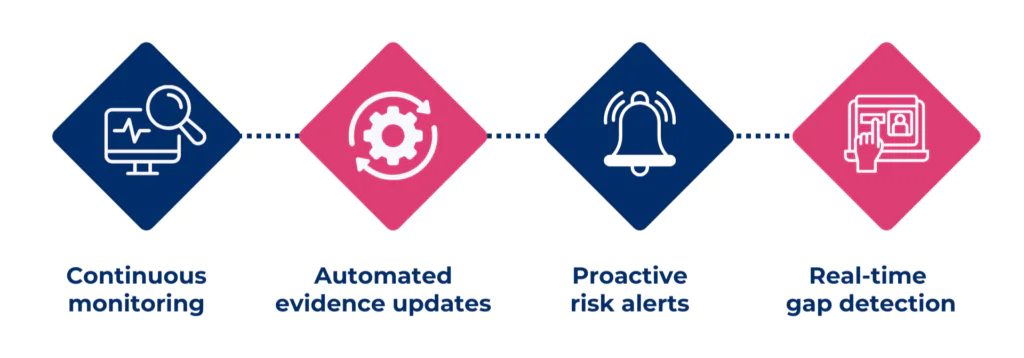
- Continuous monitoring: Controls are evaluated continuously, typically within seconds to minutes, rather than on daily or weekly schedules.
- Automated evidence updates: Evidence linked to live integrations refreshes automatically, maintaining accurate and current compliance documentation without manual effort.
- Proactive risk alerts: As soon as changes or control issues arise, teams are notified, ensuring risks are addressed immediately.
- Real-time gap detection: Control failures and compliance gaps are identified as they occur, enabling timely remediation.
Key features to look for in continuous compliance management software
Choosing the right continuous compliance software depends on its ability to automate key processes and integrate with your existing systems. These key features are vital for maintaining efficient and proactive compliance management:
Automated evidence collection tied to live data sources
Continuous compliance software automates evidence collection through direct integration with live data sources, ensuring evidence remains current while reducing manual effort and mitigating the risk of errors or omissions.
Real-time control monitoring with alerts
Real-time monitoring allows for the immediate detection of any control failures or compliance gaps. Automated alerts notify your team instantly when a discrepancy occurs, enabling fast resolution and preventing compliance issues from escalating.
Integration depth with your existing tech stack
The best software integrates deeply with your existing tools and systems, ensuring seamless data flow across your technology stack. This integration ensures that compliance workflows remain efficient, reducing manual effort and improving accuracy.
Continuous risk tracking
Continuous tracking of risks across your organization provides real-time risk assessments, enabling a proactive risk management approach. This allows teams to identify and mitigate risks before they escalate into significant issues.
Policy version management
As part of compliance management, policy versioning tracks all updates to compliance policies, ensuring transparency and a clear audit trail.
Audit-ready dashboards that update automatically
Your audit-ready dashboard should provide a real-time view of your compliance posture, ensuring decision-makers have the most accurate and updated data for timely actions.
Multi-framework support that stays current
Your platform should automatically adapt to framework changes, eliminating the need for manual control mapping updates and ensuring continuous compliance at all times.
5 best software for continuous compliance management
1. Scytale
Scytale is the leading compliance management platform for mid-market and enterprise SaaS organizations focused on continuous compliance. It provides a fully integrated GRC solution that automates evidence collection and real-time monitoring across key standards such as SOC 2, ISO 27001, GDPR and SOX ITGC. With AI-driven automation and expert GRC support, Scytale streamlines critical GRC processes, driving efficiency from audit preparation to continuous compliance.
With built-in continuous security monitoring and advanced compliance management features, Scytale helps businesses proactively identify and address compliance gaps, strengthen their security, risk, and compliance posture, and ensure continuous readiness for audits and emerging compliance requirements.
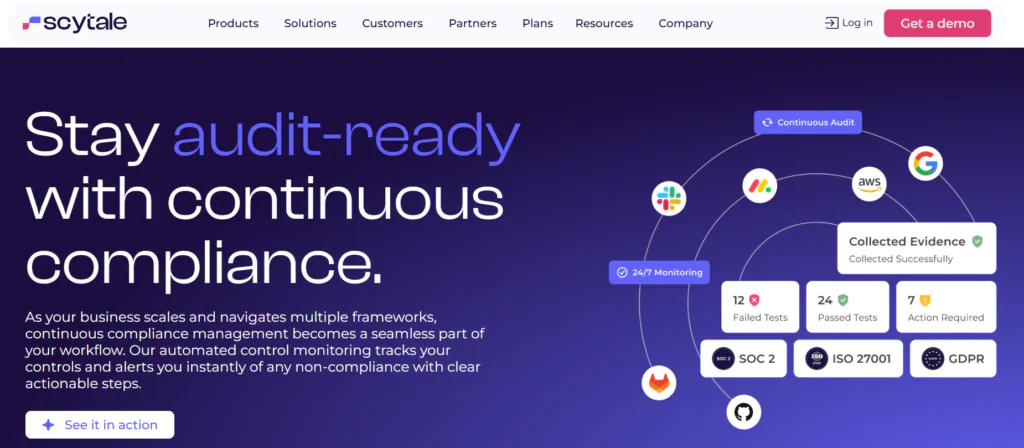
(Screenshot from Scytale’s website)
Why Scytale is the best:
- Continuous monitoring of security posture for real-time risk identification, mitigation, and management
- AI-driven automation to streamline GRC processes, reduce risk, and increase operational efficiency
- Multi-framework management to reduce duplicate work and keep compliance efforts consistent
- 24/7 control monitoring for continuous compliance, supported by dedicated GRC experts who provide tailored guidance to meet your unique needs
2. Vanta
Vanta automates compliance preparation for security audits across multiple frameworks. It integrates with cloud and identity tools to collect evidence and run automated control checks.
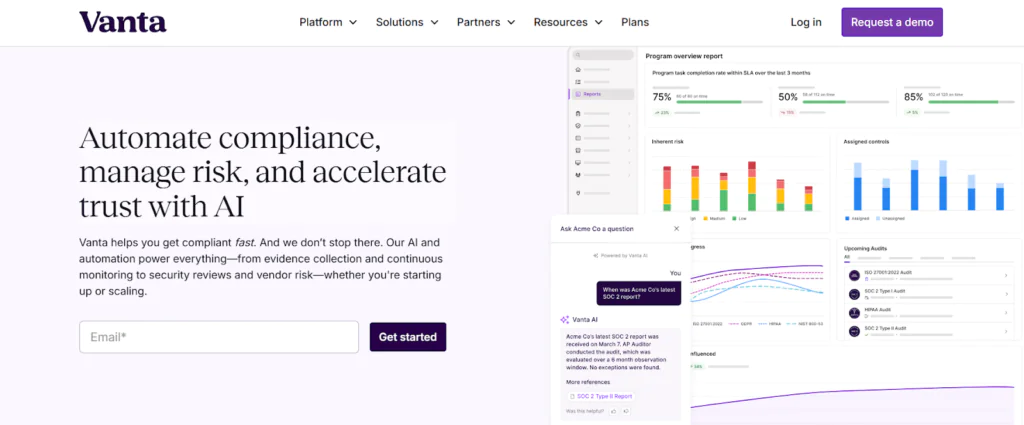
(Screenshot from Vanta’s website)
Key features:
- Automation of compliance evidence collection
- Integrates with key tools for continuous monitoring
- Prepares businesses for audits by simplifying the process
Limitations:
- Basic risk scoring doesn’t consider control effectiveness
- Add-on pricing can increase total cost
3. Drata
Drata focuses on engineering-driven teams, automating evidence collection and offering integrations with cloud and developer tooling. It provides daily automated tests and a centralized hub for managing audit evidence.
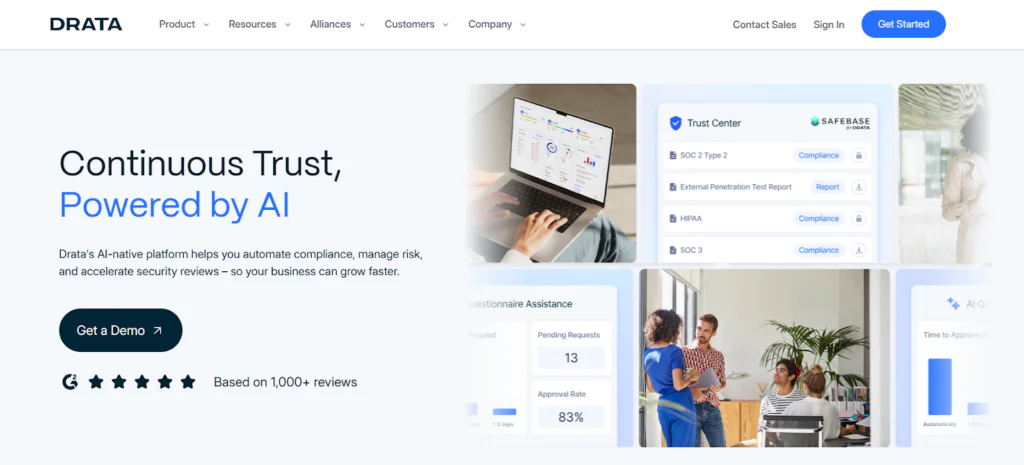
(Screenshot from Drata’s website)
Key features:
- Integrates with various tools and systems
- Policy and control templates to standardize documentation
- Centralized audit hub for organizing evidence and auditor collaboration
Limitations:
- Complexity may require dedicated resources and expertise
- Lacks advanced customization for specific workflows
4. Secureframe
Secureframe automates evidence collection and continuous monitoring across cloud tools, with AI-assisted features and compliance guidance. The platform is designed to help organizations stay compliant with key frameworks.
(Screenshot from Secureframe’s website)
Key features:
- Automated evidence collection and continuous monitoring
- AI-assisted tools for fixing failing controls and managing policies
- Guided compliance programs with support
Limitations:
- Requires some manual uploads for complex environments
- Less suited for scaling across multi-framework programs
5. Sprinto
Sprinto is a cloud-based platform designed for tech organizations, offering pre-built compliance programs and integrations for evidence collection and control monitoring. It focuses on ease of use and quick readiness for compliance.
(Screenshot from Sprinto’s website)
Key features:
- Continuous monitoring with real-time alerts
- Pre-built compliance programs for fast audit readiness
- Easy-to-use interface for simplified compliance management
Limitations:
- Limited customization options for more complex compliance needs
- Optimized for straightforward cloud setups
Best continuous compliance management software for 2026
| Platform | Key Strengths | Ideal For |
| Scytale | AI-powered compliance automation, continuous security and compliance monitoring, multi-framework management, streamlined GRC processes, expert guidance | Mid-market and enterprise SaaS organizations with complex compliance needs, seeking more efficient GRC management processes |
| Vanta | Streamlined audit preparation, cloud tool integration | Organizations seeking simple, automated compliance solutions |
| Drata | Engineering-focused integrations, centralized audit hub | Development teams with advanced technical compliance needs |
| Secureframe | Compliance guidance, AI-assisted tools | Small to mid-sized businesses with standard compliance requirements |
| Sprinto | Pre-built programs, user-friendly interface | Startups or organizations with straightforward compliance needs |
How to evaluate continuous compliance claims
Most continuous compliance platforms use similar terminology to describe their monitoring capabilities, so making an informed evaluation requires asking clear, targeted questions. Here are the key questions to ask during your evaluation:
1. How often are control checks performed?
Request the specific monitoring interval. If a vendor claims “real-time” or “continuous” checks, ask to review timestamped results in a live demonstration. True continuous monitoring occurs within seconds to minutes, not on daily or nightly schedules.
2. What triggers an alert?
Confirm whether alerts are generated based on actual control drift as it occurs, or only after scheduled reporting cycles. Request a live example to verify alert responsiveness.
3. How current is the automatically collected evidence?
Review the most recent timestamp for a sample piece of evidence in the demo environment. Outdated timestamps may indicate that monitoring is not truly continuous.
4. Can you demonstrate a real-time compliance posture view?
Request a live demonstration rather than screenshots, and confirm that dashboards reflect current system data rather than the last synchronization point.
5. What happens if an integration fails?
A continuous compliance software platform should detect failed integrations immediately and alert users to stale or missing evidence, rather than displaying outdated information.
6. How does the platform manage multi-framework control mapping?
Ensure that when a control fails, the compliance status across all mapped frameworks is updated automatically. Ask to see how this process works in practice.
Pairing these questions with a structured gap analysis of your current GRC program will provide the information needed to compare platforms accurately and make an informed decision.

Continuous compliance by framework
Continuous compliance varies based on the framework being used, as each has unique control categories, compliance evidence requirements, and monitoring expectations. Maintaining SOX compliance, for instance, requires a different approach compared to sustaining ISO 27001 compliance.
Here are a few key frameworks where continuous compliance plays a crucial role:
SOC 2 continuous compliance
For SOC 2, continuous compliance means real-time monitoring of security controls and automated evidence collection to ensure continuous adherence to the relevant Trust Services Criteria (TSC). Continuous monitoring helps identify control failures or gaps instantly, ensuring that organizations remain compliant between audits and can quickly address any issues that arise, particularly around security, availability, and confidentiality.
ISO 27001 continuous compliance
Continuous compliance for ISO 27001 focuses on maintaining your Information Security Management System (ISMS) in a constant state of readiness. Your platform should continuously monitor Annex A controls, track nonconformities as they arise, and ensure that security risk assessments and vulnerability management efforts remain up-to-date throughout the year, not just before surveillance or recertification audits.
HIPAA continuous compliance
For HIPAA, continuous compliance focuses on monitoring safeguards that protect patient data in real-time. Continuous compliance means automating evidence collection and monitoring physical, technical, and administrative controls. This includes real-time tracking of access to sensitive healthcare data and prompt detection of any security or privacy breaches, helping organizations remain compliant with HIPAA’s stringent compliance requirements.
GDPR continuous compliance
GDPR continuous compliance involves consistently monitoring personal data handling to ensure data protection measures are always in place. This includes real-time tracking of data access, processing, and retention, along with immediate breach reporting. Maintaining a consistent compliance posture ensures continuous adherence to GDPR’s transparency, consent, and data subject rights requirements.
SOX ITGC continuous compliance
For SOX ITGC, continuous compliance ensures internal controls over financial reporting are maintained throughout the year. Continuous SOX compliance software continuously monitors control effectiveness and detects issues, allowing timely remediation before they impact reporting. Automated ITGC audit documentation and 24/7 deficiencies monitoring keep SOX ITGC compliance up to date, safeguarding financial data integrity and reducing compliance risks.
| Framework | Key compliance requirements | Continuous compliance role |
| SOC 2 | Security, availability, confidentiality, processing integrity | Real-time monitoring ensures continuous adherence to Trust Services Criteria (TSC) |
| ISO 27001 | Information Security Management System (ISMS) | Continuous monitoring of risks and controls for an effective ISMS |
| HIPAA | Protection of patient data through technical, physical, and administrative safeguards | Continuous tracking of safeguards to ensure patient data protection |
| GDPR | Data protection, transparency, and data subject rights | Real-time tracking of personal data access and breach notifications |
| SOX ITGC | Internal controls over financial reporting | Real-time monitoring of financial controls, ensuring accurate reporting and timely issue resolution |
Get SOX ITGC Compliant
How scytale delivers true continuous compliance
Scytale ensures true continuous compliance by combining always-on monitoring, automated evidence collection, and tailored guidance from dedicated GRC experts. The platform’s AI-integrated compliance hub connects seamlessly to your live systems through native integrations. Scy, our next-gen AI GRC agent, reviews evidence, identifies gaps, and recommends actions so your team can respond quickly and remain aligned with compliance requirements.
Built specifically for continuous compliance, Scytale ensures your compliance posture is always up to date. When access changes, policies lapse, or controls drift, Scytale flags the issue immediately, enabling your team to resolve it before it becomes an audit finding or customer concern.
For organizations managing multiple frameworks, Scytale’s cross-framework mapping automatically updates compliance status across standards such as SOX ITGC, ISO 27001, and SOC 2. This reduces redundancy, provides full visibility, and supports scalable GRC programs as your organization grows.
FAQs about continuous compliance software
What’s the difference between continuous compliance and compliance automation?
Continuous compliance ensures real-time monitoring and continuous adherence to compliance requirements, while compliance automation primarily focuses on streamlining critical compliance tasks like evidence collection, user access reviews and vendor risk management. Scytale, for example, combines both by automating compliance processes and providing continuous monitoring to ensure ongoing compliance.
Can continuous compliance software work with manual processes?
Yes, continuous compliance software can complement manual processes by automating tasks such as evidence collection and continuous security monitoring. However, to fully realize its benefits, organizations should aim to minimize manual interventions, as true continuous compliance relies on real-time, automated data collection and monitoring.
How quickly can we set up continuous compliance monitoring?
Implementation timelines vary by software and organization, but with Scytale, integration-led setup enables organizations to ensure continuous monitoring from the start. Pre-built policy templates, automated workflows, and hundreds of integrations, including custom integrations, allow teams to begin monitoring controls within days, significantly reducing implementation time and accelerating audit readiness.
