
TL;DR: IT governance (ITG)
- IT governance helps organizations ensure their technology, systems, and IT investments support business goals while meeting security and compliance requirements.
- Different types of IT governance address key areas such as strategy, risk, performance, resources, and compliance.
- Frameworks such as COBIT and ISO 38500 provide structured guidelines for managing and governing IT effectively.
- Strong IT governance helps reduce technology risks, improve performance, strengthen decision-making, and support ongoing compliance.
- Scytale’s AI GRC platform supports IT governance by automating compliance processes, continuously monitoring controls, and helping teams manage GRC more efficiently.
As technology environments and compliance requirements grow more complex, maintaining a clear IT governance strategy becomes harder to manage manually. SaaS organizations need structured governance to keep technology decisions, security controls, and compliance requirements aligned as they scale.
IT governance (ITG) is essential, particularly for mid-market and enterprise SaaS companies, where managing GRC processes efficiently is critical to supporting growth without introducing unnecessary risk. According to the World Economic Forum, 87% of CEOs now see cyber and technology risk as a critical threat to growth, underscoring why governance cannot be treated as optional. This article explains what IT governance is, how it relates to broader GRC programs, and how organizations can implement it effectively.
What is IT governance?
IT governance refers to the processes, structures, and tools that help organizations manage IT resources to support business goals and meet compliance and regulatory requirements.
At its core, IT governance ensures that an organization’s IT systems align with business strategy while protecting sensitive data and minimizing operational and security risk. It assigns clear decision-making authority over IT investments, infrastructure changes, and technology risk, so that technology decisions consistently support broader business objectives rather than operating in isolation from them.
For SaaS companies specifically, effective IT governance provides consistent oversight of IT operations while supporting continuous compliance with frameworks such as SOC 2, ISO 27001, GDPR, and HIPAA. As SaaS organizations scale across multiple frameworks and customer requirements, governance becomes the mechanism that keeps technology decisions consistent, auditable, and defensible.
Streamline GRC workflows with no blind spots.
IT governance vs. GRC
IT governance and governance, risk, and compliance (GRC) are closely related, but they focus on different areas. IT governance focuses on how technology supports business goals, while GRC covers governance, risk, and compliance across the organization. Here are the key differences between IT governance and GRC:
Scope
IT governance focuses specifically on technology, including IT investments, systems, infrastructure, security controls, and technology-related decision-making. GRC has a wider scope, covering governance, risk, and compliance across multiple business functions, including IT, security, finance, legal, and operations.
Primary focus
The main goal of IT governance is to ensure technology supports the organization’s strategy, resources are used effectively, and IT-related risks are appropriately managed. GRC focuses on helping the organization manage risk, meet regulatory and compliance requirements, and maintain consistent governance practices across the business.
Ownership and responsibility
IT governance is typically led by CIOs, CTOs, CISOs, and other IT leaders, with input from senior management. GRC generally involves a broader group of stakeholders, including executive leadership, risk teams, compliance teams, security teams, legal teams, and business owners.
Relationship to compliance
IT governance establishes many of the technology controls, processes, and responsibilities that support compliance. A mature GRC compliance program brings these together with controls and requirements from across the organization, providing a more complete view of risk and compliance.
How they work together
IT governance is an important part of a broader GRC strategy rather than a separate initiative. Strong IT governance gives GRC programs clearer technology oversight, better-defined controls, and reliable compliance evidence, helping organizations manage requirements more efficiently as they scale.
For example, 2X Solutions replaced spreadsheets and disconnected systems with one centralized GRC platform, reducing internal compliance effort by 83% and giving the team continuous visibility into its compliance posture.
5 types of IT governance
Organizations can structure IT governance in different ways depending on their size, business model, risk profile, and compliance requirements. The right approach helps define how technology decisions are made, who is responsible for them, and how IT supports wider business goals.
Understanding these approaches can help organizations choose a governance model that provides the right balance of control, flexibility, security, and oversight. Here are the five common types of IT governance and where each fits best:
| Type | Primary focus | Best suited for |
|---|---|---|
| Centralized | Consistent control and standards | Large enterprises requiring tight oversight |
| Decentralized | Speed and flexibility | Organizations with autonomous teams |
| Hybrid | Balance of control and agility | Scaling SaaS companies |
| Compliance-based | Security compliance and regulatory alignment | Companies under SOC 2, ISO 27001, GDPR frameworks |
| Risk-based | Risk identification and mitigation | Data-heavy, security-driven organizations |
IT governance framework examples
Established frameworks give organizations a structured approach to IT governance instead of requiring them to build processes and controls from scratch. They provide recognized guidelines for managing technology, reducing risk, improving oversight, and keeping IT aligned with wider business goals.
Different frameworks focus on different areas, from information security and cybersecurity risk to IT service management and board-level oversight. Organizations may use one framework or combine several, such as the NIST Cybersecurity Framework, depending on their business needs, risk profile, and compliance requirements. Here are some of the most common IT governance frameworks:
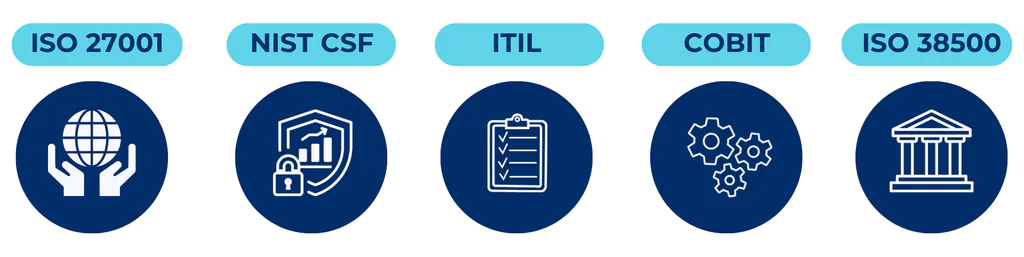
| Framework | Primary focus | Best used for |
|---|---|---|
| ISO 27001 | Information Security Management System (ISMS) | Organizations focused on data protection |
| NIST CSF | Cybersecurity risk management and resilience | Improving cybersecurity posture and risk management |
| ITIL | IT service management and business alignment | Improving service delivery and IT efficiency |
| COBIT | Enterprise governance and management of IT, maintained by ISACA | Aligning IT strategy with business goals across governance and management domains |
| ISO 38500 | Board-level principles for governance of IT | Directors and executives overseeing IT investment and risk at the governance level |
Key components of an effective IT governance framework
An effective IT governance framework needs to keep working as systems, teams, risks, and compliance requirements change. This requires clear responsibilities, structured risk management, ongoing compliance oversight, and measurable IT performance.
Together, these components help organizations keep technology aligned with business goals while strengthening security and compliance risk management. Here are the key components of an effective IT governance framework:
Governance structure and roles
Clear roles and responsibilities establish who makes IT decisions and who is accountable for their outcomes. IT leaders, risk managers, compliance officers, and business stakeholders should understand their responsibilities to improve oversight and avoid gaps in accountability.
Risk management strategy
A strong risk management strategy helps organizations identify, assess, and manage risks across IT systems, processes, and vendors. Rather than responding to issues after they occur, teams can prioritize risks and put appropriate mitigation measures in place.
Security and compliance requirements
IT governance should account for relevant security, privacy, and regulatory requirements, such as SOC 2, GDPR, CCPA, HIPAA, and the EU AI Act. Regularly reviewing these requirements helps organizations adapt their controls and processes as compliance obligations evolve.
IT performance management
Metrics and KPIs help organizations measure whether IT systems and processes are delivering the expected results. Tracking areas such as system performance, security, risk, and compliance gives leadership better visibility and supports more informed IT decisions.
AI-native GRC for how teams work today.
7 key steps to implement IT governance
Implementing a strong IT governance framework helps mid-market and enterprise SaaS companies manage technology, risk, and multiple compliance requirements more effectively. Rather than treating IT governance as a one-time initiative, organizations should build it through a structured process that evolves with the business. Here are seven key steps to implement IT governance:
1. Assess current IT governance practices
Evaluate existing processes through a structured gap analysis to identify weaknesses in oversight, documentation, controls, and accountability.
2. Choose an IT governance framework
Select the framework, or combination of frameworks, that best fits the organization’s size, business goals, risk profile, and regulatory requirements.
3. Define IT governance roles and responsibilities
Assign clear ownership for IT decisions, risk management, security, and compliance to strengthen accountability and prevent gaps in responsibility.
4. Develop IT governance policies and procedures
Create clear policies and procedures based on the chosen framework, giving teams consistent guidelines for managing IT systems, risks, and controls.
5. Implement supporting governance and compliance tools
Use platforms like Scytale to centralize risk and compliance processes, automate repetitive tasks, and reduce reliance on spreadsheets and manual tracking.
6. Monitor IT controls and report on compliance
Continuously track controls and use metrics and automated compliance reporting to identify gaps, measure performance, and maintain visibility into compliance status.
7. Review and continuously improve IT governance
Regularly assess the effectiveness of the governance framework and update processes, controls, and policies as systems, vendors, risks, and regulatory requirements change.
Simplify IT governance with Scytale
Managing IT governance becomes harder when controls, evidence, risks, and compliance tasks are spread across spreadsheets and disconnected systems. Scytale brings these processes into one AI GRC platform, automating evidence collection, continuously monitoring controls, and helping teams identify and address gaps before they create extra work.
Instead of manually tracking requirements across different frameworks, teams can reuse evidence and map controls across standards such as SOC 2 and ISO 27001. Scytale also combines automation with dedicated GRC experts who help teams understand requirements, prepare for audits, and keep governance processes working effectively as requirements change.
FAQs about IT governance (ITG)
What is the meaning of IT governance?
IT governance is the framework organizations use to ensure technology supports business goals while managing IT-related risks and responsibilities. It provides structure for decision-making, accountability, performance, security, and compliance across IT operations.
Who is responsible for IT governance?
Responsibility for IT governance is typically shared across the board, senior leadership, IT leaders, security teams, and compliance professionals. Clear ownership helps ensure technology decisions support business priorities while risks and compliance requirements are properly managed.
What is an IT governance framework?
An IT governance framework provides structured principles, processes, and responsibilities for managing technology and IT-related decisions. It helps organizations establish accountability, manage risks, monitor performance, and align IT activities with wider business objectives.
What are some IT governance framework examples?
Common IT governance frameworks and standards include COBIT, ITIL, NIST CSF, ISO 27001, and ISO 38500. Organizations may use one or combine several depending on their technology environment, business goals, risk profile, and compliance requirements.
What are IT governance tools?
IT governance tools help organizations centralize processes such as risk management, control monitoring, compliance tracking, and reporting. AI GRC platforms like Scytale automate many of these processes, reducing manual work while giving teams continuous visibility into controls and risks.
How does IT governance support compliance?
IT governance establishes clear responsibilities, controls, and processes that help organizations meet security and regulatory requirements. Leading platforms like Scytale support IT governance by automating evidence collection, continuously monitoring controls, and centralizing compliance management across multiple frameworks.
