


TL;DR: Continuous compliance
- Continuous compliance keeps your compliance program aligned with live system data, offering real-time visibility and reducing overall risk.
- Real-time monitoring helps identify control gaps early, allowing teams to address issues proactively and mitigate potential risks.
- With continuous compliance, organizations maintain clear, ongoing visibility into control status, reducing pressure during audit cycles.
- Core systems are centrally connected, ensuring up-to-date compliance tracking and minimizing the risk of outdated or inaccurate data.
- Leading AI-driven compliance automation platforms like Scytale ensure continuous compliance by streamlining critical GRC processes and providing expert guidance for consistent oversight.
Many SaaS organizations still manage compliance by focusing on audit deadlines. Teams rush to collect evidence, address control gaps, and prepare reports based on outdated data. By the time auditors or regulators are involved, ownership is unclear, and leadership lacks an accurate view of the organization’s security posture. The financial consequences of these gaps are significant: in 2025, the average data breach cost was $4.4 million, however; organizations using AI for security reduced their losses by $1.9 million through earlier detection and stronger control oversight.
Continuous compliance addresses this risk by integrating your controls to live systems so evidence mirrors real-time activity across your environment. When access changes or a configuration drifts, your team is instantly alerted, enabling proactive resolution before audits or stakeholder reviews.
Let’s explore what continuous compliance truly means and how to build an efficient, scalable compliance program that drives organizational growth while reducing manual effort.
What is continuous compliance?
Continuous compliance is a GRC approach designed to keep your controls, evidence, and risk records current with system changes. Your compliance posture reflects continuous activity across access management, vendor oversight, configurations, and policies rather than a static snapshot. This shift strengthens compliance management by connecting oversight directly to operational systems.
In practice, continuous compliance includes:
- Controls that run automatically on a set schedule or when system changes occur, so issues are identified early
- Evidence captured directly from connected systems without manual collection
- Clear ownership and status visibility so leadership maintains an accurate view of exposure
- Automated alerts that prompt control owners to address changes as needed
This model integrates oversight into daily operations and supports consistent audit readiness throughout the year.
Traditional compliance vs. continuous compliance
The distinction between these two models affects how compliance programs operate and how risk is managed across the organization. The structure of the work, the visibility leaders have into current exposure, and the overall audit process vary significantly by approach.
The comparison below outlines the practical differences between the two:
| Area | Traditional compliance | Continuous compliance |
| Cadence | Focused on periodic assessments and audit deadlines. | Continuous security monitoring throughout the year, with no specific deadline. |
| Effort distribution | High effort concentrated around audit periods. | Effort is spread out, ensuring consistent focus and management year-round. |
| Risk exposure | Risk gaps can go undetected for extended periods of time and between audits. | Risks are identified early, with continuous alerts to mitigate risk exposure. |
| Audit experience | Involves manual processes and last-minute preparation. | Audits are streamlined with real-time, up-to-date evidence and dashboards. |


Why continuous compliance matters
Continuous compliance helps your organization consistently meet security and regulatory requirements, reducing risk and ensuring operational continuity. Here are the key reasons why continuous compliance is vital for a proactive and efficient approach to managing Governance, Risk, and Compliance (GRC).
Reduced audit stress
Continuous compliance ensures your organization is always prepared for audits with built-in audit capabilities that keep evidence up to date and control status visible in real time. This eliminates the need for last-minute preparation and manual report creation, allowing your team to focus on more high-priority, strategic tasks.
Faster issue detection
Continuous monitoring detects control drift and gaps as soon as they appear, enabling quick resolution. Your team receives real-time alerts when access changes, vendor configurations shift, or policies expire. This proactive approach helps prevent compliance failures and security incidents before they escalate.
Lower compliance costs
Traditional compliance models concentrate work around audit periods, driving up labor costs and slowing down other initiatives. Continuous compliance distributes effort across the year, reducing the need for urgent, resource-draining tasks. Automated workflows for evidence collection and control updates help to lower the total cost of effective compliance management.
Better security posture
With continuous compliance, security controls remain active and visible throughout the year. Real-time monitoring helps identify potential security gaps early, allowing your team to respond quickly. This continuous vigilance helps maintain a strong security posture, ensuring security and compliance objectives are aligned as the business grows.
Customer and investor confidence
With up-to-date evidence, accurate reporting, and comprehensive dashboards, enterprises can seamlessly support customer, vendor, and investor assessments. This visibility reinforces stakeholder confidence, aligns with transparency expectations, and strengthens relationships. Additionally, organizations can effectively demonstrate their security and compliance posture through their Trust Center, further instilling trust and credibility.
Key components of continuous compliance
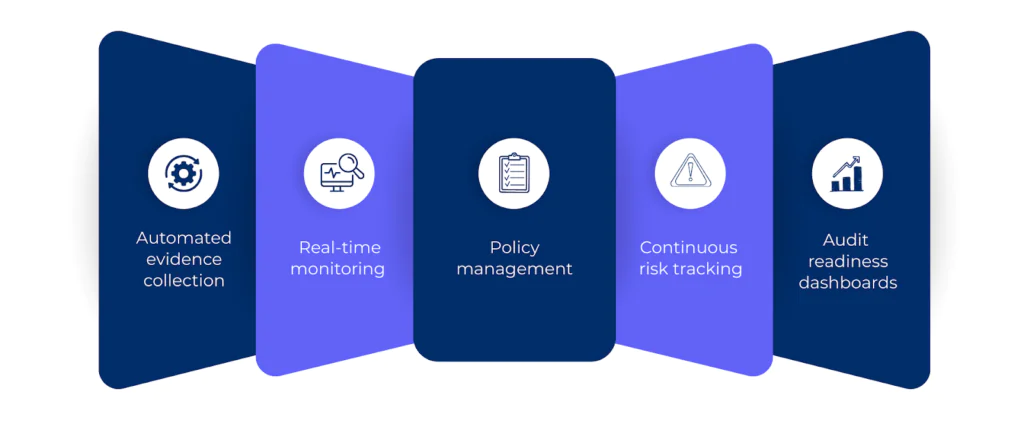
Continuous compliance relies on several key components to ensure that your compliance program is always up to date and operational. Here is a breakdown of these components and how they contribute to an effective GRC strategy:
Automated evidence collection
Automated evidence collection is a core component of continuous compliance. By integrating with cloud providers, HR platforms, and security systems, AI driven automation strengthens compliance evidence management through continuous evidence capture and increased efficiency. Your evidence collection remains accurate and current, ready for review at any time.
Real-time monitoring
Real-time monitoring ensures that controls are constantly evaluated across all systems. Alerts are sent as soon as a control fails or drifts, allowing your team to take immediate action. This continuous visibility helps your organization maintain a strong compliance posture at all times.
Policy management
Security management policy is essential for maintaining current and accurate security and governance protocols. With version tracking, approval workflows, and employee acknowledgment features, your policies remain aligned with your controls and accessible for audits. This ensures your policies stay up to date and compliant with relevant frameworks.
Continuous risk tracking
Continuous risk tracking allows your team to monitor potential risks as they arise. By integrating with systems and tracking changes in vendors, access, and configurations, risks are logged in real time. This helps your organization manage and mitigate risks before they escalate into more complex issues.
Audit readiness dashboards
Audit readiness dashboards provide a clear, real-time overview of your compliance status across frameworks. They display control performance, evidence status, and risk trends, allowing leadership to make informed decisions. These dashboards help ensure your team is always prepared for compliance-related and investor reviews.
How to achieve continuous compliance
Achieving continuous compliance requires a structured approach, defined ownership, and the right technology. Here are the 6 steps to build an effective continuous compliance program:
1. Map your compliance requirements
Start by identifying the security compliance and privacy frameworks that apply to your business, such as SOC 2, ISO 27001, HIPAA and SOX ITGC. Map the relevant controls for each standard to avoid redundancy and ensure all critical areas are covered. This will create a centralized control library, laying the foundation for efficient automation and reporting.
2. Integrate your tech stack
To achieve continuous compliance, seamless integration with core systems is crucial. Connecting your tools to your compliance automation platform enables seamless evidence collection, maintaining accurate and up-to-date records. This minimizes manual data entry, ensuring your evidence collection stays current while allowing daily operations to continue without disruption.
3. Automate control monitoring
Automated control monitoring ensures that your compliance posture remains up to date, continuously checking control performance and status. With real-time alerts, your team can address issues such as access reviews, vendor settings, and configuration changes before they become significant problems. By leveraging compliance software, organizations reduce compliance risks and ensure alignment with operational requirements.
4. Assign ownership
Clear ownership of each control is crucial to maintaining accountability across your organization. Designate teams or individuals within departments such as security, HR, and IT to manage their respective controls. This ensures transparency, minimizes confusion during audits, and keeps your GRC program continuously aligned with organizational goals.
5. Establish review cadences
Although automation reduces manual effort, regular reviews of controls, policies, and risks are still essential. Schedule periodic check-ins with key stakeholders to assess control performance and identify areas for improvement. These reviews keep leadership informed and ensure that your GRC program adapts to changes in organization’s needs.
6. Leverage a compliance automation platform
Manual tracking becomes increasingly inefficient in established SaaS organizations, particularly when managing multiple frameworks. A dedicated compliance automation platform centralizes controls, evidence, policies, and risk tracking, providing real-time visibility into compliance status. By utilizing AI-driven continuous compliance management software, your organization can maintain compliance while enhancing efficiency, saving time, and reducing reliance on manual intervention.

Continuous compliance for common frameworks
Continuous compliance helps organizations stay aligned with their security and compliance requirements by providing real-time monitoring and continuous updates. Here are a few common frameworks where continuous compliance plays a key role:
SOC 2 compliance
For SOC 2, continuous compliance ensures the relevant Trust Services Criteria controls are always monitored and up to date. Your team can track access reviews, change management, and vendor monitoring in real time. This approach ensures that evidence remains current and ready for Type II audits, improving security review management.
ISO 27001 compliance
ISO 27001 requires continuous compliance with its Information Security Management System (ISMS) standards. Continuous compliance ensures that Annex A controls and risk assessments are always up to date, enabling early identification of nonconformities. This eliminates last-minute scrambling and ensures continuous audit readiness.
HIPAA compliance
Maintaining HIPAA compliance requires consistent monitoring of safeguards protecting patient data. Continuous compliance ensures your team tracks access to sensitive records, system configurations, and policy updates in real time. This approach keeps healthcare organizations compliant with all the required safeguards.
GDPR compliance
For GDPR compliance, continuous monitoring ensures that your data protection practices are always aligned with stringent GDPR compliance requirements. Your team can track access controls, data retention, and breach response processes in real time. This helps your organization respond promptly to data subject requests and regulatory reviews, improving governance and trust with key stakeholders.
SOX ITGC compliance
Continuous compliance for SOX ITGC ensures that internal controls over financial reporting are consistently maintained. Continuous monitoring of control effectiveness identifies potential issues before they affect financial statements. Automated ITGC audit documentation and 24/7 deficiency tracking uphold SOX ITGC compliance, safeguarding financial data integrity and reducing compliance risks.

Top challenges in achieving continuous compliance
Achieving continuous compliance can be challenging, with many organizations encountering obstacles as they shift from traditional compliance models. Here are a few common challenges teams face when implementing continuous compliance:
Tool sprawl
When controls are spread across multiple platforms, it’s difficult to maintain a unified view of compliance. Without centralized visibility, evidence becomes fragmented, requiring manual data collection and increasing the risk of errors, which results in inaccurate and outdated reports.
Integration gaps
When systems are not fully integrated with your compliance automation platform, evidence can become outdated, and the status of controls may remain unclear. These integration gaps create blind spots, which are often first identified during audits or by internal teams reviewing GRC metrics to assess compliance performance.
Organizational resistance
Compliance management can often be seen as an additional burden that slows progress. Without clear ownership and leadership backing, controls lose focus and critical GRC processes begin to break down.
Resource constraints
Security and compliance teams are often stretched thin, making it difficult to implement an effective continuous compliance strategy. Without the right GRC tools and well-defined processes, maintaining continuous compliance can quickly become an overwhelming responsibility.
How Scytale enables continuous compliance
Scytale’s AI-driven compliance automation platform, combined with its expert GRC team, ensures continuous compliance by seamlessly integrating with your live systems, including cloud providers, HR tools, and identity platforms. This integration ensures that your compliance evidence is automatically updated, providing leadership with an accurate, real-time view of your compliance posture across multiple frameworks.
Automation is central to Scytale’s approach. It continuously monitors controls, flags issues such as access changes, and links evidence to control requirements. With cross-framework mapping, updates are applied automatically, ensuring compliance across SOX ITGC and key frameworks like ISO 27001, SOC 2, and GDPR. Scytale’s AI GRC agent, Scy, further enhances this process by identifying gaps and offering actionable guidance, ensuring your compliance program remains efficient and audit-ready.
FAQs about about continuous compliance
Is continuous compliance required by any framework?
While no framework explicitly mandates continuous compliance, many require that controls operate consistently and that evidence remains current throughout the year. Top compliance automation tools meet these expectations by maintaining accurate records across frameworks, eliminating the need for last-minute preparation.
How much does continuous compliance cost?
The cost of continuous compliance depends on the scope of frameworks, team size, and required tools. Over time, automation reduces costs by decreasing manual work, streamlining audit preparation, and minimizing repeated testing, making compliance more predictable and less expensive compared to traditional methods.
Can we achieve continuous compliance without automation?
In theory, it’s possible, but manual tracking is not practical for mid-market or enterprise organizations. Achieving continuous compliance requires numerous integrations, real-time monitoring, and structured GRC workflows. Elements that leading compliance automation platforms like Scytale simplify and support.
How do auditors view continuous compliance?
Auditors view continuous compliance as a positive approach. Real-time, accessible evidence, defined control ownership, and continuous monitoring lead to smoother, more efficient audits. The practice of maintaining continuous compliance at all times reassures auditors of your organization’s strong governance and control integrity.
