


TL;DR: ISO 27001 KPIs
- ISO 27001 KPIs are measurable indicators used to evaluate how effectively an organization’s ISMS is performing against its objectives.
- Well-chosen ISO 27001 KPIs help demonstrate continuous improvement and support executive decision-making.
- Effective KPIs should be business-relevant, process-integrated, assertive, and reviewed regularly to stay aligned with a changing risk landscape.
- Common measurement pitfalls include tracking too many metrics, ignoring business context, and failing to update KPIs as the organization evolves.
- Leading AI GRC platforms like Scytale help organizations track ISO 27001 KPIs continuously, reducing manual effort and strengthening audit readiness.
Implementing an Information Security Management System (ISMS) is only the first step toward ISO 27001 compliance. As organizations grow, introduce new technologies, and face changing security risks, they need a structured way to understand whether their security efforts continue to support business objectives and compliance requirements. Without meaningful measurement, it becomes difficult to identify priorities, demonstrate progress, or make informed security decisions.
ISO 27001 key performance indicators (KPIs) provide a practical framework for measuring the health of an ISMS and guiding continual improvement. In this article, we’ll explore what ISO 27001 KPIs are, why they matter, examples of the most valuable metrics to track, and best practices for measuring them effectively.
What is ISO 27001 certification?
ISO 27001 certification is one of the most effective ways to demonstrate to customers, partners, and regulators that your organization meets internationally recognized information security standards. ISO 27001 is the global standard for establishing, implementing, maintaining, and continually improving an Information Security Management System (ISMS), and remains the only auditable international standard that defines the requirements for an ISMS.
Achieving certification demonstrates that your organization has implemented a structured approach to managing information security and has been independently assessed against internationally recognized requirements. It provides greater confidence to customers and stakeholders while helping organizations build trust and support long-term business growth.

ISO 27001 key performance indicators (KPIs)
ISO 27001 KPIs are measurable metrics that help organizations track the success of their information security efforts and determine whether their security objectives are being met.
They provide clear insight into how well controls, processes, and risk management activities are performing over time. By monitoring KPIs consistently, organizations can identify trends, measure progress, and detect areas that require attention before they become larger security or compliance issues. Tracking these metrics also provides evidence that the organization is committed to continuous improvement, a core ISO 27001 requirement.
The most effective KPIs are aligned with your organization’s business objectives, information security goals, and risk profile. Rather than collecting data for its own sake, organizations should focus on metrics that support better decision-making and help strengthen their overall security posture.
What are the benefits of key performance indicators?
ISO 27001 KPIs do more than measure performance. They provide actionable insights that help organizations improve security, demonstrate continuous compliance, and make more informed business decisions. Here are some of the key benefits of tracking information security KPIs.
Measure security performance
KPIs show whether your information security controls, processes, and initiatives are achieving their intended objectives. By measuring performance consistently, organizations can identify trends, monitor progress, and determine whether their ISMS continues to operate effectively.
Demonstrate compliance
Tracking KPIs provides evidence that security controls are being monitored, reviewed, and improved over time. This supports ISO 27001’s continual improvement requirements and demonstrates to auditors, customers, and leadership that information security remains a business priority.
Support better decision-making
Reliable KPI data helps organizations prioritize investments, justify corrective actions, and evaluate the effectiveness of security initiatives. Instead of relying on assumptions, leadership can make informed decisions based on measurable results.
Drive continual improvement
KPIs help organizations identify weaknesses before they become larger security or compliance issues. Regularly reviewing performance metrics enables teams to strengthen controls, reduce risk, and continuously improve their information security program.
Get ISO 27001 Compliant 90% Faster
Features of ISO 27001 key performance indicators
Effective ISO 27001 KPIs should provide meaningful insights into the performance of your ISMS while supporting informed decision-making. The right KPIs measure what matters most and help organizations demonstrate continual improvement over time. When selecting KPIs, consider the following characteristics.
1. Business aligned
KPIs should align with your organization’s business objectives, information security goals, and regulatory requirements. Choosing metrics that support strategic priorities helps ensure the data collected is relevant and valuable to stakeholders. Business-aligned KPIs also make it easier to demonstrate how information security supports broader organizational goals.
2. Integrated into existing processes
KPIs should be easy to measure using data that already exists within your organization’s systems and documentation. Integrating KPI tracking into existing processes reduces administrative effort and improves reporting consistency. It also helps ensure metrics can be monitored regularly without creating unnecessary manual work.
3. Actionable
A good KPI should highlight meaningful trends, identify control weaknesses, and reveal areas that require attention. The goal is to provide insights that support timely corrective actions and continual improvement, not simply to report data. Actionable KPIs enable organizations to make informed decisions and strengthen their security controls over time.
4. Regularly reviewed
KPIs should be reviewed and updated periodically to ensure they remain relevant as business objectives, risks, and regulatory requirements evolve. Regular reviews help organizations continue measuring what matters most and keep their ISMS effective over time. Updating KPIs as your organization changes ensures they continue to support meaningful performance measurement and informed decision-making.
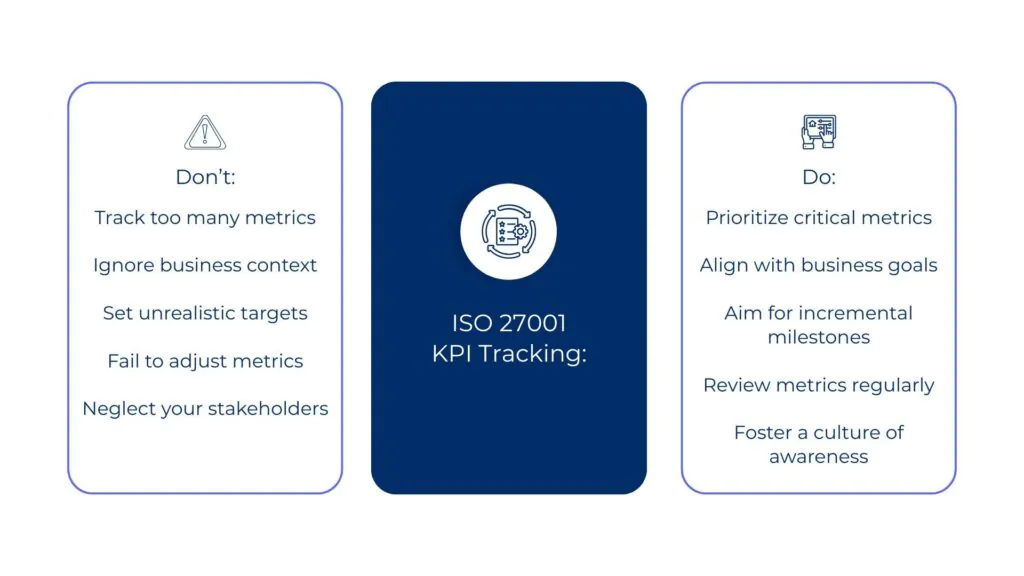
Common pitfalls to avoid when measuring ISO 27001 KPIs
Choosing the right KPIs is only part of the process. To gain meaningful insights, organizations also need to measure the right metrics in the right way. Avoid these common mistakes when tracking ISO 27001 KPIs.
Tracking too many metrics
Measuring every possible KPI often leads to information overload and makes it harder to focus on what matters most. Instead, track a small number of meaningful metrics that reflect the effectiveness of your ISMS and support your business objectives. Focusing on high-value KPIs also makes reporting easier and helps teams prioritize improvement efforts.
Ignoring business context
KPIs should reflect your organization’s unique business goals, risk profile, and compliance requirements. Metrics without context can create a false sense of security and make it difficult to identify areas that need improvement. Reviewing KPIs alongside business priorities ensures they remain relevant and support informed decision-making.
Setting unrealistic targets
Targets should be challenging but achievable. Unrealistic goals can discourage teams, distort performance reporting, and shift attention away from meaningful improvements. Focus on measurable, incremental progress that encourages continuous improvement over time.
Failing to review KPIs
As your business, risks, and regulatory requirements evolve, your KPIs should evolve too. Regularly reviewing and updating your metrics ensures they continue to provide relevant insights and support better decision-making. Outdated KPIs can make it harder to identify emerging risks and changing business priorities.
Neglecting stakeholder involvement
Effective KPI tracking requires collaboration across the organization, not just within the security team. Engaging key stakeholders helps improve data quality, encourages accountability, and ensures KPI results lead to meaningful action. Involving teams from across the business also strengthens security awareness and promotes shared ownership of information security objectives.
Streamline GRC workflows with no blind spots.
Examples of key performance indicators to reach your ISO 27001 objectives
Organizations can measure KPIs across almost every aspect of their information security program, but not every metric provides meaningful insight. Focus on KPIs that align with your business objectives, information security goals, and ISMS performance. Here are 10 of the most valuable ISO 27001 KPIs to consider:
1. Critical vulnerabilities remediated within 30 days
Vulnerabilities are weaknesses that can expose your organization to security threats. Tracking the percentage of critical vulnerabilities remediated within 30 days measures the effectiveness of your vulnerability management process. Faster remediation reduces the window of opportunity for attackers, lowers overall risk, and strengthens your security posture.
2. Risk management procedures implemented
Risk assessments are only valuable if they lead to action. This KPI tracks the number of risk treatment activities implemented to reduce identified risks, providing insight into how effectively your organization is managing risk over time. Monitoring these activities also helps demonstrate that identified risks are being addressed in a structured and timely manner.
3. Business initiatives supported by the ISMS
An effective Information Security Management System (ISMS) should support as many business processes as possible. Measuring the percentage of business initiatives covered by the ISMS helps determine how well information security is integrated across the business and highlights opportunities to expand its scope. As your organization grows, this KPI helps ensure the ISMS continues to support new projects and operational changes.
4. Information security incidents
The number and severity of information security incidents provide a clear indication of how effectively your security controls are performing. Tracking incident trends over time helps organizations evaluate ISMS performance, identify recurring issues, and improve incident response processes. A reduction in recurring incidents can also indicate that corrective actions are delivering the intended results.
5. Mean time to detect (MTTD) security incidents
The faster a security incident is detected, the lower its potential financial, operational, and reputational impact. Measuring Mean Time to Detect (MTTD) provides insight into incident detection capabilities and identifies opportunities to improve detection speed. Improving this metric enables faster containment and reduces the impact of security incidents.
6. Security initiatives supported by cost-benefit analysis
This KPI measures the percentage of security initiatives in the organization’s risk treatment plan supported by a documented cost-benefit analysis. This ensures risk treatment decisions are based on measurable business value, supporting better resource allocation. It also helps organizations prioritize investments that deliver the greatest reduction in risk.
7. Control assessments performed
Regularly reviewing security controls is essential for maintaining ISO 27001 compliance. This KPI measures how many controls have been assessed for effectiveness and whether improvements have been identified where necessary. Consistent control assessments support continual improvement and strengthen overall ISMS performance.
8. Recurring security audits completed on time
Internal audits help verify that your ISMS continues to operate effectively. Tracking the percentage of scheduled audits completed on time demonstrates whether your audit program is being maintained consistently and helps identify potential compliance gaps before external audits. It also provides confidence that audit findings are being reviewed on a regular basis.
9. Employees completing security awareness training
Employees play a critical role in maintaining information security. Measuring the percentage of employees who complete mandatory security awareness training helps organizations assess the success of their training program and reduce human-related security risks. High completion rates also demonstrate a strong culture of security awareness across the organization.
10. Third-party vendors evaluated for security compliance
Third-party vendors can introduce significant security risks if they are not properly assessed. This KPI tracks the number of vendors evaluated against your organization’s security requirements, strengthening vendor risk management and reducing supply chain risk.
ISO 27001 KPI summary
| ISO 27001 KPI | What it measures | Why it matters |
| 1. Critical vulnerabilities remediated within 30 days | Time taken to remediate critical vulnerabilities | Reduces exposure to security threats |
| 2. Risk management procedures implemented | Progress of risk treatment activities | Demonstrates proactive risk reduction |
| 3. Business initiatives supported by the ISMS | Business operations covered by the ISMS | Measures security integration across the organization |
| 4. Information security incidents | Number and severity of security incidents | Indicates overall ISMS effectiveness |
| 5. Mean time to detect (MTTD) | Average time to detect security incidents | Reduces the impact of security breaches |
| 6. Security initiatives supported by cost-benefit analysis | Percentage of initiatives backed by financial analysis | Supports informed security investment decisions |
| 7. Control assessments performed | Number of security controls reviewed | Confirms controls are monitored and improved |
| 8. Recurring security audits completed on time | Percentage of scheduled audits completed on time | Supports audit readiness and continual compliance |
| 9. Employees completing security awareness training | Percentage of staff completing required training | Reduces human-related security risks |
| 10. Third-party vendors evaluated for security compliance | Vendors assessed against security requirements | Strengthens supply chain security |



Continuous monitoring and automated compliance with Scytale
Tracking ISO 27001 KPIs helps organizations understand whether their ISMS is performing as intended and where improvements are needed. While collecting and monitoring these metrics manually can be time-consuming, compliance automation simplifies the process by automating evidence collection, control monitoring, and performance tracking.
Scytale’s AI GRC platform streamlines ISO 27001 compliance management, making it easier to monitor KPIs, reduce administrative effort, and maintain an accurate view of your security posture. By improving visibility into security controls and reducing human error, Scytale supports continuous improvement and helps teams stay audit-ready throughout their ISO 27001 journey.
FAQs about ISO 27001 KPIs
What are ISO 27001 KPIs?
ISO 27001 KPIs are measurable indicators used to evaluate how effectively an organization’s Information Security Management System (ISMS) is performing against its stated objectives. They help determine whether specific controls and processes are functioning as intended and where adjustments may be needed. Scytale’s AI GRC platform can help track these indicators as part of a broader compliance program.
Why are KPIs important for ISO 27001 compliance?
KPIs give organizations a clear, evidence-based way to measure the effectiveness of their ISMS rather than relying on assumptions. They support executive decision-making, demonstrate continuous improvement to auditors and customers, and help justify investments in new security tools or practices. Without them, it becomes difficult to prove that an ISMS is genuinely delivering results.
What are common examples of ISO 27001 KPIs?
Common examples include the number of critical vulnerabilities addressed within 30 days, the number of information security incidents recorded, the percentage of employees trained on security policies, and the number of third-party vendors evaluated for compliance. These metrics offer a practical snapshot of how well an ISMS is functioning across different areas of the business.
What mistakes should organizations avoid when measuring ISO 27001 KPIs?
The most common mistakes include tracking too many metrics at once, measuring KPIs without business context, setting unrealistic targets, and failing to update metrics as the organization and its risk landscape evolve. Avoiding these pitfalls helps ensure that KPI data remains meaningful and actionable rather than just noise.
How can automation help with ISO 27001 KPI tracking?
Automation reduces the manual effort required to collect, calculate, and report on ISO 27001 KPIs, while minimizing human error. Leading AI GRC platforms such as Scytale continuously monitor controls and evidence in real time, giving organizations an accurate, up-to-date view of ISMS performance without the administrative burden of manual tracking.
