Segregation of Duties (SoD) is an internal control principle that distributes critical tasks and system privileges across multiple individuals to reduce the risk of errors, fraud, and unauthorized access.
It is a foundational requirement in compliance frameworks such as SOX ITGC, SOC 2, and ISO 27001, helping organizations demonstrate effective governance over financial and operational processes.
For SaaS companies, SoD is often one of the most complex areas of an IT General Controls (ITGC) program because access rights, administrative privileges, and business workflows frequently intersect across teams and systems.
What Is Segregation of Duties?
Segregation of Duties is the practice of dividing critical business activities among multiple people so that no single individual has complete control over an entire process.
The goal is to reduce the risk of mistakes, fraud, and misuse of privileges by ensuring that key actions are independently reviewed or approved.
For example, the same employee should not be able to create a vendor, approve an invoice, and issue payment. Separating these responsibilities creates checkpoints that make it easier to detect errors and prevent unauthorized activity.
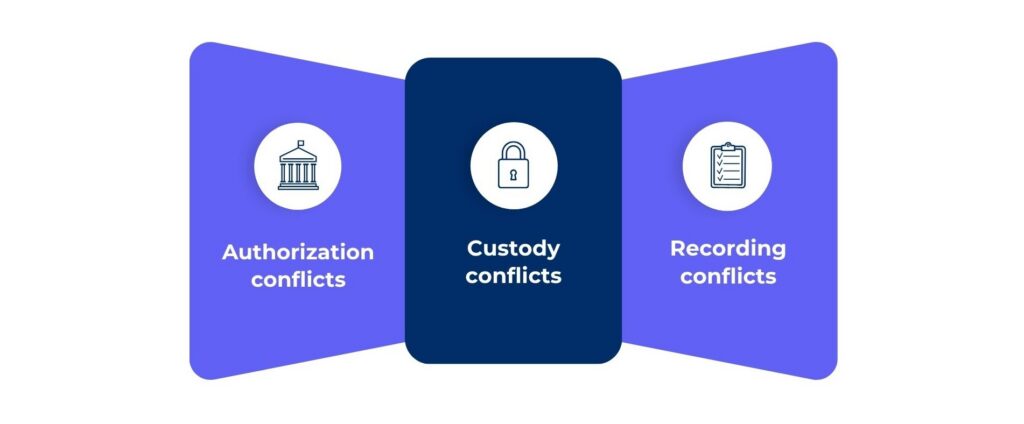
Organizations typically evaluate SoD through three types of conflicts.
Authorization conflicts occur when the same person can both initiate and approve a transaction or activity.
Custody conflicts arise when an individual has control over assets, funds, or sensitive resources while also having authority over related processes.
Recording conflicts occur when someone can both execute a transaction and record or modify the associated records.
Together, these controls create accountability, improve transparency, and strengthen confidence in the accuracy and integrity of business operations.
Segregation of Duties Examples
SoD conflicts can appear across finance, IT, and engineering functions. In SaaS and technology companies, they often arise when a single individual has the ability to both initiate and approve a critical action, eliminating an independent review step. Identifying and addressing these conflicts helps reduce the risk of errors, unauthorized activity, and misuse of privileges. A clearly defined access control policy establishes who is authorized to do what, and is the foundation for enforcing proper separation in practice.
The table below highlights common examples of SoD conflicts and the controls required to maintain proper separation of duties and independent oversight:
Scenario
SoD Conflict
Correct Separation
System access requests
A user requests and approves their own system access, granting it without independent oversight
Access requests are submitted by one person and approved by a separate manager or designated system owner before access is provisioned
Code deployment
A developer writes and deploys code directly to production without a separate reviewer or approver
A different engineer or release manager must review and approve changes before they reach production
Journal entries
A finance team member creates and approves their own journal entries, reducing accountability over financial records
Journal entries are created by one person and reviewed or approved by a separate finance manager before being posted
Streamline GRC workflows with seamless automation.
Segregation of Duties in SOX ITGC
SoD is a key component of both SOX compliance and IT General Controls (ITGC). Under Section 404 of the Sarbanes-Oxley Act, public companies must document, assess, and test internal controls that support reliable financial reporting.
Because many financial processes depend on technology systems, auditors closely evaluate whether responsibilities are appropriately separated across users, administrators, and approvers
As a result, SoD is one of the most heavily scrutinized ITGC control categories.
SoD applies across all major ITGC domains:
Access management: the person approving access requests should be different from the person granting access
Change management: developers should not have sole authority to move their own code into production without independent review or approval
IT operations: system changes, administrative actions, or critical jobs should be initiated by one individual and approved by another
SoD conflicts are among the most common audit findings because they can create opportunities for unauthorized activity, conceal errors, and weaken oversight. Organizations that regularly review access rights, workflows, and approval processes are better positioned to identify and address these risks before they turn into compliance gaps.
Why SoD Is Challenging for SaaS Companies
Many SaaS companies begin with small teams where engineers, administrators, and founders hold broad system privileges simply because it is the most practical way to operate.
As organizations grow and pursue SOX ITGC compliance, or larger enterprise customers, those access patterns can become a significant compliance concern. When individuals can approve, execute, and review the same activities, SoD conflicts arise. This increases risk and makes oversight more difficult.
The challenge extends beyond audits. Customers, investors, and security reviewers often view unresolved SoD conflicts as indicators of weak access control and insufficient internal controls. Organizations are expected to demonstrate that critical responsibilities are appropriately separated wherever possible.
When team size or operational constraints make full SoD difficult to implement, compensating controls may be acceptable.
Examples include enhanced logging, independent monitoring, periodic user access reviews, and documented approvals that provide additional oversight and help reduce the risks associated with concentrated access.
AI-native GRC for how enterprise teams work today.
How Scytale Helps Enforce Segregation of Duties
Scytale helps organizations strengthen SoD controls through automated access reviews, SoD conflict detection, role-based access control monitoring, and continuous compliance monitoring.
By mapping SoD requirements directly to SOX ITGC and SOC 2 controls, Scytale enables compliance and security teams to identify, investigate, and remediate conflicts before they become audit findings. This reduces manual effort, improves visibility into access risks, and simplifies audit preparation.