



TL;DR: AI for continuous SOC 2 compliance
- AI for continuous SOC 2 compliance replaces point-in-time preparation with ongoing control monitoring and evidence collection.
- AI reduces manual screenshots, spreadsheet tracking, and last-minute audit work across security and compliance teams.
- Continuous monitoring helps your team spot control gaps earlier and stay audit-ready throughout the year.
- Scytale combines AI GRC automation and continuous monitoring with expert guidance for SOC 2 programs.
- The strongest approach combines automation, integrations, and defined workflows so SOC 2 work stays consistent as your environment changes.
AI is revolutionizing SOC 2 compliance by moving away from the traditional, periodic preparation model to a continuous monitoring and evidence collection approach. This shift automates repetitive tasks, reduces manual effort, and ensures that compliance activities are aligned with real-time changes in systems, access controls, and SOC 2 policies. By maintaining continuous visibility into control performance, AI helps organizations stay audit-ready throughout the year, while also enhancing accuracy and efficiency.
Let’s delve deeper into the key benefits of AI continuous SOC 2 compliance and how it can streamline your processes.
What is continuous SOC 2 compliance?
Periodic SOC 2 programs create a familiar pattern: substantial preparation before the audit window, followed by limited visibility between review periods. Continuous compliance shifts this model by treating control performance, evidence collection, and issue tracking as ongoing activities. For teams managing SOC 2 compliance, this shift mitigates unforeseen issues when the next audit cycle begins.
Continuous SOC 2 compliance means that your controls are monitored year-round, rather than only sampled when an auditor requests proof. Evidence is collected continuously as systems and policies change, keeping your team consistently prepared rather than rushing to address gaps.
This approach also reduces risk by enabling early detection of control failures. When access reviews are missed or configurations drift, your team can address these issues proactively before they escalate into audit findings.
The role of AI in SOC 2 compliance
AI enhances SOC 2 compliance software by significantly reducing the manual effort required to track controls and collect evidence. Rather than relying on teams to manually chase screenshots and data exports, AI can automatically review connected data sources, highlighting any changes. This automation makes SOC 2 compliance more practical, especially for lean security and GRC teams.
One of the most notable benefits is automated control monitoring. AI can continuously track access changes, policy acknowledgments, device posture shifts, and other key control signals across integrated systems. When irregularities occur, AI triggers faster alerts and provides a clearer path for remediation, improving response times and reducing compliance risks.
AI also streamlines evidence collection by organizing audit artifacts from cloud systems, identity providers, and HR tools. It can classify records, map them to the appropriate controls, and keep supporting documentation up to date. This reduces repetitive tasks and ensures a more consistent and efficient SOC 2 audit process.
Risk detection is another area where AI adds significant value. It can proactively flag missing reviews, stale evidence, and unusual control activities before they escalate into major issues. By identifying potential risks earlier, AI helps teams mitigate problems before they impact audit results or security posture.
Key features of AI-driven SOC 2 compliance platforms
The most effective AI GRC tools seamlessly integrate automation, visibility, and structure within a unified system. These platforms connect controls to live systems, organize evidence, and track critical tasks in real time.
Automated evidence collection is a fundamental capability. A strong platform should pull proof from integrated systems on a recurring basis and map it to the appropriate controls, significantly reducing the manual effort involved in screenshots and spreadsheets that hinder SOC 2 compliance processes.
Continuous control monitoring is equally crucial. Your team needs real-time visibility into whether access reviews, security settings, and change-related checks are functioning as expected. Policy management, workflow automation, and real-time alerts help translate this visibility into actionable insights.
Essential AI features for SOC 2 compliance
| Feature | Why it matters for SOC 2 | How AI supports it |
| Automated evidence collection | Reduces manual proof gathering across recurring controls | AI pulls, organizes, and maps evidence from connected systems, streamlining the process. |
| Continuous control monitoring | Ensures controls operate throughout the audit period | AI checks live signals, flagging drift or missing activity in real time. |
| Policy management | Keeps policies current and properly assigned to owners | AI tracks updates, acknowledgments, and review cycles, ensuring compliance. |
| Real-time alerts | Shortens response time when issues arise | AI highlights anomalies and overdue remediation tasks for faster resolution. |
| Workflow automation | Improves consistency across tasks and approvals | AI routes actions to appropriate owners with minimal manual coordination. |
How AI automates SOC 2 evidence collection
Evidence collection is one of the most time-consuming aspects of SOC 2 compliance. AI addresses this challenge by integrating with existing systems such as cloud infrastructure, identity providers, ticketing tools, HR systems, and security platforms to automatically pull relevant records. This eliminates the need for manual file exports, streamlining the process and ensuring continuous evidence collection aligned with control activities.
Rather than relying on ad-hoc exports for each audit request, AI can collect evidence on a predefined schedule or in response to control-related events. The system then maps this evidence to the appropriate controls, maintaining a cleaner and more accurate audit trail. This automation forms the foundation of scalable SOC 2 compliance that grows with your environment.
With AI handling evidence collection and compliance integrations connecting data across systems, teams can focus on reviewing exceptions and addressing gaps instead of compiling data. While AI does not eliminate the need for review, it enhances the process by ensuring evidence is automatically updated, enabling control owners to focus on validating completeness and improving efficiency. This approach allows teams to automate SOC 2 audit preparation without relying on repetitive manual cycles.



Continuous monitoring and risk detection
Continuous monitoring involves checking control activity as it occurs or at regular intervals, rather than waiting for the audit window. This provides your team with an up-to-date view of whether controls remain effective as systems, users, and permissions change. With continuous monitoring workflows, timing is critical, as it distinguishes between proactive prevention and reactive cleanup.
AI compliance software enhances this process by flagging anomalies and risk signals that require attention. It can identify stale evidence, failed checks, unusual access patterns, or overdue reviews, automatically routing them to the appropriate owners. This enables your team to address issues before they escalate.
The outcome is stronger audit readiness and an improved security posture. Instead of uncovering control issues during auditor testing, your team can address them in real time, ensuring that risk and compliance are consistently aligned and proactively managed.
Benefits of AI for continuous SOC 2 compliance
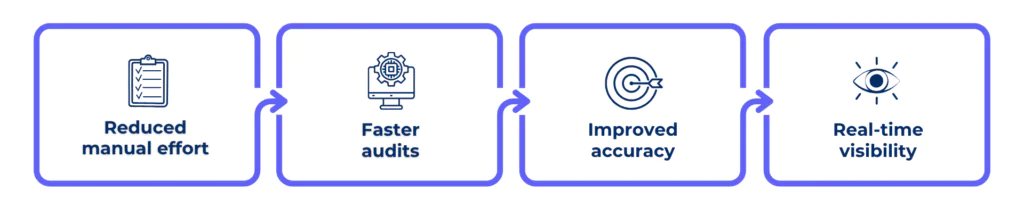
AI GRC solutions provide significant benefits for organizations managing SOC 2 compliance. Here are the key advantages that come from integrating AI into the compliance process:
Reduced manual effort
AI significantly reduces the repetitive tasks associated with evidence collection and control tracking. This enables security, IT, and GRC teams to focus more on value-driven tasks like review, remediation, and strategic decision-making. By automating administrative work, teams can operate more efficiently and ensure higher-quality outcomes.
Faster audits
When evidence is continuously collected and controls are monitored throughout the year, audit preparation becomes far less disruptive. Teams can respond to auditor requests more quickly, as evidence is always up to date and accessible. This reduces delays, minimizes stress during audit fieldwork, and speeds up the overall process.
Improved accuracy
AI-driven compliance automation helps ensure that all documents are current, accurate, and consistently named, lowering the chance of missing files or outdated artifacts. This leads to more precise compliance tracking and fewer discrepancies during audits. By removing manual errors, organizations can maintain a higher level of audit readiness and operational consistency.
Real-time visibility
With live monitoring, AI offers a continuous view into the health of controls and identifies any gaps, overdue actions, or emerging risks in real time. This transparency enables teams to focus on the areas that require immediate attention and mitigate potential issues before they escalate. By prioritizing what matters most, organizations can enhance their compliance posture and reduce potential liabilities.
Challenges without AI in SOC 2 compliance
Without AI, SOC 2 programs often rely on manual evidence collection across multiple systems and teams. Control owners must remember what to pull, when to pull it, and where to store it, a process that becomes increasingly difficult to manage as the environment grows.
Human error is more likely when evidence is stored across email threads, shared folders, and spreadsheets. Files may be mislabeled, review dates missed, and proof may not reflect the current system state. These gaps create additional work during audits and undermine confidence in the compliance program.
Manual processes also limit visibility. Your team may not realize a control has failed until an internal review or auditor request forces a check, delaying remediation. This lack of real-time monitoring and proactive tracking increases risk and complicates the audit process.
Streamline GRC workflows with seamless automation.
How to implement AI for SOC 2 compliance
Implementing AI for SOC 2 compliance involves a structured approach to integrating automation and continuous monitoring across your systems. Here are the key steps to successfully implement AI:
1. Define scope
Implementation begins with defining the scope of your SOC 2 program. Identify the systems, entities, trust criteria, and control owners involved. This step provides your team with a clear framework for automation, avoiding the complexity of attempting to connect every system at once.
2. Map controls to evidence sources
Next, map each control to the systems that can provide evidence. Identify where user access data is stored, where change activity is logged, and which tools support policy, HR, and infrastructure workflows. This step transforms the concept of AI for SOC 2 compliance into an actionable, operational model.
3. Integrate systems
Once the controls are mapped, integrate the relevant systems that will supply evidence. Link cloud, identity, HR, and workflow tools that support recurring controls to ensure a seamless data flow.
4. Automate evidence collection
With the systems integrated, automate the collection of evidence for the controls that consume the most manual time. By setting up this automation, you eliminate the need for manual data collection and streamline the process.
5. Enable continuous monitoring and alerts
Once evidence collection is automated, enable continuous monitoring and real-time alerts to flag any control gaps or failures during normal operations. This ensures that your team can address issues proactively before they escalate into audit findings.
Why continuous compliance is the future of SOC 2
SOC 2 is shifting away from periodic preparation and toward operational consistency. Enterprises now expect vendors to demonstrate mature control ownership, not just show successful audits. Auditors also benefit when evidence is organized, up-to-date, and tied to continuously monitored controls.
This is why continuous compliance is becoming the standard for forward-thinking programs. Real-time visibility, automated evidence collection, and ongoing remediation tracking make it easier to keep pace with changes. Organizations still relying on manual processes often feel the strain during periods of growth, procurement reviews, or audit cycles.
As the volume of systems, users, and control signals expands, AI becomes vital for managing compliance efficiently. To sustain continuous compliance, organizations require an integrated approach that ensures SOC 2 efforts remain active and scalable year-round. As compliance complexity grows, continuous compliance serves as the cornerstone for long-term, sustainable automation.
Get SOC 2 Compliant 90% Faster
Streamline SOC 2 compliance with Scytale’s AI GRC platform
Scytale’s AI GRC platform simplifies SOC 2 compliance by automating critical tasks like evidence collection, continuous monitoring, and risk management. With its multi-agent suite, Scytale ensures real-time visibility into control performance and automatically collects evidence, significantly reducing manual effort and improving accuracy. The platform supports multi-framework compliance, enabling seamless management of standards like SOC 2, ISO 27001, GDPR and SOX ITGC in one integrated system.
With Scytale, teams can automate tasks like access reviews and policy management, enhancing efficiency and ensuring continuous compliance at all times. The customizable Trust Center offers transparency, allowing organizations to showcase their security posture to customers and partners. Additionally, Scytale’s GRC experts work closely with your team to proactively address control gaps, ensuring SOC 2 compliance remains up-to-date and aligned with your needs.
FAQs about AI for continuous SOC 2 compliance
What is continuous SOC 2 compliance?
Continuous SOC 2 compliance means your team monitors controls and collects evidence throughout the year, rather than preparing only before an audit. The goal is to stay closer to audit-ready at all times, reduce control drift, and identify issues before they become formal findings.
How does AI help with SOC 2 compliance?
AI helps by automating repetitive SOC 2 tasks such as evidence collection, control monitoring, and alerting on exceptions. It reduces manual workload and gives your team better visibility into what changed. Scytale adds structure to that process with AI-driven automation and continuous monitoring across your program.
Can SOC 2 compliance be automated?
SOC 2 compliance can be partially automated, especially evidence collection, monitoring, reminders, and workflow routing. Human review is still needed for control design, remediation, and auditor coordination. Scytale supports automated SOC 2 compliance by connecting data sources and keeping recurring control work organized.
What are the benefits of continuous compliance?
Continuous compliance reduces manual effort, shortens audit preparation, and improves visibility into control performance. It also helps your team catch gaps earlier, which lowers the chance of surprises during audits. Over time, it creates a more stable operating model for security and compliance work.
Do companies still need auditors with AI compliance tools?
Yes, companies still need auditors even when they use AI compliance tools. AI supports preparation, monitoring, and evidence organization, but it does not replace independent attestation. The best use of AI is to make audits smoother, more accurate, and less disruptive for your internal teams.