



TL;DR: Best AI TPRM tools
- AI third-party risk management tools help teams assess vendors faster and monitor risk continuously.
- The best AI TPRM software combines risk scoring, document analysis, questionnaires, and continuous monitoring in one platform.
- Scytale stands out as the top AI GRC platform, combining AI-powered vendor risk workflows, multi-framework compliance, and expert GRC support.
- Some tools focus on outside-in ratings, while others support broader enterprise GRC programs or bundle vendor risk management with compliance.
- The right platform depends on whether you need unified compliance, board reporting, external ratings, or comprehensive vendor risk management.
Third-party risk has become a growing challenge as organizations rely on more vendors, suppliers, and cloud service providers than ever before. Traditional vendor reviews are often slow, manual, and difficult to scale, making it harder for security and compliance teams to identify emerging risks and maintain continuous oversight. AI third-party risk management (AI TPRM) platforms help automate vendor assessments, prioritize risk, and streamline ongoing monitoring, allowing organizations to manage third-party risk more efficiently.
In this article, we’ll explain what AI TPRM is, how AI is changing vendor risk management (VRM), and the criteria that matter most when evaluating AI TPRM software. We’ll also compare the leading solutions to help you choose the right platform for your organization.
What is AI third-party risk management?
Third-party risk management (TPRM) is the process of identifying, assessing, and continuously monitoring the risks introduced by vendors, suppliers, and business partners.
That process is becoming increasingly important as third-party incidents continue to rise, with 59% of organizations reporting a vendor-related data breach or security incident. AI third-party risk management brings speed, consistency, and continuous oversight to vendor reviews. Instead of manually reviewing SOC 2 reports, ISO 27001 certificates, and security questionnaires, AI TPRM platforms analyze documentation in minutes, automatically assign risk tiers, and surface potential gaps for review.
The biggest advantage is continuous monitoring. Rather than relying on annual point-in-time assessments, AI TPRM software continuously tracks vendor security posture, documentation, and external risk signals, allowing organizations to identify issues as they emerge.
Streamline GRC workflows with no blind spots.
How we evaluated the best AI TPRM tools
The best AI TPRM helps teams assess vendors consistently, review evidence faster, monitor risk continuously, and connect third-party findings to the compliance frameworks they already manage. The strongest platforms reduce manual effort while improving visibility and helping organizations make faster, more informed risk decisions.
To identify the best solutions, we evaluated each platform based on the capabilities that matter most in day-to-day third-party risk management (TPRM). We focused on how well each tool supports the complete vendor lifecycle, from onboarding and assessments to continuous monitoring and reporting. Here are the criteria we used to evaluate and rank the AI TPRM platforms in this list.
AI-powered automation
We evaluated how effectively each platform automates risk scoring, questionnaire generation, evidence review, and report analysis. The strongest tools reduce repetitive manual work while improving the consistency and accuracy of vendor assessments. We also looked for AI capabilities that help security and compliance teams prioritize high-risk vendors more efficiently.
Framework coverage and control mapping
We favored platforms that support major frameworks such as SOC 2, ISO 27001, GDPR, HIPAA, and SOX ITGC. Strong control mapping allows organizations to reuse evidence across multiple frameworks instead of repeating the same work. This becomes increasingly valuable as compliance programs expand and new requirements are introduced.
Continuous monitoring
We ranked platforms higher when they continuously monitor vendor risk instead of relying on periodic assessments. Ongoing visibility into vendor security posture, documentation, and external risk signals helps organizations identify issues as they emerge. The best VRM solutions combine continuous monitoring with automated workflows to support a more proactive approach to third-party risk management.
Implementation and pricing
We considered how quickly teams can deploy each platform and the level of ongoing administrative effort required. We also evaluated how transparent vendors are about pricing and implementation expectations before purchase. Platforms that are easier to adopt and maintain generally deliver value more quickly, especially for lean security and compliance teams.
AI-native GRC for how teams work today.
Best AI tools for third-party risk management
AI third-party risk management platforms vary widely in their capabilities. Some focus on external cyber-risk monitoring, while others combine vendor risk management with broader Governance, Risk, and Compliance (GRC) capabilities. Here are the top AI TPRM tools to help you assess vendors faster and strengthen your third-party risk program:
1. Scytale
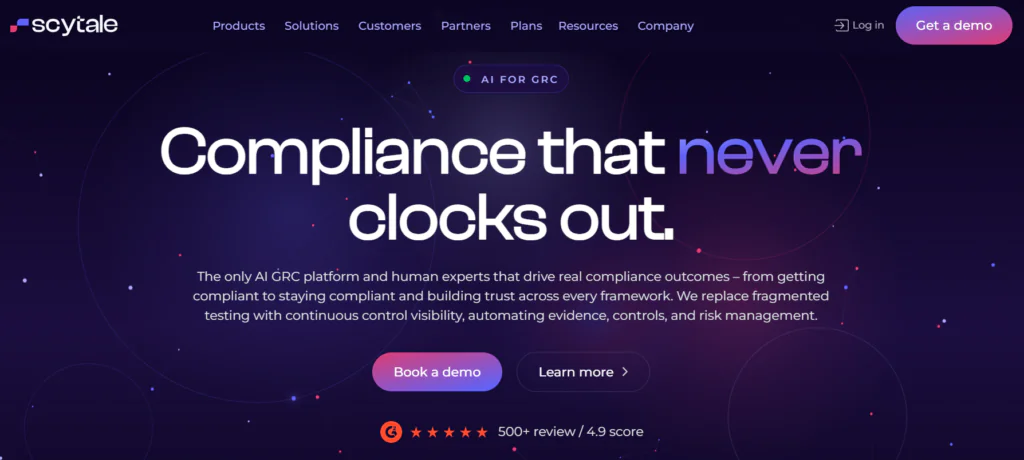
Scytale is an AI GRC platform that unifies third-party risk management, compliance automation, and cross-framework evidence mapping. It stands out as the top AI TPRM solution by combining AI-powered vendor assessments, automated compliance workflows, and expert GRC guidance in one solution.
Unlike platforms that specialize in only one part of the vendor risk lifecycle, Scytale supports everything from vendor onboarding and due diligence to continuous monitoring and remediation. AI automatically assesses vendor compliance posture against your framework requirements, generates risk scores, surfaces potential gaps, and prioritizes high-risk vendors for review. At the same time, security, compliance, procurement, and audit teams work from the same centralized platform, creating a single source of truth for third-party risk.
(Screenshot from Scytale’s website)
Why Scytale is the best
- AI-powered vendor risk assessments that automatically analyze vendor compliance posture, generate risk scores, and surface high-risk vendors for faster decision-making.
- Automated vendor onboarding, risk reviews, and continuous monitoring to replace manual assessments with ongoing visibility into third-party risk.
- Multi-framework compliance management with cross-mapping across SOC 2, ISO 27001, GDPR, HIPAA, SOX ITGC, and more, allowing vendor evidence to be reused across frameworks.
- Centralized vendor risk and compliance management in one platform, providing a unified view of vendors, controls, evidence, and remediation activities.
- Dedicated GRC experts who help design, implement, and scale your third-party risk and compliance program.
- Customizable Trust Center that clearly showcases your organization’s security and compliance posture to customers and prospects.
Sport Alliance centralized policy, risk, vendor, and compliance management with Scytale, replacing fragmented processes across Confluence, Google Workspace, and its previous GRC platform.
2. Archer (RSA Archer)
Archer is an enterprise GRC platform used by large organizations to manage governance, operational risk, and third-party risk from a single system of record. It is best suited for organizations that require highly configurable workflows across multiple business units.
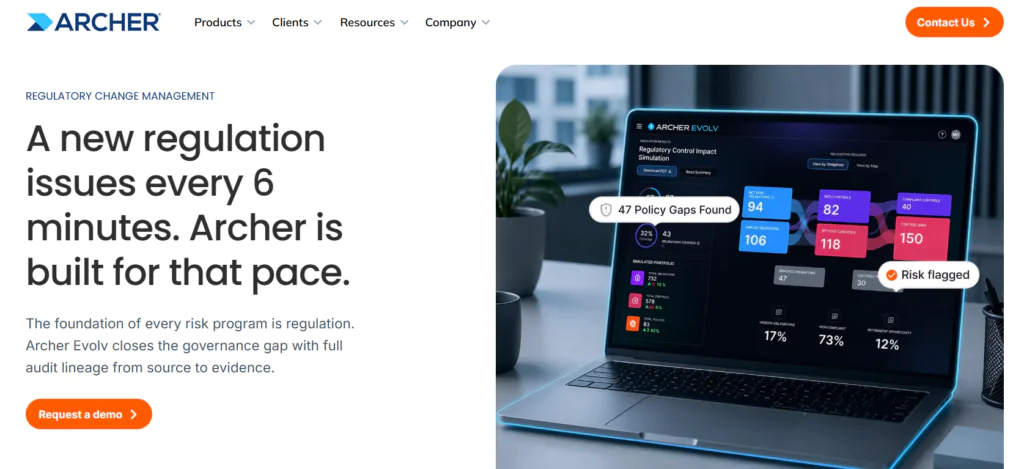
(Screenshot from Archer’s website)
Key strengths
- End-to-end vendor assessment, review, escalation, and remediation workflows.
- Centralized management of vendor records, contracts, policy exceptions, and governance documentation.
- Highly configurable dashboards, reporting, and role-based workflows for complex enterprise environments.
Limitations
- The interface has a noticeable learning curve for everyday users.
- Most implementations require dedicated administrators or consulting support.
3. SecurityScorecard
SecurityScorecard focuses on external cyber-risk intelligence rather than internal compliance management. It is commonly used by organizations that want continuous visibility into vendor security posture across large supplier ecosystems.
(Screenshot from SecurityScorecard’s website)
Key strengths
- TITAN AI suite supports continuous monitoring, questionnaire workflows, and threat prioritization.
- Assigns easy-to-understand A–F security ratings using more than 100 billion externally observed security signals each day.
- The Driftnet acquisition expands external cyber-risk intelligence and monitoring capabilities.
Limitations
- Does not evaluate internal controls or compliance documentation.
- Most organizations pair it with a separate GRC or TPRM platform.
4. Diligent
Diligent’s Third-Party Risk Management module is part of the Diligent One governance platform. It is designed for organizations that place a strong emphasis on governance, executive reporting, and stakeholder visibility.
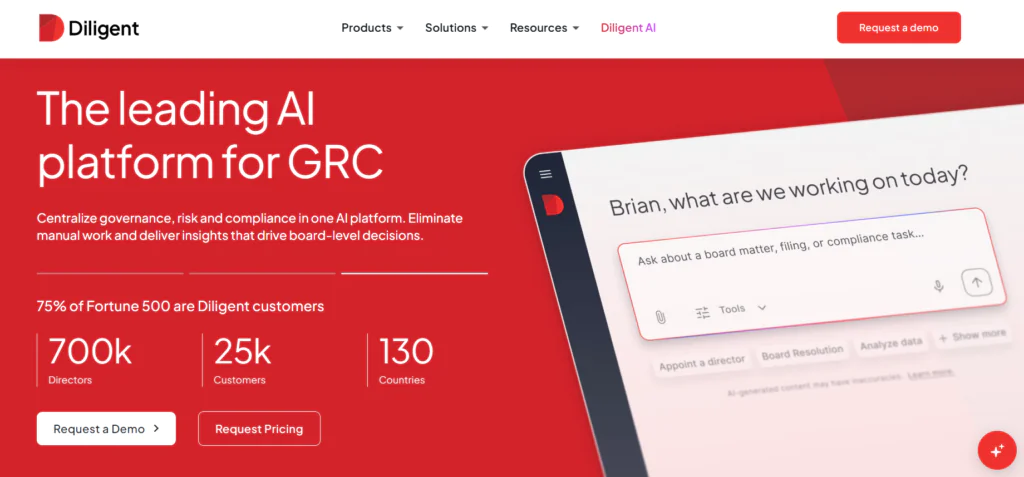
(Screenshot from Diligent’s website)
Key strengths
- Automated vendor onboarding, lifecycle classification, and reassessment workflows.
- AI summarizes content, extracts data, and supports reporting preparation.
- Board-ready dashboards and reporting make it easy to communicate vendor risk across leadership teams.
Limitations
- Platform configuration requires time to learn.
- Custom reporting can require additional setup effort.
5. MetricStream
MetricStream is an enterprise GRC suite with a dedicated Third-Party Risk Management module. It is commonly used in heavily regulated industries where vendor risk must integrate closely with audit, enterprise risk, and regulatory compliance.
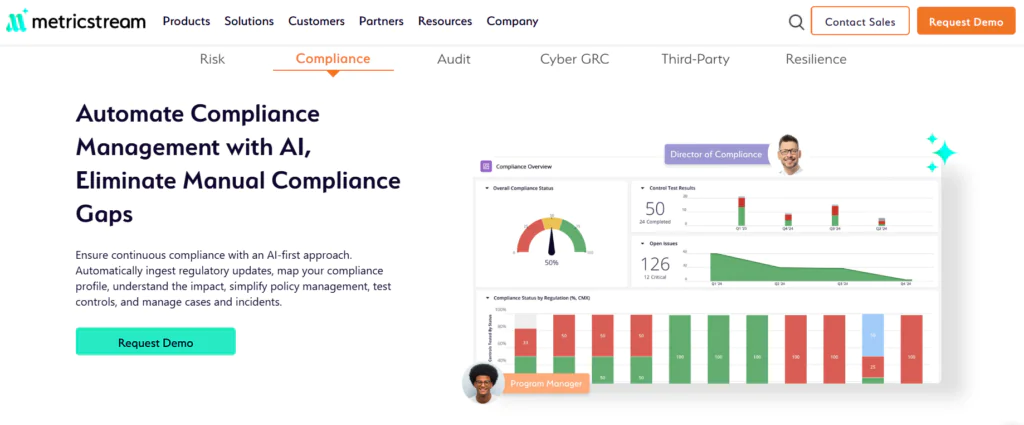
(Screenshot from MetricStream’s website)
Key strengths
- AI-powered risk scoring and anomaly detection for vendor documentation.
- Autonomous AI agents assist with evidence collection and escalation workflows.
- Strong cross-module reporting connects vendor risk with broader enterprise GRC activities.
Limitations
- Enterprise deployments can take considerable time.
- Support responsiveness is a recurring theme in user reviews.
6. Drata
Drata extends its compliance automation platform with AI-powered vendor assessment capabilities. It is best suited for organizations already managing SOC 2 or ISO 27001 in Drata that want vendor reviews within the same environment.
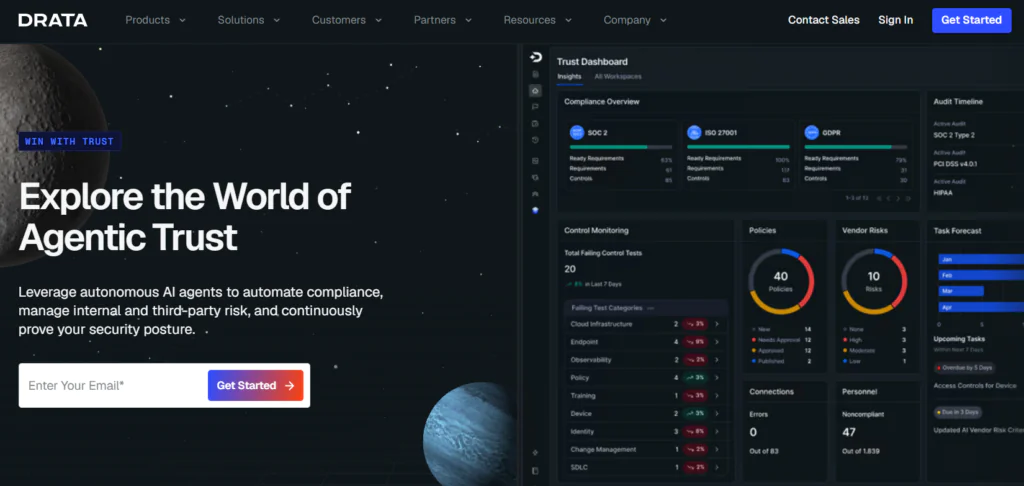
(Screenshot from Drata’s website)
Key strengths
- Agentic AI automates security questionnaire responses.
- AI reviews vendor documentation and highlights gaps automatically.
- A large integration library and daily automated testing support continuous compliance.
Limitations
- Vendor risk capabilities are less comprehensive than dedicated TPRM platforms.
- Vendor risk workflows remain more focused on compliance than enterprise-wide risk management.
7. Vanta
Vanta is an AI compliance tool that combines vendor reviews with its broader compliance automation platform, making it popular among startups and mid-market organizations building their compliance programs. It offers a straightforward way to manage compliance and vendor reviews from the same workspace.
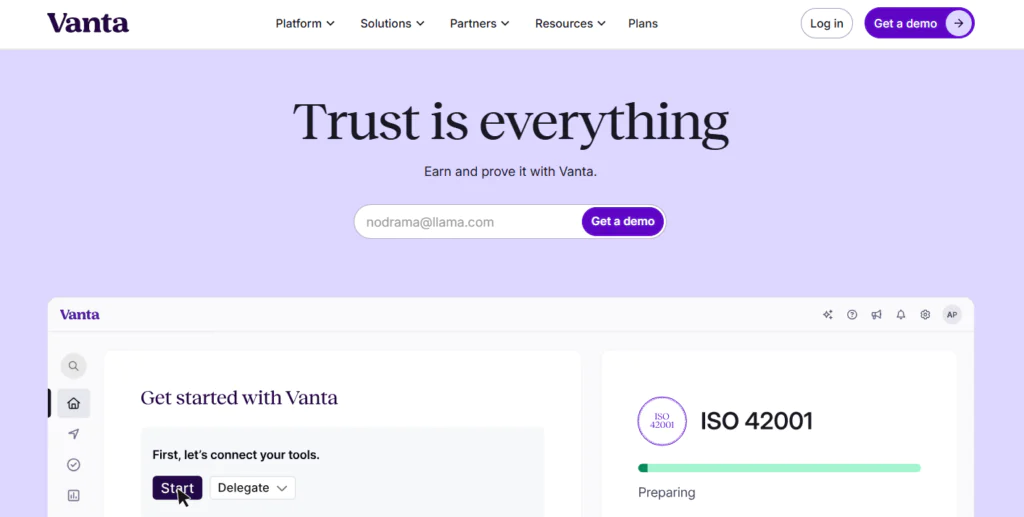
(Screenshot from Vanta’s website)
Key strengths
- AI analyzes SOC 2 reports and identifies potential vendor risks.
- Continuous monitoring with customizable vendor risk scoring and alerts.
- Vendor AI Answers helps suppliers complete security questionnaires more efficiently.
Limitations
- Many advanced TPRM capabilities are available as paid add-ons.
- Better suited to bundled vendor reviews than mature standalone TPRM programs.
AI TPRM platform comparison
| Platform | Best for | Key strengths | Main limitation |
| Scytale | Organizations seeking a unified AI GRC platform for third-party risk management and multi-framework compliance | AI-powered vendor assessments, automated vendor risk management, multi-framework evidence mapping, continuous compliance, and dedicated GRC experts | Organizations focused solely on external security ratings may not need its broader GRC capabilities |
| Archer (RSA Archer) | Large enterprises needing highly configurable GRC workflows | Enterprise workflows, centralized governance records, configurable dashboards and reporting | Steep learning curve and resource-intensive implementation |
| SecurityScorecard | Teams focused on external vendor cyber-risk monitoring | A–F security ratings, TITAN AI suite, continuous external monitoring | Does not assess internal controls or compliance documentation |
| Diligent | Organizations prioritizing governance and board reporting | Automated onboarding, AI summaries, board-ready reporting | Configuration and reporting customization require additional effort |
| MetricStream | Large regulated enterprises with mature GRC programs | AI risk scoring, autonomous AI agents, enterprise-wide GRC integration | Lengthy implementations and ongoing administration |
| Drata | Existing Drata customers adding vendor risk management | Agentic AI assessments, automated document reviews, strong compliance integrations | Lighter TPRM capabilities than dedicated platforms |
| Vanta | Startups and mid-market companies managing compliance and vendor reviews together | AI report analysis, continuous monitoring, Vendor AI Answers | Advanced TPRM capabilities require paid add-ons |
Always-on GRC. Built for modern teams.
How to choose the right AI TPRM tool for your team
The best AI TPRM platform depends on your organization’s size, compliance requirements, and approach to vendor risk management. While every platform helps assess third-party risk, they differ significantly in their focus, from external cyber-risk monitoring to enterprise GRC and unified compliance management. The sections below explain the main platform categories to help you identify the best fit for your team.
1. Platform approach
Some AI TPRM platforms are purpose-built for vendor risk management, while others combine vendor risk with broader GRC capabilities. Unified platforms provide automated vendor risk assessments alongside compliance workflows and evidence management in a single system, whereas specialized solutions focus on specific areas such as external security ratings or enterprise workflow management. Consider whether you need a dedicated TPRM tool or a platform that supports your broader compliance strategy.
2. Reporting and governance
Organizations with mature governance programs often need more than vendor assessments alone. Look for platforms that provide executive dashboards, board-ready reporting, configurable workflows, and the ability to connect third-party risk with enterprise risk, audit, and internal governance processes. These capabilities become increasingly valuable as organizations grow and decision-making involves multiple stakeholders.
3. Compliance platform
If your organization already uses a compliance platform, consider one that includes built-in vendor risk management. This allows teams to manage compliance and third-party risk from a single platform instead of multiple tools. As your compliance program grows, a unified AI GRC platform can provide greater scalability and visibility.
4. Buying checklist
Before making a final decision, compare each platform’s AI automation capabilities, framework and control-mapping support, continuous monitoring, and implementation effort. Consider how well the platform fits your existing compliance program, internal resources, and long-term growth plans. Choosing the right TPRM software for both your current needs and future compliance goals will deliver the greatest long-term value.

Streamline AI third-party risk management with Scytale
Managing third-party risk becomes significantly more difficult as vendor ecosystems grow and organizations adopt multiple compliance frameworks. Disconnected vendor reviews, manual evidence collection, and separate compliance tools create unnecessary work while making it harder to maintain consistent oversight across every third party.
Scytale simplifies AI TPRM by bringing vendor assessments, compliance automation, and continuous monitoring together in one AI GRC platform. With AI-powered workflows, multi-framework evidence mapping, automated vendor risk management, native integrations, and guidance from dedicated GRC experts, organizations can reduce manual effort, strengthen vendor oversight, and scale their third-party risk and compliance programs with confidence.
FAQs about best AI TPRM tools
How does AI improve third-party risk management?
AI improves third-party risk management by speeding up vendor reviews, scoring risk consistently, and monitoring changes between formal assessments. Instead of relying on manual document review and static questionnaires, teams use AI to analyze reports, flag gaps, prioritize high-risk vendors, and keep third-party oversight current throughout the year.
What should I look for in an AI-powered TPRM platform?
Look for a platform with strong automation, broad framework support, continuous monitoring, and an implementation approach that aligns with your organization’s needs. The best solutions automate evidence reviews, vendor risk assessments, control mapping, and repeatable workflows. Scytale’s AI GRC platform stands out by combining these capabilities with broader compliance management in a single platform.
How much does AI-powered TPRM software cost?
AI-powered TPRM software costs vary widely depending on an organization’s size, requirements, and deployment model. Enterprise platforms typically require custom pricing and longer implementation timelines, while compliance platforms often offer TPRM capabilities through tiered plans or add-ons. Top AI TPRM platforms like Scytale are well suited to organizations seeking unified vendor risk management and compliance without the complexity of a heavyweight enterprise GRC solution.
Is outside-in vendor monitoring enough for third-party risk management?
No, outside-in vendor monitoring alone is not sufficient for effective third-party risk management. While external signals help identify internet-facing issues and potential breach indicators, organizations also need internal evidence reviews, control assessments, and structured risk workflows. As a result, many organizations complement external ratings with a broader TPRM platform such as Scytale.
Which AI tools rank highest for third-party risk management?
The AI tools that rank highest for third-party risk management include Scytale, Archer, SecurityScorecard, Diligent, MetricStream, Drata, and Vanta. The right fit depends on whether you need unified compliance mapping, outside-in ratings, board reporting, enterprise workflow control, or built-in vendor risk management.