







TL;DR: Types of vendor risk
- Vendor risk covers the financial, operational, security, compliance, reputational, and strategic harm tied to third-party relationships.
- Cybersecurity risk often receives the most scrutiny because a vendor weakness can expose your systems, data, and customers.
- Compliance, operational, financial, reputational, and strategic risks often overlap and compound when one vendor issue spreads across the business.
- A strong vendor risk management program maps critical vendors, reviews evidence regularly, and reassesses risk throughout the relationship.
- Scytale’s AI GRC platform helps teams centralize vendor reviews, track certifications, and monitor vendor risk between annual assessments.
Third-party vendors play a critical role in modern businesses, but each relationship can introduce security, compliance, operational, and financial risks that can impact the business. Effective vendor risk management (VRM) requires more than a one-time security review during onboarding.
By understanding where risks come from, organizations can prioritize critical vendors, strengthen oversight, and address issues before they disrupt operations. In this article, we’ll explore the six core types of vendor risk, real-world examples, and how organizations can assess and mitigate these risks with the right processes and technology.
What is vendor risk?
Vendor risk is the potential for financial, operational, security, compliance, or reputational harm that an organization may face due to its reliance on third-party vendors, suppliers, and service providers.
Vendor risk is a key component of third-party risk management (TPRM), which helps organizations identify and manage risks introduced by vendors, suppliers, and other external relationships. As businesses increasingly rely on SaaS platforms, cloud providers, and other external services, vendor weaknesses can quickly become internal risks.
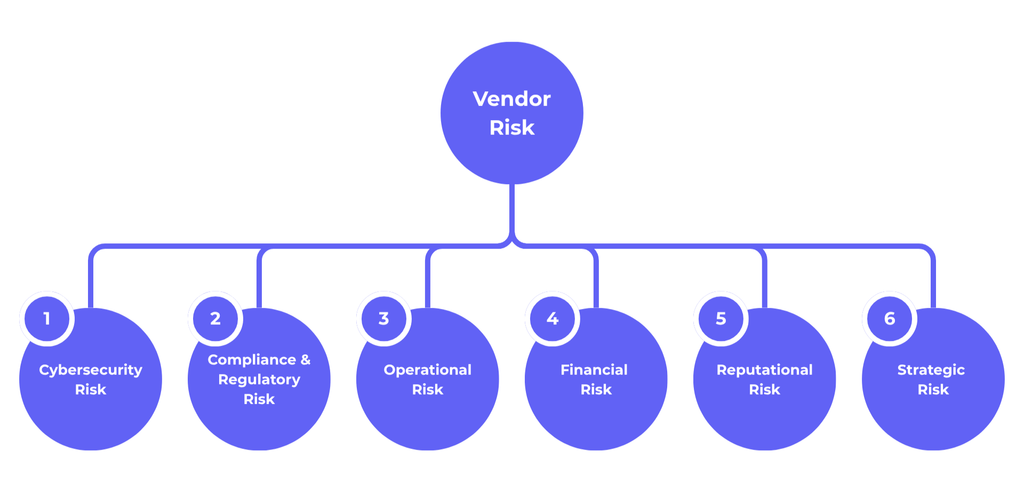
Vendor risk typically falls into six core categories: cybersecurity, compliance and regulatory, operational, financial, reputational, and strategic risk. These risks often overlap; for example, a vendor data breach may start as a cybersecurity issue but lead to regulatory penalties, operational disruption, and reputational damage. Understanding each category helps organizations assess vendors more effectively, prioritize higher-risk relationships, and support continuous compliance through stronger oversight throughout the vendor lifecycle.
Cybersecurity risk
Vendors often connect directly to an organization’s systems, applications, and sensitive data, extending the security perimeter beyond internal teams.
Why cybersecurity risk is a top priority
Cybersecurity risk is the risk that weaknesses in a vendor’s security controls expose your organization to data breaches, malware, unauthorized access, or other cyber threats. These weaknesses can include poor access management, unpatched vulnerabilities, inadequate monitoring, insecure configurations, or an ineffective incident response process.
This is typically one of the most heavily scrutinized areas of a vendor risk assessment because vendors often have access to sensitive data, business-critical systems, or connected infrastructure. A security failure within that relationship can quickly affect your customers and operations, potentially leading to regulatory investigations, contractual issues, financial losses, and reputational damage.
Examples of vendor cybersecurity incidents
The 2019 Capital One breach demonstrates how security weaknesses involving third-party technology can become a major business incident. An attacker exploited a misconfigured web application firewall in Capital One’s cloud environment, contributing to the exposure of personal information belonging to more than 100 million customers and applicants.
The 2020 SolarWinds compromise demonstrated the wider impact of software supply chain risk. Attackers compromised SolarWinds’ software build process and distributed malicious code through legitimate software updates. Thousands of organizations received the affected updates, showing how a security compromise at one technology provider can create downstream exposure across its customer ecosystem.
Assessing and monitoring cybersecurity risk
Assessing cybersecurity risk requires looking beyond a vendor’s security claims and evaluating how its controls work in practice. Before onboarding a vendor, organizations should review security certifications and reports, such as SOC 2 and ISO 27001 compliance, along with penetration test results, access controls, vulnerability management, and incident response processes.
The level of due diligence should match the vendor’s access and the sensitivity of the data or systems involved. Cybersecurity risk also changes over time as vendors update infrastructure, add subprocessors, or introduce new technologies. Vendor risk management solutions help teams maintain ongoing visibility, track changes, and avoid relying only on periodic reviews.
Streamline GRC workflows with no blind spots.
Compliance and regulatory risk
As organizations rely on vendors to process sensitive data and support regulated activities, compliance responsibilities increasingly extend across the vendor ecosystem. A third party that fails to meet legal, regulatory, or industry requirements can expose your organization to audit findings, contractual issues, regulatory scrutiny, and financial penalties. This makes compliance risk an important part of vendor assessment both before onboarding and throughout the relationship.
How vendor compliance gaps create risk
Compliance and regulatory risk occurs when a vendor fails to meet legal, regulatory, industry, or contractual requirements. While organizations can outsource services, they often remain responsible for ensuring vendors properly handle sensitive data and meet applicable obligations.
For example, if a vendor processes EU personal data without appropriate contractual protections or GDPR safeguards, both parties may face regulatory consequences. Serious GDPR infringements can result in fines of up to €20 million or 4% of worldwide annual turnover from the preceding financial year, whichever is higher.
Industry-specific compliance requirements
Requirements vary by industry and the data a vendor handles. In healthcare, organizations should determine whether a vendor qualifies as a business associate and, where required, establish a Business Associate Agreement (BAA) alongside evidence of HIPAA compliance.
Vendors that store, process, or transmit payment card data should also be assessed against applicable PCI DSS compliance requirements. One vendor may also introduce multiple obligations. A provider supporting several teams, data types, or jurisdictions could trigger GDPR, CCPA, PCI DSS, and contractual requirements simultaneously, making centralized oversight important.
How to manage compliance risk over time
Managing compliance risk starts with mapping the requirements that apply to each vendor and identifying the necessary evidence, such as certifications, audit reports, attestations, DPAs, and BAAs. Reviews should continue throughout the vendor lifecycle. Certifications expire, regulations change, subprocessors are added, and services expand. A structured vendor compliance management process helps teams keep evidence current and identify gaps before they surface during an audit, incident, or regulatory review.
Operational risk
Operational risk becomes a concern whenever an organization depends on a vendor to keep an important business process running. Understanding these dependencies helps identify where vendor failures could have the greatest impact.
What operational risk looks like
Operational risk occurs when a vendor’s outages, process failures, staffing gaps, or quality issues disrupt your organization’s ability to operate or deliver services. The impact can range from reduced productivity and poor customer experiences to lost revenue, depending on how critical the vendor is to your operations.
For example, a payment processor outage could prevent customers from completing purchases, while cloud downtime could take an application offline. A subcontractor delay or staffing shortage could also affect service delivery. Disruptions at non-critical vendors may have little impact, while failures involving critical providers can have significant consequences.
Understanding concentration and fourth-party risk
Concentration risk increases when an organization relies heavily on a single vendor for a critical function without a suitable alternative. This creates a single point of failure, where an outage, financial issue, acquisition, or product discontinuation could leave the organization with limited options and significant operational disruption.
Risk can also extend beyond direct vendors through fourth-party dependencies. Vendors often rely on their own cloud providers, data processors, software platforms, and subcontractors, meaning issues further down the supply chain can still impact your business. Understanding these dependencies helps organizations identify hidden concentration risks and strengthen their vendor resilience.
How to assess critical vendors
A strong TPRM program starts by identifying vendors that are critical to business operations and applying deeper due diligence where a failure would have the greatest impact. Organizations should evaluate factors such as the vendor’s access to sensitive data, business importance, service dependencies, and potential impact on operations.
TPRM software can help teams centralize assessments, track critical vendor dependencies, and maintain visibility across the vendor lifecycle. For high-risk vendors, organizations should review service level agreements (SLAs), uptime commitments, business continuity and disaster recovery plans, recovery objectives, escalation procedures, and fourth-party dependencies. A risk-based approach ensures resources are focused on the vendors most likely to affect customers, revenue, and essential operations.
Financial risk
Financial risk is the risk that a vendor’s financial condition prevents it from fulfilling its contractual obligations, or that a vendor-related failure creates direct financial losses for your organization.
Key areas of financial risk
Warning signs can include declining revenue, insufficient cash reserves, mounting debt, loss of major customers, or difficulty raising capital. Financial risk can also result from other vendor issues. A cybersecurity incident may lead to remediation costs, regulatory penalties, and lost customers, while an outage can result in lost sales and a compliance failure can trigger legal and remediation costs.
Examples of vendor financial failures
A vendor entering bankruptcy or severe financial distress mid-contract is a clear example. If the vendor supports a critical function, your organization may suddenly need to find a replacement, negotiate a new contract, migrate systems and data, and dedicate internal resources to an unexpected transition.
Financial risk therefore often overlaps with operational, cybersecurity, compliance, and reputational risk. This makes financial health an important part of broader vendor risk management, not simply a procurement consideration.
How to review and mitigate financial risk
Financial due diligence should match the importance of the vendor relationship. For critical vendors, especially smaller or newer providers, organizations should review financial statements, credit indicators, funding history, cash position, and other signs of financial stability before entering a long-term agreement. This helps identify potential issues that could affect the vendor’s ability to deliver services.
Organizations can also reduce exposure through contractual protections and contingency planning. Depending on the relationship, this may include indemnification provisions, liability limits, termination rights, service-level commitments, and clear data return or transfer requirements. Maintaining an exit or replacement plan ensures teams can respond quickly and minimize disruption if a vendor’s financial position declines.
Always-on GRC. Built for modern teams.
Reputational risk
Reputational risk occurs when a vendor’s actions, failures, or public controversies damage your organization’s brand and customer trust.
How vendors can impact brand reputation
Reputational risk can arise even when your organization is not directly responsible for an incident. Customers may still associate a vendor failure with the company they do business with. If a provider mishandles customer data, experiences a preventable breach, or becomes associated with unethical conduct, customers may question whether appropriate vendor oversight was in place.
The consequences can extend beyond the initial incident, with loss of trust affecting customer retention, slowing sales cycles, increasing scrutiny during security reviews, and making it harder to attract employees and business partners. Vendor due diligence can help limit this exposure by identifying concerns around a provider’s security history, regulatory record, business practices, and reputation before they develop into larger issues.
Real-world example of reputational risk
The Facebook-Cambridge Analytica scandal demonstrates how third-party data practices can create significant reputational consequences. Cambridge Analytica obtained data relating to millions of Facebook users through a third-party app, triggering widespread criticism of Facebook’s approach to privacy and third-party access.
The incident resulted in regulatory investigations, financial penalties, and years of scrutiny around Facebook’s handling of personal data. It showed that even when another organization is directly involved, customers and regulators may still hold the company that enabled access accountable.
How to assess reputational risk
Technical security reviews alone cannot capture reputational exposure. Vendor due diligence should also consider previous controversies, litigation, ethical practices, regulatory history, governance, breach history, and relevant public sentiment.
Higher-risk vendors may require deeper review, particularly when they handle customer data, represent your brand, or support highly visible services. Proactive due diligence, ongoing monitoring, and clear escalation procedures should form part of your risk mitigation approach, helping teams identify warning signs before a vendor issue becomes a wider brand problem.
AI-native GRC for how teams work today.
Strategic risk
Unlike an outage or security incident, strategic risk often develops gradually as your business and its needs evolve. A vendor that works well today may become less suitable as your organization grows, enters new markets, or faces new requirements.
What strategic risk looks like
Strategic risk is the risk that a vendor’s capabilities, priorities, or long-term direction no longer align with your organization’s goals. As companies grow, enter new markets, adopt new technologies, or face new compliance requirements, vendor relationships must evolve with changing business needs.
This risk can be easy to overlook because there may be no immediate failure. The vendor continues providing its service, but the gap between what it offers and what your business needs gradually widens. Eventually, limitations around scalability, integrations, geographic coverage, security, or compliance can start restricting growth.
How vendor misalignment affects growth
A vendor that works well in the early stages may become a constraint as the business grows. Limited scalability, integrations, geographic coverage, or support for new requirements can slow expansion and force an unexpected migration, diverting time and resources away from customers, product development, and other growth priorities.
Assessing long-term vendor alignment
Vendor risk management programs should include periodic strategic reviews to ensure critical vendors continue to support the organization’s long-term needs. Teams should evaluate whether a vendor can scale with expected growth, continues to invest in its product, supports the company’s roadmap, and remains aligned with changing business requirements.
A broader risk management strategy should also consider how reliance on critical vendors could affect future flexibility. Regularly reviewing strategic fit helps organizations identify misalignment early, evaluate alternatives, and avoid costly or disruptive changes later.
Comparison of vendor risk types
| Risk type | Primary exposure | What to review | Typical mitigation |
| Cybersecurity | Breaches, malware, unauthorized access | Certifications, penetration tests, incident history | Continuous monitoring, security reviews |
| Compliance and regulatory | Fines, audit findings, violations | DPAs, attestations, regulatory requirements | Regulation mapping, evidence tracking |
| Operational | Outages, service disruption | SLAs, BC/DR plans, fourth parties | Redundancy, failover planning |
| Financial | Vendor failure, costs, lost revenue | Financials, credit, funding | Due diligence, liability terms |
| Reputational | Brand damage, loss of trust | Controversies, conduct, breach history | Reputation screening, escalation |
| Strategic | Misalignment, limited scalability | Roadmap, scalability, concentration | Strategic reviews, exit planning |
How Scytale helps you manage vendor risk
Scytale brings third-party risk management into one AI-powered trust and compliance platform, helping teams automate vendor assessments, centralize evidence, and maintain visibility into vendor risk. Teams can track vendor certifications and requirements across SOC 2, ISO 27001, HIPAA, GDPR, and other frameworks, making it easier to spot gaps and keep information up to date without chasing documents or managing assessments across spreadsheets.
Vendor risk can change long after onboarding. Scytale’s continuous monitoring capabilities help teams identify changes between formal reviews, while dedicated GRC experts provide hands-on guidance to help teams understand requirements, address gaps, and strengthen their vendor risk processes. By combining automation, centralized evidence, and expert support, Scytale gives teams a more consistent and scalable way to manage third-party risk.
FAQs about types of vendor risk
What is the difference between vendor risk and third-party risk?
Vendor risk refers specifically to the exposure tied to vendors, suppliers, and service providers your company relies on. Third-party risk is broader and includes other outside parties such as partners, contractors, and affiliates. Vendor risk sits inside a wider third-party risk management program and often receives the most structured assessment.
How many types of vendor risk are there?
Most vendor risk programs group exposure into six core categories: cybersecurity, compliance and regulatory, operational, financial, reputational, and strategic risk. Some organizations add privacy or concentration risk as separate labels, but those usually fit within the six core types used in most vendor risk assessments.
What is the most common type of vendor risk?
Cybersecurity risk is often the most common type of vendor risk. Vendors frequently handle sensitive data, connect to internal systems, or support critical infrastructure, which raises the chance that weak controls create direct exposure. Many teams start their vendor risk assessment process with security evidence for that reason.
How often should you reassess vendor risk?
You should reassess vendor risk based on the vendor’s criticality, data access, and business impact. Critical vendors usually need ongoing monitoring plus formal periodic reviews, while lower-risk vendors may need less frequent reassessment. Scytale’s AI GRC platform helps teams track changes between annual reviews so risk decisions do not rely only on stale point-in-time evidence.
What tools help manage vendor risk?
Vendor risk management software helps teams centralize questionnaires, evidence collection, certification tracking, and reassessment workflows. The right tool should support multiple frameworks, criticality-based reviews, and continuous monitoring. Leading AI GRC platforms like Scytale support this process by giving compliance teams one place to assess vendors, track certifications, and monitor changes over time.
