




TL;DR: AI TPRM
- AI TPRM applies machine learning, NLP, and agentic workflows to vendor assessments, monitoring, and reporting.
- Traditional third-party risk management becomes increasingly difficult to manage when teams rely on manual questionnaires, spreadsheets, and periodic reviews.
- The strongest AI TPRM use cases focus on risk scoring, continuous monitoring, document review, predictive analysis, and workflow automation.
- AI-driven TPRM improves speed, scale, and consistency when teams keep humans involved in final risk decisions.
- Scytale brings AI TPRM into a broader compliance workflow with automated assessments, monitoring, and unified risk visibility.
Third-party risk is becoming harder to manage as vendor ecosystems grow, threats evolve, and compliance requirements become more demanding. Artificial intelligence (AI) is helping organizations move beyond manual questionnaires and periodic reviews by making vendor risk management faster, more continuous, and easier to scale.
In this article, we’ll explore how AI is changing third-party risk management, where it can have the greatest impact, and what organizations should consider when introducing AI into their TPRM programs.
What is AI TPRM?
Artificial Intelligence Third-Party Risk Management (AI TPRM) is the application of artificial intelligence to support and automate how organizations identify, assess, monitor, and respond to risks associated with third-party vendors.
AI TPRM adds a layer of intelligence to traditional third-party risk processes by analyzing vendor data, documents, questionnaires, security evidence, and external risk signals. Technologies such as machine learning and natural language processing (NLP) can interpret this information, identify patterns or potential gaps, and generate insights that help organizations better understand vendor risk. Agentic AI can take this further by carrying out multi-step tasks, such as requesting missing evidence, routing assessments for review, or triggering follow-up actions based on identified risks.
In practice, AI TPRM can support activities across the entire vendor lifecycle, from initial due diligence and risk scoring to ongoing monitoring and remediation. Rather than operating as a separate process, it can work alongside existing GRC programs and TPRM software to turn large volumes of third-party information into actionable risk insights, automate repetitive workflows, and help teams focus their attention where human judgment and intervention matter most.
Streamline GRC workflows with seamless automation.
Why traditional TPRM can’t keep up
Traditional TPRM processes are struggling to keep pace as vendor ecosystems grow, risks evolve, and regulatory requirements increase. Manual processes and periodic reviews can make it difficult for security and compliance teams to keep up and maintain effective oversight. Here are the key reasons traditional TPRM is struggling to meet third-party risk demands:
Manual processes slow down vendor assessments
Traditional third-party risk management often depends on spreadsheets, security questionnaires, emails, and manual document reviews. Every new vendor adds administrative work, from collecting information and reviewing evidence to assigning risk scores and chasing missing responses. As vendor numbers increase, these repetitive processes create bottlenecks that can delay assessments and vendor onboarding.
Point-in-time assessments create visibility gaps
Annual or periodic assessments provide a snapshot of a vendor’s risk posture at a particular moment, but risk can change significantly between reviews. A vendor could experience a security incident, lose a certification, introduce a new subprocessor, or change how it handles sensitive data months before the organization reassesses it. Without ongoing visibility, security and compliance teams may not identify these changes until they have already created additional exposure.
Growing vendor ecosystems stretch resources
As organizations adopt more SaaS applications, cloud providers, contractors, and other third parties, the workload associated with TPRM grows with them. Teams must assess new vendors while continuing to monitor existing ones, manage remediation, collect evidence, and respond to internal stakeholders. Adding vendors without adding equivalent resources makes it difficult for manual TPRM programs to maintain consistent depth and quality across every assessment.
Regulatory requirements demand stronger oversight
Regulations and compliance frameworks increasingly expect organizations to demonstrate how they identify, assess, document, and manage risks across their third-party relationships. Requirements under DORA, GDPR, ISO 27001, and SOC 2 can create significant documentation and evidence demands, particularly for organizations managing multiple frameworks. Spreadsheet-based processes make it harder to maintain consistent records, clear audit trails, and evidence that demonstrates effective risk management over time.
Always-on GRC. Built for modern teams.
Key use cases: How AI is actually used in TPRM
AI can support teams across many parts of the third-party risk management process, automating time-consuming tasks and helping them make better-informed risk decisions. Here are the key ways AI is being used in TPRM:
Automated vendor risk assessments
Vendor onboarding creates immediate pressure because every new supplier requires a questionnaire, a risk rating, and an appropriate review path. AI automatically analyzes questionnaire responses, scores inherent and residual risk, and prioritizes vendors based on factors such as the sensitivity of the data they access, geographic location, criticality, and compliance posture.
This helps teams streamline vendor risk management by focusing on the vendors that present the greatest risk instead of treating every assessment equally. Rather than manually triaging hundreds of vendors, analysts can begin with those that require the deepest review.
Continuous risk monitoring
Annual assessments provide only a snapshot of vendor risk. AI continuously monitors threat intelligence feeds, breach databases, regulatory filings, and other external sources to identify changes in a vendor’s security or compliance posture as they occur.
This allows organizations to detect issues such as newly disclosed data breaches, expired certifications, financial instability, or regulatory actions long before the next scheduled assessment. Instead of relying on periodic reviews, continuous monitoring turns TPRM into an ongoing risk management process.
Intelligent document and contract analysis
Reviewing contracts, audit reports, security questionnaires, and policy documents is one of the most time-consuming parts of TPRM. Natural language processing (NLP) extracts key information, identifies missing clauses, and flags compliance gaps, including absent GDPR language, weak ISO 27001 commitments, or missing service level agreements (SLAs).
For example, a contract review agent can quickly identify a missing liability clause and automatically route the agreement to legal for review. The same technology can extract relevant controls from a SOC 2 report or security questionnaire without requiring analysts to manually read every page.
Leen achieved SOC 2 compliance in just 4 months using Scytale, despite having no prior compliance experience or in-house security hire.
Predictive risk modeling
Traditional assessments provide a view of a vendor’s current risk profile. Predictive models help identify where risk may emerge next. By analyzing historical vendor performance, previous findings, external threat intelligence, and industry trends, AI identifies patterns that may indicate future vulnerabilities.
These insights allow organizations to strengthen due diligence, request additional evidence, introduce compensating controls, or renegotiate contract terms before problems become security incidents. Procurement, security, and compliance teams can prioritize resources based on where risk is heading rather than where it has already appeared.
Workflow automation and orchestration
Many TPRM delays occur during administrative handoffs rather than technical analysis. Third-party risk management automation helps remove these bottlenecks, with AI GRC agents routing tasks to the correct stakeholders, pre-filling questionnaires using publicly available vendor information, requesting supporting evidence, sending follow-up reminders, and updating GRC dashboards automatically.
By connecting vendor intake, assessments, remediation, and reporting, workflow automation reduces manual coordination and keeps records current across the entire TPRM process. Analysts spend less time tracking status updates and more time evaluating vendor risk.
Key AI TPRM use cases
| Use case | Primary AI method | Operational outcome | Best suited for |
| Automated vendor risk assessments | Risk scoring models | Faster vendor prioritization | High-volume onboarding |
| Continuous risk monitoring | External signal analysis | Earlier issue detection | Critical vendors |
| Intelligent document and contract analysis | NLP extraction and review | Faster clause and compliance gap review | Contract-heavy programs |
| Predictive risk modeling | Historical and external pattern analysis | Earlier intervention planning | Mature risk teams |
| Workflow automation and orchestration | Agentic task routing | Less manual coordination | Cross-functional TPRM programs |
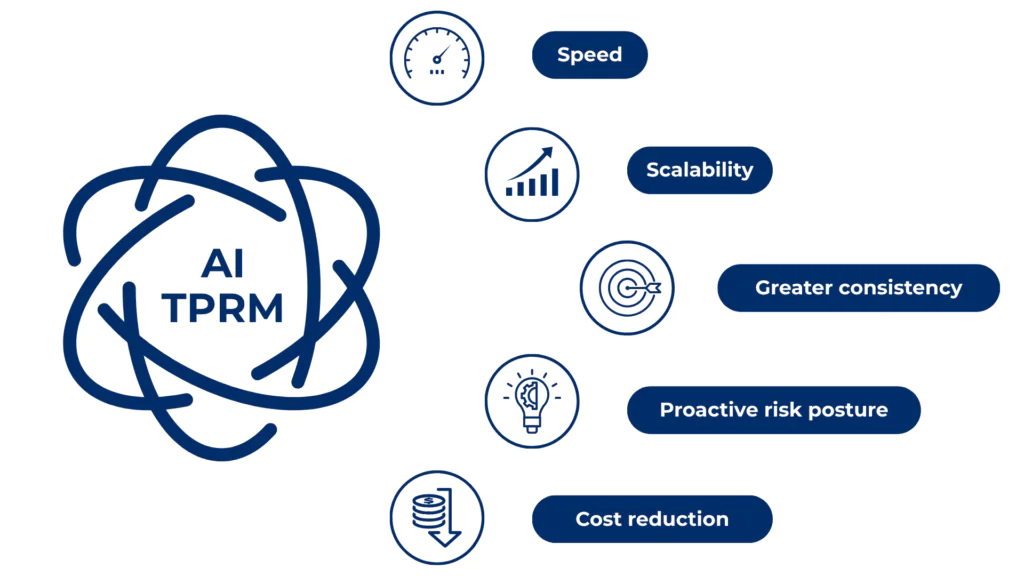
Benefits of AI-driven TPRM
AI is changing how organizations approach third-party risk by making TPRM programs more efficient and easier to manage as vendor ecosystems grow. By reducing reliance on manual processes, teams can strengthen oversight while focusing their time and resources on the risks that require the most attention. Here are the key benefits of using AI in TPRM:
Speed
Manual vendor reviews often stall while analysts score questionnaires, review documents, and follow up with vendors for missing information. AI accelerates these tasks by automating risk scoring, document analysis, and workflow management, helping teams complete vendor assessments faster. Faster reviews shorten onboarding cycles and help the business engage new vendors without unnecessary delays.
Scalability
Manual TPRM programs become increasingly difficult to manage as vendor ecosystems grow because every new supplier adds more review work. AI vendor risk management allows organizations to assess and monitor a growing number of vendors without requiring a proportional increase in headcount. By automating repetitive assessment and monitoring tasks, teams can expand their TPRM programs while maintaining consistent oversight.
Greater consistency
Human expertise remains essential for evaluating complex risks, but manual reviews can vary depending on workload, experience, or reviewer judgment. AI applies the same scoring logic across every vendor assessment, consistently identifies missing evidence, and highlights potential compliance gaps. The result is more consistent risk assessments and a stronger foundation for comparing vendors across the organization.
Proactive risk posture
Traditional assessments provide a snapshot of vendor risk at a single point in time. AI combines continuous monitoring with predictive analytics to identify emerging issues, such as newly disclosed breaches, deteriorating security posture, or compliance changes, before they become business disruptions. This supports continuous compliance by helping teams identify and address vendor risks as they emerge rather than waiting for the next scheduled assessment.
Cost reduction
Manual TPRM requires significant time for vendor intake, document reviews, evidence collection, follow-up requests, and reporting. By automating much of this work, AI reduces administrative effort and enables security and compliance teams to support more vendors with the same resources. Reducing administrative work can lower the operational cost of TPRM while helping teams dedicate more resources to identifying, assessing, and addressing higher-priority risks.
AI-native GRC for how teams work today.
Challenges and best practices for adopting AI in TPRM
Introducing AI into third-party risk management requires more than simply adopting new technology. Organizations need the right processes and oversight to use it effectively. Here are the key challenges and best practices to consider:
Data quality and integration
AI is only as effective as the data it receives. Many organizations rely on fragmented systems and self-reported vendor information, making incomplete or inconsistent data a common challenge. In AI-powered TPRM, poor-quality inputs can produce unreliable risk scores and insights.
The best approach is to begin with high-volume, low-judgment tasks such as data collection, document classification, and questionnaire pre-filling. AI-generated results should be validated against reliable sources, such as security ratings, threat intelligence, public filings, and audit reports, rather than relying solely on vendor-submitted information.
Explainability
Risk scores are only useful if teams can explain how they were generated. Limited model transparency can create challenges when security teams need to justify why a vendor was rejected, placed under remediation, or removed from the supply chain. While AI increases speed, organizations also need audit-ready reasoning that can withstand scrutiny from executives, auditors, regulators, and boards.
When evaluating AI TPRM solutions, prioritize platforms that provide transparent scoring methodologies and map risk assessments to recognized frameworks such as NIST CSF and ISO 27001. Clear scoring logic creates a defensible link between supporting evidence, identified risks, and final decisions.
Change management
Adopting AI compliance tools alone will not modernize a TPRM program. Organizations also need updated workflows, clear ownership, and training so security, procurement, legal, and compliance teams understand how AI fits into existing processes. Without these changes, AI risks becoming another disconnected tool rather than an operational improvement.
The most successful programs keep humans in the loop for relationship management, exception handling, and formal risk acceptance while allowing AI to automate repetitive, evidence-heavy tasks. This balance preserves human judgment where context matters most while enabling teams to scale vendor reviews more efficiently.
The future of AI in third-party risk management
Third-party risk management is moving beyond periodic assessments toward continuous, actionable risk intelligence. The use of AI in third-party risk management is making it easier to turn complex vendor data into clear risk summaries, audit narratives, and actionable insights, helping security teams communicate emerging risks to executives with less manual reporting.
The next step is deeper integration between AI TPRM and AI GRC platforms. As these systems become more connected, organizations can map vendor risks to controls and requirements across multiple frameworks in real time. Instead of managing third-party risk separately, teams can gain a more complete view of how each vendor affects cybersecurity, privacy, compliance, and operational resilience across the business.
The scope of monitoring is also likely to expand beyond cybersecurity, incorporating signals related to financial stability, ESG, regulatory exposure, and operational resilience. Agentic AI could take this further by identifying fourth-party and nth-party dependencies, revealing risks deeper in the supply chain that traditional vendor assessments may not capture. Together, these capabilities point toward a more proactive approach to TPRM, where organizations continuously identify, assess, and respond to changing third-party risks rather than waiting for the next scheduled review.



How Scytale simplifies AI-powered TPRM
Scytale is an AI GRC platform that brings automated vendor risk assessments, continuous monitoring, and compliance management into one system. Instead of managing third-party risk across spreadsheets and disconnected tools, teams get a centralized view of vendor risk alongside their broader compliance program.
Automated risk scoring and alerts help teams prioritize higher-risk vendors faster, while continuous monitoring provides visibility between assessments. Scytale also combines automation with human GRC experts who help interpret findings, manage exceptions, and support risk decisions when context matters. The result is less manual work, clearer oversight, and a TPRM program that scales with your vendor ecosystem.
FAQs about AI TPRM
How does AI TPRM differ from traditional third-party risk management?
AI TPRM uses machine learning, NLP, and workflow automation to speed vendor assessments, monitoring, and reporting. Traditional third-party risk management relies more heavily on questionnaires, spreadsheets, and periodic reviews. The main difference is continuous, data-driven analysis instead of point-in-time oversight, while human teams still own final risk decisions.
What are the top AI use cases in third-party risk management?
The top AI use cases in third-party risk management include automated risk scoring, continuous monitoring, document review, predictive modeling, and workflow orchestration. Each one addresses a specific bottleneck in vendor oversight. Together, they help teams review more vendors, catch issues earlier, and keep reporting current without a proportional increase in manual work.
Can AI replace human analysts in vendor risk assessments?
No, AI should not replace human analysts in vendor risk assessments. It handles repetitive review work well, though people still need to manage exceptions, vendor relationships, and formal risk acceptance. Top AI GRC platforms like Scytale follow this approach by combining AI-powered automation with human GRC experts who help teams interpret findings and make informed risk decisions.
What are the biggest risks of using AI in TPRM?
The biggest risks of using AI in TPRM are poor input data, weak integration, and black-box scoring logic. If the model relies on incomplete or self-reported data alone, the output becomes less trustworthy. Teams also need explainable reasoning so they can clearly understand and justify vendor risk scores and decisions.
How do I get started implementing AI in my TPRM program?
Start by applying AI to high-volume, low-judgment tasks such as questionnaire pre-fill, evidence gathering, and initial scoring. Then validate outputs against multiple data sources and keep humans involved in final decisions. Scytale’s AI GRC platform supports this approach by combining automation, continuous monitoring, and expert guidance within a centralized compliance platform.