


TL;DR: GRC implementation
- A structured GRC program integrates governance, risk management, and compliance into a unified framework.
- It centralizes policies, controls, and risks, offering real-time visibility and increasing operational efficiency.
- Key steps for implementing a successful GRC program include defining objectives, assessing the current GRC state, and selecting the right GRC platform.
- Continuous monitoring ensures proactive GRC management, enabling continuous compliance tracking and minimizing risk exposure.
- Scytale’s AI-powered platform automates critical GRC processes, streamlining implementation and ensuring effective GRC program management.
As security and compliance expectations grow and technology environments expand, ad-hoc governance, risk, and compliance practices no longer scale. Many organizations track controls in separate tools, store policies in multiple places, and collect evidence manually. Audit preparation takes significant effort, control performance is difficult to monitor, and leadership faces uncertainty when reviewing audit reports.
A structured Governance, Risk, and Compliance (GRC) program closes these gaps. With a coordinated framework, your organization centralizes policies, assigns ownership, monitors controls throughout the year, and maintains continuous compliance. For mid-market and enterprise SaaS organizations, this approach reduces duplicated work, strengthens risk oversight, and supports confident reporting to boards, customers, partners, and investors. In this comprehensive guide, we’ll walk you through the key steps to building a successful GRC program.
What is a GRC program?
A GRC program integrates governance, risk management, and compliance into a single operating framework across your organization. The three pillars work together to create consistent oversight and enhanced control across the business:
- Governance: Defines accountability, decision processes, and policy direction across teams.
- Risk Management: Identifies and tracks operational, cybersecurity, vendor, and financial reporting risks, with clear ownership and mitigation plans to help prevent incidents such as cyberattacks.
- Compliance: Ensures controls meet compliance, regulatory, and contractual requirements across frameworks such as SOC 2, ISO 27001, HIPAA, and GDPR as well as SOX ITGC.
By aligning these functions under one strategy, a GRC program replaces siloed efforts with consistent standards and stronger oversight of enterprise risk and IT governance. It connects policies, controls, systems, and reporting to give leadership a clear view of risk exposure and control performance.
6 signs your organization needs a GRC program
Managing risk and compliance can be challenging as organizations expand. An effective GRC program streamlines these processes, enhancing efficiency and providing always-on visibility. Here are a few signs your organization may need one:
1. Audit findings piling up
Recurring audit findings signal gaps in internal controls, documentation, or policy enforcement. Without a coordinated GRC framework, remediation slows down and the same issues resurface in future audits, increasing operational risk and audit effort.
2. Siloed risk data
When risk is spread across departments and tools, leadership lacks a clear view of enterprise risk exposure. Fragmented risk management leads to missed cross-functional risks and slower decision-making. Centralized GRC oversight provides a single source of truth for risk tracking and reporting.
3. Inconsistent policies across teams
Different departments operating under different policies create confusion and increase non-compliance risk. Standardized governance policies improve clarity, accountability, and consistent control execution across the organization.
4. Scaling challenges
As organizations expand across regions, systems, and business units, risk management and compliance requirements increase in complexity. Without a scalable framework and a clear risk management strategy, teams struggle to maintain oversight, keep pace with regulatory changes, and manage control performance across the organization.
5. Customer security questionnaire overload
High volumes of customer due diligence requests and security questionnaires often expose gaps in documentation and evidence management. Manual responses consume security and compliance resources and slow sales cycles. Centralized control tracking and evidence management improve response speed and consistency.
6. Upcoming regulatory deadlines
Frequent deadline pressure indicates weak visibility into control readiness and reporting status. Reactive preparation increases audit risk and executive uncertainty. Continuous security monitoring and structured reporting ensure continuous compliance with critical frameworks and regulations, while supporting confident sign-offs.

Prerequisites for GRC implementation
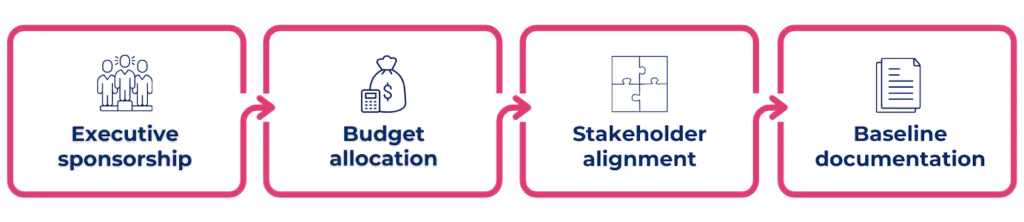
Implementing a successful GRC program requires careful planning and coordination across various aspects of the organization. Ensuring the right support, resources, and alignment will pave the way for an effective and sustainable framework. Let’s have a closer look at the essential prerequisites for successful GRC implementation.
Executive sponsorship
Executive sponsorship is fundamental to a strong GRC program. Without clear leadership support, resources, authority, and organizational focus remain limited. Senior leaders should drive the initiative, communicate its importance across the organization, and support adoption through governance oversight and regular review.
Budget allocation
A defined budget supports effective GRC implementation. Funding should cover technology platforms, personnel, training, and external advisory services. Appropriate budgeting ensures the program remains scalable, sustainable, and aligned with long-term risk management goals.
Cross-functional stakeholder alignment
GRC requires coordination across IT, legal, finance, operations, and human resources. Stakeholders must understand program objectives and collaborate on control design, policy enforcement, and reporting. Cross-functional alignment prevents siloed processes and supports consistent compliance management across the organization.
Baseline documentation of current state
Before implementation, your organization should document its current governance, risk, and compliance framework. This includes existing policies, data security controls, systems, and workflows. A clear baseline highlights gaps, supports prioritization, and establishes the foundation for an effective GRC strategy.
Step-by-step guide to implementing a GRC program
Successfully implementing a GRC program requires a structured, step-by-step approach to ensure alignment with organizational goals and efficient risk management. Each stage builds upon the previous one, ensuring continuous improvement and adherence to compliance requirements.
Here are the essential steps to successfully implement a high-impact GRC program:
Step 1: Define your GRC objectives and scope
The first step in implementing a GRC program is defining your objectives, such as improving risk management, enhancing compliance processes, or meeting regulatory requirements. Establish the scope by selecting relevant standards such as SOC 2 or ISO 27001 and determining which business units or risk domains to cover. Setting these boundaries ensures a focused GRC program aligned with organizational priorities.
Step 2: Assess your current GRC state
Before moving forward, assess where your organization stands in terms of governance, risk, and compliance. Conduct a gap analysis against your target security and privacy frameworks and identify existing weaknesses. Document your current policies, controls, and tools to determine what’s working well and what requires improvement. This baseline will give you the insights needed to prioritize actions and allocate resources efficiently.
Step 3: Build your GRC team
Building a dedicated GRC team is crucial for successful implementation. Clearly define roles and responsibilities, including a CISO for security, a compliance manager for compliance requirements, and a risk owner for risk assessment. Ensure cross-functional liaisons are in place to facilitate communication and alignment across departments.
Step 4: Select your GRC platform
Manual approaches to managing GRC don’t scale as your organization grows. Selecting the right GRC tool is essential to ensure efficiency and long-term success. When evaluating GRC software, look for features that streamline compliance monitoring, automate evidence collection and management, and support risk management. Scytale’s AI-driven automation platform integrates these capabilities into a seamless workflow, ensuring scalability and continuous compliance.
Step 5: Map controls to frameworks
Control mapping involves creating a unified set of controls that address the requirements of security and privacy frameworks. This approach eliminates duplicate efforts, increases efficiency, and ensures a streamlined compliance process, allowing you to manage risk effectively across various standards with consistency and ease.
Step 6: Implement GRC policies and procedures
With controls mapped, implement the policies and procedures that govern your GRC program. Document them clearly, aligning with risk management goals and compliance requirements. Communicate to relevant stakeholders and train employees to ensure adherence, maintaining a compliant, security-conscious culture across the organization.
Step 7: Establish risk assessment processes
Risk management begins with identifying, scoring, and treating risks. Define your risk identification process, ensuring it’s comprehensive and captures all relevant risks across business units. Establish workflows for scoring to prioritize actions by severity, and implement treatment plans with clear risk mitigation actions, timelines, and owners to address issues before they impact operations.
Step 8: Set up GRC continuous monitoring
Transitioning from point-in-time audits to continuous monitoring enables your organization to stay ahead of compliance and risk management needs. Implement automated systems to collect evidence and track your security and compliance posture, helping identify issues before they escalate and ensuring your GRC program remains current and effective.
Step 9: Prepare for GRC audits
Audit readiness is a key component of any GRC program. Regularly review your compliance evidence and ensure it’s well-organized and accessible. Work with auditors to define expectations and align your compliance documentation with their requirements. Maintaining accurate and up-to-date records throughout the year ensures a seamless audit preparation process, minimizing stress and maximizing efficiency for effective compliance management.
Step 10: Measure and improve your GRC program
The final step is measuring the success of your GRC program and making improvements. Define key GRC metrics, such as audit findings, risk mitigation effectiveness, and time-to-compliance to evaluate performance and identify areas for improvement. Regular refinement ensures your organization remains compliant and risk-aware over the long term.
By following these 10 steps in the GRC implementation checklist, you’ll establish a solid foundation for a successful GRC program. This approach ensures your organization maintains compliance, optimizes risk management, and is strategically positioned for ongoing improvement.
Get Compliant 90% Faster
Common GRC implementation mistakes to avoid
GRC implementation requires careful planning and execution to avoid common pitfalls. Below are key mistakes to avoid, along with valuable strategies to ensure a more successful and sustainable implementation process:
| Mistake | Description | Recommended solution |
| Treating GRC as an IT-only project | Programs stall when ownership sits with IT alone. Governance, risk, and internal controls need input from finance, legal, HR, and operations. | Involve leaders across departments early. Assign cross-functional roles so policies and controls reflect real business processes. |
| Underestimating change management | Teams resist new controls and workflows. Adoption drops and teams create workarounds. | Plan training, communication, and feedback loops from the start. Assign change champions and track adoption as a GRC metric. |
| Choosing tools before defining requirements | Teams invest in software without clear workflows or compliance reporting needs. This leads to rework and low platform usage. | Define workflows, control ownership, compliance goals, and integrations first. Select technology that supports those requirements. |
| Ignoring risk in favor of compliance-only focus | Focusing only on compliance can overlook emerging risks and vulnerabilities that don’t fit into existing frameworks. | Balance risk management with compliance goals, focusing on proactive risk identification and meeting compliance requirements. |
How long does GRC implementation take?
The timeline for GRC implementation depends on several factors, including the scope, number of frameworks, system complexity, and team availability. Here’s an overview of typical implementation periods:
- Focused Program (Single Business Unit): 8 to 12 weeks
- Enterprise-Wide Program (Multiple Regions & Frameworks): 4 to 9 months
- Faster Programs: Projects with strong ownership, clear data sources, and executive support tend to progress more quickly.
Compliance software can significantly shorten implementation timelines by centralizing control monitoring, automating evidence collection, and providing leadership with real-time visibility into GRC posture. Scytale provides GRC software for multiple frameworks, including SOC 2, ISO 27001, and SOX ITGC, streamlining your path to effective GRC management. With the ability to accelerate compliance processes by up to 90% faster, teams can establish a sustainable GRC framework for the long term.

How Scytale supports GRC implementation
Scytale’s AI-powered compliance automation platform, supported by expert guidance and the innovative AI GRC agent, Scy, helps organizations implement and manage their GRC programs more efficiently, with improved speed and accuracy. The platform centralizes policies, controls, risks, and evidence into a comprehensive, AI-driven hub, providing real-time visibility and streamlined management across multiple frameworks.
By automating critical compliance processes and continuously monitoring your organization’s security and compliance posture, Scytale ensures your business remains audit-ready and compliant. With tailored support from Scytale’s team of GRC experts, your team will receive the guidance needed to define scope, optimize controls, and maintain ongoing compliance. This integration of AI-driven automation and expert insight not only accelerates GRC implementation but also streamlines management, enabling your team to focus on strategic priorities and operate at an elevated level of efficiency and effectiveness.
FAQs about GRC implementation
What’s the biggest challenge in GRC implementation?
The biggest challenge often lies in organizational alignment and change management. GRC spans multiple teams with varying priorities and workflows. Successful GRC programs are driven by leadership that sets clear direction, assigns ownership, and supports new processes with training and accountability across the organization.
Should we hire a consultant for GRC implementation?
The decision largely depends on your organization’s internal expertise and available resources. If your team has a strong security posture and experienced legal and audit professionals, you may be able to handle GRC implementation internally. Alternatively, leveraging compliance automation platforms like Scytale can streamline the process, offering built-in guidance from expert GRC advisors, and eliminating the need for external consultants. This approach helps you maintain control while benefiting from expert insights and AI-driven automated support.
Can we implement GRC without software?
While it’s possible to implement GRC without software, it becomes increasingly challenging as your company scales and the GRC requirements become more complex. In the early stages, teams may rely on documents and spreadsheets, especially in smaller environments. However, as the scope and complexity grow, manual tracking can lead to version control issues, missed reviews, and audit delays. Dedicated GRC platforms centralize controls, evidence, and reporting, helping teams stay audit-ready while reducing the risk of errors and ensuring compliance as your organization expands.
How do we measure GRC program success?
GRC program success is measured through key metrics that reflect its effectiveness and alignment with business objectives. These include a reduction in audit findings, shorter audit cycles, fewer high-risk items, faster evidence collection, and improved executive visibility into risk, security, and compliance posture. These metrics provide a clear view of how well the GRC program manages risk, enhances operational efficiency, and supports the organization in maintaining compliance within acceptable levels.
