


TL;DR: GRC platforms for compliance teams
- Many GRC platforms promise broad capabilities but often introduce complexity through inefficient interfaces, unreliable automation, and integration challenges.
- Compliance teams need automation that reduces manual work and improves efficiency across GRC processes.
- Seamless integrations, transparent audit trails, and real-time visibility are essential for accountability and audit readiness.
- An effective GRC solution should be easy to adopt, supported by experts, and scalable as compliance needs evolve.
- Leading GRC platforms like Scytale streamline GRC processes with seamless integrations, AI-driven automation, and multi-framework support, helping teams manage compliance programs more efficiently.
Evaluating top GRC platforms can be a challenging process for compliance teams of any size. With each vendor claiming to be the best, it’s easy to get lost in feature comparison charts that often appear nearly identical. While platforms highlight automation, risk management, and reporting, these features don’t always address the specific needs of compliance teams. The real challenges often get overlooked in favor of marketing language that emphasizes theoretical benefits over practical application.
As compliance requirements become stricter, the demand for more efficient GRC platforms continues to rise. By 2031, the GRC platform market is projected to reach USD 92.68 billion, as organizations increasingly see these platforms as essential assets for managing compliance. With the surge in demand, choosing a platform that matches both current and future needs has never been more important.
Let’s explore what compliance teams need from GRC platforms in 2026, focusing on the tools that truly make a difference.
The problem with most GRC platforms
Many Governance, Risk and Compliance (GRC) platforms promise broad capabilities, but their actual use often leads to frustration. Below are some common issues that contribute to inefficiency:
Vast capabilities, limited impact
While GRC platforms often advertise extensive functionality, they frequently fall short in practice, complicating workflows rather than simplifying them. Teams end up managing more tasks than expected, adding friction and slowing progress.
Complex interfaces and workarounds
Instead of providing intuitive automation, many platforms feature interfaces that require constant workarounds. Users spend more time navigating the platform than completing their tasks, creating inefficiency and undermining the platform’s intended benefits.
Unfulfilled automation expectations
Automation is often marketed as a time-saving feature, yet it can do the opposite. Instead of seamless automation, teams often spend time troubleshooting and fixing broken processes, creating more work that the platform was supposed to eliminate.
Increased complexity and time lost
The gap between marketing claims and actual platform performance leads to significant inefficiencies. Teams often spend more time addressing integration issues or adapting to an inflexible platform, preventing them from focusing on high-priority tasks.
Lack of scalability
Many GRC tools struggle to support growing security and compliance demands. When GRC requirements become more complex, platforms that lack flexibility create bottlenecks, resulting in inefficiencies and additional costs.
AI-native GRC for how teams work today.
What compliance teams actually need
Automation that works without babysitting
Automation should operate smoothly in the background, handling key tasks like evidence collection and control monitoring with minimal manual input. If your team is frequently fixing broken integrations or manually triggering automation, the platform isn’t delivering the promised efficiency. An effective GRC solution should eliminate manual tasks, allowing the team to focus on higher-priority responsibilities.
Integrations with the tools you already use
Your compliance software needs to integrate seamlessly with existing systems such as cloud providers, HR platforms, and identity management tools. Poor integration forces unnecessary custom development and continuous maintenance. A well-designed platform fits into your existing stack without adding complexity and offers the ability to create custom integrations, allowing your team to connect new systems as your environment grows.
Unified multi-framework support
Mapping controls across multiple frameworks should be automated, not a manual and time-consuming task. For compliance teams handling security and privacy frameworks like SOC 2, ISO 27001, HIPAA, or SOX ITGC, a platform that unifies this process reduces redundant efforts and ensures consistent tracking and reporting.
Clear ownership and accountability
A GRC platform should provide clear control ownership and track task completion for each responsibility. Many solutions fail to clearly define GRC responsibilities and ownership, leading to confusion and missed deadlines. A strong platform ensures leadership has full visibility into roles, progress, and deadlines.
Audit readiness you can actually see
Audit readiness should be clearly visible through real-time dashboards that highlight compliance gaps, overdue tasks, and evidence status. Meaningful insights into compliance status are far more valuable than vanity metrics.
Policies and compliance documentation that stay current
Effective policy management ensures compliance documentation remains accurate and up to date. The platform should support version control, distribution, and acknowledgment tracking to keep policies organized and accessible, ideally with customized templates tailored to your organization’s needs.
GRC support that understands compliance
The support team should have a deep understanding of compliance frameworks and industry nuances, not just technical guidance of the platform. When issues arise, your team needs quick, guided support to avoid disruptions. Expert support ensures the platform supports your compliance program and organizational goals.



How GRC platforms enable continuous compliance
Continuous compliance integrates compliance management into daily operations rather than treating it as a periodic audit preparation exercise. Top GRC tools support this approach by centralizing controls, policies, and documentation, giving organizations a consistent view of their compliance posture throughout the year.
By maintaining up-to-date control status and evidence, teams reduce the need for large, last-minute audit preparation efforts. This structure also improves governance by clearly documenting responsibilities, tracking compliance activities, and creating a reliable record of how controls operate over time.
Continuous compliance also strengthens oversight across the organization. Leadership gains clearer visibility into risk and compliance progress, and organizations can easily showcase their security posture through a Trust Center that provides customers and partners with access to key security and compliance documentation.
Questions to ask during a GRC platform evaluation
These questions provide a foundation for productive discussions during your GRC platform evaluation, ensuring the solution meets your team’s needs and expectations. They will help guide your assessment and determine if the GRC platform is the right fit for your SaaS organization.
- How do you handle multi-framework control mapping?
Understand how the platform automates mapping controls across multiple frameworks, like SOC 2, ISO 27001, and HIPAA. This will help reduce redundancy and streamline your continuous compliance efforts.
- What happens when an integration breaks?
Ask how the platform addresses integration issues and the typical resolution time. This will give you insight into the platform’s reliability and the vendor’s level of support.
- How long does onboarding take?
Inquire about the onboarding timeline and available resources to ensure a smooth transition. Efficient onboarding can minimize disruptions during platform setup.
- What does continuous support look like?
Clarify the type of support offered once the platform is live. Ensure it meets your needs for continued success and assistance with complex compliance requirements.
- Can the platform integrate with our existing tools?
Confirm that the platform integrates with your existing tech stack to reduce development and maintenance effort. Also check whether it supports custom integrations, which is a major benefit as your environment grows.
- How does the platform ensure audit readiness?
Inquire about the platform’s approach to maintaining audit readiness at all times. Look for real-time dashboards that provide full visibility into task completion and compliance status to help maintain ongoing audit readiness.
Streamline GRC workflows with seamless automation.
Red flags when evaluating GRC platforms
Vague answers about integrations
A platform that cannot provide clear answers regarding integration capabilities is a red flag. To ensure smooth operation, the platform should integrate effortlessly with your existing systems, without requiring custom development or continuous maintenance. A lack of clarity signals potential compatibility issues, leading to disruptions and heightened GRC risk management concerns.
Long implementation timelines
If a platform has extended implementation timelines, it could signal a lack of flexibility or excessive complexity. A GRC platform should be easy to set up with clear goals. Delays may indicate resource or usability issues, impacting GRC metrics and overall performance.
No clear audit trail for evidence
A GRC platform without an accessible and well-maintained audit trail for evidence is a risk. Without such a feature, tracking changes, approvals, and the status of evidence becomes difficult, increasing the likelihood of missed documentation and compliance gaps during audits.
Pricing that scales unpredictably
Uncertain or fluctuating pricing can lead to unexpected costs as your organization grows or needs change. A reliable GRC program should include clear, flexible, and scalable pricing models that help you predict expenses as your compliance requirements change and prevent unexpected budget increases.
| Red flag | Potential issue | Impact on team |
| Vague answers about integrations | Difficulty integrating with existing systems. | Causes disruptions and ongoing technical issues. |
| Long implementation timelines | Extended setup periods or unclear onboarding. | Delays value realization and frustrates the team. |
| No clear audit trail for evidence | Lack of transparency in tracking evidence. | Increases risk and reduces accountability during audits. |
| Pricing that scales unpredictably | Unclear or inconsistent pricing. | Leads to budget uncertainty and unexpected costs. |
How team size and maturity affect platform choice
As your compliance team grows, so will its compliance automation platform requirements. Whether you’re leading a small team or managing an expansive GRC department, the right platform depends on your team’s current size and anticipated growth.
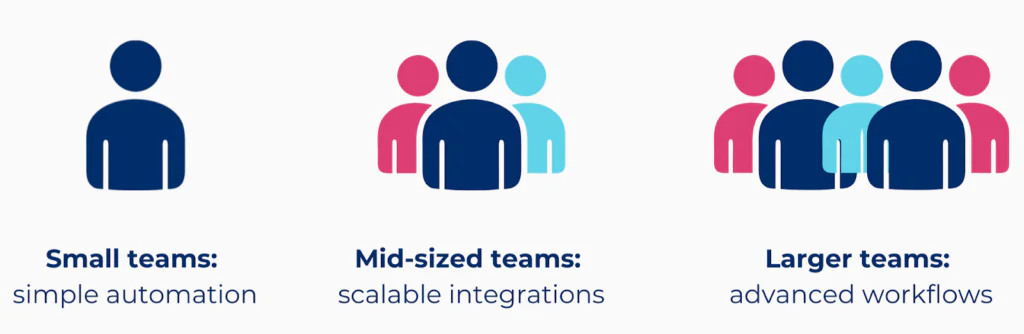
Small teams:
Smaller teams need a platform that’s intuitive and simple. The focus should be on solutions that automate routine tasks, provide basic compliance reporting, and are cost-effective without unnecessary complexity.
Mid-sized teams:
As your team grows, the need for a platform with scalability and advanced integrations becomes critical. Look for tools that support multi-framework compliance management, allow granular control over tasks, and offer customizable reporting to meet evolving needs.
Large teams:
Larger teams with more than a 20-person GRC department require a platform capable of handling complex workflows, multiple frameworks, and deep integrations with other organizational systems. Key features like advanced evidence collection, greater customization options, and comprehensive reporting are key to maintaining control and operational efficiency.
How Scytale’s GRC platform supports modern compliance teams
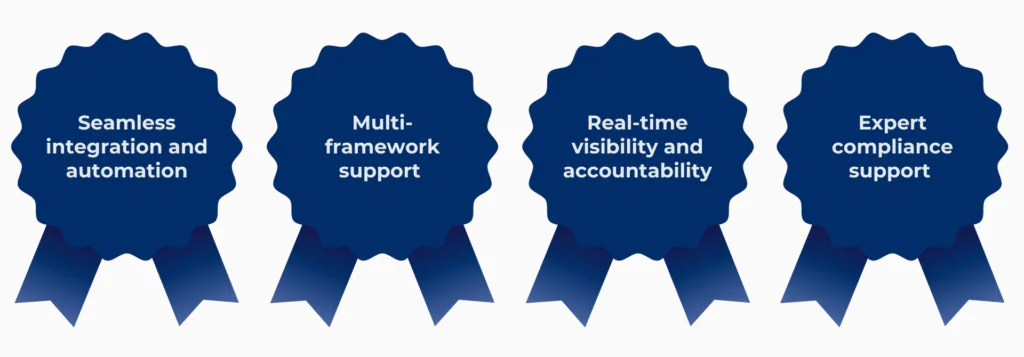
Scytale supports modern compliance teams by simplifying GRC operations and reducing manual coordination across systems, teams, and frameworks. The AI-driven platform integrates with tools such as cloud providers, HR systems, and ticketing platforms, allowing compliance processes to align with existing workflows. Automation of critical tasks such as evidence collection and control monitoring reduces operational effort and allows teams to focus on higher-value tasks.
The platform also enables organizations to manage multiple frameworks within a unified GRC program. Automated control mapping across key standards such as SOC 2, ISO 27001, HIPAA, and GDPR reduces duplicate work and simplifies framework management. Real-time dashboards provide full visibility into audit readiness, task progress, and evidence status, helping teams maintain oversight and accountability across their compliance program.
Beyond automation, Scytale provides tailored support from GRC experts who guide organizations throughout their compliance journey, along with Scy, an AI GRC agent that reviews evidence, identifies gaps, and recommends next steps to help teams maintain a structured and reliable approach to GRC management.
FAQs about choosing a GRC platform
What’s the most common regret teams have after choosing a GRC platform?
The most common regret is selecting a platform that is difficult to integrate with existing systems or requires manual intervention. Teams often find that the GRC platform doesn’t automate as expected or lacks the scalability they require.
How long should GRC platform onboarding take?
Onboarding should take no more than a few weeks, depending on the complexity of the platform. Leading GRC platforms like Scytale, which combine AI-driven automation with dedicated GRC expert guidance, can help streamline the process and reduce disruption to day-to-day operations.
Should we prioritize features or support when choosing a platform?
While features are important, support should also be a high priority. A GRC platform with responsive, expert guidance ensures that your team can overcome challenges, especially with integrations or complex compliance requirements.
Can we switch GRC platforms later if we outgrow one?
Yes, you can switch platforms as your needs change. However, this can be complex and time-consuming. It’s crucial to choose a GRC platform that can scale with your organization, allowing a smoother transition to a more advanced solution when necessary.
