Policy management is the process of creating, maintaining, distributing, and tracking the policies that govern how an organization operates. It helps organizations communicate expectations, demonstrate compliance, and maintain accountability across the organization.
What Is Policy Management?
Policy management provides organizations with a structured approach to governing thepoliciesthat support security, compliance, and business operations. It helps ensure employees have access to current guidance, establishes accountability for policy ownership, and promotes consistent policy oversight across the organization. As Governance, Risk, and Compliance (GRC) requirements become more complex, effective policy management helps organizations maintain consistency and strengthen accountability.
The policy management process typically involves:
Drafting, reviewing, and approving policies before they are published.
Distributing policies to employees and collecting acknowledgments to create an auditable record.
Maintaining version control and regularly reviewing policies to reflect changes in regulations, business operations, and emerging risks.
As a result, policy management is an ongoing process that helps organizations improve governance, reduce risk, and ensure employees are working from the most current guidance available.
Streamline GRC workflows with no blind spots.
Why Does Policy Management Matter for Compliance?
Policy management plays a critical role in achieving and maintaining continuous compliance. Most compliance frameworks and regulations require organizations to maintain documented policies governing security, privacy, risk, and operational processes. Here are some of the key reasons it matters:
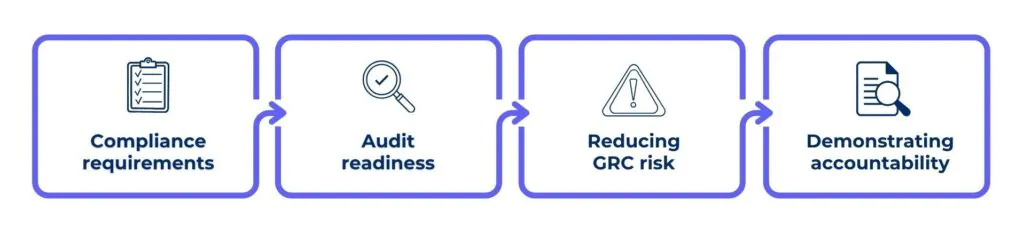
Compliance requirements
Documented policies are a foundational requirement across most compliance frameworks. They provide evidence that an organization has formally established procedures for managing security, privacy, and operational risks and communicating them across the organization.
Audit readiness
Auditors do not simply verify that policies exist. They also assess whether policies are current, approved, communicated to employees, and consistently followed in practice. Organizations are often required to provide evidence of policy reviews, version history, and employee acknowledgments during audits.
Reducing GRC risk
Poor policy management is one of the most common causes of audit findings and can undermine an organization’s broader risk management strategy. Outdated policies, missing approvals, inconsistent communication, or a lack of employee acknowledgment can create compliance gaps even when technical controls are functioning effectively.
Demonstrating accountability
A structured policy management process helps organizations demonstrate accountability and governance maturity. Regular policy reviews, documented approvals, and acknowledgment tracking provide clear evidence that compliance requirements are being actively managed as regulations and business needs change.
AI-native GRC for how teams work today.
What Policies Do Compliance Frameworks Require?
Most compliance frameworks require organizations to maintain documented policies that define how security, privacy, and operational activities are managed. While specific requirements vary by framework, the following policy categories are among the most commonly required:
1. Acceptable use policies
Acceptable use policies define how employees can access and use company systems, devices, applications, and data. These policies help reduce security risks by establishing clear expectations for responsible technology use.
2. Access control policies
Access control policies govern how users are granted, modified, and removed from systems and applications. They help organizations enforce least-privilege access and protect sensitive information from unauthorized access.
3. Security management and data classification policies
Security management policies outline the organization’s overall approach to protecting information assets. Data classification policies establish how different types of information should be categorized, handled, stored, and shared.
4. Incident response policies
Incident response policies define how security incidents are identified, reported, investigated, and resolved. These policies help organizations respond consistently and minimize the impact of security events.
5. Vendor management policies
Vendor management policies establish requirements for evaluating, onboarding, monitoring, and reviewing third-party service providers. They help organizations manage risks associated with external vendors that have access to systems or sensitive data.
6. Business continuity and disaster recovery policies
Business continuity and disaster recovery policies outline how critical operations will continue during disruptions and how systems will be restored following an incident. These policies help organizations maintain resilience and minimize downtime.
What Is Policy Management Software?
Policy management software is a common component of modern GRC tools, helping organizations create, distribute, maintain, and track policies from a centralized platform. Instead of storing policies across shared folders, email threads, or Google Docs, teams can manage the entire policy lifecycle in a single system with clear ownership and approval workflows.
Most policy management solutions include features such as centralized policy libraries, version control, automated policy distribution, employee acknowledgment tracking, and review reminders. These capabilities help ensure employees always have access to the latest approved policies and provide administrators with visibility into policy adoption and compliance.
Policy management software also creates audit-ready records by maintaining documentation of approvals, updates, reviews, and employee acknowledgments. This makes it easier to demonstrate compliance during audits while reducing the administrative burden associated with managing policies manually.
Scytale brings policy management into a unified AI GRC platform, helping organizations connect policies to controls, risks, audits, and compliance frameworks. AI-powered workflows help teams maintain consistency across their GRC program while reducing the operational burden of managing policies manually.
By combining automation, multi-framework governance, and expert GRC support, Scytale enables organizations to scale policy management as compliance requirements increase. The result is a more scalable and efficient approach to governance, risk, and compliance.