










TL;DR: AI governance software
- AI governance software helps enterprises manage AI risk, policy enforcement, model oversight, and evidence across the AI lifecycle.
- The strongest platforms connect AI governance work to broader compliance, security, and data governance programs.
- Enterprises should evaluate governance scope, framework support, workflow depth, and fit for technical and non-technical teams.
- Scytale’s AI GRC platform stands out for teams that want AI governance inside a wider compliance program instead of in a separate point solution.
- The right platform depends on whether your main priority is model operations, data governance, privacy, or cross-framework compliance.
Enterprise AI programs introduce new governance challenges as organizations expand their use of artificial intelligence. With internal models, AI copilots, and third-party AI services operating across multiple departments, maintaining accountability and consistent oversight becomes increasingly complex. Without a structured approach, businesses risk losing visibility into how AI is used, who is responsible for decisions, and whether their practices align with evolving regulatory expectations.
As demand for AI governance grows, so does the range of software available to support it. From specialized AI governance solutions to privacy-focused suites and broader GRC software, each offers different capabilities and approaches to managing AI-related risks. In this article, we explore what AI governance software does, the key features to consider, and how seven leading platforms compare to help you find the right solution for your organization.
Best AI Governance Software
- Scytale
- IBM watsonx.governance
- ModelOp
- Collibra AI Governance
- Deeploy
- LogicGate
- OneTrust
What is AI governance software?
AI governance software is a platform that helps organizations control how AI systems are approved, documented, monitored, and reviewed through policy management, risk assessment, approval workflows, and framework mapping.
AI governance software gives enterprises one operating layer for policy, risk, oversight, and evidence across every AI system the business builds or buys. It replaces scattered spreadsheets and email approvals with repeatable workflows, which becomes essential as generative AI governance extends oversight to copilots, chat assistants, and AI features embedded in vendor products.
Unlike traditional GRC platforms, which manage control libraries, audits, and enterprise risk registers, an AI governance platform focuses on model behavior, training data lineage, explainability, human review, and lifecycle controls. These needs sit closer to product, data science, legal, and procurement teams, so the strongest tools connect AI-specific oversight to the existing compliance program rather than running it as a separate track.
Streamline GRC workflows with no blind spots.
Key features to look for
Enterprise buyers need AI governance software that addresses real AI risks rather than generic compliance workflows. According to McKinsey, 78 percent of organizations now use AI in at least one business function, making effective governance essential for both internal AI models and third-party services. Here are the key features to evaluate when choosing an AI governance platform:
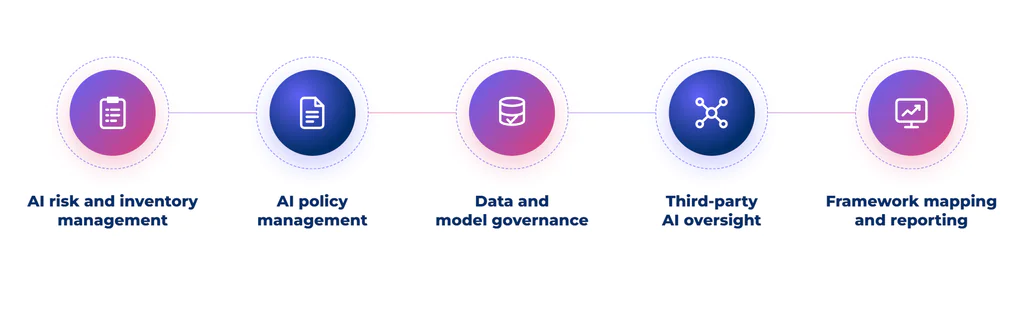
AI risk and inventory management
A complete AI inventory is the foundation of an effective AI governance program. The platform should track AI systems, owners, use cases, risk ratings, approvals, and review dates to provide visibility into AI usage across the organization. Continuous risk monitoring also helps teams identify potential issues early and prioritize systems that require closer oversight.
AI policy management
AI policy management should cover acceptable AI use, model development, third-party vendors, human oversight, and incident response. Look for centralized policy management with version control, employee attestations, and approval workflows that keep policies consistent and up to date. These capabilities help organizations enforce responsible AI practices and demonstrate compliance with evolving governance requirements.
Data and model governance
Effective AI governance software should provide controls for training data, data lineage, model explainability, performance monitoring, and change management. These capabilities help organizations maintain transparency, protect sensitive information, and identify risks throughout the AI lifecycle. Strong data and model governance is particularly important for businesses developing custom AI models or using AI for high-impact decisions.
Third-party AI oversight
Many enterprises rely on third-party AI services and vendors rather than developing all AI systems internally. Look for vendor assessments, risk scoring, ongoing monitoring, and contract review workflows that integrate AI third-party risk management into existing governance processes. Centralizing these activities helps organizations identify external AI risks, evaluate vendor compliance, and maintain oversight of third-party AI usage.
Framework mapping and reporting
Enterprises often need to manage AI governance requirements across multiple standards, regulations, and internal policies. AI governance software should support ISO 42001 compliance, NIST AI RMF, and other relevant frameworks, with cross-mapping capabilities that reduce duplicate compliance work. Centralized reporting and dashboards also help compliance teams track progress, demonstrate audit readiness, and provide stakeholders with clear visibility into AI governance.
AI-native GRC for how teams work today.
Top 7 AI governance software for enterprise risk
The platforms below were selected based on governance scope, framework support, workflow depth, and fit for enterprise risk teams. The evaluation also considered whether each product treats AI oversight as a standalone function or connects it to broader compliance work, a distinction that separates point solutions from AI GRC platforms. Here are the top 7 AI governance tools for enterprise risk:
1. Scytale
Scytale stands out as the best AI governance software for enterprises that want to manage AI risk inside the same program that handles security, privacy, and audit demands. Rather than adding another disconnected system, its AI GRC platform ties AI oversight to cross-framework controls, evidence workflows, and continuous monitoring across 80+ frameworks, including ISO 42001, SOC 2, ISO 27001, GDPR, and SOX ITGC.
For organizations comparing the best AI compliance platforms, Scytale’s advantage lies in operational governance with less duplicate work. Scytale’s AI agents review evidence, identify control gaps, and guide remediation, while dedicated GRC experts help teams turn AI policy into enforceable controls. This approach centralizes policies, risks, vendors, and controls in one system, giving AI, security, and compliance teams a single source of truth.
For example, Hamburg-based software provider Sport Alliance used Scytale to centralize policy, risk, vendor, and compliance management in one platform, replacing fragmented processes across Confluence, Google Workspace, and its previous GRC tool.
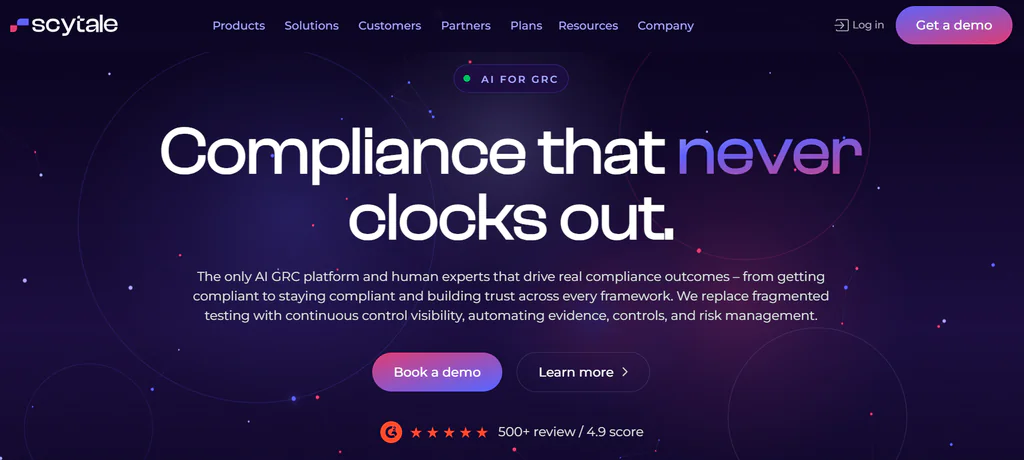
(Screenshot from Scytale’s website)
Why Scytale is the best:
- Continuous AI governance and compliance monitoring with real-time visibility into AI-related risks, control effectiveness, and compliance gaps
- Agentic compliance that streamlines AI risk management, evidence collection, policy management, and other manual governance tasks
- Multi-framework management with cross-mapping across AI governance standards like ISO 42001, the EU AI Act, and NIST AI RMF, alongside SOC 2 and ISO 27001
- Streamlined integrations with essential business and security tools to connect AI governance with existing compliance workflows
- Customizable Trust Center to showcase your AI governance practices, security controls, and compliance posture to customers and stakeholders
- Dedicated GRC expert support to help organizations navigate AI governance requirements, address compliance gaps, and prepare for audits
2. IBM watsonx.governance
IBM watsonx.governance is a model lifecycle governance toolkit built for large AI programs running across hybrid and multicloud environments. It supports oversight from model request and development through validation, deployment, and production monitoring, with a strong presence in regulated industries.
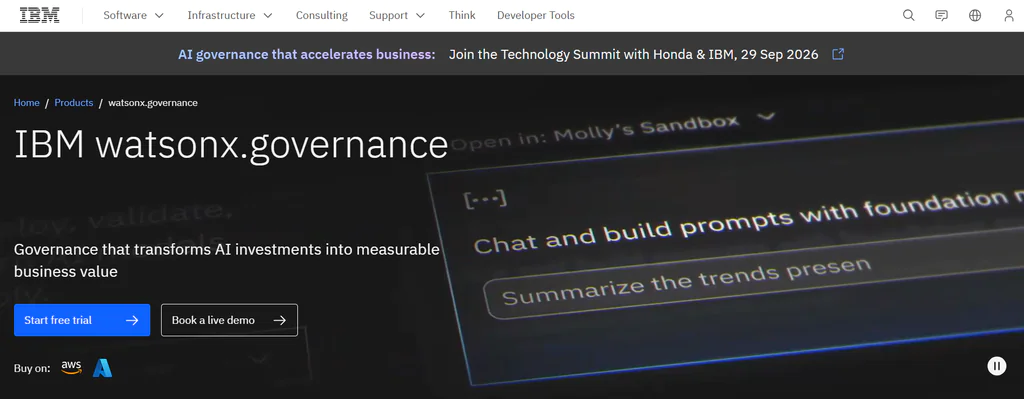
(Screenshot from IBM watsonx.governance’s website)
Key strengths:
- Continuous monitoring detects model drift, bias, and quality issues to support reliable AI performance and governance.
- Automated AI fact sheets document model metadata, development decisions, and performance throughout the AI lifecycle.
- Integration with IBM OpenPages strengthens model risk management, regulatory compliance, and oversight in highly regulated industries.
Limitations:
- Coverage outside the IBM ecosystem may require additional integrations and configuration for organizations using diverse technology stacks.
- Implementation complexity and learning requirements make the platform better suited to experienced technical teams and mature AI programs.
3. ModelOp
ModelOp is a model operations and governance platform that acts as a central control layer for enterprise AI portfolios. It covers inventory, risk tiering, and policy enforcement across traditional machine learning, generative AI, and agentic systems.
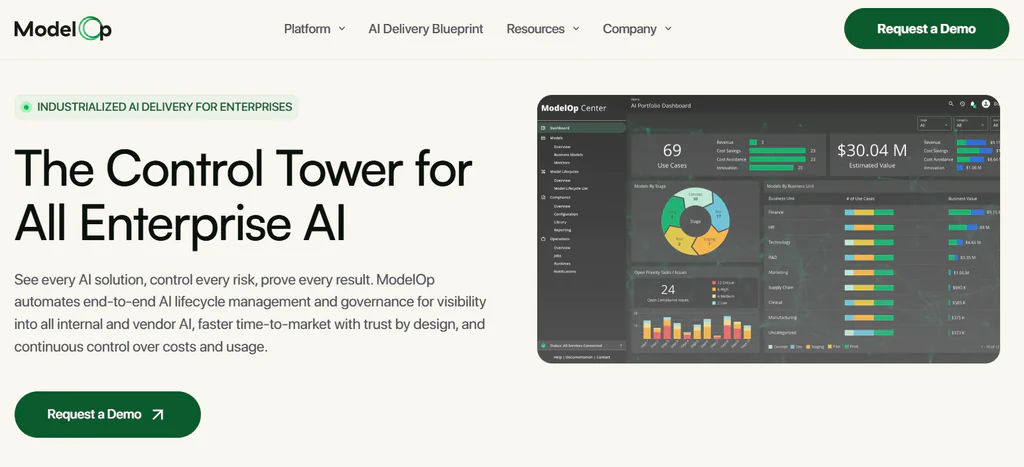
(Screenshot from ModelOp’s website)
Key strengths:
- Centralized AI inventory provides visibility into internally developed, third-party, and embedded AI systems across enterprise environments.
- Automated risk classification assigns appropriate governance controls based on predefined policies, model characteristics, and risk levels.
- Comprehensive audit trails document model approvals, governance decisions, and monitoring results throughout the AI lifecycle.
Limitations:
- Strong focus on model operations means organizations may need additional tools for broader compliance management.
- Non-technical stakeholders may require additional workflow configuration and support to participate effectively in AI governance processes.
4. Collibra AI Governance
Collibra AI Governance extends Collibra’s data intelligence platform into AI oversight, building on its catalog, metadata, and stewardship capabilities. It suits enterprises where AI risk decisions depend on knowing which data trains and feeds each model.
(Screenshot from Collibra AI Governance’s website)
Key strengths:
- Comprehensive data lineage connects AI use cases to underlying datasets, improving transparency and supporting governance decisions.
- Data stewardship workflows establish clear accountability and ownership for datasets used in AI development and operations.
- Seamless integration with Collibra’s existing data catalog helps enterprises extend established data governance practices into AI oversight.
Limitations:
- Organizations without established data governance programs may struggle to realize the platform’s full AI governance benefits.
- Limited visibility into unauthorized AI tools can leave gaps in monitoring employee use of unapproved applications.
5. Deeploy
Deeploy is an AI governance and deployment platform focused on explainability, monitoring, and human oversight of models in production. It helps teams understand how models behave after release and document decisions for accountability purposes.
(Screenshot from Deeploy’s website)
Key strengths:
- Built-in explainability capabilities help teams interpret model predictions, understand AI decisions, and demonstrate greater transparency.
- Continuous production monitoring identifies performance changes and potential risks, helping organizations maintain oversight of deployed models.
- Human feedback workflows allow subject matter experts to review, validate, and correct AI-generated decisions when necessary.
Limitations:
- More specialized capabilities provide less coverage for enterprise-wide privacy, policy management, and broader compliance requirements.
- Stronger focus on internally developed models may limit governance coverage for organizations relying on third-party AI services.
6. LogicGate
LogicGate is a configurable GRC platform whose Risk Cloud applications can be applied to AI governance workflows. It appeals to enterprises that want AI risk intake, review, and approval to mirror their existing enterprise risk processes.
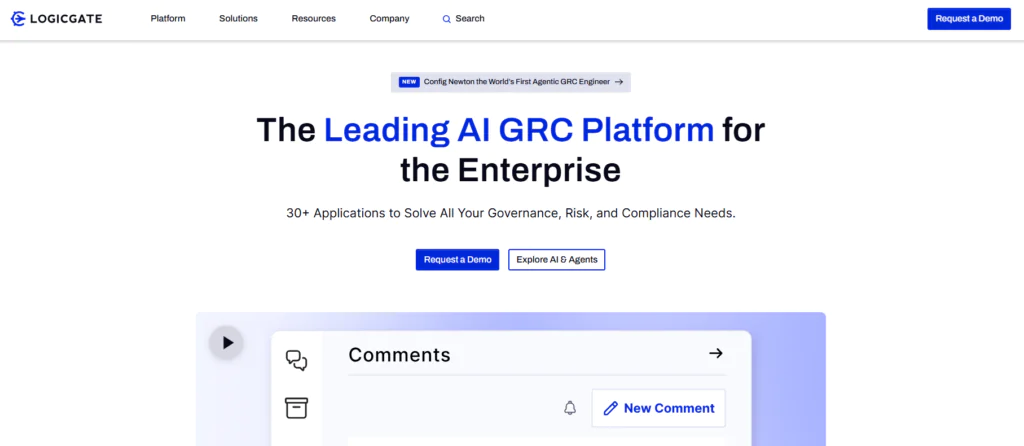
(Screenshot from LogicGate’s website)
Key strengths:
- Configurable no-code workflows enable organizations to customize AI risk assessments, approval processes, and escalation procedures.
- Integration with enterprise risk management processes helps align AI-related risks with existing reporting and oversight structures.
- Flexible data models support tailored governance requirements, allowing businesses to adapt workflows to internal policies and responsibilities.
Limitations:
- Extensive customization options can increase implementation effort compared with platforms offering predefined AI governance workflows.
- AI-specific controls, evidence collection, and monitoring processes may require additional configuration to support comprehensive governance.
7. OneTrust
OneTrust approaches AI governance from its privacy and data governance suite, extending existing capabilities to AI inventories, risk assessments, and policy oversight. It fits enterprises that already run privacy operations in OneTrust, although the platform’s breadth introduces significant implementation and administration complexity.
(Screenshot from OneTrust’s website)
Key strengths:
- Centralized AI project intake and approval workflows use reusable assessment templates to standardize governance processes.
- Prebuilt framework mappings support alignment with the EU AI Act, NIST AI RMF, and ISO 42001 requirements.
- Automated AI asset discovery integrates with data platforms like Databricks to improve visibility into enterprise AI usage.
Limitations:
- Broad functionality and extensive configuration requirements can increase implementation complexity for teams seeking focused AI governance.
- Privacy-focused workflows may be less suitable for engineering teams requiring detailed oversight of production AI models.
AI governance software platforms compared
| Platform | Governance scope | Framework coverage | Best for |
|---|---|---|---|
| Scytale | AI governance plus cross-framework compliance operations | 80+ frameworks, including ISO 42001, SOC 2, ISO 27001, and GDPR | Enterprises and SaaS teams managing complex AI governance and compliance requirements |
| IBM watsonx.governance | Model lifecycle governance at scale | AI regulations and internal model risk policies | Large AI teams in regulated industries |
| ModelOp | Model operations and inventory | Policy-based controls mapped to AI regulations | Large model portfolios |
| Collibra AI Governance | Data-governance-led AI oversight | Data policies plus AI regulation templates | Mature data catalog programs |
| Deeploy | Explainability and production monitoring | EU AI Act-oriented oversight controls | Model transparency priorities |
| LogicGate | Configurable AI risk workflows | Custom frameworks, including NIST AI RMF | Risk teams extending ERM to AI |
| OneTrust | Privacy-led AI governance | EU AI Act, NIST AI RMF, ISO/IEC 42001 | Established privacy programs |
Always-on GRC. Built for modern teams.
How Scytale simplifies AI governance
AI governance becomes harder when security, privacy, procurement, legal, and product teams all need to work from the same controls and evidence. Scytale simplifies that coordination by bringing AI inventory, AI policy management, risk assessment, and cross-framework control mapping into the same AI GRC platform that runs the rest of the compliance program, with automated evidence collection and continuous monitoring keeping AI controls current between formal reviews.
With support for ISO 42001 alongside SOC 2, ISO 27001, GDPR, and SOX ITGC, teams map a single control to multiple requirements instead of running separate governance tracks. A multi-agent suite flags gaps and drives remediation, while dedicated GRC experts help translate AI policy into enforceable controls and audit-ready evidence. Book a demo to see how Scytale brings AI governance and compliance into one platform.
FAQs about AI governance software
What is AI governance software?
AI governance software is a platform that helps organizations manage how AI systems are approved, documented, monitored, and reviewed. It centralizes AI inventories, policies, risk assessments, and evidence so security, legal, and data teams can oversee internal models and third-party AI tools through repeatable workflows.
How is AI governance software different from GRC software?
AI governance software focuses on AI-specific oversight such as model inventory, explainability, data lineage, human review, and third-party AI use. Traditional GRC software manages broader compliance and risk workflows. Scytale’s AI GRC platform bridges both areas by connecting AI governance work to wider compliance controls, evidence, and reporting.
Which frameworks should AI governance software support?
AI governance software should support the frameworks and internal policies shaping your AI program. Most enterprises start with ISO 42001, NIST AI RMF, privacy obligations, and internal AI use policies. Leading AI GRC platforms like Scytale help teams map AI controls across multiple frameworks, which reduces duplicate work across governance and compliance programs.
Do we need AI governance software if we only use third-party AI tools?
Yes, third-party AI use still creates governance obligations around vendor review, acceptable use, data handling, approvals, and monitoring. Your team still needs visibility into where AI appears and which risks follow. Even without internal model development, Scytale helps centralize policy, evidence, and oversight for external AI use.
How do you measure AI governance maturity?
You measure AI governance maturity by reviewing inventory coverage, policy adoption, risk assessment consistency, control monitoring, and reporting quality across the AI program. Mature programs move from ad hoc reviews to repeatable workflows with clear ownership. Many teams use a formal maturity model to benchmark progress and prioritize next steps.
