










TL;DR: Enterprise GRC software
- Enterprise GRC software helps large organizations manage risk, compliance, audits, and reporting across multiple teams and business units.
- The best enterprise GRC platforms support complex structures, deep integrations, and clear reporting for executives, auditors, and control owners.
- Enterprises should compare GRC platforms based on scale, framework coverage, workflow flexibility, and implementation fit.
- Scytale’s AI GRC platform combines AI-driven automation with enterprise-ready compliance operations for teams that need speed and control.
- The right platform reduces manual work, improves visibility, and supports a more consistent compliance program across the business.
Large organizations rarely struggle with a lack of controls. They struggle with fragmentation across entities, frameworks, systems, and stakeholders, which is why buyers evaluating enterprise GRC software approach the decision differently from smaller teams.
As programs scale, governance, risk, and compliance work needs to run as one operating model rather than a collection of disconnected spreadsheets and point tools. The goal is not a longer feature list, but a platform that teams can use across audits, reporting cycles, and cross-functional ownership without adding operational drag. In this article, we cover what to look for in an enterprise GRC platform and how the leading options compare.
Top 7 GRC platforms for enterprises
- Scytale
- ServiceNow
- LogicManager
- Workiva
- Diligent One
- Hyperproof
- Sprinto
What is an enterprise GRC platform?
An enterprise GRC platform is software that gives large organizations one system for managing governance, risk, compliance, audits, and reporting across multiple teams, entities, and frameworks.
Unlike lighter tools built for startups and SMBs, which typically support a single team working toward one or two certifications, enterprise platforms are designed for layered ownership, formal approval workflows, and broad framework coverage. They connect evidence, risks, policies, and audit activity so that governance, risk, and compliance (GRC) work runs from a single source of truth.
The difference shows up in scale and operating depth. Enterprise buyers typically need configurable workflows, role-based access, deep system integrations, and reporting that serves executives, auditors, and control owners at the same time, and these requirements tend to shape the shortlist from the start.
Key features to look for
Enterprise teams feel the cost of weak GRC architecture quickly, because a platform that works for one audit or one framework often breaks down once a program spans regions, subsidiaries, and dozens of internal stakeholders. Clear evaluation criteria help organizations separate GRC platforms built for complex environments from tools designed for a narrower scope. Here are the key features to evaluate:
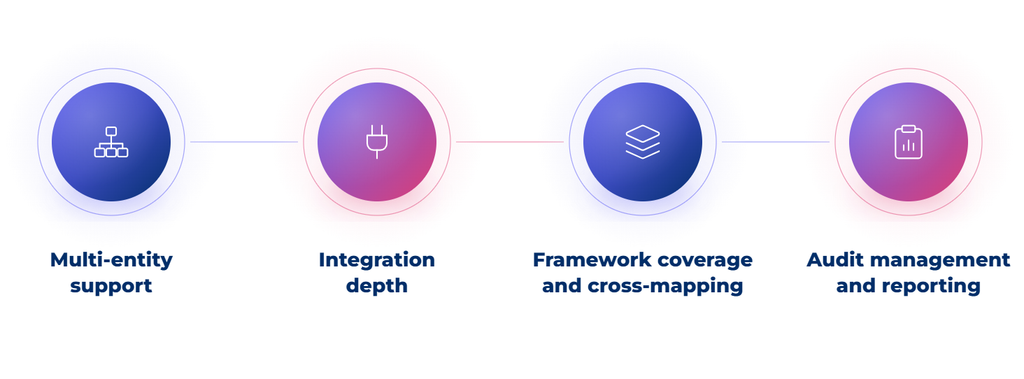
Multi-entity support
Enterprise programs rarely sit inside one legal entity or one operating team. The platform should let organizations segment ownership, approval logic, and reporting by business unit or entity while preserving a central view of controls and risk.
Role-based access, structured task routing, and evidence reuse across entities keep local teams accountable without creating parallel programs that leadership cannot see. This capability matters most when central teams need oversight of systems spread across many subsidiaries and regions.
For example, ICL Group, a NYSE-listed chemical company with over 12,000 employees across 100 entities, uses Scytale to audit nine separate global SAP systems from a single dashboard instead of flying its SOX team on-site.
Integration depth
Manual evidence collection does not scale across hundreds of systems and control owners. A strong platform connects with the identity, cloud, HR, ticketing, and security tools teams already use, then maps collected evidence to controls automatically.
Integration depth also determines how well a platform supports continuous control monitoring, since checks can only run as often as the underlying data refreshes. Mapping these requirements against what compliance teams need from GRC platforms helps buyers test vendor claims before they commit.
Framework coverage and cross-mapping
Most enterprises manage several frameworks at once, such as SOC 2, ISO 27001, GDPR, and SOX ITGC. A broad framework library with control cross-mapping lets teams satisfy overlapping requirements once, rather than rebuilding the same evidence for each audit.
Audit management and reporting
Executives, auditors, and control owners need different outputs from the same system. Enterprises should look for audit trails, issue tracking, executive dashboards, and exportable compliance reporting that holds up under board review and external assurance.
Implementation planning belongs in this evaluation as well. When a broader rollout is planned, how to implement a GRC program becomes part of the buying process rather than a separate project, because reporting structures depend on how ownership is configured from the start.
AI-native GRC for how teams work today.
7 best GRC platforms for enterprises
Some of the best GRC platforms lean toward broad risk and governance oversight, while others focus on compliance automation and audit execution, including the AI GRC platform model that pairs automation with expert support. Here are the 7 best GRC platforms for enterprises, selected for how well each addresses complex operating environments rather than lightweight point use cases:
1. Scytale
Scytale stands out as the best enterprise GRC platform for organizations that need enterprise-grade compliance operations without adding manual overhead. Its AI-driven automation covers evidence collection and continuous monitoring across 150+ integrations, while cross-framework mapping across 80+ frameworks, including SOC 2, ISO 27001, GDPR, HIPAA, and SOX ITGC, reduces duplicate work across large compliance programs.
What differentiates Scytale is the combination of software and dedicated GRC expertise in one operating model. Its multi-agent suite reviews evidence, detects gaps, and keeps controls mapped across frameworks, while GRC experts support implementation, audit readiness, and ongoing program management. As a result, enterprise teams can standardize compliance across business units with less manual coordination and stronger audit readiness.
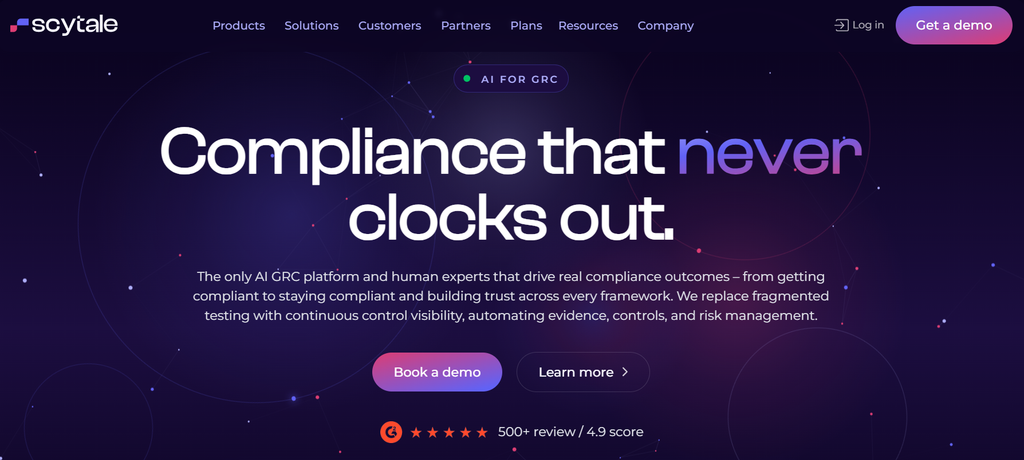
(Screenshot from Scytale’s website)
Why Scytale is the best:
- Continuous compliance through real-time monitoring, with full visibility into security and risk posture across business units
- Agentic compliance that streamlines evidence collection, access reviews, and other manual tasks at enterprise scale
- Multi-framework management with cross-mapping to eliminate duplicate work across standards like SOC 2, ISO 27001, GDPR, HIPAA, and SOX ITGC
- Streamlined integrations with essential tools and customizable options for enhanced automation and flexibility
- Customizable Trust Center to clearly showcase your security and compliance posture
- Dedicated GRC expert support, providing tailored guidance throughout the entire compliance journey
2. ServiceNow
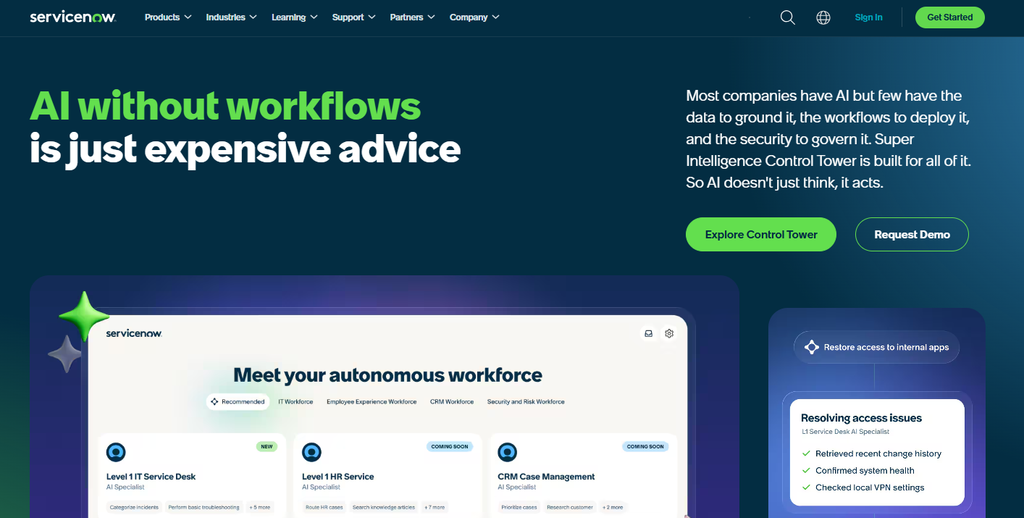
ServiceNow delivers GRC capabilities on the same platform that runs IT service management and broader enterprise workflows. It typically fits organizations that already run major parts of their internal operations inside the ServiceNow ecosystem.
(Screenshot from ServiceNow’s website)
Key strengths:
- Configurable workflows that span IT, security, risk, and compliance functions at scale
- Native connection between GRC activity and IT service management processes
- Enterprise reporting and issue management suited to large, layered governance structures
Limitations:
- Implementation often depends on significant internal resources or certified partner support
- Licensing and configuration effort can be high for compliance-only use cases
3. LogicManager
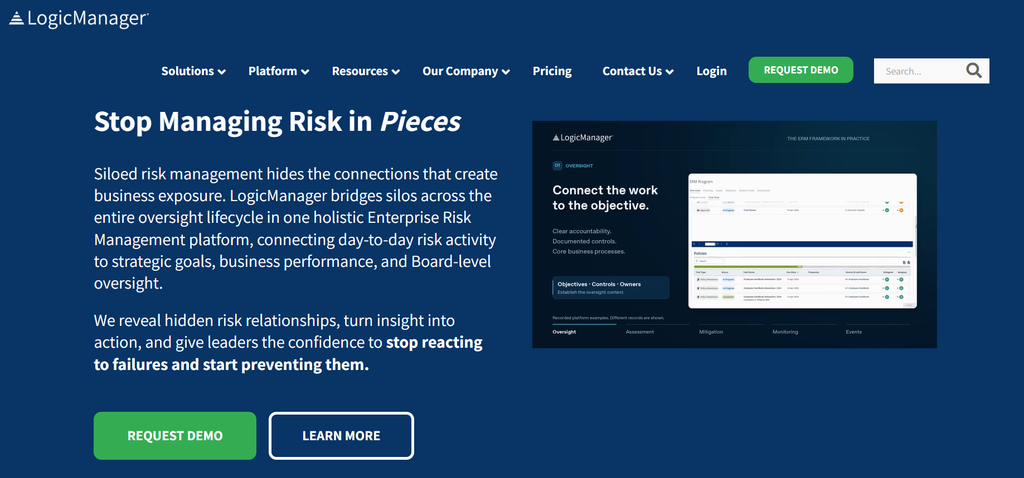
LogicManager is an enterprise risk management platform that uses structured workflows to support governance, internal control, and risk programs. It suits organizations that prioritize risk visibility and formal oversight across departments.
(Screenshot from LogicManager’s website)
Key strengths:
- Structured risk registers, assessments, and issue tracking for enterprise-wide programs
- Centralized oversight that links risks across business functions and risk domains
- Leadership reporting that tracks risk posture and remediation progress over time
Limitations:
- Automated evidence collection is less central than on compliance automation platforms
- Audit-heavy technical programs may need extra support for day-to-day execution
4. Workiva
Workiva is a connected reporting platform that brings financial reporting, controls, and compliance work into one environment. It often appeals to enterprises with strong finance, SOX, and external reporting requirements alongside broader GRC needs.
(Screenshot from Workiva’s website)
Key strengths:
- Collaborative reporting workflows shared across finance, audit, and compliance teams
- Linked documentation that provides traceability from source data to final reports
- Strong alignment between assurance activity and executive or regulatory reporting
Limitations:
- Best suited to reporting-centric programs rather than automation-first security compliance
- Technical control monitoring across cloud environments is not its primary focus
5. Diligent One
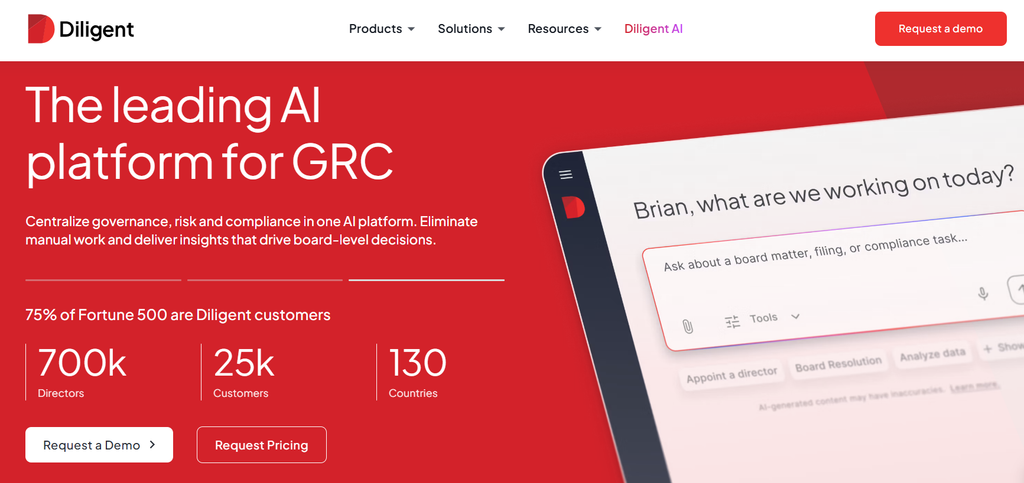
Diligent One is a governance, risk, and audit platform that connects operational assurance work with board-level oversight. It often fits enterprises that want board reporting tied directly to risk, audit, and compliance activity.
(Screenshot from Diligent One’s website)
Key strengths:
- Governance workflows that connect audit, risk, and board stakeholders in one place
- Audit management tools for planning, fieldwork, and issue follow-up across entities
- Board-ready reporting that links operational risk data to executive visibility
Limitations:
- Technical compliance teams may need additional tooling for automated evidence collection
- Broad module coverage can add complexity for teams focused on faster audit cycles
6. Hyperproof
Hyperproof is a compliance operations platform focused on program management, control tracking, and audit coordination. It suits teams that want a structured system for managing controls, tasks, and framework activity across a growing compliance program.
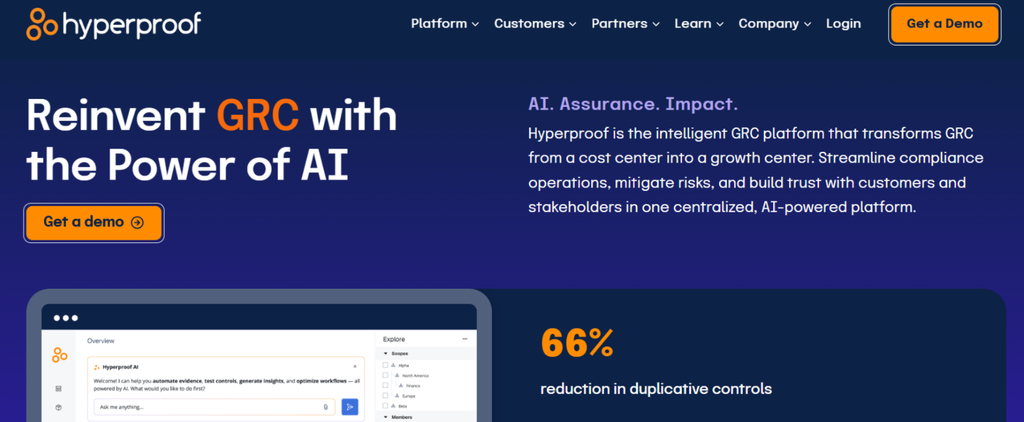
(Screenshot from Hyperproof’s website)
Key strengths:
- Control management and task tracking organized across multiple compliance frameworks
- Recurring workflows that support repeatable compliance cycles and audit preparation
- Clear visibility into control ownership and program status across internal stakeholders
Limitations:
- Enterprises with broad risk management needs may require additional tooling
- Teams without in-house GRC expertise may need outside support during setup
7. Sprinto
Sprinto is a compliance automation platform with an emphasis on continuous monitoring and audit readiness. It often fits organizations that want faster operational execution and less manual evidence work.
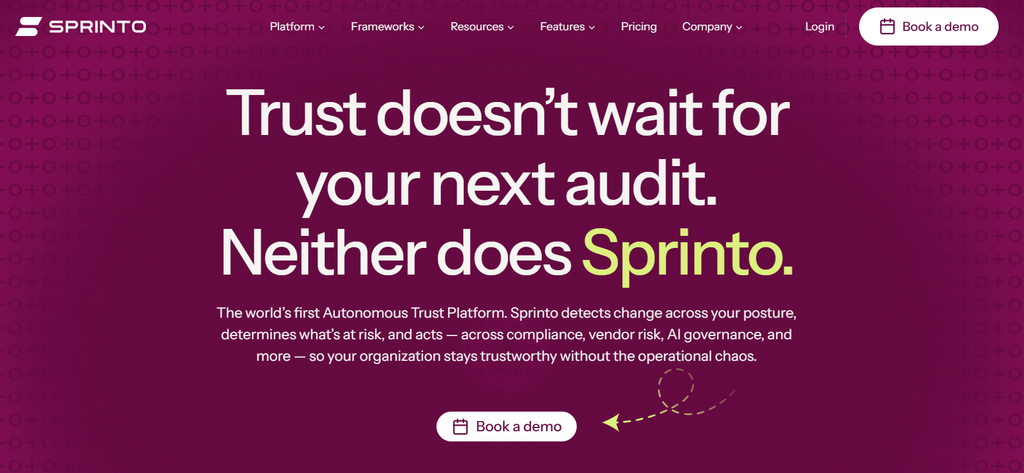
(Screenshot from Sprinto’s website)
Key strengths:
- Automated evidence collection and monitoring across common cloud and SaaS workflows
- Guided workflows and policy templates that support relatively fast initial certification
- Structured task and control management for recurring audit preparation cycles
Limitations:
- Large enterprises with broad governance and risk requirements may outgrow its scope
- Multi-entity governance and complex enterprise system integrations may require more configuration
7 best enterprise GRC platforms at a glance
| Platform | Key strength | Scale | Framework coverage | Ideal buyer |
|---|---|---|---|---|
| Scytale | AI GRC automation, continuous monitoring, AI agents, multi-framework management, and expert guidance | Multi-entity enterprise programs | 80+ frameworks | Enterprises managing complex, multi-framework compliance programs |
| ServiceNow | IT workflow alignment | Very large enterprises | Broad, configurable | Existing ServiceNow customers |
| LogicManager | Risk management structure | Enterprise-wide risk programs | Risk and control focused | Formal ERM programs |
| Workiva | Connected reporting | Finance-led enterprises | Reporting and assurance focused | Finance and SOX-heavy teams |
| Diligent One | Board-level oversight | Large governance structures | Governance and audit focused | Board-linked GRC programs |
| Hyperproof | Compliance operations | Mid-market to enterprise | Multi-framework compliance | Structured compliance teams |
| Sprinto | Fast audit readiness | SMB to mid-market | Common compliance frameworks | Speed-focused compliance teams |
Always-on GRC. Built for modern teams.
How Scytale supports enterprise GRC
Enterprise compliance programs break down when teams rely on disconnected evidence, manual follow-up, and one-off audit preparation. Scytale’s AI GRC platform addresses this by bringing automated evidence collection, continuous control monitoring, policy workflows, and audit readiness into one operating model. Its agentic GRC ecosystem detects gaps, reviews evidence, and maps controls across frameworks, so teams avoid rebuilding the same work for every requirement or audit cycle.
As programs expand across entities and regions, Scytale supports 80+ frameworks, 150+ integrations, and clear reporting for executives, auditors, and control owners. Dedicated GRC experts work alongside internal teams through implementation, remediation, and audit preparation, which helps organizations move faster without losing rigor. The result is a scalable compliance program with less manual effort, stronger visibility, and continuous audit readiness.
FAQs about enterprise GRC software
What is an enterprise GRC platform?
An enterprise GRC platform is software that centralizes governance, risk, compliance, audit, and reporting work for large organizations with multiple teams and entities. Unlike standard GRC tools built for smaller teams, it supports formal workflows, role-based access, deep integrations, and broad framework coverage.
What is the best GRC software for large enterprises?
The best GRC software for large enterprises depends on your operating model, framework scope, and reporting needs. Some teams need broad governance oversight, while others need faster compliance execution. Scytale’s AI GRC platform stands out for enterprises that want AI-driven automation plus dedicated GRC support in one platform.
How long does it take to implement an enterprise GRC platform?
Implementation time depends on your scope, integrations, and internal approval process. A focused rollout for one program moves faster than a multi-entity deployment across several frameworks. Leading AI GRC platforms like Scytale help shorten time to value by combining automation with expert guidance during setup and rollout.
How much does enterprise GRC software cost?
Enterprise GRC software cost varies based on platform scope, number of frameworks, integrations, service model, and deployment complexity. Large organizations should evaluate total operating cost, not license price alone. Manual evidence work, audit preparation time, and fragmented reporting often create larger long-term costs.
What is the difference between GRC and IRM?
GRC covers governance, risk, and compliance as a broad operating model across the business. IRM, or integrated risk management, focuses more specifically on identifying, assessing, and managing risk. Many enterprise platforms support both, though some lean more toward compliance execution while others center on risk oversight.
