










TL;DR: ISO 42001 certification
- ISO 42001 certification helps prove your organization manages AI with clear governance, risk controls, and accountability.
- The standard matters most for companies building AI, embedding AI into products, or selling into regulated and enterprise environments.
- ISO 42001 is voluntary, but customer diligence, procurement reviews, and AI oversight expectations often make it feel required.
- The strongest trigger is repeated pressure from buyers, regulators, or internal stakeholders to show structured AI governance.
- Scytale’s AI GRC platform helps teams prepare for ISO 42001 certification with automation, cross-framework mapping, and expert guidance.
AI adoption has moved faster than most governance programs. Teams now ship AI features, answer security reviews, and face board scrutiny before they have built a repeatable system for managing AI risk.
That gap creates a trust problem, particularly now that 88% of organizations report regular AI use in at least one business function. Buyers, regulators, and boards increasingly want evidence that AI is governed responsibly rather than verbal assurances. In this article, we explain who benefits most from ISO 42001 certification and how to decide whether it fits your business.
What is ISO 42001 certification?
ISO 42001 certification is independent, third-party confirmation that an organization operates an artificial intelligence management system (AIMS) that meets the requirements of the ISO/IEC 42001 standard.
Certification shows customers, partners, and auditors that an organization’s AI program follows a recognized structure rather than ad hoc decisions. The core ISO 42001 requirements cover how organizations assign responsibility, assess AI risks, document intended use, monitor outcomes, and improve controls over time.
For teams new to ISO 42001 certification, the central point is that certification proves a repeatable management system around AI, not a one-time set of policies. An accredited certification body audits that system, and the organization then maintains it through periodic surveillance audits and continuous improvement.
Streamline GRC workflows with no blind spots.
Who needs ISO 42001 certification?
Organizations feel pressure to pursue ISO 42001 certification at different points, but the need typically rises when AI affects customer trust, regulated decisions, or revenue tied to enterprise diligence. Once customers and regulators must rely on how a team builds, deploys, or depends on AI, formal alignment with ISO 42001 becomes a practical business asset rather than a nice-to-have signal. Here are the types of organizations that typically benefit most:
AI developers
Teams building foundation models, AI applications, or internal AI systems face the clearest case for certification. These teams own model design choices, training data decisions, testing methods, human oversight, and post-release monitoring, so buyers and regulators expect evidence that each of those decisions is controlled.
ISO 42001 helps AI developers document governance from development through deployment. It gives product, security, legal, and leadership teams a shared operating model for risk reviews, change management, and accountability.
AI-powered SaaS
SaaS companies embedding AI into customer-facing workflows often need stronger assurance before enterprise buyers approve a deal. When a platform summarizes data, automates decisions, generates content, or supports sensitive workflows, procurement teams will ask how those features are governed.
Certification allows SaaS vendors to answer those questions with a recognized framework instead of custom explanations every quarter. It also pairs well with adjacent readiness work, such as an ISO 42001 checklist or broader trust documentation.
Regulated industries
Healthcare, financial services, insurance, education, and other regulated sectors face higher scrutiny when AI influences outcomes, access, or customer treatment. In these environments, weak governance can create legal exposure, audit friction, and reputational damage.
ISO 42001 gives regulated organizations a structured way to demonstrate oversight across risk assessment, transparency, human review, and control testing. It also helps when internal compliance teams need a single management system that aligns AI governance with existing security and privacy programs.
Enterprise vendors
Vendors selling into large enterprises often benefit from ISO 42001 certification before a buyer asks for it by name. Security questionnaires, legal reviews, and procurement committees increasingly probe AI use, especially when a product handles customer data or automates business decisions.
Certification shortens those conversations because it gives buyers a familiar assurance signal. Instead of defending its process from scratch for every deal, the vendor points to an audited management system and answers diligence questions with greater consistency and speed.
Organizations scaling AI internally
Some companies do not sell AI products, yet they still rely on AI across engineering, support, HR, finance, or security operations. Once internal use spreads across teams, leadership needs a common governance model for approval, monitoring, and acceptable use.
ISO 42001 helps these organizations move from scattered experimentation to managed oversight. That matters when the board, customers, or regulators ask who approved a specific AI use case, how its risks were reviewed, and which controls remain in place after launch.
Which organizations benefit most from ISO 42001 certification
| Organization type | Why ISO 42001 matters | Typical trigger | Best fit |
|---|---|---|---|
| AI developers | Shows formal governance over model design, testing, and monitoring | Customer trust, product risk, audit readiness | Teams building or training AI systems |
| AI-powered SaaS | Supports buyer diligence for embedded AI features | Enterprise deals, security reviews, legal reviews | SaaS vendors with customer-facing AI |
| Regulated industries | Adds structure for oversight in sensitive use cases | Compliance pressure, board scrutiny, sector rules | Healthcare, finance, insurance, education |
| Enterprise vendors | Provides a recognized assurance signal during procurement | Questionnaires, vendor reviews, contract negotiations | B2B vendors selling to large enterprises |
| Internal AI adopters | Creates one governance model across business functions | Rapid AI expansion, leadership oversight | Organizations scaling AI across departments |
Is ISO 42001 mandatory?
ISO 42001 is voluntary, and no general law requires every business that uses AI to certify. However, voluntary standards often become de facto requirements when customers, regulators, insurers, or enterprise procurement teams expect formal proof of governance, and some buyers write certification directly into contracts or tenders.
That pressure typically grows fastest in high-trust markets. Organizations that sell AI into regulated workflows, answer detailed questionnaires, or prepare for obligations under the EU AI Act often find that buyers treat certification as evidence that controls match the maturity of the product. The EU AI Act does not require ISO 42001, but the two emphasize similar practices, including documented governance, accountability, and traceable controls.
The practical question, therefore, is not whether the standard is legally mandatory in every case. It is whether the market now expects documented AI governance, and whether the organization prefers to prove it once through certification rather than through repeated custom responses.
AI-native GRC for how teams work today.
Is ISO 42001 worth it?
ISO 42001 certification typically pays off when AI governance affects revenue, trust, or operational risk. The cost and effort are real, since certification requires leadership ownership, documented processes, risk reviews, internal coordination, and audit preparation, so the return depends on how often AI governance influences deals, oversight, or product decisions. Here are the main factors to weigh before committing:
Where the value shows up first
The first benefit usually appears in customer trust. Enterprise buyers want evidence that an AI program has defined roles, review processes, and monitoring, and certification gives them a recognized signal rather than an unverified claim in a sales presentation. Certification also improves internal consistency. Product, security, legal, and compliance teams work from one management system, which reduces duplicated reviews and clarifies who approves new AI use cases.
How it supports sales and procurement
Certification often shortens procurement cycles for AI-powered vendors. When buyers ask about governance, bias review, human oversight, or incident response, teams answer from a documented system instead of building one-off responses for each request. This benefit becomes easier to quantify when organizations compare ISO 42001 certification cost against the value of the deals it influences. A standard is far easier to justify when it removes friction from enterprise sales and renewals.
Why it helps with control alignment
Many organizations already run security, privacy, and risk programs, yet AI introduces new review points around intended use, data quality, model behavior, and human oversight. ISO 42001 connects those activities into one management system rather than leaving them spread across separate processes. That alignment matters for teams comparing frameworks, such as NIST AI RMF vs ISO 42001. ISO 42001 provides a certifiable governance structure while keeping broader AI risk practices connected.
When the investment makes less sense
The return is generally weaker for organizations with limited AI use, low customer scrutiny, and no near-term enterprise or regulated exposure. In that case, a lighter governance program may address the immediate need without a full certification project. The standard also loses value when leadership treats it as a badge rather than an operating system. Certification requires named owners, regular review routines, and evidence discipline; without them, the audit effort produces documentation that has little effect on how AI is actually governed.
Signs your organization should get ISO 42001 certified
Growing pressure from customers, partners, or internal stakeholders to demonstrate responsible AI practices is a clear sign that your organization may benefit from adopting the ISO 42001 standard. Increasing reliance on AI, particularly when it influences products, customer outcomes, or business decisions, also highlights the need for stronger oversight and accountability. Here are the most common signs your organization is ready for certification:
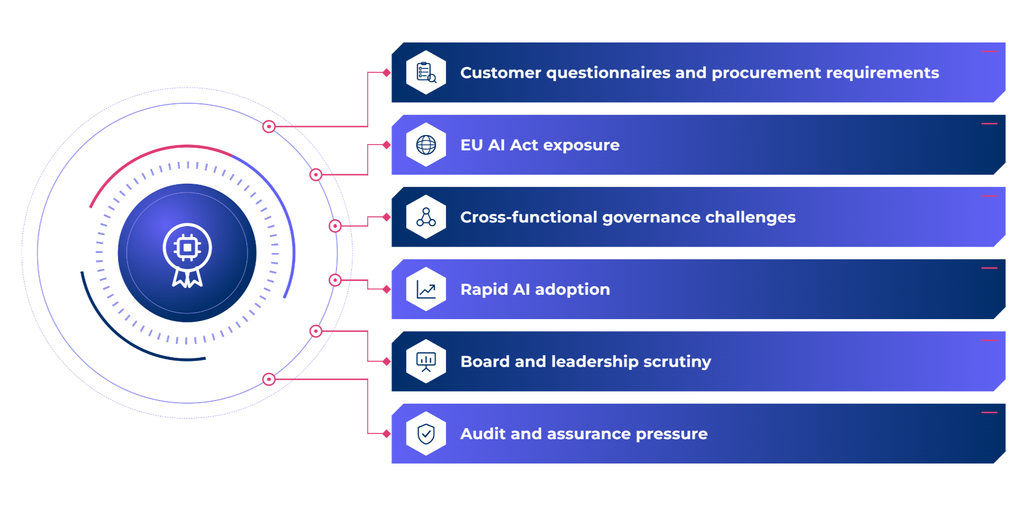
Customer questionnaires and procurement requirements
Sales and security teams may face repeated questions about AI governance, model oversight, training data, and human review during procurement. When enterprise buyers request documented evidence of responsible AI practices before approving contracts, renewals, or vendor onboarding, ISO 42001 certification can help demonstrate a structured approach to AI management.
EU AI Act exposure
Organizations developing, deploying, or using AI systems in the European market may face obligations under the EU AI Act. These requirements increase the need for documented governance, risk assessments, and traceable controls. While ISO 42001 certification does not automatically establish EU AI Act compliance, it provides a structured management system that can support regulatory readiness.
Cross-functional governance challenges
As AI adoption expands, product, legal, security, and compliance teams may struggle to establish clear responsibilities for approving AI use cases, monitoring risks, and implementing controls. ISO 42001 helps organizations define accountability, standardize governance processes, and maintain consistent oversight across departments.
Rapid AI adoption
When multiple teams introduce AI features or internal tools, informal governance practices can become difficult to manage. Without consistent policies and monitoring, organizations risk overlooking security concerns, compliance gaps, and unintended AI outcomes. ISO 42001 provides a scalable framework for managing AI systems as adoption grows.
Board and leadership scrutiny
Executive teams increasingly expect clear reporting on AI risks, governance responsibilities, and control effectiveness. When leadership requires regular updates, documented reviews, and evidence of accountability, ISO 42001 provides a structured approach to meeting these expectations. This pressure often emerges internally before customers begin requesting certification.
Audit and assurance pressure
Organizations using AI in sensitive data environments, regulated workflows, or high-impact decisions face growing assurance requirements. Auditors and compliance teams need reliable evidence of governance practices, risk assessments, and ongoing monitoring. ISO 42001 establishes a certifiable management system that centralizes governance processes, supports continuous improvement, and simplifies audit preparation.
Always-on GRC. Built for modern teams.
How Scytale simplifies ISO 42001 certification
ISO 42001 projects often stall on coordination, evidence collection, and control mapping across teams. Scytale‘s AI GRC platform addresses those bottlenecks by automating evidence collection, supporting continuous compliance monitoring, and connecting the existing tech stack through 150+ integrations, so AI governance stays tied to day-to-day operations.
Teams work from one workspace for requirements, evidence, workflows, and reporting, with cross-framework mapping across 80+ frameworks that reduces duplicate work where AI governance overlaps with ISO 27001, SOC 2, GDPR, or existing assurance programs. Combined with dedicated GRC experts who guide each stage of the certification path, Scytale helps organizations reach audit readiness faster and maintain ISO 42001 certification with confidence.
FAQs about ISO 42001 certification
Which organizations need ISO 42001 certification?
Organizations that build, embed, or depend on AI systems that affect customers, decisions, or regulated outcomes benefit most from ISO 42001 certification. This typically includes AI developers, AI-powered SaaS vendors, enterprise suppliers, and companies in regulated sectors. The need becomes more pressing when buyers or regulators repeatedly ask for proof of structured AI governance.
Is ISO 42001 certification mandatory for businesses using AI?
No, ISO 42001 certification is voluntary, and no general law requires businesses that use AI to certify. It can become a practical requirement when a customer contract, tender, or procurement policy asks for it. The EU AI Act does not mandate ISO 42001, although both emphasize similar governance and documentation practices.
Does a company need ISO 42001 certification if it develops its own AI systems?
A company that develops its own AI systems is not legally required to certify, but it has one of the strongest cases for doing so. Developers own decisions on training data, testing, human oversight, and monitoring, so customers and regulators expect evidence that those decisions are governed. Scytale’s AI GRC platform helps development teams document these controls and keep evidence audit-ready from design through deployment.
Can small businesses and startups get ISO 42001 certified?
Yes, ISO 42001 sets no limits by company size, so small businesses and startups can pursue certification. The scope and effort generally scale with the number of AI systems an organization runs and the level of risk they carry. Leading AI GRC platforms like Scytale help smaller teams reduce manual work through automated evidence collection and expert guidance.
Which industries benefit most from ISO 42001 certification?
Healthcare, financial services, insurance, education, and the public sector typically benefit most, because AI in these industries can influence access, outcomes, and customer treatment. Technology and SaaS companies that embed AI into their products also gain significant value during enterprise procurement. In each case, certification gives buyers and regulators a recognized signal of structured AI governance.
