


TL;DR: Enterprise GRC
- Enterprise GRC gives large organizations one centralized approach to managing governance, risk, and compliance across departments.
- EGRC works best when governance, risk, and compliance operate as one connected program rather than separate functions.
- Enterprise GRC software reduces manual, spreadsheet-driven work while improving visibility, consistency, and reporting across multiple frameworks.
- Building an effective enterprise GRC program requires executive support, clear ownership, standardized processes, and shared control mapping.
- Scytale’s AI GRC platform centralizes evidence, controls, risks, and framework overlap to reduce manual work and simplify enterprise-wide compliance management.
As organizations grow, Governance, Risk, and Compliance (GRC) becomes harder to manage across the business. More teams take on responsibilities, regulatory and security requirements increase, and keeping everyone aligned becomes more complex. Without a coordinated approach, organizations can struggle to understand what needs attention, who owns it, and where the biggest risks lie.
Enterprise GRC brings greater structure and accountability to these responsibilities as the business grows. In this article, we’ll explore enterprise GRC and how to build an effective program.
What is enterprise GRC?
Enterprise GRC (EGRC) is an organization-wide approach to managing governance, risk, and compliance through connected processes, data, and oversight.
Unlike GRC activities managed separately by individual departments, enterprise GRC connects policies, risks, controls, compliance requirements, evidence, and reporting across the business. This creates a more consistent approach and a shared source of truth for teams and leadership.
EGRC is particularly valuable for large organizations with complex regulatory, security, and operational requirements, including regulated businesses and SaaS companies managing multiple frameworks and stakeholders. Centralized data and standardized workflows help teams coordinate GRC activities more efficiently while giving leadership clearer visibility into the organization’s overall risk and compliance posture.
Always-on GRC. Built for modern teams.
The three pillars of enterprise GRC
Enterprise GRC is built around three core pillars: governance, risk, and compliance. Each has a different role, but together they help organizations manage responsibilities, risks, and compliance requirements across the business.
Governance
Governance establishes how decisions, policies, and responsibilities are managed across the organization. At enterprise scale, executive leaders and boards use governance to set expectations, assign ownership, and ensure departments such as security, legal, finance, HR, and operations follow consistent policies and decision-making processes.
- Policy alignment: Establishes consistent policies and standards across departments and business units.
- Executive accountability: Assigns clear ownership to executives, boards, and other stakeholders for key decisions and responsibilities.
- Decision oversight: Creates reporting and escalation processes that give leadership visibility into issues that could affect the wider organization.
Risk
Enterprise risk and compliance management provides an organization-wide view of strategic, operational, cyber, financial, and third-party risks. A consistent risk assessment methodology helps teams evaluate and prioritize these risks using shared criteria rather than maintaining isolated approaches across departments.
- Organization-wide oversight: Tracks risks across business units, systems, vendors, and operations rather than within a single department.
- Shared prioritization: Assesses risks based on likelihood and business impact to help leadership focus resources where they matter most.
- Cross-functional response: Coordinates risk ownership and mitigation across teams when an issue affects multiple areas of the business.
Compliance
Compliance at enterprise scale involves managing multiple regulatory requirements, industry standards, and frameworks across the organization. This may include SOC 2, ISO 27001, GDPR, HIPAA, and internal control requirements, often with overlapping controls and evidence requirements.
- Multi-framework coordination: Maps overlapping requirements and controls across frameworks to reduce duplicated compliance work.
- Evidence management: Centralizes evidence from different departments for audits, assessments, and ongoing compliance activities.
- Continuous visibility: Supports continuous compliance by giving teams and leadership an up-to-date view of compliance status, control gaps, and responsibilities across the organization.
Streamline GRC workflows with seamless automation.
Traditional GRC vs. enterprise GRC: Key differences
Traditional GRC can work when a GRC program is managed by a small team, within a single department, or across a limited number of frameworks. As organizations grow, however, disconnected processes can make it harder to coordinate responsibilities and give leadership a complete view of governance, risk, and compliance.
Enterprise GRC addresses this complexity by connecting departments, data, and workflows through a centralized approach. Instead of teams managing separate parts of the GRC program, enterprise GRC creates a shared operating model for managing risks, controls, policies, evidence, and reporting across the organization.
The key difference is scope and integration. Traditional GRC typically focuses on individual requirements or departmental needs, while enterprise GRC connects these activities across the business. This gives teams clearer ownership, more consistent data, and better visibility as GRC requirements become more complex.
| Dimension | Traditional GRC | Enterprise GRC |
| Documentation | Manual spreadsheets and department-owned files that often create silos | Unified repository for policies, controls, risks, evidence, and other GRC data across the organization |
| Collaboration | Departments manage GRC activities independently with limited shared ownership | Cross-functional teams work within shared workflows, responsibilities, and processes |
| Reporting visibility | Department-specific reporting makes it difficult to build an organization-wide view | Enterprise-wide reporting provides leadership with a single source of truth for risks, controls, and compliance |
| Use of technology | Disconnected point tools and manual tracking across different teams | Integrated enterprise GRC software automates workflows, centralizes data, and supports organization-wide oversight |
Benefits and challenges of enterprise GRC
Enterprise GRC can create significant value, but moving to an enterprise-wide approach requires careful planning, coordination, and commitment across the organization. Success depends on how well the program aligns with business priorities, existing processes, and the teams responsible for putting it into practice. Here are the main benefits and challenges of enterprise GRC to consider:
Benefits of enterprise GRC
- Faster, more informed decision-making: Real-time visibility into risks, controls, and compliance status gives leadership reliable information to prioritize issues and make decisions across the business.
- Streamlined compliance management: Automation reduces manual evidence collection, control testing, reporting, and other repetitive tasks, while shared controls can support requirements across multiple frameworks.
- Fewer silos and less duplicated work: Centralizing GRC data replaces disconnected spreadsheets, local trackers, and department-specific processes, allowing teams to work from the same information.
- Proactive risk mitigation: Continuous monitoring helps teams identify control gaps, emerging risks, and compliance issues earlier, before they develop into audit findings, customer concerns, or larger business risks.
- Greater stakeholder and customer trust: Consistent, up-to-date reporting gives executives, auditors, customers, and other stakeholders greater confidence in the organization’s risk and compliance posture.
Challenges of enterprise GRC
- Stakeholder misalignment and resistance to change: Departments may have established processes, tools, and reporting methods they are reluctant to replace. Without clear ownership and executive support, adoption can become inconsistent across the organization.
- Legacy data and system silos: Policies, risks, audit records, controls, and evidence may be spread across spreadsheets and disconnected systems. Migrating and standardizing this information can be one of the most difficult parts of implementation.
- Managing an evolving multi-framework landscape: Organizations may need to manage several frameworks and regulations simultaneously while requirements continue to change. Multi-framework compliance platforms can help centralize overlapping controls and requirements, reducing the duplicate work that comes from treating each framework as a separate project.
- Resource and budget requirements: Implementing and maintaining enterprise GRC requires investment in technology, integrations, internal resources, and ongoing program management. Without sufficient budget, ownership, and executive sponsorship, implementation can stall or fail to deliver its intended value.
AI-native GRC for how enterprise teams work today.
How to build an enterprise GRC program
Building an effective enterprise GRC program requires a coordinated approach across teams, frameworks, and business processes. As GRC responsibilities expand, organizations need the right structure to maintain clear ownership, consistent controls, and visibility across the business. Here are the four key steps to building an enterprise GRC program that can scale with your organization:
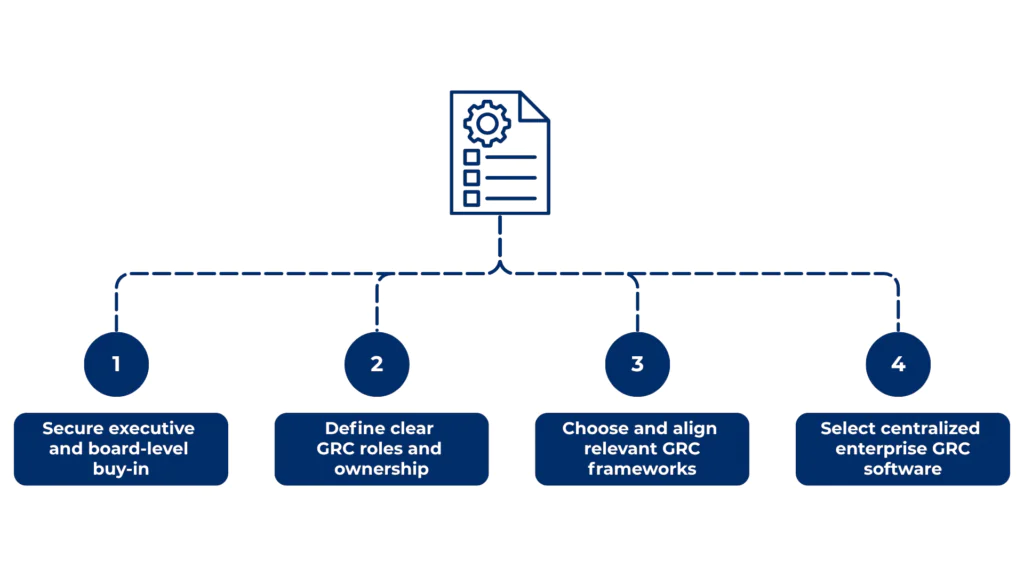
1. Secure executive and board-level buy-in
Enterprise GRC needs top-down support because it changes how departments manage and report risk, controls, and compliance. Executive and board sponsorship establishes GRC as an organization-wide priority and gives teams the authority to standardize processes across legal, HR, IT, security, finance, and other business units. Without this mandate, departments may continue using their own tools, data, and reporting methods, limiting the visibility an enterprise GRC program is intended to provide.
2. Define clear GRC roles and ownership
Establish who is responsible for managing the overall program and who owns individual activities across the organization. Depending on the business, leadership may sit with a GRC director, Chief Risk Officer (CRO), CISO, or dedicated risk and compliance committee.
Department-level responsibilities should also be clearly defined. Legal may oversee regulatory obligations, HR may own employee-related policies and controls, while IT and security manage technical controls, system risks, and supporting evidence. Clear ownership reduces duplicated work and prevents important responsibilities from falling between teams. Program performance should also be tracked using GRC metrics, such as control effectiveness, risk remediation times, compliance status, and outstanding audit findings.
3. Choose and align relevant GRC frameworks
Select frameworks based on regulatory obligations, customer requirements, industry expectations, and the organization’s risk profile. Enterprises may need to manage requirements across SOC 2, ISO 27001, NIST CSF, privacy regulations, and internal control programs.
Rather than managing each framework as an isolated project, identify overlapping requirements and map them to common controls. Standardizing control language and processes across the broader GRC program can significantly reduce duplicate work as additional frameworks are introduced.
4. Select centralized enterprise GRC software
Choose enterprise GRC tools that bring compliance tracking, risk assessments, controls, evidence, policies, and reporting into one system. The right GRC software should support cross-department workflows and provide leadership with organization-wide visibility rather than forcing teams to manage frameworks through disconnected spreadsheets and point tools.
For example, Sport Alliance used Scytale to centralize policy, risk, vendor, and compliance management in one platform, replacing fragmented processes across Confluence, Google Workspace, and its previous GRC tool.
Look for capabilities such as automated evidence collection, continuous control monitoring, multi-framework mapping, integrations, task ownership, and centralized reporting. These capabilities reduce manual work and make enterprise GRC easier to maintain as risks and compliance requirements change.

How Scytale supports enterprise GRC
Scytale brings the core components of an enterprise GRC program into one platform, connecting risk, controls, evidence, frameworks, and reporting. This gives teams a consistent way to manage GRC across departments while reducing the manual work involved in maintaining multiple frameworks. Cross-framework mapping across 80+ frameworks, including SOC 2, ISO 27001, ISO 42001, GDPR, HIPAA, and SOX ITGC, also allows teams to reuse controls and evidence rather than managing each framework separately.
Scytale combines automation with dedicated GRC expert support to help organizations build, manage, and scale their enterprise GRC program. Experts support teams through onboarding, identify gaps, and help align processes as requirements evolve, reducing fragmented workflows and making growing multi-framework compliance easier to manage.
FAQs about enterprise GRC
What does enterprise GRC mean?
Enterprise GRC means managing governance, risk, and compliance as one coordinated program across an organization. It connects departments and responsibilities to provide shared accountability and organization-wide oversight.
How does GRC differ from enterprise GRC (EGRC)?
The difference is scope and operating model. Traditional GRC often stays inside one department or one framework, while enterprise GRC connects multiple departments, leaders, and obligations on one system. EGRC focuses on organization-wide reporting, shared workflows, and centralized oversight rather than isolated compliance activity.
Do third-party risks fall under enterprise GRC?
Yes, third-party risks fall under enterprise GRC because vendor exposure affects security, operations, legal obligations, and customer trust across the business. An enterprise program tracks vendor risk alongside internal controls and compliance work. That shared view helps leaders assess outside dependencies with the same rigor as internal risks.
What should you look for in enterprise GRC software?
Look for enterprise GRC software that centralizes risk, compliance, controls, evidence, and reporting across departments. Key capabilities should include automation, continuous monitoring, cross-framework mapping, integrations, and clear reporting for leadership. Top AI GRC platforms like Scytale combine AI-powered workflows, centralized dashboards, and expert support to reduce manual work and simplify complex GRC programs.
How long does it take to implement an enterprise GRC program?
Implementation time depends on your scope, framework count, data quality, and internal alignment. A focused program moves faster when leadership sets ownership early and teams standardize controls across departments. Scytale’s AI GRC platform helps shorten the path by automating evidence work and guiding onboarding with dedicated GRC experts.
