



TL;DR: Common controls framework
- A common controls framework combines overlapping security and privacy requirements from multiple frameworks into one control library.
- Teams managing several audits use a common controls framework to reduce duplicate testing and reuse evidence across mapped requirements.
- A strong common controls framework writes controls to the highest applicable standard, then splits sub-controls only when requirements conflict.
- The build process starts with framework inventory and requirement mapping, then moves into ownership, platform setup, and continuous monitoring.
- Scytale’s AI GRC platform simplifies common controls frameworks with cross-framework mapping, automated evidence collection, and continuous monitoring.
A growing number of organizations are expected to demonstrate compliance with multiple security, privacy, and industry standards at the same time. What may start with a single certification often expands into a complex mix of customer requirements, regulatory obligations, and new frameworks as the business grows. Managing each one independently quickly becomes difficult to scale, increasing the administrative burden on compliance and security teams.
A common controls framework (CCF) offers a more sustainable approach by helping organizations manage overlapping requirements through a unified control strategy. In this article, you’ll learn what a common controls framework is, how it works, how to build one, the frameworks it typically maps, and best practices for ongoing multi-framework compliance.
What is a common controls framework (CCF)?
A common controls framework (CCF) is a unified set of security and privacy controls built by mapping and consolidating requirements from multiple frameworks, such as SOC 2, ISO 27001, PCI DSS, and HIPAA, into a single control library.
Instead of managing separate controls for each framework, organizations can use one standardized control framework to satisfy overlapping compliance requirements, reducing duplicate work and creating a more consistent compliance program. Unlike SOC 2 or ISO 27001, a CCF is not a published standard or certification. It is an organization-specific framework built by referencing authoritative standards and regulations, then consolidating their shared requirements into a single operating model. A CCF becomes valuable as soon as an organization manages two or more frameworks, and for many teams it becomes operationally necessary once three or more certifications run simultaneously.
A CCF does not replace published frameworks such as NIST CSF or COBIT. Instead, it builds on them by mapping their overlapping requirements into a single set of controls while the original frameworks remain the source of truth.
Streamline GRC workflows with no blind spots.
How does a common controls framework work?
A common controls framework works by treating overlapping compliance requirements as a single operating model instead of managing each framework independently. Rather than creating separate controls, policies, and evidence for every audit, organizations identify where requirements overlap and build one control library that satisfies multiple frameworks. This reduces duplicate work, improves consistency, and simplifies Governance, Risk, and Compliance (GRC) management.
1. Identify overlapping requirements across in-scope frameworks
The first step is to compare every framework your organization must comply with and identify requirements that address the same risk. Controls related to access management, encryption, logging, incident response, vendor risk management, and business continuity often have significant overlap across frameworks. Although the wording may differ, the underlying objective is usually the same.
2. Map those overlaps into a centralized control library
Next, group related requirements into a centralized control library. Each control should have a single control statement, a defined owner, and one source of supporting evidence. Instead of maintaining multiple versions of the same control, you map each framework requirement back to that shared control, creating a consistent structure that can support multiple audits.
3. Write each control to the strictest requirement
Once related requirements are grouped together, write the shared control to satisfy the most demanding requirement in the mapped set. This allows the same control to meet less stringent requirements automatically. For example, ISO 27001 Annex A.8.5 and PCI DSS Requirement 8.4 both address authentication security. However, PCI DSS defines multi-factor authentication in greater detail, so the shared control should be written to meet the PCI DSS requirement. Doing so allows the same control and supporting evidence to satisfy both frameworks.
4. Automate testing and monitoring across mapped controls
Finally, automate control testing, evidence collection, and continuous monitoring so the same evidence supports every framework mapped to that control. This eliminates repeated manual work and helps organizations stay audit-ready throughout the year. Where frameworks genuinely conflict, such as one requiring longer data retention while another emphasizes data minimization, create framework-specific sub-controls rather than forcing a single control that compromises both requirements.
Benefits of a common controls framework
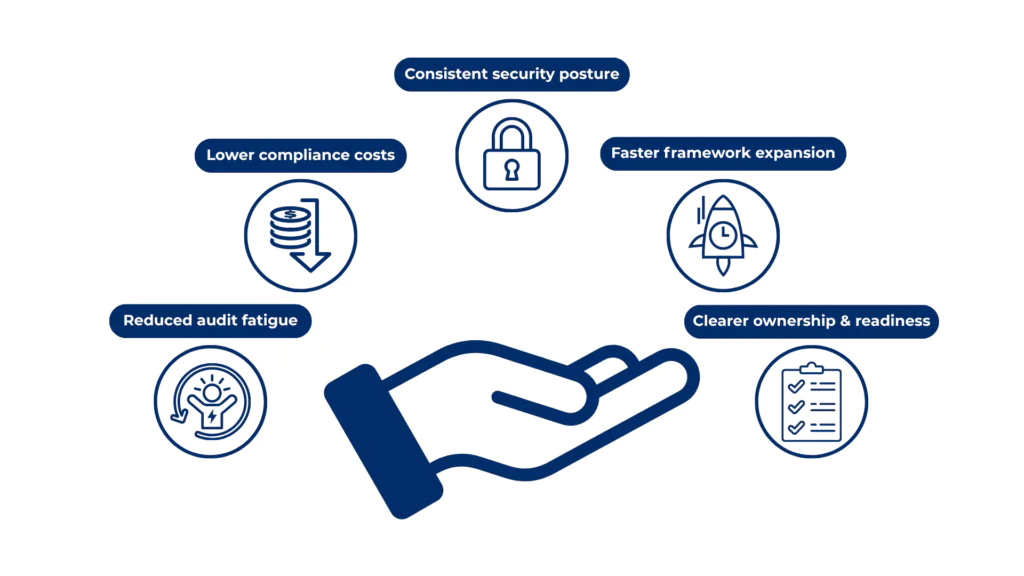
A common controls framework delivers value by reducing duplicate work across your compliance program. Instead of treating every audit as a separate project, organizations manage one shared set of controls that supports multiple frameworks. Here are the key benefits of implementing a common controls framework:
Reduced audit fatigue
A CCF reduces audit fatigue by allowing teams to test controls once and reuse the same evidence across every mapped framework. Instead of collecting separate access reviews, policy approvals, or incident records for multiple audits, a single evidence set can satisfy several compliance requirements at the same time.
Lower compliance costs
As a CCF matures, the cost of adding another compliance framework decreases. Many new requirements can be mapped to existing controls rather than requiring entirely new documentation, testing procedures, or consulting work. This reduces both implementation effort and ongoing maintenance costs.
Consistent security posture
A CCF improves consistency by defining one control for each security risk. Rather than different teams interpreting requirements in different ways, everyone follows the same control definitions, ownership model, and evidence standards. This reduces compliance gaps while strengthening your overall security program.
Faster framework expansion
Adding new certifications becomes much easier because you already have an established control baseline. Instead of building a new compliance program from scratch, organizations can map frameworks such as CMMC, DORA, or FedRAMP to existing controls, significantly reducing the time and effort required to achieve compliance.
Clearer ownership and readiness
A well-designed CCF assigns a single owner to every control and keeps supporting evidence up to date throughout the year. This creates clear accountability while helping organizations stay continuously audit-ready. Instead of scrambling to gather documentation before an audit, teams can focus on identifying and improving control gaps before they become audit findings.
AI-native GRC for how teams work today.
How to build a common controls framework: A step-by-step approach
Building a common controls framework helps organizations consolidate overlapping requirements into a single, centralized control library that supports multiple compliance frameworks. Here are the eight steps to build and maintain an effective common controls framework:
Step 1: Inventory every applicable framework and regulation
Start by identifying every framework, regulation, and customer requirement your organization must comply with today. This should include certifications you currently maintain, industry-specific regulations, contractual obligations, and any customer security requirements that influence your compliance program.
Don’t stop with your current obligations. Also include frameworks your organization expects to pursue within the next 12 to 18 months, whether driven by customer demand, market expansion, or strategic growth. Planning ahead helps you build a framework that can scale without requiring significant redesign every time a new certification is added.
Step 2: Extract requirements into a common format
Break each framework down into its individual controls or clauses and record every requirement in a standardized matrix. Organizing requirements into the same structure makes it much easier to compare frameworks that use different terminology but ultimately address the same security objectives.
Your matrix should capture more than just the requirement itself. Include information such as the control objective, expected evidence, responsible owner, implementation notes, and audit frequency. Having everything in one place creates the foundation for accurate control mapping.
Step 3: Map overlapping requirements
Once every requirement has been documented, identify controls that address the same underlying risk and group them together. Common areas of overlap include access management, encryption, logging and monitoring, incident response, vendor risk management, vulnerability management, and business continuity.
As you build these control clusters, identify whether one framework represents a strict superset of another. If one standard requires stronger controls or additional evidence, use that requirement as the baseline so a single control can satisfy multiple frameworks without unnecessary duplication.
Step 4: Design unified controls
Create one shared control for each group of overlapping requirements and write it to satisfy the highest applicable standard within that cluster. This approach allows the same policy, process, testing procedure, and evidence to meet the expectations of several frameworks simultaneously.
Not every requirement can be merged into a single control. If two frameworks have genuinely conflicting obligations, such as different data retention requirements or incompatible regulatory expectations, create framework-specific sub-controls instead. This preserves compliance without compromising either framework.
Step 5: Perform a gap assessment
Compare your proposed common controls framework against your existing security controls, policies, procedures, and operational processes. The goal is to determine which controls already exist, which require improvement, and which must be created from scratch before audits begin.
Prioritize remediation based on business risk, audit timelines, and regulatory impact rather than trying to complete everything at once. Addressing the highest-risk gaps first helps strengthen your security posture while keeping certification projects on schedule.
Step 6: Assign ownership and operating procedures
Every control should have a clearly defined owner who is responsible for maintaining its effectiveness over time. Ownership should include more than a person’s name. Define how often the control is performed, how it is tested, what evidence must be collected, and what happens if the control fails.
Documenting these operating procedures creates accountability across the organization and prevents controls from becoming neglected after certification. It also ensures auditors know exactly who owns each control and how it is maintained throughout the year.
Step 7: Configure your CCF in an AI GRC platform
Once your control library has been finalized, implement it within an AI GRC platform instead of relying on spreadsheets or disconnected documentation. A centralized platform allows every control to be mapped across multiple frameworks while maintaining a single source of truth.
Modern GRC platforms can automate evidence collection, control testing, and continuous monitoring. As evidence is collected, it can automatically satisfy every framework requirement mapped to that control, reducing manual effort and helping teams stay continuously audit-ready.
Step 8: Continuously maintain and expand the framework
As standards change and your business grows, your control library should be reviewed and updated regularly. Changes to frameworks such as SOC 2, ISO 27001, PCI DSS, or HIPAA should trigger a review of your mappings to ensure controls remain aligned.
The same process applies when your organization adopts new certifications. Instead of creating an entirely new compliance program, map new requirements to existing controls wherever possible and extend the framework only where necessary. This allows your control framework to grow efficiently while maintaining consistency across every compliance framework.
Always-on GRC. Built for modern teams.
Common frameworks mapped in a CCF
Most common controls frameworks are built by consolidating requirements from the standards and regulations an organization must comply with. The right mix depends on your industry, customer requirements, and regulatory obligations, but these are the frameworks most commonly mapped into a CCF.
SOC 2
SOC 2 is widely used by SaaS companies because its Trust Services Criteria focus on the security controls enterprise customers expect. It is often the first framework organizations adopt. Its controls overlap heavily with other frameworks, making SOC 2 a strong starting point for cross-mapping.
ISO 27001
ISO 27001 is a common CCF foundation because its Annex A controls provide detailed information security guidance. Its structure simplifies control mapping and management. Many organizations use ISO 27001 as their primary mapping anchor before adding other frameworks.
NIST Cybersecurity Framework (CSF) 2.0
NIST CSF 2.0 organizes cybersecurity around six core functions: Govern, Identify, Protect, Detect, Respond, and Recover. It provides a flexible, risk-based security framework. It complements certification frameworks by helping organizations align security activities with business risk.
PCI DSS
PCI DSS applies to organizations that handle payment card data. It includes detailed requirements for authentication, encryption, logging, and vulnerability management. Its prescriptive controls often establish the highest standard within a shared control library.
HIPAA
HIPAA establishes security and privacy requirements for organizations handling protected health information (PHI). It adds healthcare-specific safeguards to broader security controls. Many organizations map HIPAA requirements to existing controls rather than creating a separate program.
Secure Controls Framework (SCF)
The Secure Controls Framework (SCF) is an openly available meta-framework with more than 1,000 controls mapped to over 100 regulations and standards. Some organizations use the SCF as a starting point, while others build their own CCF from the frameworks they need.
Common framework comparison
| Framework | Primary purpose | Why it’s commonly mapped |
| SOC 2 | Customer assurance for service organizations | Strong overlap with SaaS security controls. |
| ISO 27001 | Information Security Management System | Detailed Annex A controls make cross-mapping easier. |
| NIST CSF 2.0 | Risk-based cybersecurity framework | Aligns security activities with business risk. |
| PCI DSS | Payment card data security | Often sets the strictest control requirements. |
| HIPAA | Healthcare information security | Adds healthcare-specific safeguards to existing controls. |
| Secure Controls Framework (SCF) | Cross-mapped meta-framework | Provides pre-built mappings across 100+ standards. |



How Scytale supports common controls framework management
A common controls framework only delivers value when control mappings, evidence, and ownership stay accurate over time. Scytale operationalizes your CCF with multi-framework cross-mapping, AI-powered evidence collection, and continuous control monitoring, making it easier to manage multiple compliance frameworks from a single platform.
Scytale automatically maps controls across more than 80 frameworks, so evidence collected for one control can satisfy matching requirements across others. For example, a SOC 2 access review can also fulfill the corresponding controls in ISO 27001, PCI DSS, or HIPAA without your team manually collecting evidence or maintaining separate mappings. Combined with continuous monitoring and support from dedicated GRC experts, Scytale keeps controls and evidence up to date year-round, ensuring your CCF remains a living compliance program instead of a static spreadsheet.
FAQs about common controls framework
What is the difference between a common controls framework and a compliance framework?
A common controls framework is an organization-built control library that maps overlapping requirements from multiple published frameworks into one structure. A compliance framework is the authoritative source, such as SOC 2, ISO 27001, HIPAA, or PCI DSS that defines the original requirements your team must satisfy.
Which frameworks are typically mapped into a common controls framework?
Teams usually map SOC 2, ISO 27001, NIST CSF, PCI DSS, and HIPAA into a common controls framework. Some also use the Secure Controls Framework as a starting scaffold because it already crosswalks many regulations and standards into a broad control structure.
Is the Secure Controls Framework (SCF) the same as a common controls framework?
No, the Secure Controls Framework is not the same as a common controls framework. SCF is a published meta-framework with prebuilt crosswalks, while a CCF is your organization’s own mapped control library, which might use SCF as a base or skip it entirely.
How long does it take to build a common controls framework?
The timeline depends on framework count, control maturity, and tool support, but most teams need several weeks to several months. Scytale’s AI GRC platform shortens the process by automating cross-framework mapping, evidence collection, and monitoring, which removes much of the manual comparison and maintenance work.
Do small businesses need a common controls framework, or only large enterprises?
Small businesses need a common controls framework once they manage multiple frameworks or customer assurance demands at the same time. Leading AI GRC platforms like Scytale help smaller teams handle that complexity without building separate control sets for every audit, which keeps ownership clear and evidence reuse practical.