








TL;DR: ISO 27001 vs 27002
- ISO 27001 is the certifiable standard for building and auditing an information security management system.
- ISO 27002 gives implementation guidance for the controls organizations use inside an ISO 27001 program.
- The main difference between ISO 27001 and 27002 is that one sets requirements while the other explains control practices.
- Teams use ISO 27002 to interpret, implement, and evidence Annex A controls during ISO 27001 certification work.
- Scytale’s AI GRC platform helps teams connect ISO 27001 requirements, control evidence, and day-to-day compliance work in one place.
Security and compliance teams often lose time on ISO 27001 vs ISO 27002 because the two standards share a numbering series and a control set, yet play very different roles in a certification program. Treating them as interchangeable can slow scoping, blur control ownership, and weaken the evidence an auditor reviews during an ISO 27001 audit.
The difference between ISO 27001 and 27002 matters most when your team starts mapping requirements to controls and evidence. Organizations that know which standard sets the rules and which one guides implementation typically scope faster and enter audits with fewer gaps. In this article, we explain how the two standards differ, how they work together, and what the 2022 update changed.
What is ISO 27001?
ISO 27001 is the international, certifiable standard that sets the requirements for establishing, implementing, maintaining, and continually improving an information security management system (ISMS).
Published jointly by ISO and the IEC, the standard defines what an ISMS must include: a defined scope, leadership commitment, risk assessment and treatment, control selection, internal audits, management review, and continual improvement. Its mandatory clauses 4 through 10 set out these management system ISO 27001 requirements, while Annex A lists the 93 reference controls organizations consider during risk treatment.
ISO 27001 tells organizations what their program must achieve, not the exact technical method for every control, which gives teams the flexibility to fit controls to their own risks and environment. Accredited certification bodies audit the ISMS against these requirements, and certified organizations maintain their status through annual surveillance audits and a full recertification audit every three years. For a broader introduction to the standard and its benefits, see our guide on what is ISO 27001.
Streamline GRC workflows with no blind spots.
What is ISO 27002?
ISO 27002 is the supporting guidance standard that explains the purpose of each Annex A control in ISO 27001 and how organizations can implement it in practice.
Unlike ISO 27001, ISO 27002 is not a management system standard and does not contain certifiable requirements. Instead, it gives teams a detailed reference for ISO 27002 controls, covering each control’s purpose, implementation guidance, and related considerations, so policies, procedures, and technical safeguards are designed with greater consistency.
This guidance becomes most valuable during implementation. When control owners ask how a control should operate, which evidence demonstrates it, or who should own it, ISO 27002 supplies the detail that the brief Annex A descriptions in ISO 27001 leave open. The 2022 edition also assigns attributes to each control, helping organizations filter and map controls by type, security property, and cybersecurity concept.
ISO 27001 vs ISO 27002: Key differences
ISO 27001 and ISO 27002 share the same control set, which is why teams often treat them as interchangeable during early scoping. In practice, the two standards serve different purposes, carry different weight in an audit, and speak to different stakeholders inside the organization. Here are the key differences between ISO 27001 vs 27002 across purpose, certification, structure, and audience:
Purpose
The clearest way to compare ISO 27001 vs ISO 27002 is by purpose. ISO 27001 defines what an organization’s ISMS must achieve, while ISO 27002 explains how teams can apply each control within that system. Put simply, ISO 27001 sets the requirements, and ISO 27002 provides the practical guidance for meeting the control-related ones.
Certification
Certification creates the most practical difference. Organizations certify against ISO 27001 through an accredited certification body, but no ISO 27002 certification exists, because the standard serves as guidance rather than an auditable requirement set. Auditors may still reference ISO 27002 when they assess whether a control is designed and operating effectively, which makes the guidance useful during audit preparation even though it is never the basis of the certificate.
Structure
ISO 27001 combines mandatory management system clauses (4 through 10) with Annex A, which describes each control in a single sentence. It also requires a risk-based approach to control selection and a Statement of Applicability (SoA) that records which Annex A controls apply and why. ISO 27002, by contrast, focuses entirely on the control set, organizing the same 93 controls under four themes and expanding each one with a purpose statement, implementation guidance, and attributes.
Audience
Executives, compliance owners, and auditors typically rely on ISO 27001 to understand what the organization must prove and how the ISMS is governed. Security engineers, IT teams, and control owners use ISO 27001 controls alongside ISO 27002 guidance to shape day-to-day execution, from access reviews to logging configurations. Viewed from the ISO 27002 vs 27001 angle, the guidance standard is the operational companion that helps those teams translate requirements into working safeguards.
ISO 27001 vs ISO 27002 comparison
| Criteria | ISO 27001 | ISO 27002 |
|---|---|---|
| Primary purpose | Defines ISMS requirements | Guides control implementation |
| Certification | Yes, organizations certify against it | No, it is not certifiable |
| Structure | Clauses 4 to 10 plus Annex A control list | Detailed guidance for 93 controls across four themes |
| Level of detail | One-sentence control descriptions | Purpose, guidance, and attributes per control |
| Mandatory status | Required for certification | Optional, recommended reference |
| Primary audience | Executives, compliance owners, auditors | Security teams, control owners, implementers |
AI-native GRC for how teams work today.
How ISO 27001 and ISO 27002 work together
Organizations get the most value from ISO 27001 and ISO 27002 when they treat the two standards as connected parts of one operating model. ISO 27001 defines what the ISMS must achieve, while ISO 27002 helps teams decide how each selected control should work and how to prove it. Here are the three stages where the two standards come together:
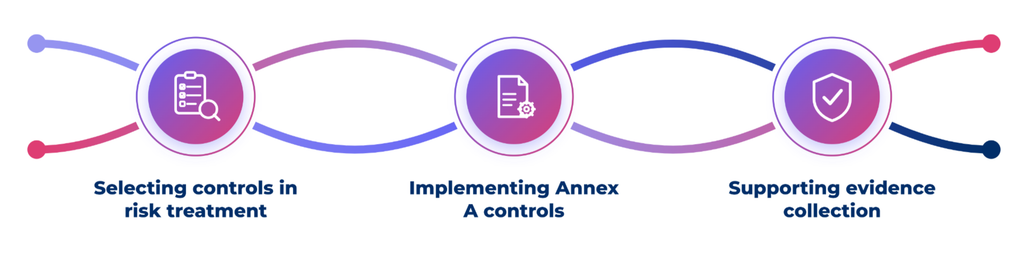
Selecting controls during risk treatment
The relationship starts with risk assessment and treatment. After identifying risks, teams determine the necessary controls, compare them against Annex A, and document their decisions in the ISO 27001 risk treatment plan and the Statement of Applicability. ISO 27002 informs these choices by clarifying what each control is meant to achieve, which helps teams judge whether a control genuinely addresses a given risk.
Using ISO 27002 to implement Annex A controls
Annex A names the controls organizations consider, but it does not spell out implementation detail. ISO 27002 fills that gap by describing the intent, common practices, and operational considerations behind each control. Teams working through access control, supplier security, or logging, for instance, use ISO 27002 to shape procedures, assign owners, and define review cadences, which reduces guesswork and produces stronger evidence for certification.
Using ISO 27002 to support evidence collection
Evidence quality improves when control owners understand what good implementation looks like before the audit begins. ISO 27002 helps teams connect each control to the records auditors expect, including approvals, tickets, system settings, logs, and periodic review outputs. Mapping controls to evidence early, and collecting that evidence continuously from integrated systems rather than by hand, keeps the ISMS audit-ready between certification cycles.
For example, an APAC-based wealth management fintech achieved its first ISO 27001 certification with Scytale, using automated evidence collection across seven AWS services to maintain continuous audit readiness.
ISO 27002:2022 control changes
ISO 27002:2022, published in February 2022, restructured the control set for the first time since 2013, and ISO 27001:2022 updated Annex A to match later that year. The changes affect how teams read, map, and maintain controls, so certified organizations need a clear view of what moved. Here are the main changes in the 2022 revision:
- New structure: Controls are grouped into four themes instead of the previous 14 domains: organizational (37 controls), people (8), physical (14), and technological (34).
- Consolidated control set: The total dropped from 114 to 93 controls, largely because overlapping controls were merged rather than removed.
- New controls: Eleven controls were added, including threat intelligence, information security for cloud services, ICT readiness for business continuity, data masking, data leakage prevention, web filtering, and secure coding.
- Control attributes: Each control now carries five attributes (control type, security properties, cybersecurity concepts, operational capabilities, and security domains) to support filtering and mapping.
For certified organizations, the ISO 27001:2022 update required a transition from the 2013 edition, and the transition period for 2013 certificates ended on October 31, 2025. Teams that have completed the move should still maintain a clean crosswalk between legacy control references, the current themes, and the evidence their auditor expects, and review policies, risk treatment plans, and the Statement of Applicability against the revised structure.
Do you need both?
If the goal is certification, the answer is straightforward: organizations need ISO 27001, because certification bodies audit the ISMS against its requirements. A separate ISO 27002 certification is not required, since no such certification exists, and organizations do not need to formally adopt ISO 27002 to achieve ISO 27001 certification.
In practice, most organizations still benefit from using ISO 27002 because it helps control owners interpret Annex A and implement controls with fewer gaps. Teams that skip the guidance often spend more time debating control design and evidence quality during audit preparation, which can extend timelines and increase the risk of nonconformities.
Always-on GRC. Built for modern teams.
How Scytale simplifies ISO 27001
Scytale‘s AI GRC platform brings ISO 27001 requirements, Annex A controls, and supporting evidence into one workspace, so teams no longer manage scope, ownership, and audit progress across disconnected tools. Automated evidence collection from integrated systems, continuous control monitoring, and structured workflows for policy and control reviews help teams move from interpreting ISO 27002 guidance to demonstrating that each control operates as intended. AI agents review evidence and flag gaps early, giving teams real-time visibility into the ISMS well before an auditor arrives.
Scytale supports more than 80 frameworks, and cross-framework control mapping lets organizations reuse ISO 27001 work for SOC 2, GDPR, HIPAA, and SOX ITGC rather than repeating it. A customizable Trust Center helps teams share their security posture with customers and partners, while dedicated GRC experts guide organizations through scoping, the Statement of Applicability, and certification audits. Together, this combination reduces manual effort and keeps ISO 27001 programs continuously audit-ready as the business grows.
FAQs about ISO 27001 vs 27002
What is the difference between ISO 27001 and ISO 27002?
ISO 27001 sets the certifiable requirements for an information security management system, while ISO 27002 provides implementation guidance for the Annex A controls. ISO 27001 defines what an organization must achieve, and ISO 27002 explains how controls can be designed and operated in practice.
Can you get certified to ISO 27002?
No, organizations cannot get certified to ISO 27002 because it is a guidance standard without auditable requirements. Certification is only available against ISO 27001, although auditors may refer to ISO 27002 when assessing how controls are implemented.
Do I need ISO 27002 to get ISO 27001 certified?
No, ISO 27002 is not a prerequisite for ISO 27001 certification, but it makes control implementation considerably easier. Most teams use it to interpret Annex A and define appropriate evidence, and leading ISO 27001 compliance platforms like Scytale map that guidance directly to controls and evidence requirements.
How many controls are in ISO 27002:2022?
ISO 27002:2022 contains 93 controls, down from 114 in the 2013 edition. They are grouped into four themes: organizational (37), people (8), physical (14), and technological (34), with 11 new controls added in the revision.
Is ISO 27002 mandatory?
No, ISO 27002 is not mandatory for any organization, including those pursuing ISO 27001 certification. It is a recommended reference that helps teams implement controls consistently, and Scytale’s AI GRC platform helps organizations apply that guidance through automated evidence collection and continuous monitoring.
