










TL;DR: AI tools for SOC 2 compliance
- AI-powered SOC 2 tools go beyond rule-based automation by interpreting evidence, detecting gaps, and recommending or executing remediation.
- The strongest platforms combine AI agents, continuous control monitoring, and cross-framework mapping in a single environment.
- Evaluate tools on how their AI handles evidence validation, policy generation, risk detection, and auditor-ready outputs.
- AI accelerates SOC 2 readiness, but a licensed CPA firm must still perform the examination and issue the report.
- Scytale’s AI GRC platform pairs a multi-agent suite with dedicated GRC experts to keep SOC 2 programs continuously audit-ready.
For B2B companies selling to enterprise buyers, SOC 2 has become a baseline requirement, and the work behind it rarely shrinks after the first report. Controls must be monitored, evidence must stay current, and policies must reflect how the business actually operates, often across several frameworks at once.
Most vendors now market SOC 2 compliance AI capabilities, yet the substance behind that label ranges from a chatbot added to a checklist to autonomous agents that review evidence and close gaps. Knowing where a tool sits on that spectrum determines whether it delivers real efficiency or simply adds another dashboard to maintain. In this article, we explain what genuine AI looks like in SOC 2 tools and compare the ten leading platforms.
Top AI tools for SOC 2 compliance
- Scytale
- Strike Graph
- Anecdotes
- TrustCloud
- Trustero
- JupiterOne
- LogicGate
- OneTrust
- Vanta
- Drata
What makes a SOC 2 tool “AI-powered”?
An AI-powered SOC 2 tool is a compliance platform that uses machine learning, large language models, or autonomous agents to interpret, validate, and act on compliance data, rather than only executing predefined automation rules.
Traditional SOC 2 compliance automation relies on fixed integrations and scripted tests that pull a configuration, check it against a rule, and mark a control as passing or failing. This approach reduces manual screenshot collection, but it cannot independently assess whether a policy meets a control’s intent or whether uploaded evidence satisfies an auditor’s requirements. It also struggles with anything outside a prebuilt connector, such as manual processes, custom systems, or narrative documentation.
Genuine AI for SOC 2 adds reasoning on top of that data layer. In practice, this means validating evidence against control requirements, drafting policies tailored to the organization’s environment, flagging gaps with specific remediation steps, and answering security questionnaires from existing documentation. The most advanced platforms go further with agentic AI, where specialized agents own tasks such as evidence review or gap remediation from start to finish. When assessing vendors, teams should ask what the AI decides or produces on its own, and what still requires a person to interpret raw automation output.
AI-native GRC for how enterprise teams work today.
How we evaluated these AI tools
This list deliberately focuses on AI capabilities rather than general SOC 2 coverage, since most established platforms already handle core evidence collection and framework templates. The real question for compliance leaders is which tools deliver meaningful AI SOC 2 compliance support, applying AI where it reduces effort and risk rather than simply adding a new interface. Here are the criteria we used to rank each platform:
- AI evidence validation: Whether the AI reviews collected evidence against control requirements and flags weak or missing artifacts before auditors see them.
- Agentic workflows: Whether specialized AI agents can own tasks such as evidence collection, gap detection, and remediation without constant prompting.
- Continuous monitoring: How effectively the platform supports AI continuous SOC 2 compliance through real-time control testing and drift alerts.
- Policy and questionnaire generation: The quality of AI-drafted policies and questionnaire responses, and how accurately they reflect the organization’s actual controls.
- Multi-framework intelligence: Whether AI-driven cross-mapping reuses SOC 2 work across ISO 27001, GDPR, HIPAA, and other frameworks.
- Human oversight and support: Whether AI outputs remain reviewable and explainable, and whether compliance expertise is available when judgment calls arise.
Get SOC 2 Compliant 90% Faster
10 best AI tools for SOC 2 compliance
The platforms below range from AI-native GRC suites to established risk and privacy platforms that have added AI to existing workflows. Each entry focuses on how the tool applies AI to SOC 2 specifically, alongside its ideal fit, pricing model, and trade-offs. Here are the 10 best AI tools for SOC 2 compliance:
1. Scytale
Scytale stands out as the best AI tool for SOC 2 compliance, built for SaaS organizations that need SOC 2 to run continuously alongside frameworks such as ISO 27001, ISO 42001, GDPR, HIPAA, and SOX ITGC. Its AI GRC platform deploys a multi-agent suite in which specialized agents own evidence collection and review, policy generation, gap detection, and remediation workflows across 80+ frameworks.
The AI Evidence Reviewer validates artifacts against control requirements before audit fieldwork begins, while the AI Risk Remediator identifies control vulnerabilities and recommends mitigation steps. Scytale’s AI GRC agents answer compliance questions in context and help complete security questionnaires using existing platform data. Combined with seamless integrations and dedicated GRC experts, these capabilities help teams maintain SOC 2 audit readiness while reducing manual work.
Pricing: Tailored packages based on company size, frameworks, and scope.
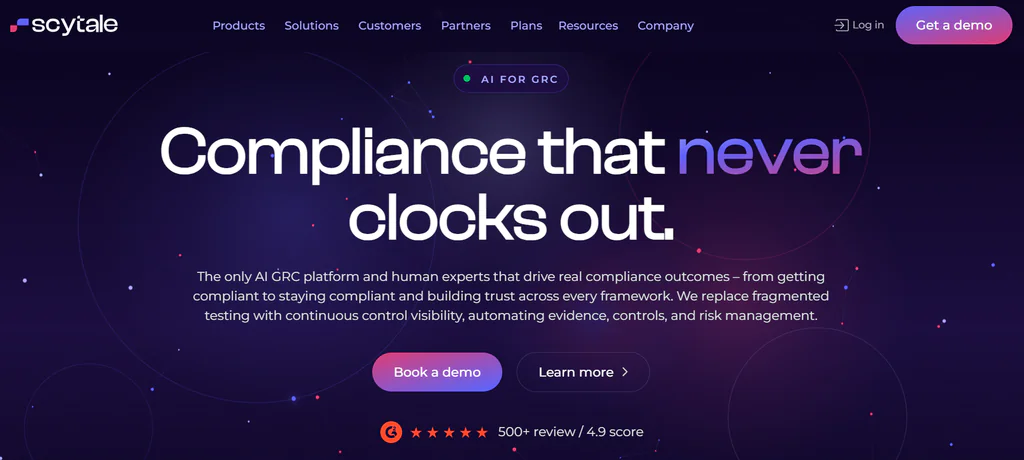
(Screenshot from Scytale’s website)
Why Scytale is the best:
- Continuous SOC 2 monitoring to detect control gaps, track security risks, and maintain audit readiness year-round.
- Agentic compliance that automates evidence collection, validates documentation, identifies compliance gaps, and streamlines remediation.
- Multi-framework management with control mapping across SOC 2, ISO 27001, GDPR, HIPAA, and SOX ITGC to reduce duplicate work.
- Seamless integrations with cloud, HR, identity, and security tools to streamline compliance workflows and keep evidence up to date.
- Customizable Trust Center to showcase your security and compliance posture and build customer trust.
- Dedicated GRC experts providing tailored guidance throughout SOC 2 preparation, audits, and ongoing compliance.
2. Strike Graph
Strike Graph is a compliance platform that tailors control sets to each organization’s risk profile, supporting SOC 2, ISO 27001, HIPAA, CMMC, and other frameworks. Its Verify AI capability reviews evidence and control design, while the AI Security Assistant supports questionnaire responses and day-to-day compliance questions.
Pricing: Free starting option, with paid plans priced by frameworks and scope.
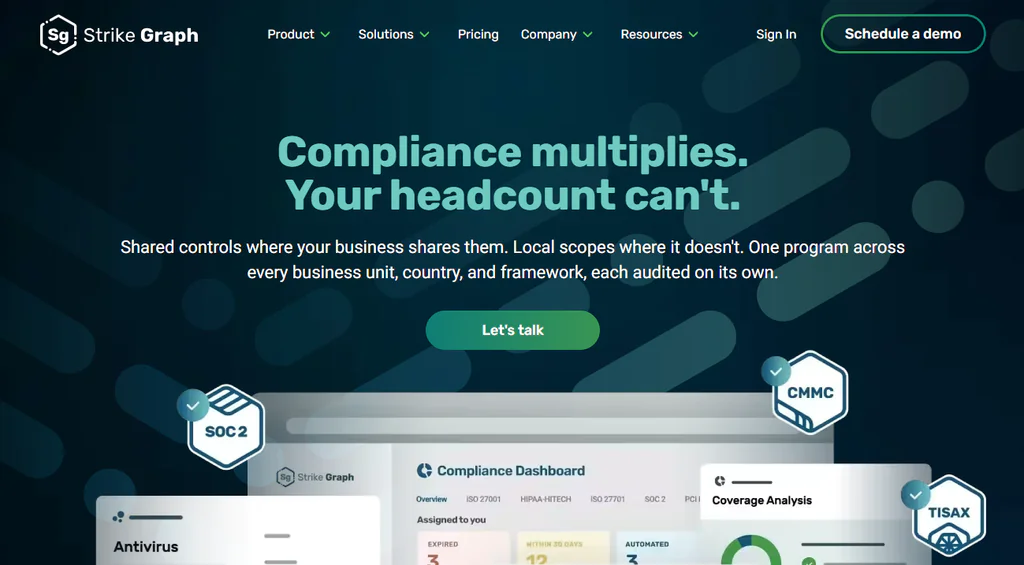
(Screenshot from Strike Graph’s website)
Key strengths:
- Risk-based control design keeps SOC 2 scope aligned with actual business risk
- Verify AI checks evidence quality before it reaches the auditor
- Shared evidence mapping reduces duplicate work when adding ISO 27001 later
Limitations:
- AI capabilities are narrower than platforms built around autonomous multi-agent workflows
- Risk-based scoping requires thoughtful upfront input to avoid misaligned control sets
3. Anecdotes
Anecdotes is an enterprise agentic GRC platform built on a data engine that structures system data into audit-grade compliance context. Teams can deploy prebuilt agents from its Agent Library, build custom agents in the no-code Agent Studio, and query their program through ChatGRC.
Pricing: Quote-based, with a free 30-day trial.
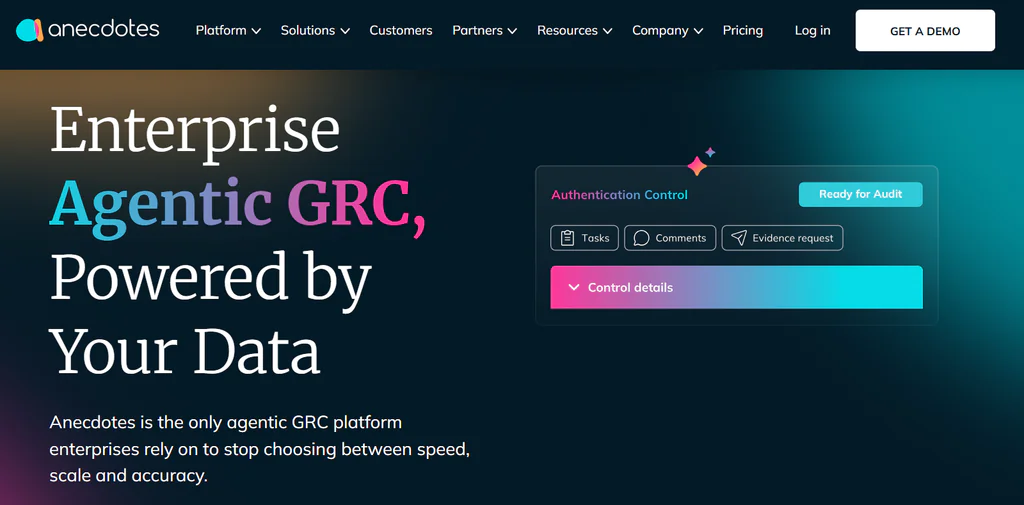
(Screenshot from Anecdotes’ website)
Key strengths:
- No-code Agent Studio lets teams build custom agents for unique workflows
- Unified data layer gives AI agents consistent, cross-system program context
- Model Context Protocol support connects GRC data to external AI assistants
Limitations:
- Designed for mature programs, which can overwhelm teams pursuing a first SOC 2 report
- Custom agents require internal ownership to design, test, and maintain over time
4. TrustCloud
TrustCloud is an AI-powered trust assurance platform whose TrustOps application automates control verification and audit readiness across SOC 2, ISO 27001, HIPAA, and privacy frameworks. Its AI models are trained on GRC-specific data and support predictive control recommendations, security questionnaire automation, and vendor risk reviews.
Pricing: Free tier for small startups on a single framework, with paid tiers and add-ons beyond that.
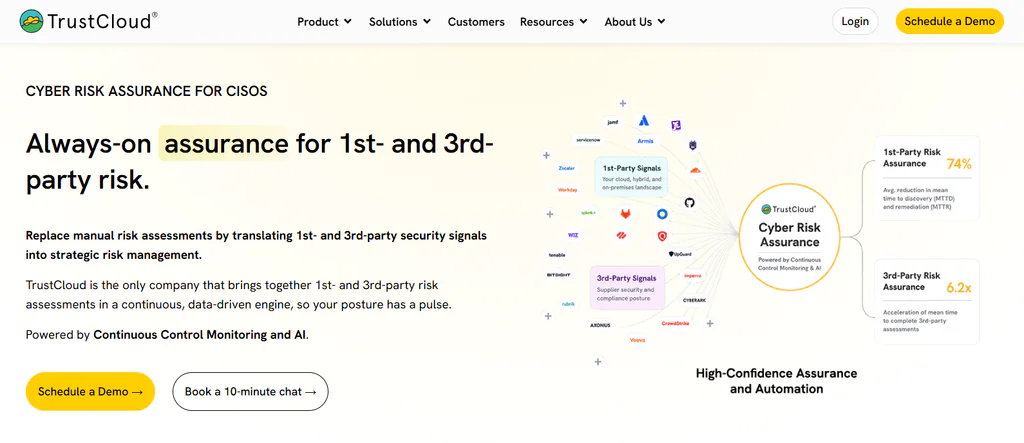
(Screenshot from TrustCloud’s website)
Key strengths:
- GRC-trained AI models recommend controls tailored to each framework’s requirements
- AI questionnaire automation shortens security reviews during enterprise sales cycles
- Integrated risk register supports quantitative risk reporting for leadership teams
Limitations:
- Integration catalog is often compared unfavorably with larger compliance automation platforms
- New regulation packs may lag until they are added to its control catalog
5. Trustero
Trustero is an AI-native GRC platform that analyzes controls, infers their intent, and validates evidence daily across SOC 2, ISO 27001, HIPAA, PCI DSS, and other frameworks. It can run on-demand AI audits against a framework, and its Report Scan tool summarizes SOC 2 reports received from vendors.
Pricing: Platform tiers listed on AWS Marketplace, with framework packages priced separately.
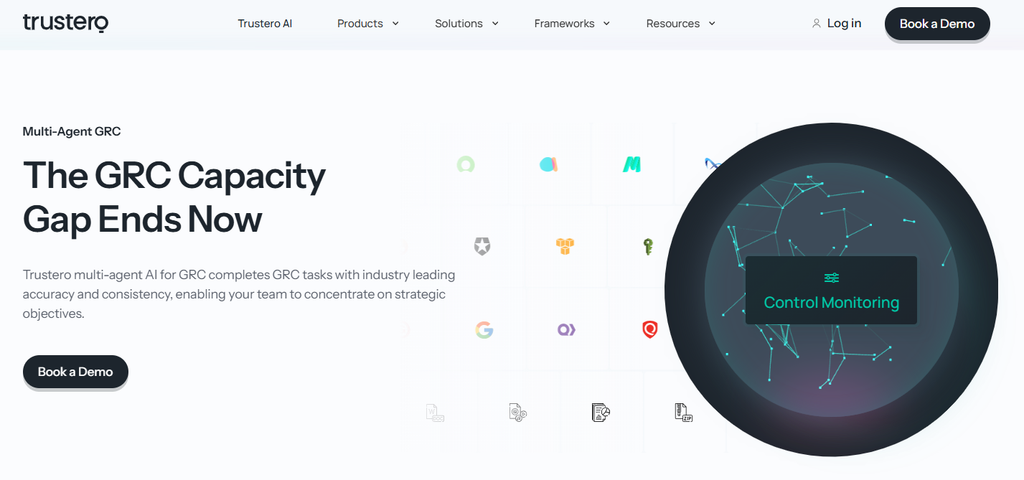
(Screenshot from Trustero’s website)
Key strengths:
- On-demand AI audits surface control gaps before formal audit fieldwork begins
- Report Scan accelerates review of vendor SOC 2 reports for third-party risk
- Natural language playbooks let teams define compliance workflows without scripting
Limitations:
- Separate platform and framework charges can raise costs for multi-framework programs
- No public pricing on its own website, which complicates early budget planning
6. JupiterOne
JupiterOne is a graph-based cyber asset platform that maps cloud, code, identity, and endpoint assets along with the relationships between them. Its continuous controls monitoring evaluates policy-as-code against the live asset graph, while JupiterOne AI lets teams query compliance status in plain English.
Pricing: Custom pricing on request.
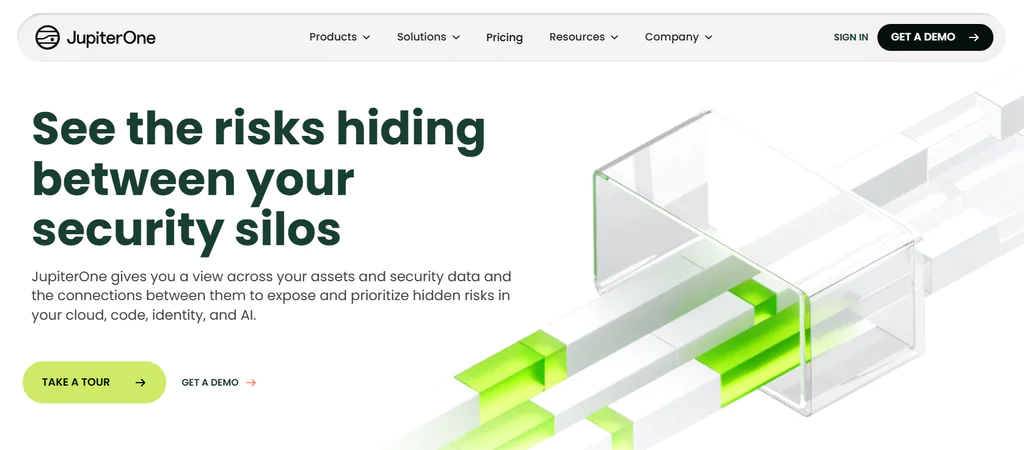
(Screenshot from JupiterOne’s website)
Key strengths:
- Asset graph exposes which systems are missing required SOC 2 controls
- Natural language queries return control and asset answers in seconds
- Policy-as-code keeps technical control testing aligned with live infrastructure
Limitations:
- Focuses on technical controls, so policies and auditor workflows may need other tools
- Mapping unusual asset types into its data model can require engineering effort
7. LogicGate
LogicGate Risk Cloud is a no-code GRC platform used to build customized risk, compliance, and third-party risk workflows. Its Spark AI suite adds opt-in capabilities such as an AI text assistant, record linking recommendations, and support for control mapping and evidence review.
Pricing: Quote-based, with Spark AI features included in subscriptions at no additional cost.
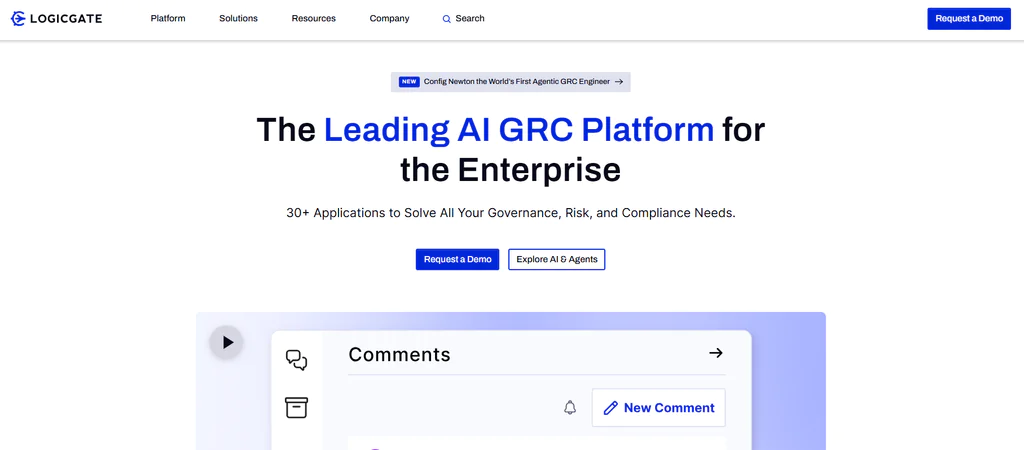
(Screenshot from LogicGate’s website)
Key strengths:
- Record linking recommendations reveal hidden connections between risks, controls, and policies
- Opt-in AI settings give administrators granular governance over AI usage
- Risk Cloud Quantify adds financial context to risk prioritization decisions
Limitations:
- No-code flexibility requires upfront configuration before SOC 2 workflows run smoothly
- Spark AI enhances user tasks but does not replace dedicated SOC 2 evidence automation
8. OneTrust
OneTrust is a broad governance platform best known for privacy management, with GRC and security assurance modules that cover frameworks such as SOC 2 and ISO 27001. Its AI capabilities span data discovery, automated policy workflows, AI-assisted risk assessments, and agents for specific use cases such as breach management.
Pricing: Quote-based and modular, priced by product and organization size.
(Screenshot from OneTrust’s website)
Key strengths:
- Unified privacy and GRC data reduces duplicate assessments across teams
- AI-driven data discovery supports SOC 2 confidentiality and privacy criteria
- AI governance tools help inventory and assess internal AI systems
Limitations:
- Privacy-first heritage means SOC 2 automation is one module among many
- Broad modular platform can be complex and costly for SOC 2-focused teams
9. Vanta
Vanta is a compliance automation platform that pairs continuous control monitoring with the Vanta AI Agent across SOC 2, ISO 27001, HIPAA, and other frameworks. The agent drafts policies, checks evidence, maps policies to controls, and helps teams answer security questionnaires.
Pricing: Quote-based across several plans, with expanded AI Agent features in higher tiers.
(Screenshot from Vanta’s website)
Key strengths:
- Broad integration library supports automated evidence collection across common tech stacks
- AI Agent drafts policies and evaluates evidence within guided workflows
- Auditor and service partner directories simplify audit firm selection
Limitations:
- AI-generated policy drafts still require careful human review before adoption
- Highly custom integrations may need additional implementation support
10. Drata
Drata is an agentic trust management platform that automates evidence collection and continuous control monitoring for SOC 2 and other frameworks. Its AI agents run third-party risk assessments, support questionnaire responses, and help build a customer-facing Trust Center.
Pricing: Quote-based tiers, with advanced GRC capabilities reserved for higher plans.
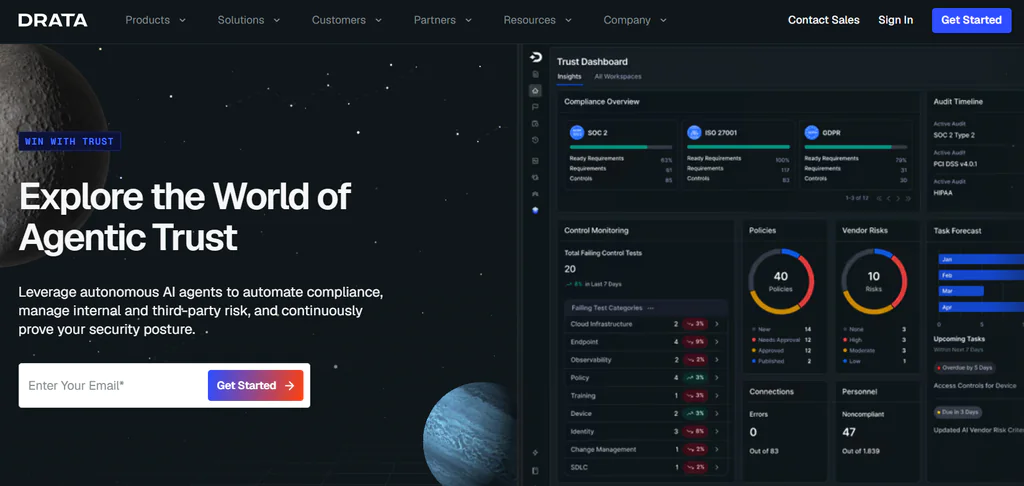
(Screenshot from Drata’s website)
Key strengths:
- Agentic third-party risk assessments review vendors with minimal back-and-forth
- Multi-framework control mapping reuses SOC 2 evidence across additional standards
- Built-in auditor access streamlines collaboration during SOC 2 fieldwork
Limitations:
- Several agentic capabilities are recent releases, with some still in beta
- Custom connections and tests are limited to higher-tier plans
AI tools for SOC 2 compared
| Platform | Key AI features | Frameworks | Best for |
|---|---|---|---|
| Scytale | AI GRC automation, multi-agent suite for evidence review, policy generation, gap detection and remediation, and the Scy AI GRC agent | 80+, including SOC 2, ISO 27001, ISO 42001, GDPR, HIPAA, and SOX ITGC | SaaS organizations of all sizes with complex compliance needs seeking efficient AI GRC management processes |
| Strike Graph | Verify AI, AI Security Assistant | SOC 2, ISO 27001, HIPAA, CMMC | Small and mid-sized companies seeking a right-sized SOC 2 control set |
| Anecdotes | Agent Studio, Agent Library, ChatGRC | SOC 2, ISO 27001, HIPAA, custom | Large enterprises running mature, highly customized GRC programs |
| TrustCloud | Control recommendations, questionnaire AI | SOC 2, ISO 27001, HIPAA, privacy | B2B software companies linking compliance work directly to sales enablement |
| Trustero | AI audits, evidence validation, Report Scan | SOC 2, ISO 27001, HIPAA, PCI DSS | Lean security teams that want AI-led audit preparation with minimal configuration |
| JupiterOne | Natural language queries, CCM | SOC 2, ISO 27001, PCI DSS, NIST | Engineering-led security teams operating complex, multi-cloud environments |
| LogicGate | Spark AI assistant, record linking | SOC 2, ISO 27001, custom | Mid-market and enterprise risk teams that need highly configurable GRC workflows |
| OneTrust | Data discovery, AI risk assessments | SOC 2, ISO 27001, privacy laws | Large enterprises consolidating privacy, GRC, and AI governance on one platform |
| Vanta | AI Agent for policies and evidence | SOC 2, ISO 27001, HIPAA, GDPR | Startups and scaling companies seeking a fast first SOC 2 report |
| Drata | Agentic TPRM, questionnaire agents | SOC 2, ISO 27001, HIPAA, PCI DSS | Growth-stage and enterprise teams that prioritize trust assurance in sales cycles |
How to choose the right AI tool for SOC 2
The right platform depends less on the length of its AI feature list and more on how well that AI fits your team, deadlines, and systems. A tool built for a large enterprise GRC function can slow down a lean team, while a startup-focused tool may stall once frameworks and business units multiply. Here are the main factors to weigh:
Team size and in-house expertise
Lean teams without a dedicated compliance hire typically benefit most from agent-led workflows backed by expert support, since AI handles execution while specialists cover judgment calls. Larger GRC functions generally need configurable workflows, granular permissions, and an AI GRC platform that scales across business units without fragmenting compliance data.
Audit timeline
When an enterprise deal depends on a SOC 2 report within weeks, prioritize tools whose AI validates evidence and closes gaps before fieldwork, not only after controls fail. Agent-led readiness combined with hands-on expert guidance can significantly shorten audit preparation timelines.
For example, customer success platform Totango used Scytale to become SOC 2 audit-ready in 2.5 weeks, a record turnaround for the company.
Existing tech stack
Map your cloud providers, identity systems, HR platforms, and ticketing tools before evaluating vendors, then confirm the AI can work with data from each one. Engineering-heavy environments may favor graph-based or policy-as-code tools, while most SaaS teams gain more from SOC 2 compliance software that unifies evidence, policies, and vendor risk in one place.



How Scytale uses AI to simplify SOC 2
Managing SOC 2 compliance shouldn’t mean spending hours chasing evidence, tracking down control owners, or preparing for audits at the last minute. With Scytale, organizations can reduce manual compliance work, identify security gaps earlier, and maintain audit readiness throughout the year. This gives security and compliance teams more time to focus on managing risks and strengthening security practices rather than repetitive administrative tasks.
Whether you’re preparing for your first SOC 2 audit or maintaining ongoing compliance, Scytale combines AI-powered workflows with dedicated GRC experts to make the process more efficient and easier to scale. As your business grows, Scytale helps you manage increasing compliance demands, build customer trust, and move through audits with greater confidence.
FAQs about AI tools for SOC 2 compliance
What are the best AI tools for SOC 2 compliance?
The best AI tools for SOC 2 compliance include Scytale, Strike Graph, Anecdotes, TrustCloud, Trustero, JupiterOne, LogicGate, OneTrust, Vanta, and Drata. Scytale’s AI GRC platform stands out by combining a multi-agent suite with dedicated GRC experts across 80+ frameworks. The right choice depends on team size, audit deadlines, and the depth of AI automation required.
How can AI tools help automate SOC 2 compliance?
AI tools automate SOC 2 compliance by collecting evidence from connected systems, validating it against control requirements, and flagging gaps before auditors review them. They also draft policies, answer security questionnaires, and monitor controls continuously to detect drift between audits.
Can AI replace manual SOC 2 compliance processes?
AI can automate many repetitive SOC 2 tasks, including evidence collection, certain control tests, and first-draft policy creation, but it cannot replace human judgment or the audit itself. Scoping decisions, risk acceptance, and final policy approval still require accountable owners, and a licensed CPA firm must perform the SOC 2 examination. Leading AI GRC platforms like Scytale pair AI agents with GRC experts to cover both sides.
What features should you look for in an AI-powered SOC 2 compliance tool?
Look for AI evidence validation, agent-driven workflows, continuous control monitoring, AI-generated policies, and cross-framework mapping. Equally important are explainable outputs that auditors can trace and expert support for decisions the AI should not make alone.
How much do AI tools for SOC 2 compliance cost?
Most AI tools for SOC 2 compliance use quote-based pricing tied to company size, the number of frameworks, and the modules selected. Some vendors offer free starter tiers or trials, while advanced AI features are often reserved for higher plans, and CPA audit fees are billed separately.
