


TL;DR: SOC 2 report
- A SOC 2 report helps organizations evaluate the strength and reliability of a company’s security controls and compliance practices over time.
- SOC 2 Type II reports are generally preferred because they assess how effectively controls operate over time.
- Reviewing exceptions, remediation gaps, and audit timelines can help identify potential security or compliance risks.
- SOC 2 has become an important requirement for enterprise sales, vendor due diligence, and building customer trust.
- Scytale is a leading SOC 2 AI compliance platform that simplifies compliance management through AI GRC automation, continuous monitoring, and dedicated expert support.
A SOC 2 report is more than a compliance document. It assesses how an organization manages security controls, protects sensitive data, and maintains compliance over time. Whether reviewing your own report or evaluating a third-party vendor, understanding how to read and analyze a SOC 2 report is important for identifying risks, assessing security practices, and making informed vendor and security decisions. As SOC 2 adoption continues to grow across SaaS and technology industries, organizations need to understand what a report reveals about security practices and continuous compliance practices.
In this article, we’ll break down the key sections of a SOC 2 report, explain what to evaluate during a review, and outline how organizations can use these insights to strengthen their overall security and compliance posture.
Why SOC 2 is a necessity
SOC 2 has become a widely recognized standard for demonstrating strong security and compliance practices across SaaS and technology organizations. Customers, enterprise buyers, investors, and procurement teams increasingly expect companies to provide independent validation that appropriate controls are in place to protect sensitive data and support secure business operations. For many organizations, SOC 2 is now a critical component of customer trust, vendor due diligence, and enterprise sales processes.
Beyond external expectations, SOC 2 also helps organizations establish more structured and mature internal security practices. The audit process encourages stronger governance, clearer accountability, improved risk management, and greater operational visibility across systems and processes. As organizations scale, maintaining SOC 2 compliance can also support ongoing audit readiness and help create a stronger foundation for broader security and compliance initiatives.
SOC 2 report types
There are two main types of SOC 2 reports: Type I and Type II. Understanding the difference is important, as each provides a different level of insight into an organization’s security and compliance practices.
SOC 2 Type I
A SOC 2 Type I report evaluates whether an organization’s security controls are properly designed and implemented at a specific point in time. It provides a snapshot of the organization’s control environment but does not assess how those controls perform over time.
SOC 2 Type II
A SOC 2 Type II report evaluates both the design and operational effectiveness of controls over a defined period, typically 3 to 12 months. Because it demonstrates that controls operate consistently over time, it is generally the preferred report among customers, enterprise buyers, and procurement teams.
| Report Type | Focus |
| Type I | Security controls at a specific point in time |
| Type II | Effectiveness of security controls over time |
💡Pro tip: SOC 2 Type II is generally considered the stronger report because it demonstrates continuous operational effectiveness rather than a point-in-time review.
Key components of a SOC 2 report
A SOC 2 Type II report includes several key sections that provide insight into an organization’s security controls, operational processes, and compliance practices over time. Understanding these sections of a SOC 2 report can help organizations review findings more effectively and identify important security and compliance considerations.
Section 1: Management assertion
This section contains a formal statement from management confirming that the organization’s systems and controls were designed and operated in accordance with SOC 2 requirements. It establishes management’s responsibility for maintaining effective security and compliance controls throughout the audit period.
Section 2: Independent service auditor’s opinion
Also known as the opinion letter, this section summarizes the auditor’s assessment of the organization’s controls. It provides a high-level conclusion on whether the controls were appropriately designed and operated effectively during the review period.
Section 3: Systems description
This section outlines the organization’s systems, infrastructure, processes, technologies, and people involved in delivering the services covered by the audit. It provides important context around how the organization manages security, availability, and data protection practices.
Section 4: Description of controls and test results
This is typically the most detailed section of the report. It includes the specific controls reviewed by the auditor, the testing procedures performed, and the results of those tests, including any noted exceptions or findings.
Section 5 (Optional): Additional information provided by management
This optional section allows management to provide supplemental information that was not formally audited as part of the SOC 2 assessment. Organizations may use it to share additional context, future security initiatives, or responses to audit findings or exceptions.
Get SOC 2 Compliant 90% Faster
How to read a SOC 2 report effectively
Reviewing a SOC 2 report can seem complex at first, but understanding how the report is structured makes it much easier to identify important security, compliance, and operational insights. A well-reviewed SOC 2 report can help organizations assess control effectiveness, evaluate vendor risk, and better understand the maturity of a company’s security practices.
Here are the key areas to focus on when reviewing a SOC 2 report:
1. Start with the auditor’s opinion
The auditor’s opinion provides a high-level summary of the audit findings and should be reviewed first. It indicates whether the organization’s controls were appropriately designed and operated effectively in accordance with the applicable Trust Services Criteria (TSC).
A clean, or unqualified, opinion indicates that no major issues were identified, while qualified, adverse, or disclaimer opinions may signal control deficiencies, insufficient evidence, or broader security concerns.
| Auditor’s opinion | Meaning |
| Unqualified opinion | Controls were properly designed and operated effectively. |
| Qualified opinion | Certain controls were not properly designed or operating effectively. |
| Disclaimer of opinion | The auditor could not issue an opinion due to insufficient evidence or information. |
| Adverse opinion | Significant issues were identified, indicating ineffective controls. |
2. Review management’s assertion
Management’s assertion outlines the organization’s statement regarding the effectiveness of its controls and compliance with SOC 2 requirements. This section helps establish management’s responsibility for maintaining the control environment covered by the audit.
3. Review the system description
The system description explains the systems, services, infrastructure, and processes included within the SOC 2 scope. Reviewing this section is important for understanding exactly what environments and operations were assessed during the audit period.
4. Evaluate control testing and results
This section provides detailed insight into the controls tested by the auditor and how those controls performed during the review period. Pay close attention to any noted exceptions, failed tests, or control gaps, as these may indicate operational or security risks.
5. Understand complementary controls
Some SOC 2 controls rely on actions performed by customers or users of the service. These complementary user entity controls outline responsibilities organizations may need to implement themselves to maintain the effectiveness of the overall control environment.
Analyzing your SOC 2 report
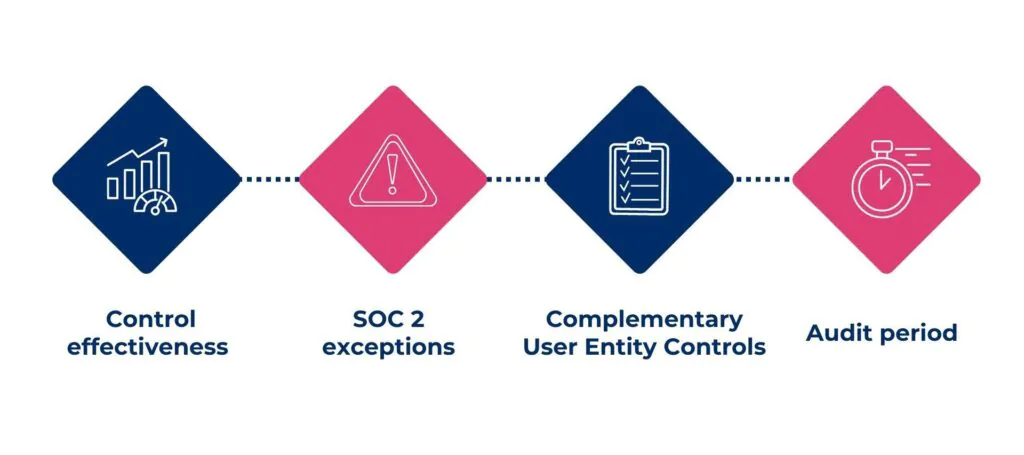
A deeper review of a SOC 2 report can help organizations identify potential risks, control gaps, and areas requiring remediation. Here are several key areas to evaluate when analyzing a SOC 2 report:
Control effectiveness
Review whether the auditor determined that controls were operating effectively throughout the audit period. Identifying any failed controls, inconsistencies, or remediation gaps can provide important insight into the overall maturity and reliability of the organization’s security program.
SOC 2 exceptions
SOC 2 exceptions identify instances where controls did not operate as intended or failed to meet audit requirements. When reviewing exceptions, it’s important to assess both their severity and potential business impact. Some exceptions may represent minor operational issues, while others could indicate more significant security or compliance risks.
Complementary User Entity Controls (CUECs)
Some SOC 2 controls rely on actions performed by customers or users of the service to maintain the effectiveness of the overall control environment. Complementary User Entity Controls (CUECs) outline the controls organizations are expected to implement within their own environments. Reviewing these requirements carefully helps organizations assess whether the controls are practical, achievable, and aligned with their internal security and operational processes.
Audit period
SOC 2 Type II reports assess controls over a defined observation period, typically ranging from 3 to 12 months. Evaluating how recent the audit period is can help determine whether the report still reflects the organization’s current security and compliance posture.



Simplify SOC 2 compliance with Scytale
Through its AI GRC platform, Scytale helps organizations simplify and streamline every stage of the SOC 2 journey. The platform centralizes key compliance workflows, including evidence collection, continuous control monitoring, audit preparation, vendor risk management, and policy management, helping organizations reduce manual effort and maintain ongoing audit readiness. Scytale’s multi-agent AI suite helps automate repetitive tasks, identify potential gaps, and improve visibility across security and compliance programs.
Scytale also offers customizable Trust Center capabilities that help organizations showcase their security and compliance posture to customers, partners, and procurement teams. Combined with dedicated GRC expert support, the platform helps organizations strengthen internal processes, support continuous compliance, and scale SOC 2 programs with greater efficiency and confidence.
FAQs about SOC 2 reports
What is a SOC 2 report and what does it contain?
A SOC 2 report is an independent audit report that evaluates how an organization manages security controls related to customer data. It typically includes the auditor’s opinion, management’s assertion, a description of the systems within the SOC 2 scope, details of the controls tested, testing results, and any identified exceptions or findings. Top SOC 2 compliance platforms like Scytale help organizations centralize and streamline many of the processes involved in preparing for and maintaining SOC 2 compliance.
What is the difference between a SOC 2 Type 1 and Type 2 report?
A SOC 2 Type I report evaluates whether security controls are properly designed at a specific point in time. A SOC 2 Type II report assesses both the design and operational effectiveness of those controls over a defined review period, typically between 3 and 12 months.
What should I look for when reviewing a SOC 2 report?
When reviewing a SOC 2 report, focus on the auditor’s opinion, the scope of the audit, control testing results, identified exceptions, and any Complementary User Entity Controls (CUECs). It is also important to review how recent the audit period is and whether the controls align with your organization’s security and compliance expectations.
What does a qualified opinion in a SOC 2 report mean?
A qualified opinion indicates that one or more controls were not properly designed or did not operate effectively during the audit period. While it does not necessarily mean the organization is insecure, it may highlight control gaps or operational issues that require further review and remediation. AI GRC platforms, such as Scytale, can help organizations identify and address control issues more proactively.
How often should a SOC 2 report be reviewed or renewed?
Most organizations renew their SOC 2 Type II reports annually to maintain continuous compliance and provide updated assurance to customers, partners, and stakeholders. SOC 2 reports should also be reviewed regularly, particularly during vendor assessments, procurement reviews, or security due diligence processes.


