








TL;DR: SOC 2 evidence collection
- SOC 2 evidence collection links every scoped control to dated, reviewable proof from the production systems where teams operate it.
- Complete evidence gives auditors the context to assess control operation, including source, system, owner, date, and audit-period coverage.
- Screenshots need visible system context, timestamps, and information tying the record to the relevant control.
- Automated collection reduces repetitive requests, organizes recurring records, and helps identifies gaps before auditors find them.
- Scytale’s AI GRC platform centralizes evidence, monitoring, ownership, and auditor-ready workflows for SOC 2 programs.
Collecting the right evidence is essential for a successful SOC 2 audit. Organizations must provide accurate, complete, and relevant documentation demonstrating that their security controls operate as intended. Missing records, incorrect timestamps, or insufficient context can lead to additional evidence requests, repeated work, and unnecessary audit delays.
A structured approach to SOC 2 evidence collection helps teams maintain clear ownership, ensure evidence meets auditor expectations, and improve audit readiness. In this article, we explain what SOC 2 evidence collection involves, what auditors look for, best practices for maintaining evidence integrity, and how automation can streamline the process.
What is SOC 2 evidence collection?
SOC 2 evidence collection is the process of gathering, organizing, and retaining proof that an organization’s controls operate as described throughout the SOC 2 audit period.
Audit evidence helps auditors verify that security controls, processes, and configurations operate as intended and meet relevant SOC 2 requirements. Each record must demonstrate that a specific control is functioning according to its documented requirements, including the relevant system, activity, and frequency.
For example, an organization may have separate controls for production environment backups and audit trail retention. Although both involve data retention, evidence supporting one control does not necessarily prove the other operates effectively. Control owners must ensure that each record directly supports the relevant control objective.
For SOC 2 Type I, evidence supports the assessment of controls at a specific point in time, while SOC 2 Type II requires evidence demonstrating that controls operated effectively throughout the observation period. Clear evidence requirements, accurate documentation, and defined ownership help organizations avoid unnecessary follow-ups and streamline the audit process.
Streamline GRC workflows with no blind spots.
What should SOC 2 audit evidence include?
SOC 2 audit evidence must be relevant, accurate, and sufficiently detailed for auditors to verify that a control operates as intended. For example, when submitting a screenshot from AWS Backup to demonstrate daily production backups, the evidence should include:
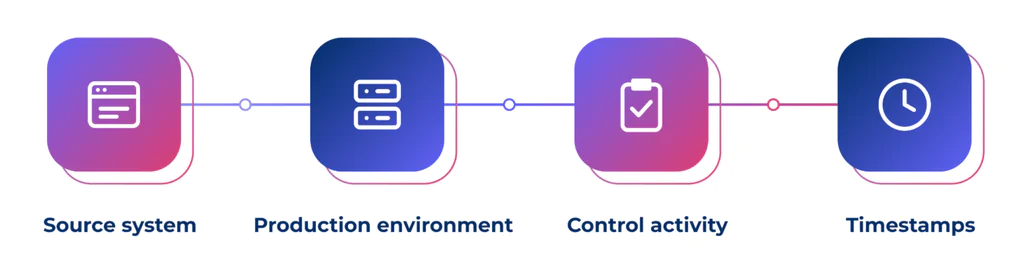
- Source system: The AWS Backup interface or URL identifying where the evidence originated.
- Production environment: Details confirming that the backup relates to the relevant production system or account.
- Control activity: Backup records demonstrating that the required activity occurred.
- Timestamps: Dates showing when the backups occurred and when the evidence was collected.
These details help auditors assess the evidence’s completeness, accuracy, and relevance to the control being tested. A cropped screenshot that excludes the source system or timestamps may not provide sufficient context, while recurring controls may require multiple records to demonstrate consistent operation throughout the audit period and support the final SOC 2 report.
SOC 2 compliance and monitoring in depth
A SOC 2 audit examines a defined system, making it essential to collect evidence from the correct environment. Since customer data and core business operations typically reside in production environments, evidence from QA or testing environments may not demonstrate that production controls operate as intended. Each record should identify the relevant environment, account, configuration, and source application so auditors can verify that it falls within the audit scope.
The format of SOC 2 audit evidence also matters. While screenshots can demonstrate specific configurations or activities, larger datasets, such as user access lists and system exports, require additional verification. For example, a CSV file alone may not provide sufficient assurance that records haven’t been altered, filtered, or removed before submission.
Best practices for maintaining SOC 2 evidence integrity
Maintaining evidence integrity helps auditors verify that submitted records accurately reflect the source system and have not been altered during collection or submission. Organizations should follow these best practices to ensure evidence is complete, reliable, and traceable:
- Verify record completeness: Compare record counts in the source system and exported file to confirm that no entries are missing. For example, if the source contains 100 records, the export should contain all 100, assuming no filters were applied.
- Export directly from the source system: Collect evidence from the original application whenever possible to minimize the risk of manipulation or missing data.
- Maintain evidence traceability: Document the source system, extraction method, timestamps, and person responsible for generating the evidence to establish a clear audit trail.
- Preserve evidence integrity: Store original exports securely and document any modifications to help auditors verify that records remain accurate and unchanged.


The importance of a SOC 2 compliance checklist for evidence
A SOC 2 compliance checklist helps organizations streamline evidence collection by clearly outlining audit requirements, assigning control ownership, and ensuring that supporting documentation is collected on time. It provides a structured approach to managing evidence requests, reducing the risk of missing records, incomplete submissions, and delays during the audit process.
By following a documented checklist, teams can verify that each control has the appropriate evidence, confirm that records are accurate and relevant to the audit period, and identify gaps before fieldwork begins. This improves audit readiness, reduces unnecessary back-and-forth with auditors, and helps organizations maintain a more organized and efficient SOC 2 compliance process.
Why SOC 2 evidence collection matters for audit readiness
Reliable evidence collection gives auditors a clear trail from each SOC 2 control to the system records proving its operation. Teams avoid late requests when they assign owners, define collection frequency, and review evidence before fieldwork. This discipline also reduces the time spent locating records across disconnected systems.
Evidence collection supports faster internal reviews because teams connect each record to the relevant SOC 2 controls. This mapping exposes gaps before an auditor finds them and directs remediation toward the affected control. It also helps teams demonstrate consistent control operation across the full audit period.
For example, Worldbox used Scytale to reuse 60–70% of its SOC 2 Type I evidence for its Type II audit, reducing duplicate work and streamlining evidence collection.
Manual vs automated SOC 2 evidence collection
Manual SOC 2 evidence collection requires control owners to gather screenshots, exports, tickets, and documents directly from source systems. While this approach can work for occasional evidence requests, recurring collection often leads to version-control issues, inconsistent documentation, and delays. Teams also spend valuable time tracking down submissions instead of verifying that evidence accurately supports each control.
Automated evidence collection connects approved systems to a SOC 2 compliance platform, collects recurring control proof on a defined schedule, and maps records to relevant requirements. Teams still review evidence, approve exceptions, and supply materials from systems without supported integrations. Automation creates a more consistent record trail while keeping control owners accountable for accuracy.
Evidence collection methods compared
| Approach | Evidence workflow | Audit risk |
|---|---|---|
| Manual collection | Control owners gather, label, and upload records for each request. | Missing context, stale files, and inconsistent timestamps create follow-up work. |
| Automated collection | Connected systems collect and organize recurring control evidence on schedule. | Teams identify gaps earlier and retain source details for auditor review. |
Always-on GRC. Built for modern teams.
How Scytale automates SOC 2 evidence collection
Scytale centralizes SOC 2 evidence collection through an AI GRC platform built for audit readiness. Its Compliance Center connects evidence to controls, while continuous monitoring identifies missing records, failed checks, and ownership gaps before audit fieldwork. Teams gain a structured workspace for evidence requests, review, and auditor collaboration.
Scytale automates SOC 2 evidence collection, supports evidence reuse, and streamlines multi-framework compliance across more than 80 frameworks. Combined with dedicated GRC experts, this reduces manual work, simplifies long-term compliance management, and helps businesses scale without adding unnecessary complexity. Teams gain greater visibility, efficiency, and control as GRC requirements and systems change.
FAQs about SOC 2 evidence collection
What evidence is needed for a SOC 2 audit?
SOC 2 audits typically require evidence for every in-scope control, including policies, system configurations, access reviews, change management tickets, backup records, and security training logs. Each record should show its source system, the relevant date, and the information the control describes. Type II audits also require samples showing that each control operated consistently across the observation period.
How long should you keep SOC 2 evidence?
Organizations should retain SOC 2 evidence for at least the full audit period and the time needed to complete the audit, and many teams keep records across multiple audit cycles. Prior evidence helps teams answer follow-up questions, compare results year over year, and prepare for annual Type II renewals. Retention periods should also align with the organization’s data retention policy and any contractual requirements.
Can screenshots be used as SOC 2 evidence?
Yes, screenshots are accepted SOC 2 evidence when they show the full system context, including the URL or application, the relevant record or configuration, and a visible system timestamp. Cropped images without this context often lead auditors to request a recapture. For large datasets such as user lists, teams typically provide direct exports from the source system instead.
What happens if evidence is missing or late during the audit?
Missing or late evidence typically triggers follow-up requests, extends fieldwork, and can delay the final report. If an organization cannot provide sufficient evidence that a control operated effectively, the auditor may identify an exception, which could affect the final audit opinion depending on its significance. Collecting and reviewing evidence on a defined schedule throughout the year reduces this risk.
How much SOC 2 evidence can be automated?
Organizations can typically automate a large share of recurring technical evidence, such as cloud configurations, access settings, vulnerability scans, and backup status, through integrations with source systems. Policies, vendor documents, and records from systems without supported integrations still require manual uploads and review. Leading AI GRC platforms like Scytale combine automated collection with continuous monitoring, so teams can focus manual effort on exceptions.
What tools support SOC 2 evidence collection?
Teams commonly rely on cloud provider consoles, identity providers, ticketing systems, and version control tools to generate SOC 2 evidence, with a compliance platform to collect and store it. A GRC platform connects these sources, maps records to controls, and tracks ownership and deadlines in one place. Scytale’s AI GRC platform supports this process with automated evidence collection, continuous monitoring, and dedicated GRC expert support.


