
TL;DR: AICPA SOC 2 mapping
- SOC 2 mapping helps organizations compare existing SOC 2 controls with other frameworks to identify overlaps and compliance gaps.
- Adopting multiple security frameworks strengthens risk management, supports business growth, and helps meet diverse customer requirements.
- Leveraging overlapping controls reduces duplicate work, saves time and resources, and streamlines compliance across multiple frameworks.
- Choosing the right mapping strategy depends on your business, customers, industry, and compliance goals.
- Scytale is a leading AI GRC platform that simplifies multi-framework compliance through automated control mapping, evidence collection, continuous monitoring, and expert GRC guidance.
Today’s security landscape requires organizations to demonstrate consistent, reliable security practices through recognized compliance and reporting frameworks. Beyond protecting sensitive data and reducing risk, these frameworks have become an important way to build customer trust, meet procurement requirements, and gain a competitive advantage.
Each compliance framework is designed to address specific business, industry, or regulatory needs, making it challenging to determine which is the right fit for your organization. For many SaaS companies, SOC 2 is the first step toward demonstrating a strong security posture. As organizations grow, they often adopt additional compliance frameworks to strengthen risk management, meet customer expectations, and support business growth.
Rather than managing each framework independently, organizations can leverage SOC 2 mapping to identify overlapping controls, improve efficiency, and streamline multi-framework compliance. In this article, we’ll explore what SOC 2 mapping is, why it matters, and how it helps organizations efficiently manage multiple compliance frameworks.
What is SOC 2?
SOC 2 is a widely recognized auditing framework that helps organizations demonstrate they have effective controls in place to protect customer data and manage information securely.
Developed by the American Institute of Certified Public Accountants (AICPA), the framework evaluates the design and operating effectiveness of controls based on the five Trust Services Criteria: Security, Availability, Processing Integrity, Confidentiality, and Privacy. Organizations can pursue either a Type I or Type II audit, depending on whether they are validating the design of their controls or their effectiveness over time.
Understanding SOC 2 controls is the first step to effectively mapping them across additional compliance frameworks. Many security frameworks share similar control requirements, allowing organizations to reuse existing controls, reduce duplicate work, and streamline multi-framework compliance.
Is SOC 2 compliance enough for SaaS companies?
Whether SOC 2 alone is sufficient depends on your organization’s industry, customer base, contractual obligations, and the markets you operate in. While SOC 2 is one of the most widely recognized security frameworks for SaaS companies, it does not satisfy every compliance objective. Organizations may need to demonstrate alignment with additional frameworks to address industry-specific requirements, regional standards, or customer procurement requests.
Rather than managing each framework independently, many organizations extend their existing compliance program through SOC 2 mapping. By identifying controls that overlap across multiple frameworks, they can leverage work already completed, reduce implementation effort, and accelerate compliance with additional standards. This approach is commonly supported through SOC 2+ reports, which combine SOC 2 with one or more complementary frameworks.
What is SOC 2 mapping?
SOC 2 mapping is the process of comparing existing SOC 2 controls with the requirements of other security and privacy frameworks, such as ISO 27001, HIPAA, GDPR, and SOX ITGC, to identify overlapping controls, gaps, and additional requirements. Developed using guidance from the American Institute of Certified Public Accountants (AICPA), it helps organizations leverage their existing SOC 2 controls instead of implementing separate controls for every new framework.
By identifying where frameworks align, organizations can reuse documentation, evidence, and control activities, reducing duplicate work and simplifying multi-framework compliance.
What is the purpose of SOC 2 mapping?
The primary purpose of SOC 2 mapping is to help organizations expand their compliance program without rebuilding it from scratch. Since many security and privacy frameworks share common control requirements, mapping allows organizations to identify which controls already satisfy multiple frameworks and where additional controls are needed.
Key benefits of SOC 2 mapping include:
- Identifying overlapping controls across multiple compliance frameworks.
- Reducing duplicate work by reusing existing controls and evidence.
- Accelerating compliance with additional frameworks.
- Improving visibility into compliance gaps and remediation priorities.
- Strengthening risk management through a more unified control environment.
Who should use SOC 2 mapping?
SOC 2 mapping is valuable for organizations looking to extend their existing SOC 2 compliance to additional frameworks or satisfy different customer security requirements. Rather than managing each framework independently, it enables organizations to build on their controls and scale their compliance program more efficiently.
SOC 2 mapping is particularly beneficial for:
- SaaS companies and cloud service providers.
- Organizations pursuing multiple compliance frameworks.
- Businesses with customers that require different security standards.
- Organizations looking to strengthen their Governance, Risk, and Compliance (GRC) program.
- Companies seeking to reduce duplicate compliance work and simplify ongoing audits.
Get SOC 2 Compliant 90% Faster
Best practices for AICPA’s SOC 2 mapping
Successfully mapping SOC 2 to additional compliance frameworks requires a strategic approach rather than simply comparing control lists. Organizations should understand the scope of their existing controls and identify opportunities to reuse them across multiple frameworks. The following best practices can help maximize the value of SOC 2 mapping.
Understand the Trust Services Criteria
SOC 2 mapping begins with a clear understanding of the five Trust Services Criteria: Security, Availability, Processing Integrity, Confidentiality, and Privacy. Security is mandatory for every SOC 2 audit, while the remaining criteria are selected based on an organization’s services, risks, and customer requirements. Understanding which criteria are included in your SOC 2 report provides the foundation for identifying control overlap with other compliance frameworks.
Choose the right compliance framework
The right framework depends on your organization’s industry, customers, geographic markets, and business goals. Many SaaS organizations expand beyond SOC 2 by adopting frameworks such as ISO 27001, HIPAA, GDPR, PCI DSS, or SOX ITGC. Using a multi-framework compliance platform simplifies compliance and supports a more scalable program.
Leverage overlapping controls
Many compliance frameworks share common security and governance controls, making control reuse one of the biggest advantages of SOC 2 mapping. Reusing existing policies, procedures, and evidence reduces duplicate work, saves time, and accelerates compliance with additional frameworks.
Align your framework strategy with your customers
Customer expectations and market requirements should influence your compliance strategy. While SOC 2 is commonly requested in North America, ISO 27001 is widely recognized internationally, and organizations in healthcare or those processing EU personal data may also require HIPAA or GDPR. Aligning your framework strategy with your target markets helps maximize the value of your compliance investment.
Streamline GRC workflows with no blind spots.
What are Common Criteria?
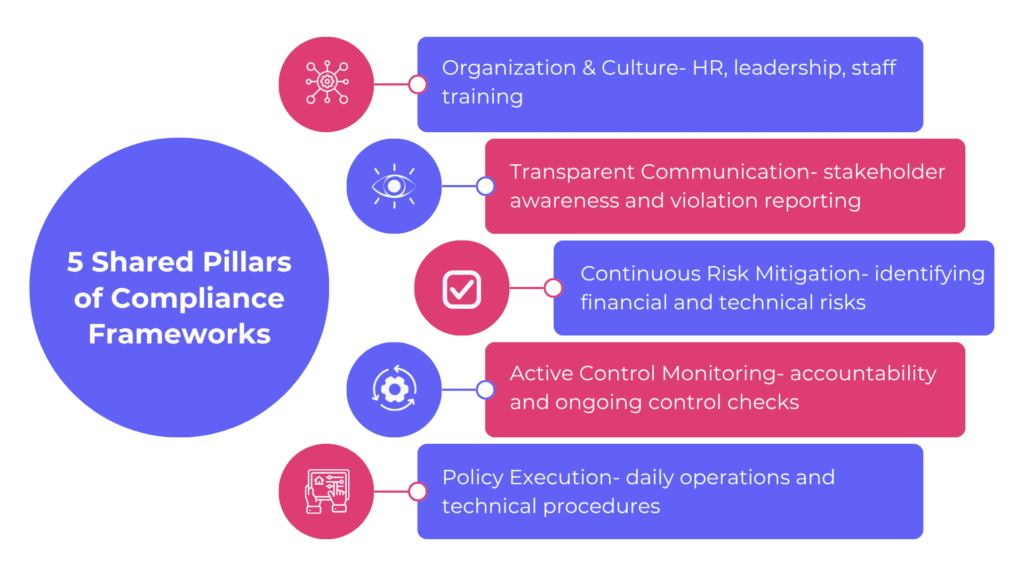
The SOC 2 Common Criteria establish the baseline security and governance requirements that every SOC 2 audit evaluates. Many of these controls overlap with other compliance frameworks, making them a strong foundation for multi-framework compliance. Here are some of the key areas covered by the Common Criteria:
1. Organization
The Organization criteria focus on governance, leadership, and accountability. They establish the policies, responsibilities, and oversight needed to support an effective control environment across the business.
2. Communication
Communication ensures that relevant information is shared with employees and stakeholders so they understand their security and compliance responsibilities. It also supports the timely reporting and resolution of control deficiencies and security issues.
3. Risk Assessment
Risk Assessment focuses on identifying, evaluating, and managing risks that could affect the organization’s objectives. This helps organizations prioritize controls and allocate resources where they are needed most.
4. Monitoring
Monitoring evaluates whether controls continue to operate effectively over time. Regular reviews, testing, and continuous monitoring help identify weaknesses and support ongoing compliance.
5. Control Activities
Control Activities are the policies, procedures, and technical safeguards implemented to reduce identified risks. They help ensure controls are consistently executed and operating as intended across the organization.
Key SOC 2 Common Criteria
| Common criterion | Focus | Example |
| Organization | Governance and accountability | Leadership, policies, oversight |
| Communication | Information sharing | Reporting issues, employee awareness |
| Risk assessment | Risk identification and evaluation | Prioritizing and managing risks |
| Monitoring | Control effectiveness | Reviews, testing, continuous monitoring |
| Control activities | Control implementation | Policies, procedures, technical safeguards |
SOC 2 to ISO 27001 mapping
SOC 2 and ISO 27001 share a significant number of overlapping controls, making them one of the most common framework combinations for SaaS organizations. Mapping SOC 2 controls to ISO 27001 allows organizations to leverage existing policies, procedures, and evidence, reducing duplicate work while accelerating ISO 27001 implementation.
Beyond improving efficiency, SOC 2 to ISO 27001 mapping helps organizations strengthen their security posture, support international business growth, and maintain a more unified compliance program. If you’re evaluating ISO 27001 vs. SOC 2, understanding how the two frameworks overlap can help you determine whether pursuing both is the right strategy for your organization.
SOC 2 to HIPAA Mapping
For organizations that handle protected health information (PHI), mapping SOC 2 controls to HIPAA can significantly simplify compliance. The two frameworks share many overlapping security controls, allowing organizations to build on their existing SOC 2 program while identifying any additional HIPAA-specific requirements.
One key distinction is that SOC 2 is a voluntary attestation, whereas HIPAA is a federal law that applies to covered entities and business associates that create, receive, maintain, or transmit PHI. Organizations subject to HIPAA must implement the required safeguards to protect health information and demonstrate ongoing compliance.



Streamline multi-framework compliance with Scytale
Scytale is a leading AI GRC platform that helps organizations streamline multi-framework compliance by leveraging controls they’ve already implemented, reducing manual effort, and accelerating the path to additional certifications. Supporting 80+ compliance frameworks, Scytale enables organizations to efficiently manage their compliance program from a single platform.
Scytale’s cross-framework control mapping enables organizations to reuse common controls across multiple frameworks. Combined with automated evidence collection, continuous compliance monitoring, and dedicated GRC expert guidance, teams can efficiently manage their compliance program from a single platform while maintaining confidence in their compliance posture.
Whether you’re expanding beyond SOC 2 to meet customer requirements, entering new markets, or strengthening your compliance program, Scytale helps eliminate duplicate work and makes continuous compliance more efficient.
FAQs about AICPA SOC 2 mapping
What is AICPA SOC 2 mapping?
AICPA SOC 2 mapping is a process that compares the SOC 2 Trust Services Criteria with the requirements of other security and compliance frameworks. It helps organizations identify overlapping controls, understand compliance gaps, and determine how existing SOC 2 controls align with frameworks such as ISO 27001, HIPAA, and GDPR. This enables organizations to expand their compliance programs more efficiently.
Why is SOC 2 mapping required?
SOC 2 mapping is not mandatory, but it is highly beneficial for organizations pursuing multiple compliance frameworks. By identifying common controls and overlapping requirements, it reduces duplicate work, saves time, and streamlines compliance efforts. Leading SOC 2 platforms like Scytale further simplify this process by automating control mapping, evidence collection, and continuous SOC 2 compliance management.
What is the difference between ISO 27001 and SOC 2 mapping?
ISO 27001 is an internationally recognized information security management standard, while SOC 2 mapping is a method of comparing SOC 2 Trust Services Criteria to other frameworks, including ISO 27001. Rather than replacing either framework, mapping helps organizations understand where requirements overlap and where additional controls may be needed. This allows businesses to work toward ISO 27001 certification while maximizing the value of their existing SOC 2 controls.
Which frameworks can be mapped to SOC 2 Trust Services Criteria?
The SOC 2 Trust Services Criteria can be mapped to several widely recognized security and privacy frameworks. Common examples include ISO 27001, HIPAA, GDPR, PCI DSS, and SOX ITGC. Scytale’s leading AI GRC platform supports cross-framework mapping across 80+ frameworks, helping organizations leverage existing controls and efficiently manage multi-framework compliance from a single platform.
What are the benefits of mapping SOC 2 controls to other frameworks?
Mapping SOC 2 controls to other frameworks helps organizations reuse existing controls, improve efficiency, and accelerate compliance with additional standards. It also strengthens compliance programs by highlighting gaps and ensuring controls align with multiple regulatory and customer requirements. For growing organizations, this creates a more scalable and efficient approach to multi-framework compliance.


